Table of Contents >> Show >> Hide
- Why Wabi-Sabi Feels So Right for London
- Meet the House: Hidden on Tiverton Road
- Material Honesty: Concrete, Wood, Stone, Brass
- Light as a Building Material
- Plan and Flow: A Small House That Feels Bigger
- What Makes It “Modest” and “Monumental” at the Same Time
- Design Lessons You Can Steal (Without Buying a Hidden London Infill)
- 500-Word Experience Add-On: A Wabi-Sabi Day Inspired by Takero Shimazaki’s London House
- Conclusion
London is a city that runs on caffeine, corner-shop optimism, and the unspoken belief that if you walk fast enough, the rain won’t notice you. It’s also a city where “peace and quiet” is treated like a luxury materialsomewhere between marble and unobtainium. Which is why a small, nearly invisible home on Tiverton Road feels almost suspicious in the best way: it’s a calm, tactile sanctuary that doesn’t try to impress the street. It tries to slow your pulse.
Designed by Takero Shimazaki Architects, this “modest yet monumental” house is often described through the lens of wabi-sabithe Japanese worldview that finds beauty in imperfection, impermanence, and the honest passage of time. In a London neighborhood of brick terraces and everyday bustle, the house quietly insists on something radical: fewer finishes, fewer distractions, more atmosphere. It’s a home that doesn’t shout, but it absolutely has presence.
Why Wabi-Sabi Feels So Right for London
Quick refresher: what wabi-sabi actually means (and what it doesn’t)
Wabi-sabi is often flattened into an Instagram caption“imperfect but cute!”but the original idea is deeper and calmer. It values simplicity over spectacle, authenticity over polish, and natural materials that show their age instead of hiding it. Think: weathered wood that turns silvery, concrete with visible pores, stone that carries a story, textiles that wrinkle without apologizing. It’s less a “style” and more a way of paying attention.
Importantly, wabi-sabi isn’t about making your home look unfinished on purpose. It’s about choosing materials and spaces that feel grounded, lived-in, and quietly generous. The end goal is not “minimal.” The end goal is ease.
London’s version of imperfection: patina, weather, and real life
London already understands patina. The city is a masterclass in layered timeVictorian brickwork, soot-darkened stone, old pubs with uneven floors that somehow feel more trustworthy because of it. But modern London living can lean toward the over-specified: glossy kitchens, bright-white walls, and the constant fear of scuff marks.
Wabi-sabi offers an antidote that feels especially relevant here. It says: let the home breathe. Let the materials do what materials do. Let the seasons show up. It’s a philosophy perfectly suited to a place where the sky changes its mind every fifteen minutes.
Meet the House: Hidden on Tiverton Road
A “blink-and-you-miss-it” facade that acts like a filter
From the street, this house plays a clever trick: it doesn’t announce itself as “a design moment.” Instead, it sits behind a fence-like face of timber cladding, visually echoing the everyday boundaries of London streetscapes. The result is a kind of architectural stealth modemore monastery than mansion, more “private refuge” than “look at me.”
That restraint is not just aesthetic; it’s psychological. The entry sequence works like a pressure valve. You move from public street to concealed threshold, and the noise of the city starts to feel like it belongs to someone else.
From a tight urban plot to a calm courtyard heart
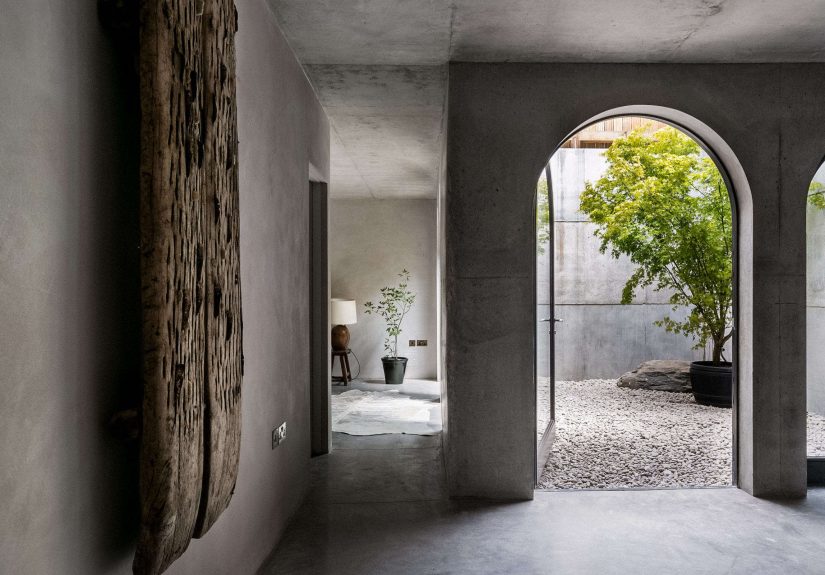
The house is famously compact and inventive, shaped by the constraints of a dense London site. Instead of fighting the limitations, the design leans into them: spaces are carved, tucked, and composed with a kind of ritual clarity. A small courtyard becomes the emotional centeran outdoor room that brings light into the home and gives the interior a steady, quiet horizon.
This is where “modest” begins to flip into “monumental.” Not because the footprint is huge (it isn’t), but because the experience is choreographed like a bigger building. You don’t just walk through roomsyou pass through moments.
Material Honesty: Concrete, Wood, Stone, Brass
Fair-faced concrete: the courage to leave things alone
There’s a particular confidence in choosing concrete and then not covering it up. In this house, concrete isn’t just structure; it’s surface, atmosphere, and mood. Its subtle imperfectionstiny variations, faint marks, tonal shiftsbecome the texture of the space. The walls don’t pretend to be flawless. They’re quietly specific.
In wabi-sabi terms, this is the point: the material tells the truth. You’re not being dazzled by decorative layers. You’re being invited to notice light on a surface, shadow in an edge, and the way time will slowly soften everything.
Weathered chestnut cladding: London rain as co-designer
The exterior timber cladding is the kind of choice that gets better with ageespecially in a city that practically specializes in “softly aged.” Over time, timber weathers and shifts in tone, taking on a silvery, seasoned look. Instead of fighting the elements, the facade collaborates with them.
This is wabi-sabi in action: the house is designed to change gracefully. It doesn’t demand constant upkeep to maintain a showroom finish. It asks to be lived with, not preserved in plastic.
Stone and brass: warmth without noise
Inside, moments of stone and brass add a quiet glowwarmth that doesn’t rely on loud color or busy pattern. A stone basin (famously repurposed from something with a prior life) feels both humble and poetic. Brass fittings bring a gentle richness, but not the “gold everything” chaos of trend cycles. It’s more like jewelry you wear every day: simple, honest, and better with time.
The paletteconcrete, timber, stone, brassreads like a shortlist. And that’s exactly the point. When you use fewer materials, each one matters more.
Light as a Building Material
Turner’s influence: painting with daylight
One of the most memorable details tied to this home is its inspiration from a J.M.W. Turner painting depicting an interior suffused with soft, enlarging light. That idealight that expands space emotionally, not just visuallyshows up throughout the house. The architecture isn’t trying to flood every corner with brightness. It’s sculpting light the way a painter would: measured, directional, and quietly dramatic.
In London, where daylight can be shy, designing for “pools of light” is both practical and poetic. It makes the home feel like it’s always in conversation with the sky.
Arches, apertures, and the calm power of shadow
The interior is marked by arched openings that soften transitions and lend a subtle, almost sacred rhythm to everyday movement. Arches can be trendy when they’re slapped onto a wall like an emoji, but here they feel structural and intentionalpart of a language that connects rooms without turning the house into a series of boxed compartments.
Wabi-sabi spaces often welcome shadow, not as a problem to eliminate, but as a partner to light. Shadow gives depth. It makes materials feel tactile. It makes the home feel inhabited even when it’s quiet.
Plan and Flow: A Small House That Feels Bigger
Subterranean calm, above-ground rest
The house uses level changes and clever spatial planning to create a sense of separation without wasted space. Living areas feel protected and cocooned, while bedrooms and private rooms enjoy a calmer relationship to light and air. The architecture turns “compact” into “composed.”
This is one of the house’s most practical gifts: it’s designed for focus and reflection in a city that rarely stops talking. The spatial hierarchy supports that goal. You can be in the house and feel like the city has been turned down a notchor three.
The courtyard as a hinge between indoors and out
The courtyard isn’t just “nice outdoor space.” It’s a hinge that organizes the home’s experience. It brings light into the interior, offers a controlled slice of nature, and acts as a mental reset point. Even a small tree or a patch of sky can change how a home feelsespecially in London, where outdoor space is both precious and political.
With wabi-sabi, nature isn’t a decorative accessory; it’s a reminder that everything changes. Leaves fall. Shadows move. Rain arrives uninvited. The courtyard makes those shifts part of daily life.
Restraint as a luxury: fewer objects, more room to breathe
In a house like this, storage and simplicity matter. The design philosophy discourages clutternot out of aesthetic snobbery, but because calm needs space. When surfaces are intentional and materials are strong, you don’t need constant visual noise. You need a chair you love, a table that ages well, and a place to put your tea without a coaster panic attack.
What Makes It “Modest” and “Monumental” at the Same Time
The phrase “modest yet monumental” sounds like a contradiction until you walk through the logic of the house. Here’s how it pulls off that balancing act:
- Modest in footprint: a compact urban home that respects the constraints of its London site.
- Modest in street presence: a quiet facade that blends into the everyday boundary language of fences and timber.
- Modest in palette: a disciplined shortlist of materialsconcrete, wood, stone, brassused with care.
- Monumental in feeling: thick, monolithic structure and a sense of refuge that reads as almost civic.
- Monumental in procession: movement through the house feels ceremonial, like entering calmer and calmer zones.
- Monumental in light: “pools of light” and deep shadow create drama without decoration.
- Monumental in timelessness: materials are chosen to age beautifully, letting time become a design collaborator.
The secret is that monumentality isn’t only about size. It’s about clarity. It’s about a space that feels inevitablelike it was always meant to exist exactly this way.
Design Lessons You Can Steal (Without Buying a Hidden London Infill)
1) Pick one “hero” material and let it lead
If you want a wabi-sabi vibe, start by choosing one primary material you genuinely loveplaster, wood, concrete, stoneand let it set the tone. The Tiverton Road house shows what happens when the hero material is treated with respect: it becomes atmosphere, not just surface.
2) Make peace with patina (it’s not a flaw, it’s a timeline)
Wabi-sabi interiors don’t fear wear; they plan for it. Choose finishes that look better after a few yearsoiled wood, natural stone, aged metals, textured walls. The goal is to stop designing for photos and start designing for living.
3) Use light intentionally, not aggressively
Brighter isn’t always better. Try lighting that creates zones: a soft pendant over a table, a wall wash that reveals texture, a lamp that makes a corner feel like a pause button. Think “measured pools of light,” not “retail showroom.”
4) Let nature in, even if it’s small
A courtyard is the dream, but a single plant with a strong silhouette, a vase with a branch, or a view line to the sky can do surprising work. Wabi-sabi is less about “bringing the outdoors in” as a slogan and more about creating a daily relationship with seasons and change.
5) Edit like you mean it
The easiest way to fake wabi-sabi is to buy “wabi-sabi decor.” The hardest (and most effective) way is to own fewer, better things. Keep what feels honest. Let go of what feels loud. If an object doesn’t earn its place, it’s probably just paying rent in your brain.
500-Word Experience Add-On: A Wabi-Sabi Day Inspired by Takero Shimazaki’s London House
Imagine arriving on a typical London morning: the sky is doing that soft gray thing it does so well, and the street is all motionfootsteps, buses, someone arguing with a dog that has clearly chosen chaos. Then you find the discreet entry. No grand doorway. No architectural flex. Just a quiet threshold that feels like it’s politely asking you to lower your voice.
Step inside (in your imagination, not in a “breaking and entering” way), and the sensory priorities shift. Concrete is cool to the touch, but it’s not sterile; it has grain, tone, and the gentle evidence of making. The air feels calmer because the space isn’t fighting for attention. The house isn’t performing. It’s hosting.
In the living area, you notice something surprisingly rare: shadow that’s allowed to exist. Instead of blasting every surface with brightness, light arrives in thoughtful portions, like a good conversationenough to feel seen, not so much you feel interrogated. The texture of the walls becomes the “art,” changing through the day as clouds rearrange the lighting like an editor trimming a film scene.
The courtyard becomes your reset button. Maybe there’s a small tree, pebbles underfoot, a slice of sky framed like a painting. You sit with a coffee (or tea, because London), and the point isn’t the beverageit’s the pause. The courtyard is a reminder that nature doesn’t need to be dramatic to be powerful. A single leaf moving in a breeze can do more for your nervous system than an entire wall of motivational quotes.
By afternoon, you start noticing how wabi-sabi changes your behavior. You put your phone down because the space doesn’t need documenting to feel real. You don’t obsess over a wrinkle in a linen throw; it looks better wrinkled anyway. You become less interested in “perfect” and more interested in “true.” Even the materials are teaching you: wood will age, brass will deepen, stone will keep its memory, and concrete will quietly hold the whole story without demanding applause.
As evening arrives, lighting turns the house into a series of warm pockets. A lamp here, a soft glow there. The home feels smaller in the comforting waylike it’s gathering itself around you. And that’s the lasting lesson of this modest yet monumental place: wabi-sabi isn’t about making a house look unfinished. It’s about making a house feel finished in the only way that mattersfinished enough for life to happen in it, beautifully, imperfectly, and without constant correction.
Conclusion
Takero Shimazaki’s Tiverton Road house is a persuasive argument that quiet can be architectural. It shows how wabi-sabi principlesmaterial honesty, measured light, and the beauty of timecan be translated into a contemporary London home without becoming a theme park of “Japanese minimalism.” Instead, it’s a lived philosophy: a compact sanctuary that turns constraints into clarity and turns raw materials into calm.
In a city that loves speed, this house chooses stillness. In a culture that often chases flawless finishes, it chooses surfaces that age with dignity. And in a world that keeps telling your home to be content, it dares to be a refuge. Modest on the outside, monumental where it counts.