Table of Contents >> Show >> Hide
- Portfolio, Defined (Without the Yawn)
- Why People Use Portfolios (Hint: It’s Not Just to Look Impressive)
- The Big Types of Portfolios (And How They Differ)
- What Makes a Portfolio Actually Good?
- How to Build a Portfolio in 7 Steps
- Specific Examples (So This Doesn’t Stay Theoretical)
- Common Portfolio Mistakes (And How to Fix Them)
- FAQ: Quick Answers to Common Portfolio Questions
- Real-World Experiences With Portfolios (The Stuff People Only Learn After Doing It)
- Conclusion
“Portfolio” is one of those words that shows up everywherefinance, job hunting, design, even government
and somehow still manages to feel a little vague. Is it a folder? A website? A pile of stocks? A fancy word
for “stuff I’ve done”? Yes. Also: it’s way more useful than it sounds.
In plain English, a portfolio is a purposeful collection of items that, together,
tell a story. The story might be: “Here’s how I invest,” “Here’s what I can create,” or “Here’s what my team
is working on and why it matters.” The key isn’t the container (binder, PDF, website, brokerage account).
The key is the curation: you’re choosing what belongs, what doesn’t, and what each piece proves.
Portfolio, Defined (Without the Yawn)
A portfolio is a collection of selected assets or work that represents something important about you or your
organizationtypically your value, your skills, your strategy,
or your results.
Think of it like a movie trailer. Nobody wants the entire three-hour director’s cut on first impression.
They want the highlights that make them think, “Okay, I need to see more.” A portfolio does the same job:
it turns “trust me” into “here’s the evidence.”
The Three Core Ingredients of Any Portfolio
- Selection: You choose what belongs based on a goal (not because it exists).
- Organization: You structure it so someone else can understand it quickly.
- Meaning: You add context: what it is, why it matters, and what it achieved.
Why People Use Portfolios (Hint: It’s Not Just to Look Impressive)
Portfolios solve a simple problem: important decisions often require proof. Employers want proof you can do
the work. Investors want proof a strategy makes sense. Leaders want proof projects align to goals. A portfolio
is your proof system.
Common reasons portfolios exist
- To showcase ability: “Here’s what I can do.”
- To manage risk and goals: “Here’s how I’m balancing growth, safety, and time.”
- To prioritize: “Here’s what we’re doing now, next, and never.”
- To tell a coherent story: “Here’s the through-line behind the work.”
The Big Types of Portfolios (And How They Differ)
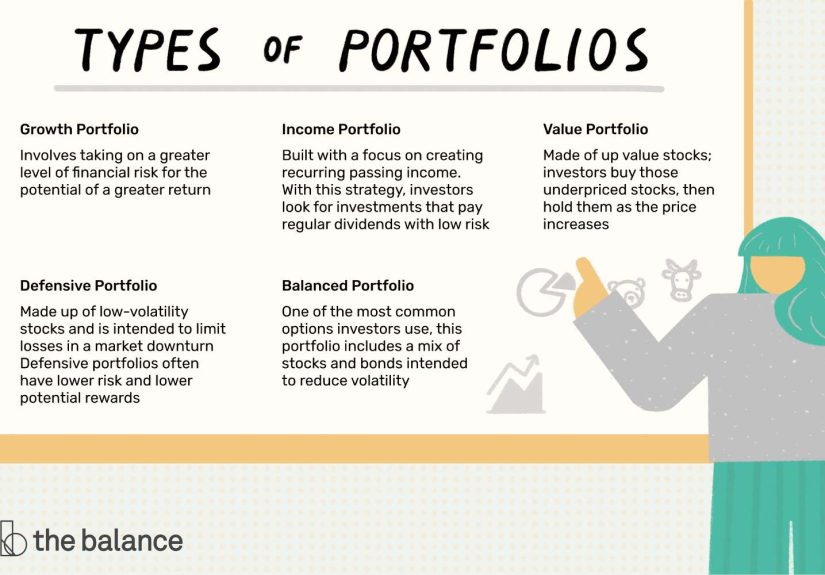
1) Investment Portfolio
An investment portfolio is the collection of financial holdings you ownoften a mix of
things like stocks, bonds, cash, and other assets. The portfolio matters because it’s not just “what you bought.”
It’s how all the pieces fit together.
Key ideas that make investment portfolios work
-
Asset allocation: how your money is divided among major categories (like stocks, bonds, cash).
This is often one of the biggest drivers of how a portfolio behaves over time. -
Diversification: spreading investments so you’re not relying on one company, sector, or asset type
to save the day. It’s basically “don’t put all your eggs in one basket,” but with fewer farm metaphors and more math. -
Time horizon + risk tolerance: how long you can leave the money invested and how much volatility
you can emotionally survive without doing something dramatic (like panic-selling in sweatpants). -
Rebalancing: adjusting back toward your target mix over time when market movement changes your weights.
Translation: “No, your portfolio is not on autopilot forever.”
Example: two people can own the same stock, but have wildly different outcomes based on what else they hold. A single
stock is a song. A portfolio is the playlistand playlists have a vibe.
2) Career Portfolio (a.k.a. Professional Portfolio)
A career portfolio is a curated set of materials that proves your skills and accomplishments beyond
what a resume can fit. A resume says “I did this.” A portfolio shows “Here’s what it looked like, how I did it,
and what happened because of it.”
What career portfolios often include
- Work samples (writing, designs, code snippets, slide decks, lesson plans, analyses)
- Project summaries (your role, constraints, approach, results)
- Certifications, awards, transcripts (only if relevant)
- Recommendations or performance highlights
- A short “About” section with your focus and strengths
Career portfolios can be physical (a binder or printed deck) or digital (a website, PDF, or portfolio platform).
Digital tends to win for speed and shareability, but physical can be clutch in an interview when Wi-Fi decides to
take a personal day.
3) Creative Portfolio
A creative portfolio is a specialized career portfolio used heavily in fields like graphic design,
photography, UX/UI, illustration, architecture, video, and marketing. It is judged on taste,
craft, and decision-makingnot just “can you do the thing,” but “do you do the thing well.”
What separates a strong creative portfolio from a “meh” one
- Fewer, better pieces: 6 great projects beat 20 average ones.
- Process clarity: show how you think, not just final visuals.
- Context: what was the goal, audience, constraint, and outcome?
- Consistency: coherent presentation, readable captions, and no mystery navigation.
4) Project or Business Portfolio
In organizations, a portfolio can mean a collection of projects and programs managed together to
achieve strategic objectives. This is where “portfolio” stops being a personal showcase and becomes a leadership tool:
deciding what to fund, what to pause, and what to stopbased on value, capacity, and risk.
Example: A company might have a “product portfolio” (all its products), or a “project portfolio” (all initiatives competing
for budget and people). The portfolio view helps prevent the classic corporate tragedy: doing 37 priorities at once and
completing none of them.
What Makes a Portfolio Actually Good?
A good portfolio is not “everything you’ve ever touched.” It’s the best evidence for a specific purpose.
It’s designed for someone else’s attention spanbecause attention is the real scarce resource.
A universal portfolio checklist
- Clear goal: What decision should this portfolio support?
- Defined audience: Recruiter, hiring manager, client, stakeholder, yourself?
- Curated content: Only what strengthens the story.
- Context on every item: What it is, your role, tools, constraints, impact.
- Easy navigation: A reader should never feel lost.
- Updated: If the newest item is from 2019, people will assume you time-traveled here.
How to Build a Portfolio in 7 Steps
Step 1: Pick your “portfolio job”
Decide what this portfolio is supposed to do. Land interviews? Win clients? Document growth? Support a promotion?
Different job = different content.
Step 2: Create a “master pile” first
Gather everything in one place. Projects, artifacts, drafts, metrics, photos, links, testimonialsanything that might be useful.
Don’t judge yet. Just collect.
Step 3: Choose 6–12 strongest pieces (for most people)
Most portfolios improve when they get smaller. Choose the work that best demonstrates the skills you want to be hired for.
If you’re early-career, school projects can be greatespecially when you explain the problem and show your reasoning.
Step 4: Write “case-study style” captions
For each item, add a short explanation:
- Goal: What problem were you solving?
- Role: What did you own?
- Approach: What was your process and why?
- Result: What changed because of your work? (Numbers are great; honest qualitative impact is fine too.)
Step 5: Organize for skimming
Use sections, headings, and consistent layouts. People scan before they read. Help them scan your way into caring.
Step 6: Make it easy to share
A digital portfolio should load quickly, work on mobile, and have clear contact information. If it’s a PDF, keep file size reasonable,
name it professionally, and ensure it’s readable without zooming to 400%.
Step 7: Update like it’s a living document
Add new work, retire outdated pieces, and refresh your “About” section as your goals change. A portfolio isn’t a museum.
It’s more like a garden: it needs occasional weeding.
Specific Examples (So This Doesn’t Stay Theoretical)
Example A: Investment portfolio (conceptual)
Imagine someone saving for retirement with decades ahead. Their portfolio might emphasize growth assets like stocks, balanced with bonds
and cash for stability and flexibility. Someone saving for a near-term home down payment may prioritize lower-volatility holdings and cash-like assets.
The point isn’t a “perfect” mixit’s aligning the portfolio to the goal, timeframe, and comfort with risk.
Example B: UX designer portfolio
A strong UX portfolio might feature 4–6 case studies. Each includes the user problem, research insights, wireframes, iterations,
constraints (time, scope, stakeholders), final design, and measurable outcomes (conversion lift, reduced drop-off, fewer support tickets).
The portfolio isn’t just pretty screens; it’s proof of thinking.
Example C: Data analyst portfolio
A data analyst might include dashboards, analysis write-ups, A/B test summaries, and a “how I work” section: data cleaning approach,
documentation habits, and how they communicate findings. Bonus points for explaining trade-offs and limitationsbecause reality always has them.
Common Portfolio Mistakes (And How to Fix Them)
-
Mistake: Including everything.
Fix: Curate ruthlessly. Your average work drags down your best work. -
Mistake: No context (“Here’s a screenshot. Enjoy.”).
Fix: Add role, goal, constraints, and outcomes. -
Mistake: Making it hard to navigate.
Fix: Use clear headings, consistent layouts, and a simple structure. -
Mistake: Trying to impress with jargon.
Fix: Use plain language. Clarity is impressive. -
Mistake: Letting it go stale.
Fix: Add one new item or improvement each month.
FAQ: Quick Answers to Common Portfolio Questions
How long should a portfolio be?
Long enough to prove your case, short enough to keep attention. Many professional portfolios land well with 6–12 strong pieces.
If you have more, group them by specialty and lead with your best.
Do I need a portfolio if I’m not in a creative field?
Not alwaysbut it can be a secret weapon. If your work produces artifacts (reports, analyses, presentations, lesson plans, documentation,
process improvements), you can build a portfolio that shows how you think and what you deliver.
Should I use a website or a PDF?
A website is great for discovery and easy sharing. A PDF is great for controlled formatting and offline viewing. Many people use both:
website for browsing, PDF for sending when requested.
What if my work is confidential?
You can anonymize details, use sanitized versions, focus on process, or build “mock” case studies that demonstrate skills without exposing
private information. You can also keep a private version to share only under appropriate circumstances.
Real-World Experiences With Portfolios (The Stuff People Only Learn After Doing It)
If you’ve never made a portfolio before, the first attempt often feels like cleaning out a closet: you discover old projects you forgot existed,
you find things you were oddly proud of at the time, and you also find a few items that make you whisper, “We don’t talk about that phase.”
That experience is normaland it’s part of the point. Portfolios don’t just help other people evaluate you; they help you see your own trajectory.
One common experience is realizing that your work needs framing. People will paste a slide deck or a design mockup into a portfolio
and assume the value is obvious. Then a recruiter asks, “What was the problem?” and suddenly the creator realizes: the problem wasn’t visible.
Great portfolio builders learn to add the missing bridge: the why, the constraints, and the impact. The work gets better instantlynot because the
project changed, but because the story became understandable.
Another frequent lesson: portfolios reveal patterns. When you lay your projects side by side, themes jump out. Maybe you’re always
the person who turns chaos into a plan. Maybe you consistently improve performance, simplify processes, or translate technical details into decisions.
That pattern can become your positioningyour “this is what you get with me” message. Many people don’t discover that message until they’ve curated
their work and noticed what keeps repeating (in a good way).
People building investment portfolios often experience a different kind of revelation: the portfolio is a behavior mirror. A strategy
looks calm on paper, but real markets test how you react to uncertainty. Investors discover that “risk tolerance” isn’t a quiz scoreit’s how you feel
when values fluctuate. That’s why many educational resources emphasize aligning the mix of assets to time horizon and comfort with volatility, and why
disciplined practices like rebalancing exist: to keep decisions from being driven entirely by emotion.
A surprisingly universal experience, across both career and investing, is the power of small maintenance habits. People who update
their portfolio once a year often dread it. People who update monthly (even for 15 minutes) barely notice the effort. They add one screenshot, write
three bullet points about a result, attach a file, remove one outdated item. Over time, their portfolio becomes a living recordsomething ready to use
when opportunity shows up. And opportunity has a suspicious habit of appearing right when you’re least in the mood to assemble documents from scratch.
Finally: a portfolio can change how you talk about yourself. Instead of generic claims (“I’m detail-oriented”), you can point to proof (“Here’s the
process I built, and here’s the outcome”). Instead of vague confidence, you develop grounded confidence. Not bravadoreceipts. And that’s the magic:
portfolios don’t just present your story. They help you own it.
Conclusion
A portfolio is a curated collection that supports a decisionwhether that decision is “hire this person,” “invest this way,” or “prioritize these projects.”
The best portfolios are focused, easy to navigate, and rich with context. They don’t try to impress with volume. They earn trust with clarity.