Table of Contents >> Show >> Hide
- What Is a Thai Stick?
- Where Did Thai Stick Come From?
- How Thai Stick Reached the United States
- Why Thai Stick Seemed So Mysterious
- Thai Stick, Thai Cannabis, and the Birth of Modern Hybrids
- Why the Original Thai Stick Faded
- Health and Legal Reality: The Part That Ruins the Party but Helps the Reader
- Experiences, Memories, and Stories That Kept Thai Stick Alive
- Final Thoughts
Some names in cannabis history sound like they were invented by a screenwriter with a lava lamp and too much free time. Thai stick is one of them. It sounds exotic, a little dramatic, and just vague enough to inspire campfire-level storytelling. Was it a strain? A cigar? A smuggler’s trophy? A relic from the golden age of counterculture? In truth, it was a little bit of all of the above.
If modern cannabis culture runs on branding, nostalgia, and the occasional oversized claim, Thai stick may be one of its earliest superstars. Long before sleek dispensary jars and laboratory potency charts, this mysterious “cigar” built its reputation the old-fashioned way: through stories, travel, rumor, and the kind of reverence usually reserved for vintage guitars and obscure surf breaks. It arrived in the American imagination as a handcrafted import from Thailand, then grew into something larger than the object itself. Thai stick became a symbol of rarity, power, and faraway cool.
So what is a Thai stick, really? Why did it become legendary in the United States during the 1970s? And why does the name still float around today, often attached to products that only vaguely resemble the original? Let’s unwrap the myth without ruining the mystery.
What Is a Thai Stick?
At its most basic, a Thai stick is a traditional cannabis bundle associated with Thailand and later popularized in the United States. It was often described as a cannabis “cigar,” though that nickname can be misleading. It was not a tobacco cigar, and the original versions were more handcrafted agricultural products than mass-market novelty items.
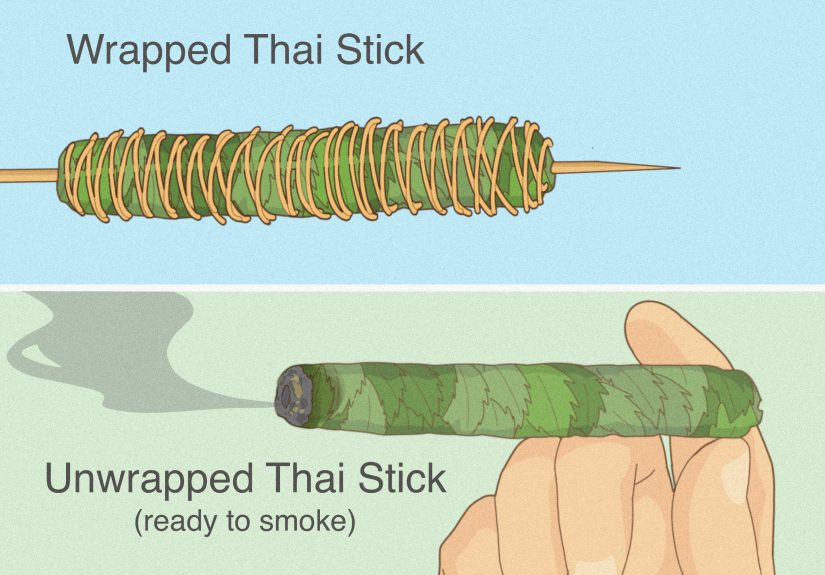
The classic idea of a Thai stick involved cured cannabis flower bound around a thin bamboo skewer and wrapped in leaf. That structure gave it its famous shape, helped it travel, and made it look distinctive enough that people remembered it instantly. In other words, if an ordinary bag of flower was a paperback novel, a Thai stick was the special-edition hardcover with dramatic cover art.
Not a Strain, Not Just a Shape, and Definitely Not Just Hype
Part of the confusion comes from the way the term has evolved. Sometimes people use “Thai stick” to describe the format. Sometimes they use it to refer to old-school Thai cannabis more generally. Sometimes it gets blended with the idea of a Thai landrace sativa, a historic genetic line connected to Southeast Asia and later linked to influential breeding lines such as Haze. In casual conversation, the phrase can mean the original product, the legendary imported flower associated with it, or a modern tribute product borrowing the name because it sounds cooler than “rolled thing with a backstory.”
That layered meaning is exactly why the phrase has survived. Thai stick was never just an object. It was also a reputation.
Where Did Thai Stick Come From?
The roots of Thai stick go back to Thailand’s long cannabis history, especially in the country’s northeastern regions near the Mekong basin. Historical accounts connect its reputation to traditional local cultivation, favorable growing conditions, and regional knowledge that predated its fame in the United States. By the time Western consumers started whispering about Thai stick like it was a mythical artifact, the agricultural and cultural foundations behind it already existed.
Thailand’s environment helped create the conditions for highly regarded cannabis, and old accounts often describe the plant material associated with Thai stick as fragrant, potent, and visually distinctive. In some retellings, indigenous and local growers in northeastern Thailand receive credit for preserving the cultivation traditions that made the product possible. That matters, because the legend often gets told from an American perspective, even though the craftsmanship and origin story were deeply Thai long before the U.S. market got involved.
Then history did what history always does: it boarded a plane, put on sunglasses, and complicated everything.
How Thai Stick Reached the United States
The rise of Thai stick in American culture is tied to the late 1960s and 1970s, when U.S. military presence in Southeast Asia, expanding backpacker routes, and surf and counterculture travel networks helped move stories and products across borders. American GIs, travelers, and smugglers all played a role in introducing Thai stick to the United States. Once it arrived, it did not stay niche for long.
Why? Because imported cannabis from Thailand carried a certain aura. It was foreign, scarce, and associated with adventure. That is a powerful marketing mix even before anyone prints a logo. Add in the fact that many Americans at the time encountered cannabis through regional or lower-grade products, and Thai stick stood out as something more refined, more intense, and more glamorous. The phrase alone sounded like it came with its own soundtrack.
By the 1970s, Thai stick had become part of American cannabis lore. It showed up in stories from veterans, smugglers, surfers, and pop culture figures. It earned shout-outs in movies and conversation. Its reputation spread far beyond the number of people who had actually seen an authentic example in person. That, oddly enough, only made it more famous. Scarcity feeds myth the way oxygen feeds a campfire.
Why Surfers, Travelers, and Counterculture Figures Matter
Historical reporting on the era often highlights surfers and wanderers who moved through Southeast Asia and brought cannabis stories back to California and beyond. Thai stick fit neatly into the mythology of the period: beautiful beaches, dangerous routes, improbable schemes, and young Americans convinced that the world was both enormous and somehow designed specifically for their road trip. It became tied to a larger story of movement between Thailand, Hawaii, and the American West Coast.
That does not mean every tale was accurate. Quite the opposite. Thai stick was famous during a period when cannabis information traveled through rumor, memory, and bravado. The result was a legend constantly being polished by retelling.
Why Thai Stick Seemed So Mysterious
The mystery around Thai stick was not accidental. It came from a perfect storm of distance, illegality, limited information, and old-fashioned storytelling. In the pre-internet era, most consumers had no way to verify origin claims, compare notes with growers in Thailand, or separate a real product from a clever imitation. If someone told you the bundle in front of you was rare, imported, and stronger than anything in your zip code, you had very few tools for fact-checking beyond raising an eyebrow.
That mystery made Thai stick bigger than itself. The name suggested handcraft. The shape looked ceremonial. The origin story stretched across oceans. And because the product existed partly in the shadows of illegal trade, it gathered the kind of mystique that ordinary consumer goods almost never get. Nobody writes epic legends about toothpaste.
There was also the issue of inconsistency. Some Thai stick was probably excellent. Some was almost certainly overrated. Some may have been authentic, while other examples were likely local products wearing imported prestige like a borrowed leather jacket. That variation did not kill the legend. It fed it. When quality fluctuates and supply is murky, people tend to remember the best version and forget the merely decent ones.
Thai Stick, Thai Cannabis, and the Birth of Modern Hybrids
Thai stick also matters because it sits near an important crossroads in cannabis history. Thai cannabis, often discussed as a classic landrace lineage, influenced later breeding and helped shape well-known families of uplifting, energetic strains. In cannabis history conversations, “Thai” is often treated as one of the old-school building blocks that contributed to later genetics beloved by breeders and enthusiasts.
That does not mean every modern product labeled “Thai” is a direct window into the past. Not even close. Contemporary cannabis markets are full of hybridization, marketing spin, and names that work harder than a publicist during awards season. Still, the historical significance remains. Thai cannabis left a genetic and cultural footprint large enough that the phrase Thai stick still carries weight decades later.
Thai Stick vs. Modern Cannagars
Today, some retailers and brands use Thai stick as a near-synonym for modern “cannagars” or premium leaf-wrapped cannabis products. Those can be elaborate, expensive, and carefully engineered, but they are not always faithful reproductions of the original Thai format or materials. In many cases, they are more like descendants inspired by the legend than exact replicas of it.
That distinction matters for anyone writing seriously about cannabis history. The original Thai stick was part of a specific place, time, and trade network. Modern products may borrow the style, the silhouette, or the romantic storytelling, but the historical Thai stick belongs to a much older chapter.
Why the Original Thai Stick Faded
Legends rarely disappear all at once. They fade in stages. Thai stick lost prominence as domestic cultivation improved, seedless flower became more available, breeding expanded, and cannabis markets changed. What once seemed rare and extraordinary was eventually competing with increasingly potent, carefully cultivated products grown closer to home.
Law enforcement pressure, changing smuggling routes, and shifting economics also played a role. Imported cannabis from the old era gradually gave way to new market realities. In the United States, consumers moved toward other forms, other strains, and later, other delivery systems entirely. Meanwhile, the original Thai stick remained frozen in memory as one of those products people talked about with a half-smile and a suspiciously cinematic level of detail.
In short, it became history before it stopped being famous. That is a neat trick.
Health and Legal Reality: The Part That Ruins the Party but Helps the Reader
Any honest modern article about Thai stick needs to include context that old legends usually skipped. Public health agencies note that cannabis can impair memory, coordination, reaction time, attention, and decision-making. Smoked cannabis can also affect lung health, and higher-potency products may carry greater risks for some users. The romantic glow of a historic product does not cancel out the basic fact that psychoactive substances affect the brain and body.
Legal context is just as important. In the United States, cannabis laws vary by state, while federal law still treats marijuana differently from how many state systems do. That means historical fascination with Thai stick should not be confused with a blanket legal green light. The laws are patchwork, the terminology can be messy, and the nostalgic stories from the 1970s do not function as legal advice now. Sadly, history is rich, but it is not a lawyer.
Experiences, Memories, and Stories That Kept Thai Stick Alive
If you really want to understand why Thai stick still gets talked about, look beyond the object and toward the experiences attached to it. Not step-by-step experiences, not product hype, and not a nostalgia contest where everybody suddenly becomes a poet after age fifty. More like cultural memory: the stories people carried, exaggerated, traded, and repeated until Thai stick became part of the folklore of an era.
For many older Americans, the name “Thai stick” belongs to a specific emotional archive. It evokes the 1970s, imported goods, military routes through Asia, long-haired California mythmaking, and the sense that cannabis culture had international passports long before most of its consumers did. In these stories, Thai stick is rarely presented as just a product. It is remembered as an event. Someone knew a guy who got some. Someone swore the aroma was unforgettable. Someone else insisted it looked too beautiful to be real. By the third retelling, it had become the cannabis equivalent of a lost jazz recording or a perfect wave that only existed on one glorious afternoon in 1974.
That is what makes the topic so interesting from a cultural point of view. The stories are often about distance as much as about the product itself. Thailand felt far away. Information was scarce. The American consumer market was less standardized. So when something arrived with a handcrafted look and a foreign name, it carried a sense of wonder that is harder to recreate today. Modern buyers can scroll through lab results, terpene breakdowns, and customer reviews while standing in line. Back then, mystery did much of the marketing heavy lifting.
There is also a generational quality to the memories. Veterans, travelers, surfers, and old-school cannabis enthusiasts sometimes recall Thai stick as part of a larger transition in American life, when global travel, underground markets, music scenes, and counterculture identity were colliding in unusual ways. In those recollections, Thai stick was not isolated from the era’s broader mood. It was wrapped up with the rise of alternative lifestyles, the expansion of youth culture, and the mythology of places like California, Hawaii, Bangkok, and the Mekong region. The object became a passport stamp in story form.
Even people who never encountered an authentic Thai stick inherited the legend secondhand. That matters. Cultural myths survive because they are portable. A person did not need firsthand knowledge to repeat the tale. All they needed was the name, the shape, and the promise that this thing was somehow different from ordinary cannabis. Once that idea got lodged in popular memory, it stayed there. Pop culture references helped. So did the habit of older consumers comparing “what we used to see back then” with what exists now.
And maybe that is the most durable part of the Thai stick experience: not consumption, but comparison. It became shorthand for an earlier world of cannabis, one defined by geography, rumor, and irregular access rather than dispensary menus and branding teams. Whether remembered accurately or through a generous haze of nostalgia, Thai stick still functions as a symbol of a wilder, less documented chapter in cannabis history. That chapter was not necessarily simpler or better. It was just less cataloged, less standardized, and therefore easier to mythologize.
So when people speak about Thai stick today, they are often talking about more than a historic cannabis cigar. They are talking about mystery itself: the thrill of not knowing everything, the glamour of distance, and the way a single object can absorb an era’s travel stories, anxieties, fashions, and legends. That is a lot for one bamboo-centered bundle to carry. Then again, history has always loved a dramatic prop.
Final Thoughts
What is a Thai stick? Historically, it was a distinctive cannabis bundle associated with Thailand, remembered in America as a rare and potent “cigar” that became famous in the 1970s. Culturally, it became much more than that. Thai stick evolved into a symbol of imported mystique, old-school craftsmanship, and the global pathways that helped shape modern cannabis culture.
Its story stretches from Thai cultivation traditions to U.S. counterculture, from agricultural reality to cinematic legend. It influenced how people talked about quality, origin, and rarity. It helped cement the reputation of Thai cannabis in the Western imagination. And even today, when the name gets recycled, rebranded, or loosely attached to modern products, the original legend still shines through.
That is why Thai stick remains fascinating. Not because it is impossible to explain, but because every explanation reveals another layer: history, trade, myth, genetics, nostalgia, and the eternal human tendency to turn rare objects into folklore. Some products sell themselves. Others become stories first and products second. Thai stick managed to do both.