Table of Contents >> Show >> Hide
- First, a quick refresher: what sleep apnea is (and why it matters)
- What an at-home sleep apnea test actually is
- Home test vs. sleep lab: how to choose the right lane
- How an at-home sleep apnea test works (step by step)
- Understanding your results without getting lost in alphabet soup
- Buying a test online: smart questions to ask before you click “Add to Cart”
- Cost, insurance, and the “will this be covered?” question
- What happens after diagnosis
- Common questions (because everyone asks them)
- Bottom line
- Real-world experiences: what people often notice during (and after) an at-home sleep apnea test
If you’ve ever woken up feeling like you “slept” for eight hours but your brain filed a formal complaint anyway,
you’re not alone. Snoring that could qualify as a neighborhood event, waking up gasping, morning headaches,
and daytime sleepiness (the kind where you could nap during your nap) can all point toward obstructive sleep apnea (OSA).
The good news: figuring out what’s going on doesn’t always require an overnight stay in a sleep lab with enough wires to power a small robot.
For many adults, an at-home sleep apnea test can be a practical first stepfast, lower-cost, and done in your own bed.
The not-so-secret secret: home testing is excellent for the right person and the right question,
but it’s not a one-size-fits-all “Congrats, you’re diagnosed!” button. Below is what at-home sleep apnea tests do well,
where they fall short, how to get reliable results, and what to do nextso you can stop guessing and start sleeping.
First, a quick refresher: what sleep apnea is (and why it matters)
Obstructive sleep apnea happens when your upper airway repeatedly narrows or closes during sleep, reducing airflow.
Your body may briefly “restart” breathing with a micro-arousaloften so short you won’t remember ityet repeated disruptions
can wreck sleep quality and drop oxygen levels. Common clues include loud snoring, choking/gasping sounds, restless sleep,
waking up unrefreshed, dry mouth, nighttime bathroom trips, trouble focusing, and daytime drowsiness.
Untreated OSA has been linked with higher risks for high blood pressure and other cardiovascular and metabolic issues,
and it can raise accident risk due to sleepiness. So when symptoms are persistent, testing isn’t just about snoring peace treatiesit’s about health.
What an at-home sleep apnea test actually is
An at-home sleep apnea testoften called HSAT (Home Sleep Apnea Testing)is a simplified breathing monitor used at home to evaluate for OSA.
It focuses on breathing and oxygen patterns rather than capturing every detail of sleep architecture.
Think “targeted mission” instead of “full documentary series.”
What HSAT typically measures
- Airflow: usually through a small nasal cannula or sensor near the nose/mouth
- Breathing effort: often via chest/abdomen belts that track movement
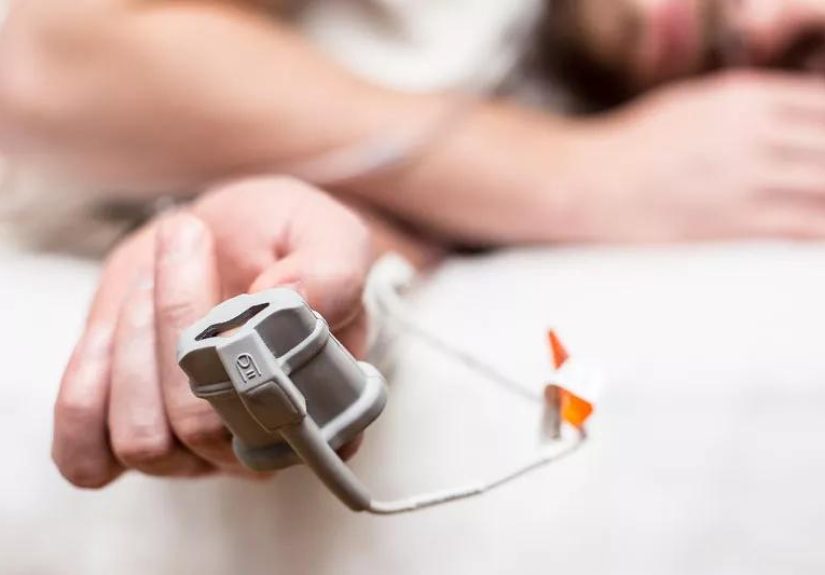
- Blood oxygen level (SpO2) and pulse: commonly via a fingertip sensor
- Sometimes: body position, snoring, and/or additional signals depending on device type
What HSAT usually does not measure
Most home tests don’t record brain waves (EEG) to confirm when you’re actually asleep, or track eye and leg movements the way an in-lab sleep study does.
That matters because many HSAT devices calculate breathing-event rates using recording time rather than true sleep time,
which can underestimate severity if you spent a lot of time awake in bed.
Home test vs. sleep lab: how to choose the right lane
In-lab polysomnography (PSG) is the most comprehensive sleep study. It can diagnose OSA and evaluate many other sleep disorders.
HSAT is best viewed as a focused tool: great for answering “Do I likely have moderate-to-severe obstructive sleep apnea?” in the right adult patient,
but not designed to diagnose every possible sleep problem.
HSAT is often a good fit if you:
- Have classic OSA symptoms (loud snoring, witnessed pauses in breathing, gasping, significant daytime sleepiness)
- Are an adult with a straightforward health history (no major complicating conditions)
- Need a more convenient or cost-effective way to start evaluation
- Can follow setup instructions and keep sensors in place overnight
You may need an in-lab study instead if you have (or your clinician suspects):
- Significant heart or lung disease or complex breathing problems during sleep
- Neuromuscular conditions that could affect breathing
- Possible sleep-related hypoventilation (breathing too shallow/slow during sleep)
- Chronic opioid use (can raise risk for central sleep apnea and breathing instability)
- History of stroke or concerns about central sleep apnea
- Severe insomnia (can reduce HSAT accuracy if you’re awake much of the night)
- Concern for other sleep disorders (narcolepsy, parasomnias, certain movement disorders)
- Children/teens (evaluation is typically different, and home testing may not be appropriate)
Important note: if a home test is negative, inconclusive, or technically messy, clinical guidelines support moving to an in-lab study rather than shrugging and hoping for the best.
How an at-home sleep apnea test works (step by step)
- Start with a medical evaluation. A clinician reviews symptoms, health history, and risk factors to decide if HSAT is appropriate.
- Get the device. It may come from a sleep clinic, a durable medical equipment provider, or a telehealth pathway that includes clinician oversight.
- Set it up at bedtime. You’ll place sensors (usually a nasal cannula, finger sensor, and sometimes belts). Expect a brief “I am now a mildly annoyed cyborg” moment.
- Sleep like you normally do. Try to follow your usual routine so the test reflects real life.
- Return or upload the data. Depending on the system, data may be uploaded automatically or returned for manual review.
- A qualified clinician interprets results. This step matters because automated scoring alone can miss issues or misclassify events.
Understanding your results without getting lost in alphabet soup
Most results summarize how often breathing events occur per hour. In lab studies you’ll often see AHI (apnea-hypopnea index).
In HSAT, you may see REI/RDI (respiratory event/disturbance index) because the device may use recording time as the denominator.
Your report may also highlight oxygen drops (desaturations), snoring, and position-related patterns (like “worse on your back”).
Severity categories are commonly described as:
mild (about 5–14 events/hour), moderate (15–29), and severe (30+).
Don’t self-diagnose based on one number, though. Symptoms, oxygen trends, and medical history shape the real-world meaning.
A person with “mild” numbers but major sleepiness and oxygen drops may still need treatmentwhile another person may need confirmatory testing if the story and the data don’t match.
What “negative” or “inconclusive” can really mean
- True negative: no meaningful OSA signals found and symptoms are mild or explained by something else.
- False negative: OSA exists, but the test missed itcommon reasons include sensor loss, too much time awake, or milder disease that’s harder to capture.
- Technically inadequate: not enough clean data to interpret confidently.
If symptoms remain strong after a negative/inconclusive HSAT, the usual next step is an in-lab polysomnography to get a fuller picture.
Buying a test online: smart questions to ask before you click “Add to Cart”
Direct-to-consumer pathways have exploded, and not all “home sleep tests” are created equal.
Some options include clinician oversight and FDA-cleared diagnostic devices; others are better described as screening tools or wellness trackers.
Before you choose, ask these questions:
- Is it a diagnostic HSAT or a screening product? A diagnostic pathway should produce a clinical interpretation you can use for treatment decisions.
- Who reviews the raw data? Look for physician review (ideally sleep medicine expertise), not just an auto-generated PDF.
- What signals does it record? At minimum, you want airflow/respiratory analysis and oxygen data; many systems also include breathing effort.
- What happens if it’s negative or fails? Repeats and follow-up guidance should be clear.
- Will the results integrate with your care? If you’ll want insurance-covered treatment later, clinician-ordered testing and documentation can matter.
Cost, insurance, and the “will this be covered?” question
HSAT is often less expensive than an in-lab sleep study, which is one reason it’s commonly used as a first step for suspected uncomplicated OSA.
Coverage depends on your insurer and your clinical situation, but a recurring theme in policies is medical necessity and proper ordering/interpretation.
If you’re using insurance, it’s worth verifying:
- Whether HSAT is required before an in-lab study is approved
- Which HSAT devices/providers are considered “in network”
- Whether a referral or prior authorization is needed
- What documentation is needed if treatment (like CPAP) is prescribed
What happens after diagnosis
If HSAT supports a diagnosis of obstructive sleep apnea, next steps typically focus on treatment that improves breathing during sleep and reduces symptoms and risk.
Common options include:
- CPAP/APAP: positive airway pressure therapy is a front-line treatment, especially for moderate-to-severe OSA.
- Oral appliance therapy: a dentist with sleep training may fit a device that moves the jaw forward, often used for mild-to-moderate OSA or CPAP intolerance.
- Positional strategies: if OSA is much worse on your back, changing sleep position can be part of the plan.
- Weight management and cardiometabolic care: when applicable, addressing underlying risk factors can improve OSA severity and overall health.
- Surgical or device-based options: in selected cases (and after evaluation), procedures or implants may be considered.
Treatment isn’t just about numbers; it’s about how you feel, your oxygen patterns, and your overall health profile.
The best plans are individualizedand usually involve follow-up to confirm improvement.
Common questions (because everyone asks them)
“Will I sleep normally with all that stuff on?”
Most people sleep well enough to get usable data. The gear is less than a full lab setup, but yes, it can feel weird at first.
Following your normal bedtime routine helps.
“Is one night enough?”
Often, yesespecially when symptoms and risk factors strongly suggest moderate-to-severe OSA. But if the night was unusually restless, sensors came off,
or your symptoms don’t match the results, repeat testing or an in-lab study may be recommended.
“Can a home test diagnose all types of sleep apnea?”
HSAT is primarily used to diagnose obstructive sleep apnea in appropriate adults. It is not the best tool for evaluating complex breathing disorders,
suspected central sleep apnea, or other sleep conditions that require more comprehensive monitoring.
“What if my test says I’m fine, but I still feel awful?”
Don’t ignore persistent symptoms. A negative HSAT does not always close the case.
If your clinical picture still suggests sleep apneaor another sleep disordertalk with a clinician about in-lab testing and broader evaluation.
Bottom line
At-home sleep apnea tests can be a smart, efficient way to diagnose obstructive sleep apnea in many uncomplicated adultsespecially when symptoms strongly fit the pattern.
The key is using HSAT in the right situation, with proper clinical oversight and clear next steps if results are negative, unclear, or don’t match how you feel.
Done well, HSAT turns “I think I’m sleeping” into “Now we actually know,” which is an underrated life upgrade.
Real-world experiences: what people often notice during (and after) an at-home sleep apnea test
People tend to imagine an at-home sleep apnea test as either (1) totally effortless or (2) a chaotic night of tangles and beeping.
In reality, most experiences fall somewhere in the middlelike assembling a simple gadget with mild bedtime drama.
A common first reaction is surprise at how minimal the equipment is compared to a sleep lab: often a fingertip sensor, a nasal cannula, and maybe a couple of soft belts.
The setup usually takes only a few minutes, but that doesn’t stop many folks from standing in front of a mirror thinking,
“Is this how astronauts feel before launch… but with less dignity?”
The most frequent complaint is sensory annoyance rather than discomfort. The nasal cannula can feel strange if you’re not used to it,
and some people notice they become hyper-aware of their breathingexactly the opposite of relaxing.
Ironically, that “I must sleep perfectly for this test” pressure can make it harder to fall asleep.
The good news: clinicians generally expect a normal amount of tossing and turning.
What matters is capturing enough quality data over the night, not winning a gold medal in tranquil slumber.
Another very common experience is the “sensor pop-off moment.”
People wake up briefly and realize the finger sensor shifted, the cannula tugged loose, or a belt slipped.
If that happens, many devices still record enough to interpret, but it can also lead to a repeat test.
The practical lesson many patients share: follow the fitting instructions closely, don’t rush the setup,
and keep the device components within reach so you can re-seat something quickly without turning on every light in the house.
The emotional experience after the test can be surprisingly intense. Some people feel validatedfinally, a reason they’re exhausted.
Others feel nervous waiting for results, especially if they’ve read scary headlines about sleep apnea.
When results come back showing moderate or severe OSA, people often report a mix of relief (“I’m not just lazy”) and annoyance (“So I have homework now?”).
If treatment is recommended, the first week can feel like a learning curveespecially with CPAP/APAPwhere the win is progress, not perfection.
Many describe the payoff as gradual but meaningful: fewer morning headaches, less daytime fog, and a sense that sleep is doing its job again.
And for those whose HSAT comes back negative or unclear despite strong symptoms, the experience can be frustratinglike being told,
“Your smoke alarm is fine,” while your kitchen is still smoky. In those cases, people often feel most supported when the next step is clear:
additional evaluation, an in-lab study, or exploring other explanations for fatigue (like insomnia, restless legs, medication effects, mood disorders,
thyroid issues, or simply not getting enough sleep). The biggest real-world takeaway is that a home sleep apnea test is a tool in a process,
not the process itself. When it’s used thoughtfullyright patient, right device, right follow-upit can be the start of a genuinely better life.