Table of Contents >> Show >> Hide
- The most common answer: the white stringy bit is the chalaza
- If it’s a tiny white dot on the yolk: it may be the germinal disc
- Other “little white things” people notice in eggs
- Is the little white thing in an egg safe to eat?
- Quick “What am I looking at?” cheat sheet
- Why eggs have “weird bits” in the first place
- Cooking tips if the “white thing” freaks you out (but you still want breakfast)
- FAQ
- Real-life kitchen experiences: of “Yep, I’ve seen that too”
- Conclusion
You crack an egg, expecting the usual golden yolk-and-goo situation… and then you spot it:
a little white string, blob, dot, or squiggle that looks like it belongs in a sci-fi movie.
Before you assume your breakfast is haunted, take a breath. In most cases, that “little white thing”
is a totally normal part of egg anatomyand sometimes it’s even a sign your egg is fresh.
The tricky part is that people use “little white thing” to describe a few different egg features.
Some are stringy. Some are spotty. Some show up only after cooking. This guide breaks down the most
common culprits, what they are, what they mean, and whether you should worry (spoiler: usually no).
The most common answer: the white stringy bit is the chalaza
If the “white thing” looks like a twisted cord or a small ropey strand attached near the yolk,
you’re almost certainly looking at the chalaza (plural: chalazae).
Think of it as the yolk’s seatbelt.
What the chalaza does
The chalazae are made from thickened egg white proteins. Their job is to anchor the yolk
and keep it centered so it doesn’t bounce around and slam into the shell. Eggs usually have two chalazae,
one on each side of the yolk, often twisted in opposite directions like tiny protein springs.
Is the chalaza a baby chicken?
No. It is not an embryo, not an umbilical cord, and not a sign that your egg is fertilized.
It’s simply part of the egg’s internal structureedible, harmless, and common.
Does seeing chalaza mean the egg is fresh?
Often, yes. Chalazae can be more noticeable in fresher eggs because the thick white
(albumen) is firmer and holds its structure better. As an egg ages, the white thins out, and the chalaza
can look less prominent or break down.
Should you remove it?
You don’t have to. It typically disappears into the egg as it cooks. But if you’re making something where
silky texture matterslike custard, lemon curd, flan, pastry cream, or a very smooth scrambleyou can
remove the chalaza easily:
- Fork method: Scoop it out after cracking the egg into a bowl.
- Strainer method: Pass beaten eggs through a fine-mesh sieve.
- Tweezer method: If you’re feeling extra precise (and slightly dramatic).
If it’s a tiny white dot on the yolk: it may be the germinal disc
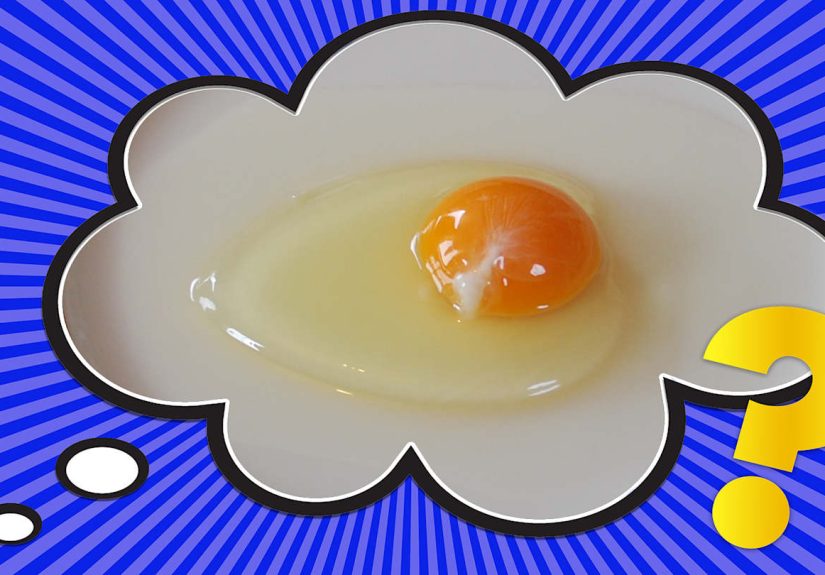
Sometimes the “white thing” isn’t stringy at allit’s a small white spot on the yolk.
That spot is often the germinal disc, a natural part of the egg where fertilization
would occur if the egg were fertilized. In typical supermarket eggs sold for eating, the presence
of a germinal disc does not mean a chick is developing.
Why the germinal disc can still appear in unfertilized eggs
The germinal disc exists whether or not fertilization happens. In an unfertilized egg, it’s simply the
starting point that could develop under the right conditionsbut it doesn’t.
How to tell “disc” from “uh-oh”
A normal germinal disc is usually a small pale spot. If you see unusual discoloration, strong off-odors,
or obvious spoilage signs (more on those below), trust your senses and toss the egg.
Other “little white things” people notice in eggs
Eggs are simple… until they’re not. Here are a few other common white-ish features that can cause kitchen
confusion.
1) Cloudy egg whites
If your raw egg white looks cloudy instead of crystal-clear, that’s usually a freshness
signal. Very fresh eggs can have more dissolved carbon dioxide, which can make the white appear cloudy.
Cloudy isn’t the same as “spoiled”it’s often the opposite.
2) Thick white clumps in the albumen
Sometimes egg whites include thicker gel-like portions. That’s normal: an egg has both thinner and thicker
albumen. Fresher eggs often have a more pronounced thick white that holds together rather than spreading
like a puddle.
3) A white “lump” on the shell or stuck to it
Occasionally you’ll find a chalky bump on an eggshell or a white deposit. This can be a minor
calcium deposit or shell irregularity. It may look strange but isn’t automatically a safety issue.
If the shell is intact and the egg smells normal, it’s usually fine.
4) The “white bubble” in a hard-boiled egg
Peel a hard-boiled egg and find a white pocket or indentation at one end? That’s typically the
air cella normal space inside the egg that tends to enlarge as eggs age. It’s also why older
eggs can be easier to peel: the air cell is bigger and helps separate shell from white during boiling.
5) White string after poaching or frying
Sometimes the chalaza becomes more visible when the egg hits heat and the proteins tighten. In a poached egg,
it can look like a little streamer waving hello. It’s still the same harmless structurejust more noticeable
because cooking changes texture.
Is the little white thing in an egg safe to eat?
In the vast majority of caseschalaza, germinal disc, cloudy whites, thick albumen, air cellyes.
These are normal egg features and not contamination.
When to skip the egg
The “white thing” itself is rarely the problem. What matters is the overall condition of the egg.
Don’t eat it if you notice:
- Strong rotten or sulfur-like odor (raw or cooked)
- Unusual rainbow sheen or weird discoloration paired with bad smell
- Shell damage with leaking contents or obvious contamination
- Mold on the shell or inside the egg (rare, but a hard no)
Food safety basics that matter more than the mystery string
Eggs can carry foodborne bacteria, so safe handling is key:
- Keep eggs refrigerated and don’t leave them out for long stretches.
- Wash hands and avoid cross-contamination after touching raw egg.
- Cook eggs thoroughly if serving high-risk individuals (young kids, older adults, pregnant people, immunocompromised).
If you’re making recipes with lightly cooked or raw eggs (like some Caesar dressings, homemade mayo,
eggnog, tiramisu), consider using pasteurized eggs for extra safety.
Quick “What am I looking at?” cheat sheet
If it looks like…
- A white string/cord near the yolk: probably chalaza (normal, edible).
- A tiny white dot on the yolk: likely germinal disc (normal).
- Cloudy whites: often a freshness indicator (normal).
- A white pocket in a hard-boiled egg: air cell (normal).
- Chalky bump on the shell: often calcium deposit (usually normal).
Why eggs have “weird bits” in the first place
Eggs are engineered for protection. Even an unfertilized egg is built to keep the yolk stable, cushioned,
and centered. The albumen (egg white) isn’t just “goop”it contains proteins that support structure, resist
movement, and help defend against bacteria. The chalazae are part of that stabilization system, and the
germinal disc is part of the yolk’s biology.
In other words: the little white thing isn’t a glitch in the system. It’s the system working as designed.
Cooking tips if the “white thing” freaks you out (but you still want breakfast)
For scrambled eggs
- Crack eggs into a bowl first (not straight into the pan).
- If you spot chalazae, remove with a forkor don’t. Once beaten, it’s usually unnoticeable.
For custards, puddings, and curds
- Beat eggs, then strain through a fine-mesh sieve for the smoothest texture.
- This removes chalazae and any tiny protein lumps that can create texture bumps.
For poached eggs
- Fresh eggs hold together better because the whites are thicker.
- Straining raw egg through a fine sieve can remove thin watery whites for a neater poach.
FAQ
Does a chalaza mean my egg is fertilized?
No. Chalazae appear in eggs regardless of fertilization. They’re structural protein strands that keep the yolk centered.
Is the white spot on the yolk a baby chick?
Usually not. A small white spot is typically the germinal disc, which exists whether or not fertilization occurred.
In store-bought eating eggs, embryo development is not what you’re seeing.
Why do some eggs have bigger or more obvious white strings?
Chalaza size and visibility can vary with freshness and natural variation. Fresher eggs often show more defined chalazae.
Will cooking destroy the chalaza?
It usually blends into the white and becomes unnoticeable. In gentle cooking (like poaching), you might still see it,
but it remains harmless.
Real-life kitchen experiences: of “Yep, I’ve seen that too”
If you’ve ever cracked an egg one-handed because you felt like a cooking-show hero, you’ve probably also had the
cooking-show plot twist: a weird little white strand dangling in the bowl like it’s auditioning for a role in
“Breakfast: The Mystery Continues.” Many home cooks go through the same emotional arc:
confident crack → confused stare → frantic Googling → relief.
One super common experience happens when you’re making something “fancy” that’s still basically eggslike homemade
ice cream, crème brûlée, lemon curd, or a silky pasta carbonara. You crack six eggs, separate yolks like a pro,
and then notice one yolk has a little white cord attached. The first thought is rarely poetic. It’s usually something
like, “Why does this egg have a shoelace?” The second thought is often, “Should I throw the whole batch away?”
The good news: this is exactly the moment when learning about chalazae saves both your dessert and your sanity.
Another relatable moment: you’re making scrambled eggs for someone picky (or for yourself on a day when texture matters),
and you spot a thicker white clump or string. Many people instinctively remove it because it “looks different,” not because
it’s unsafe. It’s the same energy as picking a single weird-looking fry out of the basket and pretending it never existed.
If you’ve done it, congratulationsyou’re officially human.
Then there’s the hard-boiled egg surprise: you peel a perfectly cooked egg and find a little dent or pocket at one end.
Some folks think it’s undercooked or “missing egg.” In reality, you’ve just met the air cell. It’s especially noticeable
in eggs that have been in the fridge a bit longer, which is why many people swear that “older eggs peel better.”
They’re not imagining itkitchen patterns often have real science behind them.
If you cook a lot, you might also notice that farm-fresh or very fresh eggs can behave differently. When you crack them,
the whites sit up taller and don’t spread as quickly. That can make the chalaza look more obvious, too. The egg is basically
showing off: “Look how structured I am. I’m practically organized.”
Finally, there’s the “company is coming” scenario. You’re making brunch, you’re trying to be calm, and an egg reveals a white
string that makes you pause mid-whisk like a suspense movie. Here’s the real takeaway from countless kitchens:
once you know what you’re looking at, it stops being weird. It becomes background detaillike the tiny bubbles in pancake batter
or the foam on simmering stock. Eggs have personality. Most of the time, that personality is completely normal.
Conclusion
The “little white thing” in an egg is usually the chalaza: a natural, edible protein strand that keeps the yolk centered.
Sometimes it’s a small white spot on the yolk called the germinal disc, or a normal feature like cloudy whites or the air cell
in a hard-boiled egg. In other words, your egg isn’t brokenit’s just being an egg. When in doubt, rely on freshness cues
like smell, shell condition, and proper storage and cooking practices. And if you still don’t like the look of it?
Scoop it out, strain it, and carry on with breakfast like the unbothered culinary legend you are.