Table of Contents >> Show >> Hide
- What Is the Average Age for Crawling?
- Why Crawling Varies So Much
- Signs Your Baby May Be Ready to Crawl
- Not All Crawling Looks the Same
- Why Crawling Matters
- Can a Baby Skip Crawling and Still Be Fine?
- How to Encourage Crawling Without Turning It Into a Job Review
- When Should You Worry About Delayed Crawling?
- Situations That Can Affect Crawling Timelines
- What to Expect After Crawling Starts
- Bottom Line: Should You Worry?
- Experience-Based Parenting Stories: What This Milestone Often Feels Like in Real Life
- Conclusion
If you are waiting for your baby to crawl, welcome to one of parenting’s most suspenseful seasons. Every wiggle looks promising. Every backward scoot feels like a plot twist. And every well-meaning relative seems ready to announce that their cousin’s baby crawled at four minutes old and then immediately applied to college.
Take a breath. Baby development is not a race, and crawling does not follow one rigid script. Some babies crawl early, some later, some invent their own weirdly adorable mobility style, and some skip traditional crawling entirely. The real question is not whether your baby is following your group chat’s favorite timeline. It is whether your baby is making steady progress in movement, strength, and curiosity.
Here is what the average crawling timeline looks like, what signs show a baby is getting ready, when delayed crawling is usually no big deal, and when it makes sense to call your pediatrician.
What Is the Average Age for Crawling?
Most babies start crawling somewhere between 7 and 10 months. That is the sweet spot many pediatric and parent-health resources mention, and it is a useful average for families who just want a ballpark answer without needing a spreadsheet.
That said, babies do not all read the same instruction manual. Some begin moving earlier, around 6 months, especially if they have developed strong head control, plenty of tummy-time strength, and a deep personal commitment to chasing the dog bowl. Others may not crawl until 11 or even 12 months. And yes, some babies skip classic hands-and-knees crawling and still go on to walk just fine.
So if your baby is 8 months old and not cruising across the living room like a tiny action hero, that alone is not a reason to panic. The broader developmental picture matters more than one exact date.
Why Crawling Varies So Much
Crawling depends on several building blocks coming together at once. A baby needs enough neck, shoulder, arm, back, and core strength to hold their body up. They also need balance, coordination, motivation, and the growing realization that life is more exciting if they can reach it themselves.
That is why crawling often appears after a series of smaller milestones. Many babies first learn to lift their chest during tummy time, roll both ways, pivot in circles, sit with less support, rock on hands and knees, and then finally figure out how to move forward instead of backward. In other words, crawling is less of a magical one-day event and more of a mini construction project.
Temperament can also play a role. Some babies are natural explorers and seem determined to cross a room for a crumpled receipt. Others are more content to stay put and let adults bring them the good stuff. Both kinds of babies exist, and both can be perfectly healthy.
Signs Your Baby May Be Ready to Crawl
If you are wondering whether crawling is close, watch for these common signs:
1. Stronger tummy-time skills
Your baby can hold their head up well, push up through their arms, and spend time on their belly without acting like you have personally betrayed them.
2. Rolling and pivoting
Before true crawling, many babies roll to get where they want to go or pivot in a circle like a tiny compass with opinions.
3. Sitting with better balance
Babies who can sit more steadily often have the trunk strength needed to start shifting into crawling positions.
4. Rocking on hands and knees
This is one of the classic pre-crawling signs. A baby may get on all fours and rock back and forth for days or weeks before moving forward.
5. Army crawling or scooting
Some babies begin by dragging themselves on their bellies, pushing backward, or using one strong leg like a little outboard motor.
6. Increased interest in moving toward people or toys
Sometimes the spark is simple: a favorite toy, your face, the TV remote, or the shocking discovery that the cat can be followed.
Not All Crawling Looks the Same
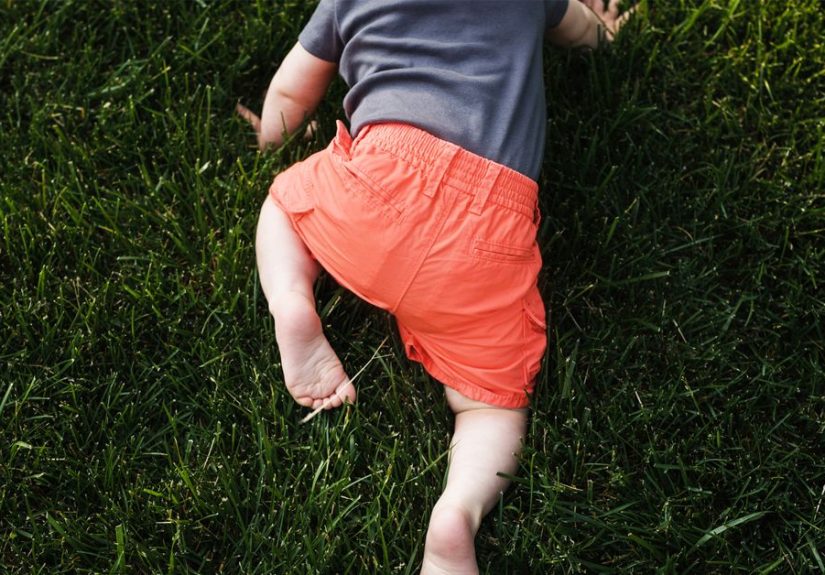
There is no single gold-standard crawl that every baby must perform. Traditional hands-and-knees crawling is common, but it is not the only show in town.
Normal variations can include:
- Commando or belly crawl: pulling forward with the arms while the belly stays on the floor
- Bottom scooting: moving while seated and pushing forward with legs
- Crab crawl: moving sideways or backward in a less-than-straight line
- Bear crawl: hands and feet on the floor with knees lifted
- Rolling as transportation: not elegant, but surprisingly effective
These variations can still count as meaningful mobility. A baby does not need to look like a textbook illustration to be developing normally. The bigger issue is whether your child is finding some way to move, explore, and build strength over time.
Why Crawling Matters
Crawling is exciting for more than sentimental reasons. It helps babies build strength in the shoulders, arms, trunk, hips, and back. It also supports coordination between the left and right sides of the body, body awareness, and the ability to shift weight while moving. In plain English, crawling is one of the many ways babies practice being tiny athletes before they become tiny walkers.
It also changes how babies interact with the world. Once a baby can move independently, everything gets more interesting. They can go after toys, explore new rooms, and make more choices during play. That growing independence can support confidence, problem-solving, and curiosity.
Still, crawling is helpful, not sacred. A baby who skips traditional crawling is not automatically headed for trouble. The key is the overall pattern of development, not whether the journey matched a parenting book photo.
Can a Baby Skip Crawling and Still Be Fine?
Yes. Some babies skip classic crawling and move straight into pulling up, cruising, and walking. Others use scooting, rolling, or another alternative style first. That can still fall within a normal range.
This is one reason many pediatric experts encourage parents to look at overall mobility rather than treating crawling as a pass-fail exam. If your baby is learning to sit, reach, pivot, pull to stand, or otherwise move with increasing skill, that progress matters.
So no, there is no secret rule that a baby must crawl properly or else be doomed to future academic disaster. Parenting culture loves a dramatic rumor. Pediatric evidence does not.
How to Encourage Crawling Without Turning It Into a Job Review
You cannot force a baby to crawl on schedule, but you can create a setup that makes movement more likely and more fun.
Prioritize tummy time
Tummy time helps build the neck, shoulders, arms, and core muscles babies use for crawling. Start with short, supervised sessions while your baby is awake, then gradually increase as they tolerate it better.
Use floor time generously
Babies need room to practice moving. Time on a firm, safe floor often helps more than spending long stretches in seats, loungers, swings, or other containers.
Place toys just out of reach
Not cruelly far. Just far enough to encourage a stretch, pivot, or scoot. Think motivational challenge, not Olympic qualifier.
Get down on the floor with your baby
Your face is often better than any toy. Lie down a little distance away, talk, smile, and encourage movement toward you.
Let your baby practice transitions
Moving from tummy to sitting, sitting to hands-and-knees, or rocking forward and back helps build coordination. Babies learn a lot in those awkward in-between moments.
Childproof early
Once mobility starts, safety becomes urgent. Install gates, secure furniture, move cords and choking hazards, and assume that anything fascinating is now target number one.
When Should You Worry About Delayed Crawling?
This is the part most parents actually care about. Not because crawling is a trophy, but because they want reassurance that they are not missing something important.
In many cases, a baby who is not crawling yet is simply on their own timeline. Still, it is worth checking in with your pediatrician if any of the following are true:
- Your baby is not showing any interest in moving toward toys, people, or objects by around 10 to 12 months.
- Your baby seems very stiff or very floppy during movement.
- Your baby uses one side of the body much more than the other or drags one side consistently.
- Your baby cannot sit independently or has major trouble controlling their head and trunk when you would expect those skills to be improving.
- Your baby has lost skills they previously had.
- You simply feel that something is off.
That last point matters. Parents notice patterns. If your instincts are buzzing, bring it up. A pediatrician may decide everything looks normal, or they may recommend developmental screening or early intervention support. Either way, asking is smart.
Situations That Can Affect Crawling Timelines
Prematurity
If your baby was born early, milestones are often measured by adjusted age rather than birth-date age, especially in the first two years. A baby born several weeks early may hit crawling and other milestones a bit later on the calendar while still developing appropriately.
Torticollis or tight neck muscles
If a baby strongly prefers looking one direction or seems uncomfortable turning the head, that can affect tummy time and movement. Pediatricians and physical therapists can help.
Limited practice opportunities
Babies need time on the floor to experiment. If a baby spends long periods in containers, they may have fewer chances to build the strength and coordination needed for crawling.
Temperament
Some babies are all gas, no brakes. Others are more into observation than transportation. Personality does not explain every delay, but it can influence how motivated a baby is to move.
What to Expect After Crawling Starts
Once crawling begins, things tend to move fast. A baby may go from rocking on all fours to crossing the room in what feels like one weekend and half a snack. Soon after, many babies start pulling to stand, cruising along furniture, and experimenting with early steps.
This is usually when parents realize two things at once: first, the baby is growing up; second, the house is wildly underprepared. Enjoy the milestone, then hide the plant soil, the pet food, the cords, the batteries, and literally anything smaller than a golf ball.
Bottom Line: Should You Worry?
Usually, no. Most babies crawl somewhere around 7 to 10 months, but normal variation is wide. Some start earlier, some later, and some never do a classic crawl at all. A delayed crawl does not automatically mean a developmental problem.
What matters most is whether your baby is making steady progress in strength, movement, balance, and curiosity. Are they rolling, sitting, reaching, scooting, pivoting, pulling up, or finding other ways to explore? Those are all important clues.
If your baby is not mobile at all by around the end of the first year, seems very one-sided, unusually stiff or floppy, or has lost skills, it is a good idea to talk with your pediatrician. Early questions are never overreacting. They are just good parenting.
And if your baby is currently doing a backward belly shimmy while glaring at the toy they cannot reach, congratulations. You may be closer to crawling than you think.
Experience-Based Parenting Stories: What This Milestone Often Feels Like in Real Life
For many families, the crawl question shows up long before crawling itself does. Around 6 months, parents often start hearing milestone chatter from friends, grandparents, daycare groups, and every corner of the internet. One baby is already rocking on hands and knees. Another is rolling everywhere like a determined little burrito. Another seems completely uninterested in moving and would prefer to be carried like royalty. That range is normal, but it does not always feel normal when you are in the middle of it.
A common experience goes like this: a parent sees that their 8-month-old can sit beautifully, laugh on command, and grab every object within reach, but still has zero interest in crawling. Anxiety creeps in. Then, two weeks later, the baby starts pivoting in circles, then pushing backward, then suddenly launches forward with no warning. Development often looks messy before it looks obvious.
Another family might have a baby who never really crawls in the classic way. Instead, the child bottom-scoots across the floor with impressive efficiency, then quickly learns to pull to stand and cruise along the couch. Parents often worry this means something is wrong because it does not look like the version they expected. But for many babies, an unconventional path still leads to healthy mobility.
Parents of preemies often describe a different kind of stress. They may compare their baby’s progress to full-term babies of the same birth month and feel behind, even when their pediatrician keeps reminding them to use adjusted age. That mental adjustment is easier said than done. It helps to remember that progress should be measured against the baby’s own developmental context, not against a random baby on social media wearing a suspiciously clean outfit.
There is also the emotional whiplash of finally getting the milestone you were waiting for. For months, parents hope the baby will crawl. Then the baby crawls, and suddenly nobody can drink coffee while looking away for three seconds. The milestone arrives with pride, chaos, and a brand-new appreciation for baby gates.
In many homes, crawling also changes the relationship between parent and child. Babies who can move independently often become more opinionated during play. They choose what they want, where they want to go, and which forbidden object is apparently the love of their life. That independence is exhausting, funny, and important. It is one of the first visible signs that your baby is becoming an active explorer, not just a passenger.
The biggest takeaway from parents who have been through this stage is simple: milestones rarely unfold in a neat, cinematic sequence. They tend to happen in bursts, detours, pauses, and surprise leaps. A baby can seem stalled, then make a huge jump. A baby can skip a skill you expected and master another one first. A baby can look “late” compared with one chart but still be entirely fine when viewed as a whole person.
That is why the most reassuring approach is usually the most balanced one: stay observant, give your baby chances to practice, celebrate progress, and speak up when something truly concerns you. You do not need to panic over every delay, but you also do not need to silence your intuition. Good parenting lives right in that middle lane.
So if you are currently wondering whether your baby is behind, try this instead: look at what your baby can do today that they could not do a few weeks ago. Maybe they can sit longer, roll faster, push up higher, grab more purposefully, pivot toward a toy, or tolerate tummy time with less protest. Those little gains are often the trail markers that lead to bigger milestones ahead.
And when crawling finally happens, whether it looks graceful, awkward, sideways, backward, or mildly chaotic, it still counts as one of those unforgettable parenting moments. One day you are cheering for a wiggle. The next day you are chasing a determined baby toward the dog’s water bowl. Childhood really knows how to keep everybody humble.
Conclusion
Crawling is a memorable milestone, but it is not a perfect test of healthy development all by itself. Most babies crawl between 7 and 10 months, yet the normal range is broad and the route can look different from child to child. Focus on overall progress, provide plenty of safe floor time, keep tummy time in the routine, and ask your pediatrician whenever you are unsure. Calm observation beats panic every time.