Table of Contents >> Show >> Hide
- What Is an Open-Source High-Speed Ethernet Switch?
- Why Open Switching Matters Now
- LATENTRED: A Serious Open-Hardware Switch Effort
- The Core Building Blocks of a High-Speed Ethernet Switch
- Open Networking Software: SONiC, SAI, DENT, and P4
- Open Hardware Is Harder Than Open Software
- Testing: The Difference Between “It Links” and “It Works”
- Where Open-Source Switches Can Shine
- The Business Reality: Open Does Not Mean Free
- The Future of Open High-Speed Ethernet
- Practical Experiences From Working On an Open-Source High-Speed Ethernet Switch
- Conclusion
Building an open-source high-speed Ethernet switch sounds, at first, like the kind of weekend project that begins with optimism, coffee, and a shopping cart full of partsand ends with a person quietly whispering to an oscilloscope at 2:14 a.m. But behind the blinking LEDs and suspiciously warm chips is one of the most fascinating corners of modern networking: the attempt to make high-performance switching more transparent, flexible, and hackable.
The phrase “open-source high-speed Ethernet switch” is not just a fancy way to say “a router with better posture.” It points to a real movement across hardware, firmware, gateware, and network operating systems. Projects such as Andrew Zonenberg’s LATENTRED, NetFPGA, SatCat5, SONiC, SAI, DENT, and P4 show that open networking is no longer limited to software running on commodity servers. Increasingly, the open-source world is creeping closer to the physical packet paththe place where nanoseconds matter, traces behave like tiny antennas, and your PCB layout can either sing like a choir or scream like a haunted modem.
What Is an Open-Source High-Speed Ethernet Switch?
A high-speed Ethernet switch is a device that moves Ethernet frames between multiple ports at gigabit, 10-gigabit, 25-gigabit, 100-gigabit, or even higher speeds. A traditional switch is often a closed appliance: the hardware design is private, the switching ASIC is controlled by vendor-specific software, and the useful documentation is hidden behind a wall of nondisclosure agreements. In other words, it is networking’s version of a locked refrigerator with snacks visible through the glass.
An open-source switch tries to change that. Depending on the project, “open” may refer to the board files, the FPGA logic, the management firmware, the network operating system, the software APIs, or all of the above. True openness is difficult at high speeds because Ethernet switching depends on specialized components: PHYs, SERDES lanes, packet buffers, clocking circuits, optical modules, power rails, and thermal management. Each one can turn a tidy design into a small engineering soap opera.
The goal is not always to beat commercial switches on price or polish. A commercial 48-port switch benefits from volume manufacturing, mature firmware, compliance testing, and support teams. The open-source goal is different: to let engineers, researchers, students, and advanced hobbyists understand, modify, audit, and extend the switching stack. It is about control, experimentation, and learning what actually happens between “ping” and “reply.”
Why Open Switching Matters Now
Ethernet is having a very busy era. Data centers are moving from 100G and 400G toward 800G and 1.6T work. Artificial intelligence clusters need huge east-west bandwidth. Enterprise networks want cheaper, more programmable infrastructure. Edge networks need compact, manageable switches. Meanwhile, open initiatives such as SONiC, SAI, OCP networking, Ultra Ethernet, and ESUN are pushing the industry toward interoperability instead of vendor lock-in.
In that context, an open-source high-speed Ethernet switch is more than a curiosity. It is a pressure test for the entire open networking dream. Can open designs handle real line-rate traffic? Can they manage VLANs, MAC learning, packet buffering, telemetry, and secure management? Can small teams build hardware that normally requires a corporate lab, a compliance budget, and a conference room full of people saying “action item”?
The answer is: partly yes, partly “please pass the rework station.” Open-source switching is advancing, but high-speed hardware remains unforgiving. At 1G, PCB mistakes are annoying. At 10G and 25G, they become personality tests. At 100G and above, the board stack-up, connector choice, insertion loss, reference clocks, power noise, and thermal design all start behaving like strict teachers with red pens.
LATENTRED: A Serious Open-Hardware Switch Effort
One of the most interesting examples is Andrew Zonenberg’s LATENTRED project, an open-hardware Ethernet switch design targeting 48 copper gigabit ports and dual 10G/25G SFP28 uplinks. The planned architecture uses an FPGA-centered design rather than a closed merchant switch ASIC. That choice is important because an FPGA can implement custom packet handling logic in programmable hardware, allowing the designer to create and inspect the switch fabric directly.
The LATENTRED concept is ambitious: a 1U switch with two 24-port line cards, QSGMII-connected PHYs, a Kintex UltraScale+ FPGA, a management processor, power distribution boards, and high-speed interconnects. This is not “plug a Raspberry Pi into a plastic switch and call it open.” It is a from-the-metal-up attempt to build the kind of network device most people only encounter as a black box humming in a rack.
Why an FPGA Instead of a Switch ASIC?
Commercial switch ASICs are incredibly efficient. They can forward packets at enormous aggregate bandwidth with mature features such as ACLs, QoS, telemetry, routing tables, tunneling, and congestion control. The catch is that many ASICs are difficult for independent developers to access fully. Datasheets may require NDAs, SDKs may be closed, and the actual forwarding pipeline can be less transparent than a cat’s long-term plan.
An FPGA-based switch offers another route. Instead of programming a vendor-defined forwarding chip, the designer builds the datapath in hardware description languages such as Verilog or VHDL. That means implementing Ethernet MACs, packet parsers, FIFOs, crossbars, MAC address tables, VLAN tag handling, counters, and control-plane interfaces. It is harder, slower, and usually less power-efficient than merchant silicon. But it is also visible, modifiable, and educational in a way closed ASIC pipelines are not.
FPGA switching is especially valuable for research, prototyping, instrumentation, aerospace systems, industrial systems, and specialized networks where standard commercial behavior is not enough. If your project needs unusual timing, deterministic behavior, custom packet formats, or deep observability, an FPGA switch can be a playground with consequences.
The Core Building Blocks of a High-Speed Ethernet Switch
1. The Physical Layer: Where Copper and Optics Get Moody
Every switch begins with ports, and ports are more complicated than they look. A copper gigabit port needs magnetics, RJ45 connectors, PHY chips, careful routing, power filtering, and management interfaces such as MDIO. SFP+, SFP28, QSFP, and other optical or direct-attach ports need high-speed SERDES lanes, cages, module management, reference clocks, and clean signal paths.
In a high-speed design, the physical layer is not just “connect pin A to pin B.” Differential pairs need controlled impedance. Length matching matters. Vias add discontinuities. Connectors have insertion loss. Power rails need low noise. Even the PCB material can become a design decision instead of a footnote. This is the part of the project where the board layout begins politely asking whether you truly respected physics.
2. The MAC and PCS: The Packet Reception Desk
The Ethernet MAC handles frame-level operations: preambles, frame boundaries, CRC checks, inter-frame gaps, and flow-related behavior. The PCS sits closer to the physical encoding side, dealing with line coding and lane alignment for various Ethernet standards. For 10G and 25G designs, implementing or integrating a reliable MAC/PCS is a major step.
Open projects often reuse existing IP where possible, but licensing can be tricky. Vendor IP may be free to use in some tools but not truly open. Fully open MAC/PCS designs are valuable because they allow inspection, modification, simulation, and long-term preservation. Nobody wants a switch project held hostage by a discontinued wizard-generated blob named something like “ten_gig_eth_final_v7_really_final.”
3. Packet Buffering: The Traffic Jam Cushion
A switch must absorb bursts. Packets arrive at unpredictable times, and multiple input ports may want the same output port. Without buffering, congestion becomes packet loss very quickly. Buffering can use block RAM, external SRAM, UltraRAM, RLDRAM, QDR memory, or other memory systems depending on the design.
The buffer architecture influences latency, throughput, fairness, and complexity. Small per-port FIFOs are simple and fast, but limited. Shared-memory fabrics are more flexible, but harder to arbitrate. Deep buffers can help with bursts, but they may introduce latency. High-speed switching is a constant negotiation between “never drop a packet” and “please do not add enough delay to age a sandwich.”
4. The Forwarding Engine: Where Decisions Happen
At Layer 2, a switch learns which MAC addresses live behind which ports. It records source MAC addresses as frames arrive, then forwards future frames toward the appropriate destination port. Unknown unicast, broadcast, and multicast frames may be flooded to multiple ports. VLAN support adds another layer of logic: ports may be access ports, trunk ports, tagged, untagged, isolated, or members of different broadcast domains.
In an open FPGA switch, this forwarding engine can be designed directly. That creates room for experimentation: custom lookup tables, unusual aging policies, special monitoring paths, hardware timestamping, or deterministic scheduling. It also creates room for bugs that forward packets into the digital equivalent of a broom closet. Simulation and test traffic are not optional; they are survival tools.
Open Networking Software: SONiC, SAI, DENT, and P4
Not every open switch project has to build the whole stack from scratch. In the broader ecosystem, SONiC has become a major open-source network operating system for disaggregated switches. It runs on hardware from multiple vendors and uses a modular architecture with containerized services. Its success shows that network software can be opened even when some hardware components remain proprietary.
SAI, the Switch Abstraction Interface, is another key piece. It defines a vendor-independent API for controlling forwarding elements such as ASICs, NPUs, and software switches. In practical terms, SAI is a translation layer between the network operating system and the forwarding hardware. Without something like SAI, every chip family becomes a separate kingdom with its own language, customs, and mysterious driver rituals.
DENT takes a Linux-centered approach for distributed enterprise edge networking, using familiar Linux kernel technologies and Switchdev. P4, meanwhile, gives developers a language for describing how packet-processing devices should parse, match, and act on packets. Together, these projects show that open-source switching is not one thing. It is a stack of ideas: open hardware, open APIs, open NOS platforms, programmable dataplanes, and community test infrastructure.
Open Hardware Is Harder Than Open Software
Open-source software can be copied almost instantly. Open hardware has to be manufactured, assembled, powered, cooled, tested, and sometimes lovingly threatened. A Git repository can contain schematics, PCB layouts, firmware, HDL, and documentation, but it cannot magically ship you a working 10-layer board with perfect BGA solder joints.
This is why open high-speed switch projects are impressive even before they are “finished.” The designer must handle component availability, PCB stack-up, power sequencing, thermal performance, test fixtures, firmware update paths, management interfaces, and mechanical packaging. Even a small mistake can require a board spin, and a board spin at high speed is not a casual expense. It is the engineering version of buying the same lesson twice.
Component access is another challenge. Many ideal switch chips are not easy to buy in small quantities. Some PHYs have public documentation; others do not. Some FPGA families are supported by free vendor tools; others require expensive licenses. This makes project architecture a balancing act between technical ambition and what a determined individual or small team can actually purchase.
Testing: The Difference Between “It Links” and “It Works”
A switch port linking up is satisfying, but it is only the first breadcrumb on a long trail. A real switch must forward frames correctly under load, preserve VLAN rules, handle broadcast storms, age MAC entries, report counters, survive cable pulls, recover from module changes, and avoid turning into a tiny rack-mounted space heater.
Testing high-speed Ethernet requires a mix of tools. Simulation can verify logic before hardware exists. Oscilloscopes and probes can validate signal integrity. Packet generators can test throughput and loss. Managed endpoints can verify VLAN behavior. Long-duration soak tests can reveal rare timing bugs. Thermal testing can show whether the design works in a lab but melts emotionally inside a closed chassis.
Projects like NetFPGA helped make hardware-accelerated networking research more accessible by giving students and researchers FPGA-based platforms for building switches, routers, and network measurement systems. SatCat5 demonstrates another valuable angle: open FPGA gateware for low-power mixed-media Ethernet switching, including support for nontraditional links such as SPI, UART, and I2C. These projects prove that open networking hardware does not need one universal form. It can be a research card, a spacecraft-friendly switch, a lab instrument, or a rack device.
Where Open-Source Switches Can Shine
Education and Research
For students and researchers, an open switch is a living textbook. Instead of reading a paragraph about MAC learning, they can inspect the table. Instead of imagining a packet buffer, they can implement one. Instead of treating the dataplane as a magical tunnel, they can watch frames move through actual logic. That kind of visibility is rare in commercial equipment.
Security and Auditability
Networking devices sit in privileged positions. They see traffic, enforce segmentation, and shape how systems communicate. Open designs can improve auditability by letting experts examine management firmware, update paths, packet handling, and telemetry behavior. Openness does not automatically make a device secure, but it gives defenders more places to look and fewer excuses to shrug.
Customization
Some environments need features that commercial switches do not prioritize. A lab may need unusual timestamping. An industrial network may need deterministic behavior. A hardware developer may want internal visibility into packet paths. A research team may need to prototype a new protocol. Open FPGA-based switching can support experiments that would be impossible or painfully expensive on closed platforms.
The Business Reality: Open Does Not Mean Free
One of the funniest myths in technology is that open source means no cost. In software, the cost often moves from licensing to integration and support. In hardware, the cost may arrive wearing steel-toed boots. High-speed FPGAs, multilayer PCBs, optical modules, connectors, power supplies, heatsinks, oscilloscopes, probes, reflow tools, and replacement components can become expensive quickly.
Still, open projects create value beyond unit economics. They produce reusable blocks, documentation, test methods, and design examples. They reduce dependence on closed ecosystems. They train engineers. They reveal what is possible. Even if an open-source high-speed Ethernet switch does not undercut a commercial switch on price, it can undercut the idea that advanced networking must remain unknowable.
The Future of Open High-Speed Ethernet
The future looks busy. Ethernet is expanding into AI and HPC workloads, with industry efforts focused on higher bandwidth, lower latency, better congestion management, and stronger interoperability. Open standards and open implementations will matter more as clusters grow larger and organizations try to avoid single-vendor dependency.
For independent open-hardware switch projects, the next few years may bring better toolchains, more accessible PHYs, improved FPGA support, cheaper used lab equipment, and stronger community libraries for MACs, PCS blocks, packet buffers, and control planes. The dream is not that every network closet will run a hand-built FPGA switch. The dream is that more of the networking stack becomes understandable, inspectable, and adaptable.
Working on an open-source high-speed Ethernet switch is therefore both a technical project and a philosophical one. It asks whether the infrastructure that carries our data should be sealed away or opened up for learning and improvement. It also asks whether you own enough tweezers. Both questions are important.
Practical Experiences From Working On an Open-Source High-Speed Ethernet Switch
The first experience anyone learns from a project like this is humility. On paper, an Ethernet switch sounds straightforward: receive packet, look up address, send packet. In practice, every word in that sentence hides a committee of problems. “Receive” includes signal integrity, PHY configuration, link training, clock domains, CRC checks, and packet alignment. “Look up” includes memory structure, aging policy, VLAN context, multicast behavior, and timing closure. “Send” includes arbitration, buffering, flow control, output scheduling, and the possibility that the destination port is already busy doing something rude.
The second lesson is that documentation quality can decide the shape of the whole design. A part with a public datasheet, sane register descriptions, and available small-quantity purchasing may win over a technically superior part locked behind an NDA. Open hardware lives or dies by accessibility. If a builder cannot buy the component, read the datasheet, and share the design files, the part may as well be made of moon cheese.
The third lesson is to build stepping stones. Jumping directly to a polished 48-port switch with 25G uplinks is heroic, but risky. A smaller board that validates the PHY, the management path, the MAC, the packet buffer, and the toolchain is not a distraction; it is insurance. Prototype platforms are where ugly bugs are invited to show up early, before they sneak into a full chassis wearing a fake mustache.
The fourth lesson is that observability is not a luxury. Counters, debug buses, internal logic analyzers, UART logs, test headers, status LEDs, and management commands save days of guessing. When packets disappear, you need to know whether they were dropped at ingress, misclassified, trapped in a FIFO, sent to the wrong port, rejected for CRC, or sacrificed to the ancient gods of clock-domain crossing.
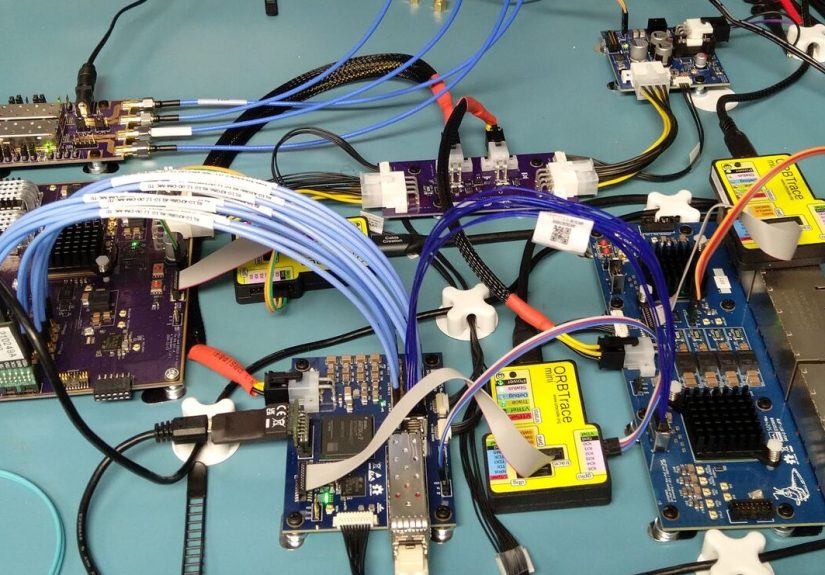
The fifth lesson is that the mechanical and power design deserve respect from day one. High-speed switches are not just logic diagrams; they are physical machines. Airflow, connector placement, cable bend radius, heat sinks, power sequencing, serviceability, and chassis layout affect whether the device can operate reliably. A bench prototype can survive with cables everywhere and a fan pointed at it like a nervous stagehand. A real switch needs discipline.
Finally, the most rewarding part is watching the first packets move through hardware you understand. Not through a sealed ASIC. Not through a mystery firmware blob. Through logic you can inspect, modify, and explain. That moment is why open-source high-speed Ethernet switching matters. It turns networking from an appliance into a craft.
Conclusion
Working on an open-source high-speed Ethernet switch is not the easiest path to more ports. Buying a commercial switch is faster, cheaper, and less likely to involve muttering at impedance calculators. But open switching offers something commercial hardware rarely provides: visibility. It lets builders explore the real machinery of Ethernet, from PHY links and FPGA datapaths to VLAN logic, packet buffers, and management software.
As open networking grows through projects such as SONiC, SAI, DENT, P4, NetFPGA, SatCat5, OCP, and Ultra Ethernet, the idea of a transparent switch becomes more realistic. The work is difficult, but the direction is exciting. The network does not have to be a black box forever. Sometimes, with enough patience, documentation, solder paste, and questionable optimism, it can be a purple PCB on a workbench pushing packets into the future.
Note: This article is written as original, publication-ready HTML body content based on real open networking concepts and publicly documented projects, without inserted source links or citation placeholders inside the article.