Table of Contents >> Show >> Hide
- 1. Raul Julia as M. Bison in Street Fighter
- 2. Uma Thurman as Poison Ivy in Batman & Robin
- 3. Alan Rickman as the Sheriff of Nottingham in Robin Hood: Prince of Thieves
- 4. Frank Langella as Skeletor in Masters of the Universe
- 5. Jim Carrey as the Riddler in Batman Forever
- 6. Margot Robbie as Harley Quinn in Suicide Squad
- 7. Gina Gershon as Cristal Connors in Showgirls
- 8. Robin Williams as Hunter Adams in Patch Adams
- 9. Denzel Washington as John Creasy in Man on Fire
- 10. Octavia Spencer as Sue Ann in Ma
- Why These Performances Still Matter
- 500 More Words on the Experience of Watching Great Performances in Bad Movies
Bad movies are a strange kind of miracle. They can waste huge budgets, flatten good scripts, bury promising ideas under digital sludge, and still somehow produce one genuinely electric performance. That is the weird magic of cinema: even when the movie itself is wobbling like a shopping cart with one busted wheel, a talented actor can still stroll in and behave as if they are starring in something destined for the Library of Congress. And honestly, bless them for it.
This list is for the actors who saved bad movies from total oblivion, or at least gave us one excellent reason not to change the channel. Some of these films were critically mauled. Some were commercially successful but artistically roasted like a marshmallow left too long over the fire. And some have since become cult favorites, which is just a fancy way of saying, “Yes, it’s a mess, but it’s our mess.” What ties them together is simple: these performances were the parts people remembered after the plot, pacing, and dialogue had gone down in flames.
If you love reading about the best performances in bad movies, the actors who almost single-handedly kept terrible films watchable, and those bizarre moments of great acting in bad films, welcome. Let’s celebrate the overachievers of cinematic chaos.
1. Raul Julia as M. Bison in Street Fighter
The glorious art of going all in
Street Fighter is the kind of movie that feels assembled during a sugar rush and edited during a fire drill. The plot is nonsense, the tone changes every five minutes, and half the cast seems to be in entirely different films. Then Raul Julia appears as M. Bison and suddenly the whole thing becomes weirdly alive. He does not treat the role like disposable camp. He treats it like Shakespeare in shoulder pads.
That is why his performance still towers over the movie. Julia gives Bison authority, wit, and just enough theatrical menace to make every scene snap into focus. He understood the assignment better than the movie understood itself. The result is one of the all-time classic examples of an actor refusing to phone it in. Street Fighter may be a notorious mess, but Julia makes it an entertaining mess, and that matters.
2. Uma Thurman as Poison Ivy in Batman & Robin
Camp queen in a neon disaster
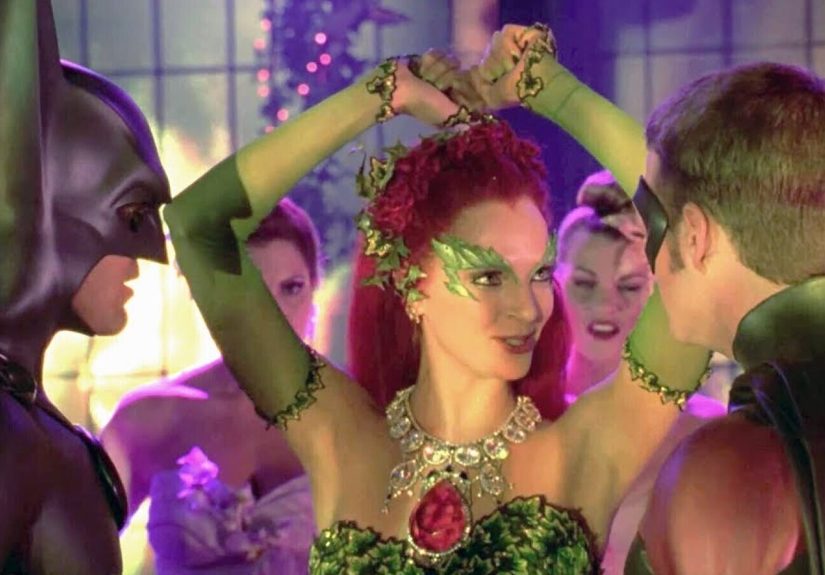
Batman & Robin is the cinematic equivalent of a toy aisle exploding. It is loud, frantic, overdesigned, and so drenched in puns it practically sweats chlorophyll. Yet Uma Thurman, draped in red hair and botanical wickedness, figures out exactly what movie she should be in and then plays that movie with total commitment. Everyone else is trapped in an expensive sugar coma. Thurman is having a ball.
Her Poison Ivy is flirtatious, arch, funny, and knowingly outrageous. She doesn’t merely chew the scenery; she turns it into compost. What makes the performance work is that Thurman never acts embarrassed by the material. She understands that camp only works when someone believes in it down to the last raised eyebrow. In a film still used as shorthand for franchise self-destruction, she remains the most deliciously watchable thing on screen.
3. Alan Rickman as the Sheriff of Nottingham in Robin Hood: Prince of Thieves
The villain who stole the whole movie
Robin Hood: Prince of Thieves wants to be a sweeping adventure, a romance, a war film, and a prestige epic all at once. It winds up feeling muddled, bloated, and occasionally allergic to charm. Alan Rickman, however, arrives with the cool precision of a man who knows that if the hero is drifting, the villain had better start sprinting.
Rickman’s Sheriff of Nottingham is hilarious, vicious, theatrical, and somehow more modern than the movie around him. He understands that the best villains are not just evil; they are entertaining. So while the film around him huffs and puffs under the weight of its own importance, Rickman slices through it with delicious contempt. His performance has become the thing most people remember because it deserves to be. He isn’t just the bright spot. He’s practically the only reason to revisit the film on purpose.
4. Frank Langella as Skeletor in Masters of the Universe
A serious actor in a gloriously silly costume
Masters of the Universe should have been a triumph of toy-based fantasy nonsense. Instead, it became a frequently mocked adaptation full of budget strain, awkward choices, and enough Earth-bound detours to make you wonder whether Eternia missed its flight. But Frank Langella, dressed as Skeletor and apparently fueled by pure professional pride, gives the role far more gravity than anyone had a right to expect.
He is not winking at the audience. He is not treating Skeletor as a joke. He plays him like a proper tyrant with wounded ego, operatic fury, and real screen presence. That sincerity is exactly what makes the performance memorable. When an actor meets absurd material with absolute conviction, the contrast becomes thrilling. Langella turns a potential punchline into an honest-to-goodness character, and that is no small feat when your face looks like Halloween with a union contract.
5. Jim Carrey as the Riddler in Batman Forever
When manic energy becomes the movie’s pulse
Batman Forever is not as catastrophically bad as its neon-soaked sequel, but it is still overstuffed, noisy, and far more interested in spectacle than coherence. Jim Carrey, though, attacks the Riddler with such caffeinated enthusiasm that he becomes the film’s real engine. The movie drags whenever it has to behave like a story. It wakes up again the second Carrey starts ricocheting around the frame.
What keeps the performance from collapsing under its own volume is that Carrey gives Edward Nygma a trace of sadness underneath all the glittering lunacy. He understands that comic-book villains work best when the madness grows out of bruised vanity and damaged ego. So yes, he is enormous here. But he is also precise. In a film stuffed with production design that screams louder than the characters, Carrey somehow screams louder than the production design and wins.
6. Margot Robbie as Harley Quinn in Suicide Squad
The star who escaped the wreckage
Suicide Squad had a killer trailer, a buzzy cast, and all the confidence of a movie that thought it had already won. Then audiences got a choppy, thinly written antihero pileup that never became as fun as it promised. The one performance that clearly survived the crash was Margot Robbie’s Harley Quinn. Even people who disliked the film tended to leave talking about her.
Robbie gave Harley danger, comedy, unpredictability, and a kind of cartoon-pop charisma that the rest of the movie badly needed. More importantly, she made Harley feel like a fully marketable, fully playable character rather than a collection of studio notes in fishnets. That is why the role outlived the film and spun off into stronger projects. Robbie found a pulse inside a movie that kept cutting its own wires, and that is exactly what actors who save bad movies do.
7. Gina Gershon as Cristal Connors in Showgirls
Sharp enough to survive the camp hurricane
Showgirls has spent decades bouncing between punchline, cult object, and reclaimed satire. Whatever your final verdict on the movie, Gina Gershon is impossible to ignore in it. While the film lurches between melodrama, exploitation, and accidental comedy, Gershon seems to understand every single one of those tones and weaponize them. She is funny, predatory, glamorous, and weirdly grounded at the same time.
Her Cristal Connors is the kind of performance that gets stronger the messier the movie becomes. Gershon never looks lost inside the excess. She looks like she runs it. That’s a big difference. In a film full of choices so large they need their own ZIP code, she makes the most controlled big choice of all: she plays the material straight enough to make the camp land harder. If you want a textbook case of a performer emerging from a critical debacle with reputation intact, here it is.
8. Robin Williams as Hunter Adams in Patch Adams
Heart, sincerity, and enough talent to almost overpower the syrup
Patch Adams is one of those movies that seems determined to squeeze every emotional button until the control panel falls off the wall. It is sentimental in giant spoonfuls, manipulative in places, and often so eager to inspire that it trips over itself. Robin Williams, however, brings exactly the kind of warmth and improvisational humanity that keeps the film from becoming completely unbearable.
Williams understood better than almost anyone how to mix clowning, compassion, and sadness in the same scene. That skill is what gives Patch Adams whatever emotional credibility it has. Without him, the movie likely collapses into pure mush. With him, it becomes at least intermittently moving. He supplies the empathy, spontaneity, and tenderness the script keeps trying to manufacture by force. In other words, the movie presses for tears, but Williams earns them the old-fashioned way: by being really, really good.
9. Denzel Washington as John Creasy in Man on Fire
A real character inside a hyper-stylized blur
Man on Fire has admirers, and fair enough, but critically it was often treated as an overcooked revenge thriller buried under relentless gloom and aggressive stylistic flourishes. Denzel Washington is the part that cuts through all that visual noise. He gives John Creasy a bruised, exhausted soul, which matters because otherwise the movie risks becoming little more than revenge with expensive editing.
Washington never treats Creasy as an action machine. He treats him as a wrecked human being who has run out of hope and then stumbles into one fragile reason to keep going. That emotional clarity gives the movie its center of gravity. Even when the film leans into excess, Washington stays locked on character. That steadiness is why people still defend the movie, or at least defend him in it. Great actors in bad films do not always save the whole enterprise, but they can absolutely rescue its emotional core.
10. Octavia Spencer as Sue Ann in Ma
The reason the movie became a whole vibe
Ma is a wonderfully odd case. It is not a complete disaster, but it is definitely the kind of uneven thriller that lives or dies on its lead performance. Luckily for everyone involved, that lead performance belongs to Octavia Spencer, who takes a pulpy revenge setup and turns it into something far more entertaining than the screenplay consistently deserves.
Spencer’s genius here is her control of tone. She can pivot from lonely to warm to terrifying with almost no visible effort. That unpredictability is what makes Sue Ann so unsettling and so fun to watch. The movie itself sometimes stalls, but Spencer never does. She gives Ma its meme power, its menace, and its identity. Without her, it is a forgettable thriller. With her, it becomes one of those movies people recommend with a grin that says, “Look, I’m not saying it’s good. I’m saying you need to see what she’s doing.”
Why These Performances Still Matter
The best actors who save bad movies do something quietly heroic: they remind us that film is never a single-person art form, but performance can still break through disaster. A bad script can flatten a story. Bad editing can wreck momentum. A confused tone can sink an entire production. Yet one committed actor can still create a character that outlives all of it.
That is why these performances endure. They are not just trivia answers or cult-favorite curiosities. They are proof that talent travels. Give a great performer weak material, and sometimes they can still carve out a memorable human being from the rubble. And honestly, there is something delightful about that. Greatness showing up in a bad movie feels rebellious. It feels like craft refusing to surrender. It feels like one actor standing in the middle of a cinematic food court and somehow cooking a five-star meal.
500 More Words on the Experience of Watching Great Performances in Bad Movies
There is a very specific joy in watching a bad movie that contains one truly excellent performance, and it is different from the joy of watching a genuinely great film. A great film sweeps you along. A bad film with one amazing actor makes you alert. You start leaning forward. You start noticing contrast. You start thinking, “Wait, why is this person acting like their rent, legacy, and possibly the fate of the republic depend on this scene?” That tension can be fascinating.
Part of the experience is that it makes the craft of acting more visible. In a well-made movie, everything supports everything else. The writing helps the performance, the editing sharpens it, the direction guides it, the score lifts it. But in a clunky movie, an actor has no such safety net. If they still manage to be compelling, you can practically see the skill at work. Timing becomes more obvious. Vocal choices become more obvious. Physical control becomes more obvious. You are no longer just enjoying a character. You are watching a performer build one under terrible conditions, like a master carpenter assembling a chair in the middle of an earthquake.
It also changes the way audiences remember movies. Plenty of bad films disappear completely, but the ones with standout performances hang around in the culture. They become recommendation bait. Somebody says, “No, no, the movie is rough, but you have to see what she’s doing in it.” That sentence alone has probably extended the shelf life of dozens of flawed films. It turns a critical failure into a curiosity, and a curiosity into a cult object.
There is also something oddly human about the whole thing. Movies fail for all sorts of reasons: bad scripts, studio interference, tonal confusion, budget issues, and the occasional deeply cursed decision no historian will ever fully explain. But a great performance inside a bad movie reminds us that effort is not evenly distributed. Somebody on that set was still trying to make art. Somebody still showed up with ideas, discipline, and nerve. Somebody looked at a ridiculous line of dialogue and thought, “Fine. I will make this work or die trying.” As viewers, we respond to that commitment because we recognize it. It feels like excellence under pressure, and that is always compelling.
Maybe that is the real reason these performances stick. They are not simply bright spots in terrible movies. They are evidence that good work matters even in messy circumstances. A bad movie can still contain intelligence, charisma, wit, danger, sadness, and grace if the right actor drags those qualities into the frame by sheer force of will. And for film lovers, that is catnip. It means no movie is completely hopeless. Somewhere in the wreckage, there might still be a performance worth applauding.