Table of Contents >> Show >> Hide
- How to Choose the Right Small Palm
- 17 Types of Small Palm Trees to Grow in Your Yard
- 1. Dwarf Palmetto (Sabal minor)
- 2. Scrub Palmetto (Sabal etonia)
- 3. Saw Palmetto (Serenoa repens)
- 4. Needle Palm (Rhapidophyllum hystrix)
- 5. European Fan Palm (Chamaerops humilis)
- 6. Lady Palm (Rhapis excelsa)
- 7. Pygmy Date Palm (Phoenix roebelenii)
- 8. Christmas Palm (Adonidia merrillii)
- 9. Bottle Palm (Hyophorbe lagenicaulis)
- 10. Spindle Palm (Hyophorbe verschaffeltii)
- 11. Cat Palm (Chamaedorea cataractarum)
- 12. Bamboo Palm (Chamaedorea seifrizii)
- 13. Parlor Palm (Chamaedorea elegans)
- 14. Buccaneer Palm (Pseudophoenix sargentii)
- 15. Mazari Palm (Nannorrhops ritchiana)
- 16. Arikury Palm (Syagrus schizophylla)
- 17. Windmill Palm (Trachycarpus fortunei)
- Best Uses for Small Palm Trees in a Yard
- Basic Care Tips for Small Palm Trees
- Practical Experiences Growing Small Palms in Real Yards
- Conclusion
- SEO Tags
Note: This list includes both true dwarf palms and compact palms that work well in smaller yards because they stay short, grow slowly, or keep a relatively narrow footprint. In other words, this is not a list of giant resort palms trying to squeeze into a townhouse patio like they pay the mortgage.
If you love the tropical look but do not have the space for a towering palm that blocks the gutters, leans over the driveway, and starts acting like the main character in your yard, small palm trees are the smart move. The best ones bring texture, movement, and a vacation vibe without swallowing the landscape. Some stay shrub-sized forever. Others mature into elegant little accents that fit neatly beside patios, pools, walkways, or foundation beds.
The trick is choosing the right small palm for your climate and your layout. A palm that behaves beautifully in coastal South Florida may throw a dramatic meltdown after one cold snap in a Zone 8 backyard. On the other hand, a cold-hardy palm that laughs at winter may prefer a more restrained, almost architectural role instead of a lush, tropical one. That is why size, sun exposure, soil drainage, and cold tolerance matter just as much as looks.
Below, you will find 17 types of small palm trees to grow in your yard, along with what makes each one useful, where it shines, and what to watch for before you plant. Whether you want a clumping palm for privacy, a fan palm for structure, or a feather palm that softens hardscape like magic, there is a good match here.
How to Choose the Right Small Palm
Before you fall in love with the first feathery frond you see, think about your site. Small palms for yards generally fit into one of three categories: trunkless or near-trunkless palms that behave like shrubs, compact single-trunk palms that stay under about 10 to 15 feet, and taller but narrow palms that still work in tight spaces because they do not spread aggressively. A good choice depends on whether you need screening, a specimen plant, or something that simply says, “Yes, this yard has style.”
Also pay attention to maintenance. Many palms hate being over-pruned, and they are not thrilled when treated like lawn ornaments that get hacked every season. Good drainage, the right palm fertilizer, and proper placement will usually matter more than constant trimming. Translation: choose wisely now, and your future self gets fewer yard regrets later.
17 Types of Small Palm Trees to Grow in Your Yard
1. Dwarf Palmetto (Sabal minor)
Dwarf palmetto is one of the best small palms for gardeners who want real cold tolerance. It usually stays low, often looking almost trunkless, with fan-shaped leaves that create a tidy, lush clump. Because it handles moisture better than many palms, it works well in rain gardens, woodland edges, and spots where the soil is not bone-dry all year.
This is a great pick for Southern gardeners who want a native look without planting something enormous. It feels subtle, not flashy, which can actually be a blessing in a smaller landscape.
2. Scrub Palmetto (Sabal etonia)
Scrub palmetto is another compact native option, especially appealing if you want a small palm with a natural, Florida-friendly personality. It tends to stay low and shrub-like, making it useful near walkways, xeric beds, and sunny borders where a full-sized palm would be way too much.
Its compact size makes it easy to tuck into dry, sandy landscapes. Think of it as the quiet minimalist of the palm world.
3. Saw Palmetto (Serenoa repens)
Saw palmetto brings dramatic texture, especially the silver-blue forms that practically glow in sunlight. It spreads more than it rises, so it is excellent for broad planting beds, wildlife gardens, and informal coastal landscapes. In the right setting, it looks rugged and beautiful at the same time.
Just remember that this palm likes room to stretch. In a tiny front bed, it may behave like a guest who stayed for brunch and then moved in permanently.
4. Needle Palm (Rhapidophyllum hystrix)
If you live where winters are a little too real for tropical plants, needle palm deserves your attention. It is widely considered one of the most cold-hardy palms available, yet it stays compact and shrubby. The deep green fan leaves give it a rich, lush appearance, especially in partial shade.
This palm is perfect for sheltered courtyards, woodland-style gardens, and small yards in the Upper South where a tropical look usually seems impossible.
5. European Fan Palm (Chamaerops humilis)
European fan palm is one of the most versatile small palms for residential landscapes. It usually grows as a clump with multiple trunks, creating a sculptural form that works beautifully near patios, entryways, and gravel gardens. It has a classic Mediterranean vibe and tolerates heat, sun, and a bit of drought once established.
If you want a palm with structure and personality, this one delivers. It is tidy enough for formal design but not so stiff that it feels boring.
6. Lady Palm (Rhapis excelsa)
Lady palm is a refined, shade-loving choice with dark green fan leaves and slender stems. It grows in dense clumps, which makes it useful as a foundation plant, a potted accent, or even a soft privacy screen in protected spaces. The texture is elegant rather than wild, so it pairs nicely with more polished landscapes.
For small courtyards and side yards that receive filtered light, lady palm is a strong candidate. It looks expensive even when your budget is firmly “garden center clearance cart.”
7. Pygmy Date Palm (Phoenix roebelenii)
Pygmy date palm is one of the most popular small palms for front yards, pool areas, and entry gardens. It has a graceful single trunk, arching feather-like fronds, and a delicate silhouette that softens hard lines in the landscape. Mature plants often stay in a manageable size range, making them especially appealing for smaller homes.
Be aware of the spines near the leaf bases. It is gorgeous, but it has boundaries.
8. Christmas Palm (Adonidia merrillii)
Christmas palm is a slender, attractive palm that earns its name from the bright red fruit that appears around the holiday season. It is often planted in groups of two or three for a fuller effect, and it works especially well in tropical and subtropical yards where space is limited but style still matters.
It is not a dwarf in the strictest sense, yet it is still far smaller and more manageable than many classic landscape palms.
9. Bottle Palm (Hyophorbe lagenicaulis)
Bottle palm is a conversation starter, mostly because its swollen trunk looks exactly like somebody sketched a palm after one too many beach cocktails. It stays relatively small for a long time and makes a strong sculptural accent near patios, courtyards, and modern tropical plantings.
This palm loves warmth and good drainage. In colder areas, it is often best treated as a container specimen that can move under protection when temperatures dip.
10. Spindle Palm (Hyophorbe verschaffeltii)
Spindle palm is closely related to bottle palm but has a trunk that bulges more in the middle than at the base. The result is a sleek, unusual silhouette that feels almost designer-made. It works best as a specimen where the shape can be appreciated up close.
Like bottle palm, it is best suited to frost-free or nearly frost-free climates. In warm coastal yards, though, it can look absolutely stunning.
11. Cat Palm (Chamaedorea cataractarum)
Cat palm is a lush, mounding palm that behaves more like a tropical shrub than a tiny tree. It forms dense clumps of glossy, feather-like leaves and is excellent for softening foundations, framing patios, or making a low privacy screen in part shade.
If your yard has a warm, protected corner that feels too empty, cat palm can fill that space with instant tropical energy without turning into a giant maintenance project.
12. Bamboo Palm (Chamaedorea seifrizii)
Bamboo palm has slender, cane-like stems and a light, airy appearance that works beautifully in shady or filtered-light landscapes. It can be grown as a hedge, a screening plant, or an accent in narrow spaces where bulkier shrubs would feel heavy.
Because of its upright clustering habit, bamboo palm is especially useful when you want privacy but do not want your yard to feel walled in.
13. Parlor Palm (Chamaedorea elegans)
Most people know parlor palm as a houseplant, but in frost-free climates it can also work outdoors in shady garden spaces. It stays compact, usually with a neat, upright habit, and brings a soft, old-school elegance to patios and small courtyard plantings.
It is not the palm for blazing sun and reflected heat. Give it shelter, rich soil, and a little dignity, and it will reward you with understated charm.
14. Buccaneer Palm (Pseudophoenix sargentii)
Buccaneer palm is slow-growing, striking, and ideal for coastal or tropical landscapes where a smaller specimen palm is needed. It has a gray trunk, a handsome crownshaft, and silvery-toned leaves that give it a clean, upscale look. Because it grows slowly, it remains useful in smaller landscapes for many years.
This is a great choice if you want something distinctive without planting a monster palm that takes over the skyline.
15. Mazari Palm (Nannorrhops ritchiana)
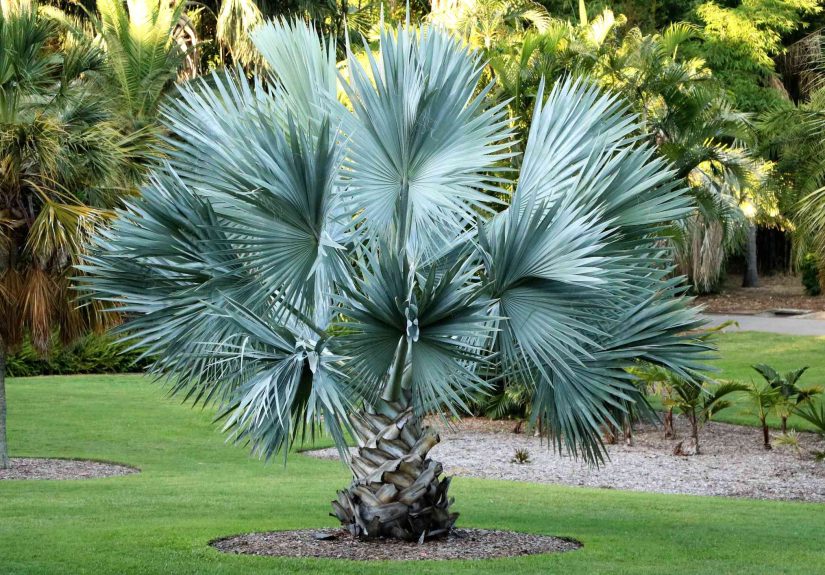
Mazari palm is one of the more unusual choices on this list, and that is part of the appeal. It has branching trunks and blue-green fan leaves that create a dry-climate, almost desert-modern feel. It is also notable for excellent cold tolerance compared with many tropical-looking palms.
For gravel gardens, xeriscapes, and sunny courtyards, Mazari palm can be a real design flex.
16. Arikury Palm (Syagrus schizophylla)
Arikury palm is a smaller feather palm with an upright form and a more restrained footprint than larger relatives in the same group. It is useful as a specimen near driveways, pool decks, and small lawn panels where you want the feather-palm look without going full boulevard resort.
Its compact form makes it a smart choice for gardeners who want something elegant but not oversized.
17. Windmill Palm (Trachycarpus fortunei)
Windmill palm is the tallest plant on this list, but it still earns a spot because it keeps a relatively narrow footprint and offers excellent cold tolerance for a palm. In small yards, that combination matters. You get real height and drama without a massive canopy.
If you want a palm that reads “tropical” from across the street but can handle cooler conditions better than many warm-climate species, windmill palm is one of the best compromises available.
Best Uses for Small Palm Trees in a Yard
Small palms are more flexible than people think. Clumping types like cat palm, bamboo palm, and lady palm work well as privacy screens, patio softeners, or poolside greenery. Trunkless natives like dwarf palmetto and saw palmetto are perfect for naturalistic plantings, low-maintenance borders, and wildlife-friendly spaces. Specimen palms such as bottle palm, spindle palm, and buccaneer palm shine when given a little breathing room and a supporting cast of lower shrubs or groundcovers.
In tight spaces, palms often look best when repeated with intention instead of planted as random one-offs. A pair of pygmy date palms can frame an entry beautifully. A group of Christmas palms can create instant vertical rhythm. A drift of scrub palmetto or saw palmetto can make a sunny bed feel curated instead of chaotic.
Basic Care Tips for Small Palm Trees
Most small palms prefer well-drained soil and hate standing in water unless they are one of the species known to tolerate wetter conditions. Plant them at the right depth, water regularly while they establish, and then adjust irrigation based on species and weather. Warm-climate palms generally need protection from severe cold, while cold-hardy palms still appreciate shelter from harsh winter wind.
Do not over-prune. Removing green fronds too early can weaken palms and make nutrient problems worse. Feed landscape palms with a fertilizer formulated for palms rather than relying only on turf fertilizer. And please, resist the urge to “hurricane cut” every palm into a sad pineapple shape. Your palm did not ask for that haircut.
Practical Experiences Growing Small Palms in Real Yards
One reason small palm trees remain so popular is that they solve a problem many homeowners run into after the first burst of landscaping enthusiasm: a yard that looked roomy on paper suddenly feels very small once every shrub, chair, stepping stone, and garden bed is in place. In those situations, small palms do something special. They add height without overwhelming the ground plane, and they create a tropical or coastal mood without demanding the footprint of a giant shade tree.
Gardeners often discover that the most successful small palms are the ones that match the yard’s personality instead of fighting it. In a compact suburban front yard, a pygmy date palm near the porch can feel elegant and welcoming. In a more natural side yard, dwarf palmetto or needle palm can look like they belong there, as if the site quietly made the choice on its own. In a modern courtyard, bottle palm or Mazari palm can bring exactly the right amount of drama without turning the design into a theme park.
Another common experience is learning that “small palm” can mean very different things. Some homeowners expect every palm on a small-yard list to stay under six feet forever. Then they meet a Christmas palm or windmill palm and realize that compact by palm standards does not always mean tiny. The good news is that many of these species still work because their form is controlled, upright, or slow-growing. That distinction matters. A plant can be taller than expected and still be appropriate if it does not spread like crazy or crowd every other feature in the landscape.
Shade is another real-world lesson. Many people assume palms want relentless sun, but several of the best small options actually look better with protection from harsh afternoon heat. Lady palm, cat palm, bamboo palm, and parlor palm often perform best where the light is softer. In practice, that makes them useful for awkward spaces most plants struggle with, such as courtyards between walls, side yards with filtered light, or patios shaded by larger trees.
Homeowners also tend to notice how much texture palms add. Even when a yard is not large, a mix of fan palms and feather palms can create layers that make the space feel more designed. A clumping palm near a fence softens the boundary. A single sculptural palm near a path creates a focal point. A low native palm at the front of a bed can tie everything together and keep the planting from looking top-heavy.
Perhaps the biggest experience-based takeaway is that small palms reward patience. They may not always explode with growth the first season, but once established, the right palm often becomes one of the most dependable, visually valuable plants in the yard. It does not need weekly fussing. It does not drop piles of petals. It does not demand constant shaping. It simply stands there looking polished, tropical, and slightly smug about how good it looks with so little effort.
Conclusion
The best small palm trees for your yard are the ones that fit your climate, your available light, and the scale of your landscape. If you want native toughness, start with dwarf palmetto, scrub palmetto, saw palmetto, or needle palm. If you want elegance in shade, look at lady palm, cat palm, bamboo palm, or parlor palm. If you want a bold specimen for a warm climate, bottle palm, spindle palm, buccaneer palm, or Christmas palm can deliver serious style without becoming backyard bullies.
Choose carefully, plant thoughtfully, and let the palm do what it does best: make even an ordinary yard feel a little more relaxed, a little more polished, and a lot more interesting.