Table of Contents >> Show >> Hide
- Before You Build: What a Good Praying Mantis Habitat Needs
- Way 1: Make a Simple Indoor Observation Habitat
- Way 2: Build a Planted Praying Mantis Terrarium
- Way 3: Create an Outdoor Garden Habitat for Wild Mantises
- Common Mistakes to Avoid
- Which Praying Mantis Habitat Is Best?
- Experiences People Commonly Have When Making a Praying Mantis Habitat
If you have ever looked at a praying mantis and thought, “You look like a tiny alien ninja who pays rent in leaves,” you are not alone. Mantises are some of the most fascinating insects in the world. They are ambush predators, camouflage experts, and surprisingly elegant little weirdos. They also have very simple needs compared with many other pets or garden visitors. That makes building a praying mantis habitat both fun and realistic, whether you want a short-term observation setup indoors or a long-term outdoor space that encourages wild mantises to show up on their own.
The trick is not making the habitat fancy. The trick is making it functional. A mantis needs secure climbing space, airflow, room to molt safely, access to moisture, and a steady supply of prey. Outdoors, it needs the same big-picture essentials: food, water, cover, and places to lay eggs or hide. If you skip those basics and focus only on “cute terrarium aesthetics,” your mantis may end up living in what amounts to a stylish disaster condo.
In this guide, you will learn three practical ways to make a praying mantis habitat: a simple indoor observation home, a planted terrarium setup, and an outdoor garden habitat that supports local mantises naturally. Along the way, you will also learn what to avoid, how to keep the enclosure safe, and why “more bugs in the garden” is not always the gardening apocalypse people think it is.
Before You Build: What a Good Praying Mantis Habitat Needs
Before choosing a setup, it helps to understand what mantises actually need. First, they need vertical space. Praying mantises climb, hang upside down, and rely on that height when they molt. A cramped habitat can cause failed molts, which is one of the biggest problems in captivity. Second, they need ventilation. Stale, damp air can encourage mold, and a mantis habitat should never feel like a steamy little greenhouse with no exit plan.
Third, mantises need structure. Twigs, stems, and branches give them places to perch, rest, hunt, and hang while shedding their exoskeleton. Fourth, they need species-appropriate moisture and temperature. Some common pet mantises tolerate average indoor conditions pretty well, while others need more precise humidity. Fifth, mantises do best alone. They are not roommates. They are not brunch friends. They are territorial predators, and if you keep more than one together, the odds of “surprise cannibalism” go up fast.
Outdoors, the rules are similar, just stretched over a larger space. A healthy mantis habitat includes plants that attract prey insects, sheltered areas for resting and hunting, access to shallow water, and fewer broad-spectrum pesticides. It is also smart to support the mantises already living in your region rather than importing nonnative egg cases that may not belong in your local ecosystem.
Way 1: Make a Simple Indoor Observation Habitat
Who this setup is best for
This is the easiest option for beginners, students, families, and anyone who wants to observe a single mantis indoors without building a full-blown insect penthouse. It works especially well for short-term care, classroom observation, or a starter setup while you learn your mantis’s habits.
What you need
- A tall jar, plastic insect container, or small terrarium with a secure mesh lid
- One or two sturdy twigs that reach near the top
- Light décor only, so the mantis can move and molt safely
- A way to mist lightly
- Live feeder insects sized appropriately for the mantis
How to set it up
Start with a container that is taller than it is wide. Mantises do not need a mansion, but they do need height. If the enclosure is too short, molting becomes risky. If it is too huge, a smaller mantis may struggle to find its prey. Add a few branches or twigs that reach almost to the top. These give the mantis a place to climb and a safe hanging point during molts.
Make sure the lid is ventilated and secure. Mantises are surprisingly capable climbers, and an insecure lid is basically an invitation to vanish behind your bookshelf and begin a new mysterious life. Keep the inside uncluttered. You want enough structure for perching, not so much jungle décor that feeding becomes difficult. Place the habitat in a bright room but out of harsh direct sun, which can overheat a small container quickly.
Mist lightly as needed for your species so the mantis can drink water droplets and the enclosure does not become bone-dry. Feed only live prey that is the right size. Tiny nymphs may do best with fruit flies or similarly small insects, while larger mantises can handle flies, moths, or appropriately sized crickets. Remove uneaten prey if it is stressing the mantis, especially during premolt periods when the insect may stop eating for a bit.
Why this method works
A simple observation habitat strips mantis care down to the essentials. It gives you the right balance of airflow, height, and visibility without requiring much maintenance. It also teaches the most important lesson in mantis care: these insects do not need constant handling or a lot of “entertainment.” They mostly need a secure place to hang out, ambush food, and continue being weird in peace.
Way 2: Build a Planted Praying Mantis Terrarium
Who this setup is best for
This option is great for people who want a habitat that looks more natural and stays visually appealing on a desk, shelf, or plant stand. It is also a strong choice if you enjoy terrarium design and want something beyond “jar with stick,” while still keeping the setup practical for mantis care.
What you need
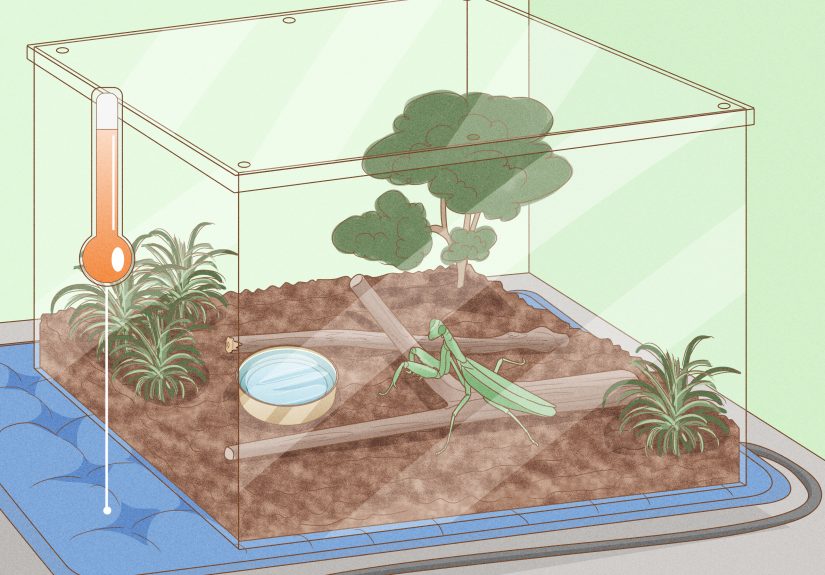
- A tall glass or acrylic terrarium with strong ventilation
- One to two inches of moisture-managing substrate
- Twigs, cork bark, or branches for climbing
- One small live plant or a few artificial plants
- A shallow water option with pebbles, or regular misting
- A thermometer and humidity awareness for your species
How to set it up
Begin with the same principle as the simple setup: height first. Then build out the lower level with a light substrate that helps hold some moisture without staying soggy. Add a few upright branches and one plant for cover and visual realism. The biggest mistake people make here is overcrowding the terrarium. A mantis is a hunter, not a tourist in a theme-park rainforest. It needs open space to move, spot prey, and molt cleanly.
Use plants carefully. A single small potted plant or a thoughtfully placed artificial plant can make the terrarium look natural and provide cover. Too many leaves, however, can make feeding harder and reduce airflow. Your goal is “naturalistic,” not “lost in a salad.” If you use a water dish, make it very shallow and add pebbles or sponge material so the mantis is not dealing with a miniature drowning hazard. Many keepers rely mostly on light misting and droplets on surfaces.
Monitor humidity and temperature based on species rather than guessing. Some common mantises do fine under ordinary indoor conditions with gentle misting, while others need tighter control. Watch the enclosure for condensation, stagnant moisture, or mold. A good planted terrarium should feel fresh and lightly humid, not swampy. If it starts looking like a weather system, dial it back.
Why this method works
A planted mantis terrarium does two useful things at once. It supports the physical needs of the insect while also mimicking the camouflage-rich environment mantises prefer. Because these insects use stillness and disguise as hunting tools, a more natural enclosure often allows you to observe more interesting behavior. You start to notice how they choose perches, angle themselves near light, and position their bodies for ambush. In other words, your bug apartment becomes a bug theater.
Way 3: Create an Outdoor Garden Habitat for Wild Mantises
Who this setup is best for
This is the best approach if you want to support praying mantises naturally in your yard, garden bed, balcony container garden, or school landscape. It is also the smartest long-term choice for people who prefer observation over captivity.
What you need
- A sunny growing area with a mix of native plants
- Flowers, shrubs, grasses, and vertical stems
- A shallow water source with stones for safe access
- An undisturbed corner with sticks, stems, or a small brush pile
- Patience and a lighter hand with pesticide use
How to set it up
Start by planting a diverse mix of native flowers, shrubs, and grasses. Diversity matters because different insects use different plant shapes, heights, and bloom times. A yard with varied plant life is more likely to attract the flies, moths, bees, and other insects that mantises hunt. Add structure too: ornamental grasses, seed heads, branching stems, and shrubs give mantises places to hide and hunt.
Next, add water. It does not need to be a dramatic koi pond worthy of a grand estate. A shallow dish, birdbath, tiny fountain, or simple water feature with stones for footing can help create a more complete habitat. Place it where it stays reasonably clean and refill it regularly. Then create cover. A quiet patch of stems, leaf litter, or a small brush pile gives insects shelter and makes the space feel more alive overall.
Most important, ease up on broad-spectrum insecticides. If you kill everything, you eliminate the mantis buffet along with the mantis. A better strategy is to tolerate a little insect activity and let the garden reach a more natural balance. Mantises are predators, but they are generalists. They will eat some pests, yes, but they will also eat beneficial insects. So think of them as part of a larger habitat web, not as a tiny hired exterminator in a green suit.
If you spot an egg case, or ootheca, on a twig or stem in fall or winter, leave it in place whenever possible. That is next season’s mantis generation waiting for spring. If you must move it, handle it gently and keep it in appropriate seasonal conditions rather than bringing it into artificial warmth too early. Also, skip the urge to buy and release random mantis egg cases online unless you are certain they are appropriate for your area. Supporting local populations is usually the more responsible route.
Why this method works
An outdoor praying mantis habitat works because it is not really “for mantises only.” It is a broader beneficial-insect and wildlife habitat. When you add native plants, water, vertical structure, and shelter while reducing pesticide pressure, you build a space where mantises can hunt, hide, and reproduce naturally. You also support birds, pollinators, and other helpful insects. It is the ecological version of setting a table and then being pleasantly surprised by the guest list.
Common Mistakes to Avoid
Making the enclosure too short: Mantises need room to hang during molts. Height is not optional.
Keeping more than one mantis together: This is a fast track to having fewer mantises than you started with.
Overcrowding the habitat: Too many plants, decorations, or branches can block hunting paths and create humidity problems.
Using pesticides in an outdoor habitat: A “clean” insect-free yard is not mantis-friendly. It is mantis-starvation-friendly.
Expecting mantises to solve every pest problem: They are helpful predators, but not precision tools. A healthy garden depends on diversity, not one dramatic insect with attitude.
Which Praying Mantis Habitat Is Best?
If you want something easy and educational, go with the simple indoor observation habitat. If you want beauty plus function, build a planted terrarium. If you want the most sustainable and natural option, create an outdoor habitat with native plants, shelter, and water. None of these methods is “the one perfect answer.” The best praying mantis habitat is the one you can maintain consistently and safely.
That is the real secret. Mantises do not need luxury. They need the right conditions. Give them height, airflow, structure, moisture, and food, and they do the rest. Usually while staring at you like they know something you do not.
Experiences People Commonly Have When Making a Praying Mantis Habitat
One of the most common experiences people have when building a praying mantis habitat is realizing that mantises are much more delicate than they first appear. At a glance, they look fierce and armored, like little insect gladiators. But once you actually care for one, especially during a molt, you quickly understand how much their success depends on simple details like height, airflow, and not being disturbed at the wrong moment. Many beginners start out thinking the enclosure should be packed with leaves, bark, moss, and tiny decorations. Then they watch the mantis struggle to move around or fail to catch food easily, and they discover that a cleaner, taller setup often works better.
Another very common experience is how attached people become to an insect they originally planned to “just observe for a few days.” A praying mantis has a way of turning casual curiosity into full-blown fascination. People start noticing favorite perches, hunting patterns, and quirky behaviors. Some mantises sit in one spot for hours like a green philosopher thinking about taxes. Others patrol their enclosure like they are late for a meeting. The more natural the habitat feels, the more of this behavior you get to see, and that is often what makes the project so rewarding.
People who build outdoor mantis habitat spaces usually report a different kind of experience: surprise. They may start by planting native flowers for pollinators and only later notice that mantises have moved in on their own. Suddenly there is one hanging from a zinnia, another tucked into ornamental grass, and an egg case attached to a stem they almost cut down. That moment changes the way many gardeners see their yard. It stops being a decorative space and starts feeling like a functioning ecosystem.
There is also the lesson of patience. A mantis habitat does not become interesting because you constantly interfere with it. It becomes interesting because you let it settle. Indoors, that means resisting the urge to handle the mantis too much. Outdoors, it means tolerating a little mess, a few chewed leaves, and some insect activity. People often find that once they stop trying to control every inch of the habitat, more life shows up. That can be a surprisingly satisfying shift in mindset.
Finally, many people come away from the experience with a new respect for “small wildlife.” A praying mantis habitat may seem like a tiny project, but it teaches big ideas: how predators fit into the food web, why native plants matter, how water and shelter shape biodiversity, and why not every useful creature looks cute and fuzzy. Sometimes conservation begins with a forest. Sometimes it begins with a bug on a stick in a jar by the window. Both count.

![18 Best Types of Charts and Graphs for Data Visualization [+ How to Choose]](https://corkopencoffee.org/wp-content/uploads/2026/05/18-best-types-of-charts-and-graphs-for-data-visualization-how-to-choose-qKM1PBYG-thumb.jpg)