Table of Contents >> Show >> Hide
- Why 2014 Wall Calendars Still Matter
- Favorite #1: Red Star Ink 12 Month Wall Calendar
- Favorite #2: Postalco One-Year Wall Calendar
- Favorite #3: Ige’s Two Thousand Fourteen Calendar
- Favorite #4: Amy Marcella’s 2014 Wall Calendar
- Favorite #5: Snug Studio’s Graphical Wall Calendar
- What These 2014 Favorites Got Right
- How to Use a Wall Calendar Without Making Your Home Look Like a Break Room
- The Experience of Living With a Great Wall Calendar
- Final Thoughts
- SEO Tags
There was something delightfully specific about the great wall calendars of 2014. They were not trying to be apps. They were not begging to sync with six devices, two family accounts, and that one mystery Gmail address nobody remembers creating. They just hung there, looked handsome, and quietly kept life from sliding into chaos. In a moment when phones were getting smarter by the week, the best 2014 wall calendars offered a gentle rebuttal: maybe what people wanted was not more digital noise, but a beautifully designed square of paper that could hold birthdays, deadlines, dinner plans, and the occasional passive-aggressive reminder to buy toilet paper.
That is what makes revisiting 2014 wall calendars so charming. The best ones were practical, yes, but they were also deeply decorative. They had the confidence to act like design objects. Some were printed on recycled stock and built for busy households. Some looked like gallery posters you could justify buying because, technically, they were organizational tools. Some leaned into clean typography. Others used watercolor, cotton cloth, or subtle geometry to turn the passing of time into something tactile and oddly comforting.
Looking back now, the most memorable 2014 wall calendars share one quality: they understood that good design can make routine feel less routine. Crossing out Tuesday is not glamorous. But crossing out Tuesday on a gorgeous calendar? That is practically self-care with better kerning.
Why 2014 Wall Calendars Still Matter
Wall calendars have always lived at the crossroads of function and style, but the 2014 crop felt especially thoughtful. Designers and small studios were treating calendars less like throwaway office supplies and more like objects worth living with for an entire year. That meant better paper, stronger layouts, smarter proportions, and visuals that could hold their own on a kitchen wall, in a home office, or beside an entryway coat rack that had seen things.
In hindsight, that design-minded approach helped 2014 calendars age unusually well. Even when the dates expired, many of them still looked good enough to frame, save, or repurpose. A calendar became a keepsake, a poster, or a small record of how daily life moved through the year. Scribbles in the margins turned into accidental time capsules. That dentist appointment, that canceled brunch, that first day at a new job, that random note about ordering paint samplesall of it stayed visible in a way digital calendars rarely preserve with any warmth.
So instead of treating this as a dusty roundup of old paper goods, it makes more sense to see these favorites as a snapshot of a bigger design mood: analog, useful, visually disciplined, and just a little romantic.
Favorite #1: Red Star Ink 12 Month Wall Calendar
The one for real life
If there is a patron saint of households trying to keep it together, it may very well be the Red Star Ink 12 Month Wall Calendar. This design had the kind of no-nonsense clarity that busy people adore. One month per page, clean structure, room for notes, and enough visual restraint to keep the wall from looking like a school fundraiser exploded.
What made it special was not flashy decoration. It was discipline. The layout gave users space to actually write things down, which seems obvious until you meet a beautiful-but-useless calendar with boxes the size of postage stamps. Red Star Ink understood that a wall calendar should work as hard as the people using it. It also carried an eco-conscious sensibility, with recycled materials and handmade production adding a layer of purpose to the design.
This was the calendar for families, freelancers, and anyone whose week could derail because they forgot a parent-teacher meeting or promised to bring cookies to something they definitely should not have promised to bring cookies to. It did not try to reinvent organization. It simply made organization look better.
Favorite #2: Postalco One-Year Wall Calendar
The one for big-picture thinkers
The Postalco One-Year Wall Calendar took a different approach: show the entire year at once and let the eye do the work. This year-at-a-glance format had a refreshing honesty. No pretending that life is only manageable one month at a time. Here was the whole year, all 365 days in view, ready to expose how quickly summer disappears and how recklessly we all overbook October.
Visually, Postalco nailed the sweet spot between utilitarian and elegant. The calendar felt almost architectural. It had the kind of measured simplicity that makes designers go quiet for a second and nod. Large enough to be useful, restrained enough to feel calm, it was built for long-term planning, not daily clutter. You could map trips, deadlines, launches, school terms, and major personal events without constantly flipping pages or losing the thread.
This is the sort of calendar that appeals to people who enjoy seeing time spatially. It turns planning into pattern recognition. A hectic spring becomes visible. A free August opens up like a gift. A project timeline no longer feels abstract because it is literally staring at you from the wall while you eat toast. Postalco’s genius was making that clarity feel graceful instead of stern.
Favorite #3: Ige’s Two Thousand Fourteen Calendar
The one that blurred the line between calendar and keepsake
Some calendars are tools. Some are decor. Ige’s Two Thousand Fourteen Calendar decided to be both and then casually added textile art to the conversation. Printed on matte black cotton cloth, it brought softness and permanence to a category usually dominated by paper. The result felt unusual in the best waygraphic, tactile, and a little ceremonial.
This was not the kind of calendar you pin up and forget about. It invited attention. The cotton material gave it depth, while the included tack used to mark the date introduced a more interactive, almost ritualistic experience. Instead of tearing off pages or flipping months, you physically moved through time. That made the act of checking the date feel less mechanical and more deliberate.
There is also something charmingly emotional about a calendar made from cloth. Paper calendars often get recycled without a second thought once December ends. A cotton calendar, by contrast, feels like an object you might fold away and keep. It makes sense that it was pitched as a possible keepsake for a wedding year or the birth of a baby. In that context, the calendar becomes more than a schedule. It becomes evidence that a particular year mattered.
Favorite #4: Amy Marcella’s 2014 Wall Calendar
The one for people who wanted art first, dates second
Amy Marcella’s 2014 Wall Calendar leaned into illustration without losing usefulness. Featuring original black watercolor imagery with botanicals and geometric motifs, it had the soul of an art print and the quiet utility of a monthly planner. For anyone bored by bland grids and corporate-looking layouts, this was the antidote.
The charm of the calendar came from contrast. Watercolor can be soft and dreamy, but black watercolor creates mood, shape, and a stronger graphic edge. That balance made the artwork feel modern rather than precious. It could live in a home office, yes, but also in a bedroom, studio, or hallway where people would actually pause to look at it.
It also speaks to a broader 2014 trend: illustrated calendars that people bought as much for beauty as for planning. In an era full of mass-produced sameness, small-batch illustrated paper goods felt personal. They suggested a maker’s hand. They looked chosen, not grabbed at checkout beside a pack of batteries and a crisis candy bar.
If Red Star Ink was the practical favorite and Postalco was the strategic favorite, Amy Marcella’s calendar was the emotional favoritethe one that made keeping track of the month feel a little more poetic.
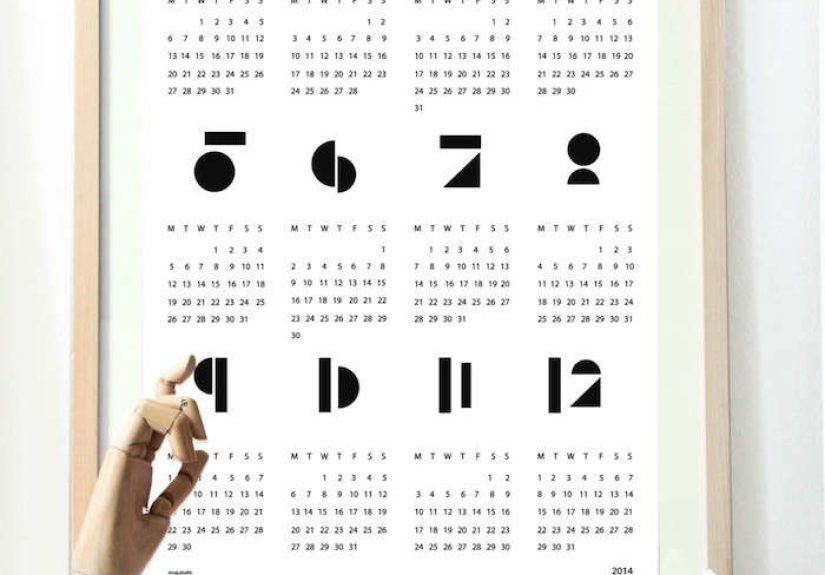
Favorite #5: Snug Studio’s Graphical Wall Calendar
The minimalist’s dream
Minimalism can go wrong in two ways: it can become sterile, or it can become smug. Snug Studio’s Graphical Wall Calendar avoided both. Its black type, geometric sensibility, and restrained palette delivered exactly what good minimalist design should: clarity with personality.
Available in white or soft pink, the calendar had enough warmth to feel decorative without slipping into fussiness. It was simple, yes, but not plain. The graphic treatment gave it rhythm. The typography carried weight. And the overall composition felt frameable, which is basically the highest compliment you can pay a calendar without sounding like you have a suspiciously intense relationship with paper products.
This design captured one of the smartest ideas of the era: a wall calendar can serve as a seasonal visual anchor in a room. Hang it above a desk or a narrow console, and suddenly it works like art with deadlines. It keeps you oriented in time while also helping the space feel more finished. Snug Studio understood that people wanted utility, but they also wanted a wall piece they would not be embarrassed to photograph for Instagram.
What These 2014 Favorites Got Right
Taken together, these five wall calendars reveal what made the best 2014 designs memorable. First, they respected materials. Recycled paper, heavyweight stock, cotton cloth, and thoughtful finishes turned calendars into tactile objects rather than disposable sheets. Second, they respected the wall. Instead of looking like office leftovers, they looked intentional in domestic spaces. Third, they respected the user. There was enough room to write, enough order to read quickly, and enough beauty to make repeated use feel pleasant.
That combination matters because the home calendar has always done double duty. It is a planning tool, but it is also a social object. People see it. Family members add to it. Guests glance at it. Children learn from it. Partners negotiate around it. It lives in shared space, which means it needs to be legible and attractive. The best 2014 calendars understood this perfectly.
They also embraced analog ritual in a way that feels almost luxurious now. There is a small satisfaction in turning a page, circling a date, pinning a note, or seeing the month physically change on the wall. It is slower than a phone notification, but that slowness is the point. A wall calendar asks you to notice time instead of just reacting to it.
How to Use a Wall Calendar Without Making Your Home Look Like a Break Room
The easiest way is to treat the calendar like decor, not an afterthought. A design-forward wall calendar works beautifully above a compact desk, in a kitchen command center, or near the entry where shoes pile up and intentions go to die. Choose one with strong typography or artwork, give it breathing room, and let it function as part of the room’s visual structure.
It also helps to edit what goes on it. The most elegant calendars become chaotic if every square is crammed with three pen colors, two arrows, and a dramatic all-caps note that simply says CALL LINDA. Use a consistent marker or pen, reserve symbols for recurring tasks, and let blank space do some of the design work. The prettiest calendar in the world cannot save handwriting that looks like a seismograph.
And if you are lucky enough to find an old wall calendar with especially strong graphics, do not be too quick to toss it after the year ends. Many of the best 2014 editions were essentially portfolios in disguise. Individual pages can be framed, archived, or repurposed in a way that gives the design a second life.
The Experience of Living With a Great Wall Calendar
A good wall calendar does something subtle but powerful: it changes the feeling of a room. Even before you write on it, it suggests structure. It tells your brain that days have shape, that weeks belong to each other, that next Thursday is not some mysterious floating concept but an actual square waiting for a plan. In homes where schedules are messy and mornings can feel like a competitive sport, that visible order is oddly reassuring.
Think about the everyday experiences tied to a calendar like this. You wake up groggy, wander into the kitchen, and check the wall before coffee has even had a chance to perform its miracles. There is your reminder about a dentist appointment, a birthday dinner, a school form due, or the package you swore would arrive on Tuesday and somehow still lives in logistical limbo. A good calendar spares you the tiny panic of forgetting. It absorbs mental clutter so your brain does not have to carry every loose end around like a bag of mismatched socks.
There is also the visual memory it creates over time. By February, the calendar is no longer pristine. It has arrows, circles, scribbled grocery notes, maybe a star beside a long-awaited trip or a job interview that felt huge at the time. By June, the wear tells a story. Some months look calm and spacious. Others look like you fought for survival with a pen and barely won. That record has texture. It reveals how life actually felt, not just how it was supposed to be organized.
For families, the experience becomes collective. One person writes in piano lessons, another adds soccer practice, someone else underlines the day relatives are visiting, and suddenly the calendar becomes the household referee. It prevents the classic domestic tragedy of double-booking Saturday and realizing far too late that one child has a recital, another has a game, and someone promised to host brunch for reasons that remain deeply unclear.
For people living alone, a wall calendar can feel surprisingly companionable. It marks progress. Deadlines get crossed out. Rent gets paid. Trips get closer. Seasons move. You notice the month changing in a way that phones often hide. Digital calendars are efficient, but they rarely offer that small emotional beat when you flip the page and realize, with equal parts terror and excitement, that it is somehow already September.
And then there is the afterlife of a great calendar. When the year is over, the best ones are hard to throw away. Maybe it is because the artwork still looks good. Maybe it is because the notes in the margins make you sentimental. Maybe it is because certain years deserve physical evidence. You fold it up, slide it into a drawer, and tell yourself you are keeping it for the design. Secretly, you are keeping it because it holds a version of your life that a cloud backup never will.
Final Thoughts
The best 2014 wall calendars were never just about counting days. They were about making time visible, stylish, and slightly easier to manage. Red Star Ink delivered everyday usefulness. Postalco offered year-long clarity. Ige turned timekeeping into a tactile keepsake. Amy Marcella brought artistry to the month grid. Snug Studio proved that minimalism could still feel warm and human.
More than a decade later, these calendars still feel relevant because they solved a timeless problem with elegance: how do you organize life without making your home feel colder? Their answer was simple. Use better materials. Respect the wall. Give people room to think. And never underestimate the emotional power of a beautiful square full of Tuesdays.
Note: This article revisits 2014-era wall calendar design through a modern editorial lens while keeping the product details and design context grounded in real period coverage.