Table of Contents >> Show >> Hide
- Why Tile Edge Trims Matter More Than People Expect
- 1. Bullnose Trim: The Classic Crowd-Pleaser
- 2. Metal Edge Profiles: Clean, Modern, and Slightly Bossy
- 3. Pencil Liners: Small Trim, Big Personality
- 4. Chair Rail and Molding Trims: Traditional, Decorative, and Surprisingly Useful
- 5. Mosaic and Listello Borders: The Decorative Scene-Stealers
- How to Choose the Right Tile Edge Trim for Your Space
- Common Tile Trim Mistakes to Avoid
- Real-World Experiences: What People Learn About Tile Trims After the Project Is Done
- Conclusion
You can choose gorgeous tile, perfect grout, and lighting so flattering it deserves its own agent, but if the edge looks unfinished, the whole project can feel a little underdressed. Tile edge trims and borders are the quiet overachievers of a well-designed room. They protect exposed edges, help tile end cleanly, and add that crisp final detail that makes a backsplash, shower wall, or fireplace surround look deliberate instead of improvised.
If you have ever stared at the raw side of a tile installation and thought, “Well, that seems aggressively unfinished,” you are not alone. The good news is that you do not need dozens of options. In most residential projects, five tile edge trims and borders do the heavy lifting: bullnose trim, metal edge profiles, pencil liners, chair rail moldings, and mosaic or listello borders. Each one creates a different mood, solves a different problem, and plays best in certain spaces.
This guide breaks down how each trim works, where it shines, and how to choose the right finishing touch without accidentally turning your bathroom into a tile showroom sample board.
Why Tile Edge Trims Matter More Than People Expect
Tile edges are not just about looks. A good trim helps protect exposed tile from chips, gives outside corners a cleaner transition, and creates a more polished stopping point where tile meets painted drywall, cabinetry, or another surface. In wet areas like showers and tub surrounds, a well-finished edge also helps the installation look tighter and more intentional, which matters even more when every line is visible.
There is also a design reason to care. The edge is where your tile project announces what kind of room it wants to be. A rounded trim feels classic and gentle. A square metal profile feels modern and sharp. A decorative border can add contrast, rhythm, or a bit of sparkle. In other words, the edge is not the boring part. It is the punctuation mark.
1. Bullnose Trim: The Classic Crowd-Pleaser
Bullnose trim is the old reliable of tile finishing. It is a tile piece with one finished, rounded edge, designed to cover the raw side of field tile. If you want a clean, traditional finish that blends into the installation, bullnose is usually the first place to look.
Where bullnose works best
Bullnose is especially useful on backsplashes, shower jambs, tub surrounds, half walls, and outside corners. It is also a smart choice when you want the trim to look like it belongs to the tile rather than sitting on top of it as an accent. Because many tile collections offer coordinating bullnose pieces, it creates a seamless look with less visual fuss.
Why people love it
The rounded edge softens transitions. That makes bullnose a favorite in bathrooms, family kitchens, and traditional interiors where harsh lines can look a little too sharp. It is easy on the eyes, easy to understand, and difficult to regret. In design terms, bullnose is the friend who always shows up on time and never starts drama.
What to watch out for
The catch is simple: not every tile line has matching bullnose. Large-format porcelain tile, especially modern imported styles, often skips coordinated trim pieces. That is when homeowners discover the deeply glamorous truth that finishing details can take longer to source than the tile itself.
If your chosen tile has no matching bullnose, do not panic. You can switch to a complementary trim in the same color family, use a metal profile, or add a decorative border that looks intentional rather than forced.
2. Metal Edge Profiles: Clean, Modern, and Slightly Bossy
If bullnose is the classic choice, metal edge trim is the modern one. These profiles create a crisp finished edge while protecting the tile at exposed corners and ends. They come in different shapes and finishes, from rounded profiles to square-edged versions and slim, minimalist strips.
Where metal trims shine
Metal profiles are perfect for contemporary backsplashes, curbless showers, niche edges, feature walls, and large-format tile installations. They are especially useful when the tile itself has rectified or straight edges and you want the finish to feel architectural rather than decorative.
Popular looks
Brushed nickel, matte black, bronze, chrome, and color-coated finishes are common choices. A rounded metal edge creates a softer, more forgiving finish, while a square profile gives a sharper, more graphic line. Slim trims can nearly disappear, while bolder profiles act as part of the design.
Why they are so practical
Metal trims solve a problem that comes up constantly in real homes: you found the tile you love, but it does not come with trim. Instead of settling for a mismatched edge, a metal profile gives you a clean ending that looks intentional. It can also be easier to coordinate with faucets, cabinet hardware, or shower fixtures than a tile-on-tile trim.
One caution
Modern does not mean automatic. Pick the finish carefully. A warm brass trim next to cool chrome fixtures can look less “designed” and more “someone lost a bet.” Repeating metal finishes elsewhere in the room usually makes the trim feel integrated.
3. Pencil Liners: Small Trim, Big Personality
Pencil liners are narrow, elongated trim pieces that add a slim decorative edge or frame. They are often rounded or slightly raised, and they are excellent for outlining tile areas without overwhelming them. Think of pencil liner as the eyeliner of tile design: subtle if done well, impossible to ignore if done badly.
Best uses for pencil trim
Pencil liners work beautifully around backsplashes, mirrors, inset panels, shower niches, and accent bands. They are also great for framing a feature tile or creating a finished boundary between two tile patterns. Because they are narrower than chair rail moldings, they add detail without making the room feel heavy.
Why designers keep reaching for them
Pencil liners introduce just enough depth and shadow to make a wall more interesting. In classic kitchens, a white pencil trim around subway tile can create a refined, almost custom look. In more decorative spaces, a marble or metallic pencil liner can define a mosaic panel and make it feel framed rather than random.
How to use them well
The best pencil trim usually either blends beautifully or contrasts very intentionally. A matching white-on-white border looks tailored. A black pencil liner around white tile looks crisp and graphic. A stone pencil around a patterned insert can make the insert feel expensive instead of chaotic.
Because pencil liners are narrow, they are also forgiving in smaller rooms. That makes them a smart choice when you want visual detail but do not want to give up the calm, clean feeling that tile often brings to a kitchen or bath.
4. Chair Rail and Molding Trims: Traditional, Decorative, and Surprisingly Useful
Chair rail tile and molding-style trims are larger, more dimensional finishing pieces. Historically, chair rail protected walls from furniture scuffs, but in tile design it now works as a decorative border, transition, or frame. This trim is especially useful when you want the tile installation to feel more architectural and furniture-like.
Where chair rail trim works best
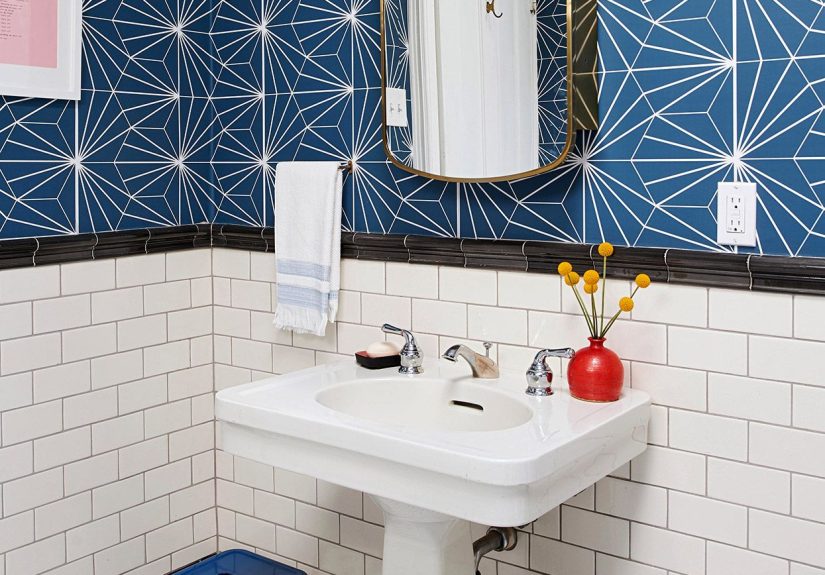
Chair rail and molding trims are ideal for wainscoting, vanity backsplashes, traditional bathrooms, fireplace surrounds, and framed feature panels. They are also useful at the top edge of a tile wainscot, where they create a finished cap between tile and painted wall.
What kind of style it creates
This trim leans classic. It works beautifully in spaces inspired by cottage, traditional, transitional, and European-style interiors. Marble chair rail adds an upscale, tailored look. Ceramic chair rail in glossy white feels timeless. More ornate molding trims can create a vintage or old-world vibe.
Why it still matters today
Even in newer homes, chair rail trim can make a simple field tile look more thoughtful. A straightforward subway tile wall becomes more elevated when it ends with a cap or molding instead of just stopping abruptly. It adds hierarchy, which is a fancy design way of saying the eye knows where to rest.
The only real caution is scale. A chunky molding in a very small room can feel heavy. If your space is compact, you may be better off with a pencil liner unless you truly want a more formal, decorative effect.
5. Mosaic and Listello Borders: The Decorative Scene-Stealers
Mosaic borders and listellos are the trim options for people who want more than a neat edge. These decorative strips can add contrast, texture, color, sparkle, or pattern. They are often used as accent bands in showers, statement borders on backsplashes, or framing elements around feature areas.
What makes them different
Unlike bullnose or metal profiles, mosaic and listello borders are not only about hiding an edge. They are design features in their own right. A narrow strip of marble mosaic can outline a niche. A glass accent band can break up a large shower wall. A contrasting border can frame a field of simple tile and make the whole installation feel layered.
Where they work best
These borders are ideal for shower niches, vanity walls, kitchen backsplashes, fireplace facades, and feature walls where you want a little movement or contrast. They are especially effective when the main tile is simple and the border is doing the decorative work.
How to avoid going overboard
This is where restraint earns its paycheck. One good border can elevate a room. Three competing borders can make the room look like it lost a fight with a sample catalog. Choose a mosaic or listello that relates to the main tile in tone, finish, or material. The goal is emphasis, not chaos.
How to Choose the Right Tile Edge Trim for Your Space
The best trim depends on three things: the style of the room, the tile itself, and where the edge appears. If your room is classic and the tile collection offers matching trim, bullnose is usually an easy win. If your tile is rectified, modern, or missing coordinating trim, metal edging is often the smartest solution.
If you want subtle decoration, pencil liners are a strong middle ground. If you are designing a more traditional or furniture-like space, chair rail or molding trim adds polish. If the room needs a focal point, a mosaic border can do the job with far more flair than plain trim.
Also think about maintenance and longevity. Simpler trims are often easier to clean and less likely to date quickly. Decorative borders can be stunning, but they should still fit the architecture of the room. A finish that feels timeless usually outlasts a finish that felt trendy for exactly six minutes on social media.
Common Tile Trim Mistakes to Avoid
Choosing trim last
Many people select the field tile first and assume the trim situation will magically sort itself out. It often does not. Always confirm edge-finishing options before ordering the main tile.
Ignoring thickness
Tile trim needs to suit the tile it is finishing. A trim that sits too proud or too shallow can make the installation feel awkward, even if the color is perfect.
Mixing styles without a plan
A rustic handmade-look tile paired with an ultra-sleek metal profile can be gorgeous, but only if the contrast is intentional. The same goes for ornate moldings and minimalist tile. Opposites can attract. They can also file for divorce.
Overdecorating the border
If your tile already has strong pattern, texture, or color variation, a quiet trim may be the better choice. Let one element be the star and let the others clap supportively from the side.
Real-World Experiences: What People Learn About Tile Trims After the Project Is Done
Ask homeowners, DIYers, and remodeling pros what they remember about a tile project, and many of them will not start with grout lines or thin-set. They will talk about the edge. That is because the edge trim is one of those decisions that feels tiny in the planning stage and oddly enormous once the room is finished.
One of the most common experiences is surprise. People assume the main tile is the main event, then realize the trim determines whether the installation looks custom or unfinished. A backsplash can be beautifully installed, but if the side edge dies awkwardly into painted drywall, that is the detail your eye keeps finding. The lesson usually comes fast: the finishing touch is not extra, it is part of the design.
Another common experience is regret over waiting too long to choose trim. Someone falls in love with a gorgeous porcelain tile, orders it, schedules the installer, and only then learns there is no matching bullnose. Suddenly the “simple kitchen update” becomes a scavenger hunt involving five websites, three phone calls, and a growing emotional attachment to brushed nickel profiles. Seasoned remodelers learn to check trim options first, because edge decisions affect the entire plan.
There is also the finish-matching lesson. In photos, almost any trim can look good. In real life, warm brass next to cool stainless steel, or polished metal next to matte fixtures, can feel slightly off even when you cannot explain why. People who are happiest with their results usually repeat at least one finish elsewhere in the room. When the trim relates to the faucet, sconces, shower hardware, or cabinet pulls, the space feels coordinated instead of accidental.
Homeowners also learn that subtle trim often ages better than dramatic trim. That does not mean decorative borders are a bad idea. It just means the most beloved projects tend to use decorative accents strategically. A framed niche, a slim liner, or one elegant mosaic band often feels sophisticated for years. Overly busy borders can start to feel like a design decision made during a strong espresso moment.
Then there is the cleaning reality. Slim metal profiles and simple bullnose trims are usually easy to wipe down. Deeply textured decorative pieces, highly beveled moldings, or fussy accent strips can collect dust and soap residue faster than expected. In a powder room this may not matter much. In a daily shower, people notice quickly which details were beautiful in theory and annoying in practice.
Finally, people remember how much confidence a finished edge gives a room. It is hard to explain until you see it. The trim creates closure. It tells the eye, “Yes, this was planned.” Even modest tile can look high-end when the edge is crisp and appropriate. And expensive tile can look strangely unfinished when the edge is treated like an afterthought. That is why the finishing touch matters so much. It is not just the end of the tile. It is the moment the whole room starts to look complete.
Conclusion
The right tile edge trim does more than hide a raw side. It protects the installation, sharpens the design, and gives the room a finished, intentional look. Bullnose is timeless and easygoing. Metal profiles are sleek and modern. Pencil liners add detail without drama. Chair rail moldings bring architecture and tradition. Mosaic borders add personality and emphasis.
If you choose the trim as carefully as you choose the tile, your project will look better immediately and hold up visually for years. And that is the magic of a good finishing touch: it is small, but it changes everything.