Table of Contents >> Show >> Hide
- Why filmmakers repurpose everyday items as props
- How the trick works: the secret sauce behind “unnoticeable” props
- 50 times filmmakers repurposed everyday items as props
- How to spot repurposed props without becoming unbearable at movie night
- of “I can’t unsee it” experiences (and why that’s part of the fun)
- Conclusion
Movies are basically magic… powered by duct tape, spray paint, and that one crew member who can turn a kitchen gadget into “advanced alien technology” by rotating it 90 degrees and adding a blinking light.
If you’ve ever watched a sci-fi thriller and thought, “Wait. Is that… my blender?”welcome. You’ve developed Prop Vision. There’s no cure. Only pausing.
The truth is, repurposing everyday items as movie props isn’t lazinessit’s a proud, time-tested filmmaking superpower. Prop masters and production designers have one mission:
create a believable world fast, safely, and on budget. And sometimes the quickest route to “galactic control interface” is the clearance aisle at a big-box store.
Why filmmakers repurpose everyday items as props
1) Budget and time are the boss fight
Even big productions make constant trade-offs. Custom-building every gadget from scratch is slow and expensiveespecially when the camera only lingers for three seconds before the hero sprints away.
Repurposing saves time, money, and sanity (at least until the internet notices your “space scanner” is a thing from aisle seven).
2) Real objects already look “real” (shocking, I know)
Everyday products are designed by actual engineers to look functional, ergonomic, and purposeful. That built-in “this must do something” vibe is gold for production design.
Add weathering, repaint it, and suddenly a kitchen tool looks like it’s survived three asteroid fields and a union-mandated lunch break.
3) Safety, durability, and repeatability matter
Props get dropped, thrown, bumped into door frames, and occasionally used in ways that would make a manufacturer’s warranty spontaneously combust.
A sturdy consumer item can be safer and more consistent than a fragile one-off buildespecially for background set dressing where reliability beats perfection.
4) The camera is easier to fool than the pause button
In motion, under dramatic lighting, with a cinematic score yelling “FEEL EMOTIONS NOW,” your brain stops nitpicking. That’s the plan.
The prop just needs to read correctly: silhouette, surface detail, and “buttons that imply science.”
How the trick works: the secret sauce behind “unnoticeable” props
Great repurposed props follow a few unspoken rules:
- Change the context: Put the object somewhere it “belongs” in the story (a medbay, a cockpit, a villain lair with suspiciously tasteful accent lighting).
- Change the finish: Paint, weathering, matte coats, and grime instantly de-toaster-ify a toaster.
- Add “greeblies”: Tiny bits, panels, vents, and widgets create complexityyour brain assumes complexity equals technology.
- Hide the giveaway angles: Film it from the “that’s definitely not my bathroom accessory” side.
50 times filmmakers repurposed everyday items as props
Below are 50 real-world examples that fans have spotted and shared over the yearssome subtle, some shameless, all wildly entertaining.
Think of this as a friendly field guide to the moment your brain whispers, “I own that.”
-
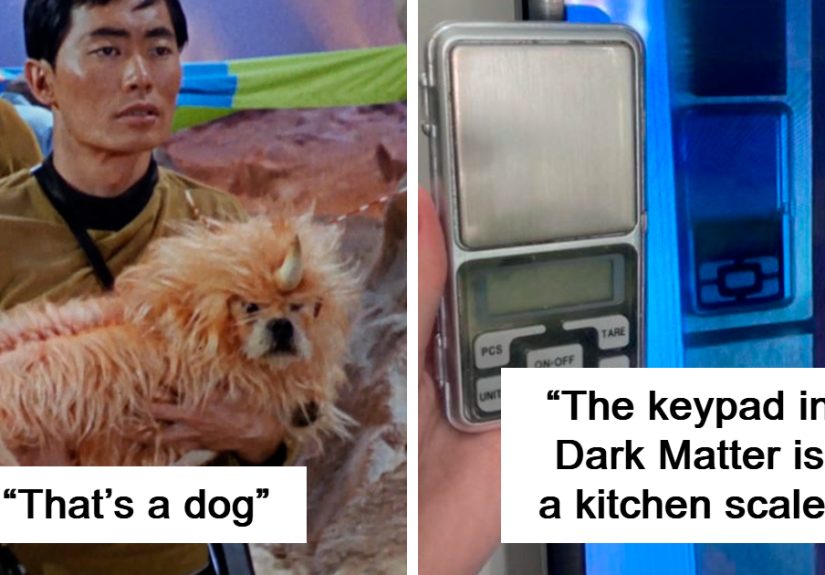
“Alien creature” that’s… just a dog (with costume help)
Sometimes the most convincing “unknown species” is a familiar one wearing a little extra production design. -
1960s Batman utility belt pouches made from kitchen sponges
When your superhero budget is tight, absorbent household materials become “tactical gear.” Holy hydration, Batman. -
Galaxy Quest face “scanning tool” that resembles a medical speculum
A real medical instrument, repurposed into sci-fi intimidation. Uncomfortable? Yes. Memorable? Also yes. -
Angel lab “thingies” that appear to be IKEA toilet brushes
Nothing says “serious science” like a bathroom accessory given a metallic makeover. -
An Indian TV hospital scene using a Scotch-Brite scrubber as “medical equipment”
If it’s the right shape and the lighting is dramatic, a scrubber can play doctor for a day. -
Andor S01E04: egg slicers used as sci-fi lights
Kitchen tools, promoted to “spaceship interface” by the ancient art of repositioning. -
The Book of Boba Fett: a 100-liter water butt becomes a background droid
Background props are where repurposing becomes a competitive sport. -
Dark Matter: keypad that’s actually a kitchen scale
Buttons + display + “someone pressing it urgently” = believable futuristic access panel. -
The Expanse: medbay device that looks like a spice dispenser
Medical-grade spices, because the ship’s doctor believes in flavor and trauma care. -
Deadpool 2: Nerf blasters used as guns
A wink for eagle-eyed viewersand a reminder that foam darts deserve cinematic respect too. -
X-Men: The Last Stand: Sony earbuds used as medical equipment
When you need something small, clinical-looking, and plausibly “connected,” consumer tech is ready for its close-up. -
Andor: a character carrying what looks like a cymbal hard case
The rebellion is toughbut the gig economy is tougher. -
The Tick (2001): “remote device” that’s a Bumble Ball toy
Colorful toy becomes serious gadget with one simple spell: metallic paint. -
The Mandalorian: pit droid tool that looks like a rotisserie skewer
The galaxy is powered by droids, honor… and barbecue accessories. -
Dune costume detail using a washing machine hose/clamp
Functional shapes from everyday hardware can read as “future survival gear” instantly. -
My Chemical Romance music video: “security camera” is a Polaroid SX-70
Retro tech becomes sci-fi surveillance with the right framing and intent. -
The Phantom Menace: wall ornament that’s a children’s ball thrower
Set dressing loves anything that looks handmade, functional, and slightly mysterious. -
The Expanse: car topper used as a pediatric cryostasis pod
The outline sells it. Add the right textures and suddenly it’s “life support.” -
Star Trek VI: a drum machine as a starship control interface
If it has pads and knobs, it can steer a spacecraft. (Musically.) -
Robot Jox: “medical injector” that’s a repainted hot glue gun
The grip, the trigger, the heftit already feels like a tool. Paint does the rest. -
Iron Sky: spaceship radio that’s a headlamp
Props that are already meant to be worn or held often translate beautifully to “field comms.” -
Warrior Nun: upside-down Canon printer as futuristic equipment
Turn it over, shoot it tight, add dramaboom. “Advanced device.” -
Spy Kids: handheld Battleship game as a gadget
The button layout screams “interface,” and the movie’s vibe is playful enough to make it feel intentional. -
Star Wars: lightsaber hilt built from a vintage camera flash handle
One of the most iconic “repurpose wins” ever: a real camera flash becomes the foundation for a legendary weapon. -
Aliens: “alien pill storage” that’s a Scrabble tile holder
The best part: it’s so mundane you almost respect the audacity. -
The Batman: boots that look like Air Jordan 1s
Sometimes repurposing isn’t a gadgetit’s wardrobe realism sneaking in through your sneaker knowledge. -
Star Wars: Luke’s “macrobinoculars” built from a vintage camera body
Old cameras already look like sci-fi gear because they’re covered in purposeful knobs and optics. -
The Expanse: translator device that resembles a Nokia E70
Compact, button-heavy, and instantly “official”classic phone-as-future-tech energy. -
Loki: TVA terminal that resembles a Weltron 8-track stereo
Retro-futurism loves anything that looks like it came from “the future… as imagined in 1976.” -
The Mandalorian: “safe” prop that resembles an ice cream maker
The galaxy’s most famous “I can’t unsee it” container returns in a new job. -
Back to the Future Part II: repurposed barcode scanner
Nothing says “futuristic commerce” like a device built to judge your groceries. -
Star Wars: medical droid mouth grill that matches a Shure SM58 mic grill
Audio gear has industrial styling that reads as spaceship-grade immediately. -
Star Wars: Millennium Falcon joystick that resembles a fish-shaped toilet handle
A bold choice. A brave choice. A choice that the internet will never forget. -
Obi-Wan Kenobi: a device that resembles a Kodak Retinette 1A camera/rangefinder
Cameras = instant “scanning device,” because lenses imply analysis. -
Batman (1989): utility belt buckles that look like Ford emblems
Logos and shiny metal are irresistible to costume departmentsjust swap context and keep moving. -
Batman v Superman: a Batman gadget that resembles a Braun electric shaver
The sleek curves and vent patterns do half the sci-fi work for you. -
Highlander: egg cartons used as acoustic dampening panels
Cheap, textured, and instantly “industrial.” Also: your recycling bin is now a set decorator. -
Aliens: a “save” button that resembles a gas gauge
A tiny detail, but exactly the kind of thing that makes control panels feel functional. -
Barbie: Ken’s pocket “device” that resembles a bedside lamp switch
Sometimes the prop is a vibe accessoryespecially when the character’s vibe is “confident confusion.” -
The Expanse: space suit pocket that resembles an ASUS ROG badge
Branding plus sharp geometry can accidentally look like futuristic insignia. -
Tron (1982): costume helmet that resembles a hockey helmet
Sports gear already reads as protective techperfect for stylized worlds. -
Star Trek: Picard: hacking interface that resembles a Korg nanoKONTROL
Music controllers are basically “buttons for doing important things,” and film loves that. -
The Rookie: a handheld barcode scanner playing “serious equipment”
If it’s handheld and beeps, it can be rewritten as law-enforcement wizardry. -
Aliens: deep fat fryer used as a control panel
Fried food technology, repurposed into space panic technology. -
MacGruber: an iPhone 3G as a “hacking” tool
The quickest way to say “tech” on screen is often… actual tech. -
Battlestar Galactica (1979): “fruits” that are just balloons
Nothing grows like balloons in the alien orchards of low-budget ingenuity. -
Captain Picard holding what looks like a box cutter
Sometimes “future tool” is literally “present tool,” and the uniform does the convincing. -
Star Trek: Deep Space Nine: Klingons drinking out of measuring cups
The day your kitchenware becomes “alien culture” is the day you start labeling drawers differently. -
Star Trek (2009): a device that resembles an external hard drive
Storage tech shows up as set dressing all the timebecause sleek rectangles look like “systems.”
How to spot repurposed props without becoming unbearable at movie night
- Look for familiar ergonomics: consumer objects are built to be held, pressed, opened, and carried.
- Watch background dressing: extras and walls are prime real estate for thrift-store science.
- Notice repeated shapes: the same base object may appear in multiple scenes with different paint jobs.
- Pay attention to “too perfect” details: uniform seams, manufacturer vents, and product geometry can give it away.
- Remember the golden rule: if it has buttons, it can be a spaceship.
of “I can’t unsee it” experiences (and why that’s part of the fun)
The first time you catch a repurposed prop, it feels like finding a secret doorway in a room you thought you knew. You’re watching a tense scenealarms blaring, hero sweating,
someone dramatically whispering “We have to do this now”and then your brain interrupts with, “That’s my kitchen scale.” Suddenly you’re not just watching the story;
you’re watching filmmaking.
A lot of viewers describe the same progression: it starts as a harmless giggle, becomes a hobby, and ends with you pausing scenes like a wildlife photographer who just spotted a rare species
(the elusive “hardware store part painted matte black”). You might rewatch an episode specifically to confirm your suspicion, then spiral into comparing screenshots, reading forums,
and learning terms like “kitbashing” and “greeblies” as if you’re earning a secret degree in cinematic scavenger hunting.
The funniest part is how repurposed props change the way you shop. You walk through a home goods store and your mind starts casting objects. A soap dispenser isn’t a soap dispenser;
it’s an “alien nutrient injector.” A handheld barcode scanner isn’t retail equipment; it’s “field-grade reconnaissance.” A lamp switch becomes “mission-critical device,”
and you have to stop yourself from whispering, “This would look incredible with a little weathering.” You’ll also develop a new respect for art departments, because they’re doing
professional-level illusion work using objects you once ignored while searching for paper towels.
If you’ve ever visited a behind-the-scenes exhibit, watched interviews with prop makers, or even just seen photos of prop warehouses, you know the vibe:
shelves upon shelves of everyday items waiting for their second career. What looks like random clutter is actually a palette. The crew isn’t thinking “egg slicer” or “measuring cup”
they’re thinking “shape,” “texture,” “believability,” and “does it read on camera?” In that context, repurposing becomes less like cutting corners and more like visual problem-solving.
And honestly? The audience is part of the game now. Online communities swap screenshots like trading cards. People cheer when a show hides a recognizable object in plain sight.
Others treat it like a scavenger hunt: “Spot the household item before the comments do.” It’s playful, communal, and weirdly affectionatebecause noticing the trick doesn’t ruin the magic.
It reminds you that movie worlds are built by humans. Creative humans. Slightly sleep-deprived humans. Humans who can look at a kitchen gadget and think,
“Yes. That belongs on a spaceship.”
Conclusion
Repurposed props are one of those filmmaking quirks that make cinema feel both bigger-than-life and delightfully homemade. Whether it’s a camera part becoming a legendary weapon
or a measuring cup becoming “alien drinkware,” the point isn’t to fool you foreverit’s to sell the moment. And if you notice? Congratulations. You’ve joined the secret club.
The initiation ritual is rewinding.