Table of Contents >> Show >> Hide
- Why Public Notices Make Perfect Comedy Material
- 7 Classic Types of Hilarious Responses to Public Notices
- Examples of Hilarious Responses to Public Notices
- “Please Keep This Door Closed” vs. “Challenge Accepted”
- The Legendary “Do Not Touch” Button
- Office Fridge Showdown
- The Overly Honest Elevator Sign
- Strict Parking Rules, Loose Interpretations
- Bathroom Reality Check
- The “Employees Must Wash Hands” Remix
- “Quiet Please” Meets Karaoke Night
- “Wet Paint” With a Plot Twist
- The Existential Recycling Bin
- “No Food Beyond This Point” With a Loophole
- “Staff Only” and the Inner Child
- The Overexplaining Coffee Machine
- Overly Dramatic Fire Door
- “No Loitering” Philosophers
- The Friendly Dog Sign
- The “Break Room” Therapist
- No Skateboarding, Just Wordplay
- Public Transit Comedy
- “For Your Safety” and Sass
- The Printer That Has Had Enough
- Gym Motivation, Kind Of
- Vending Machine Wisdom
- “No Smoking” With a Twist
- Computer Lab Real Talk
- Why These Responses Make Us Laugh
- How to Respond to Public Notices Without Crossing the Line
- Real-Life Experiences with Funny Public Notices and Responses
- Conclusion: Why We Can’t Get Enough of Hilarious Responses to Public Notices
Public notices are supposed to be the grown-ups of the communication world: serious, practical, and just a tiny bit boring.
Think “Please keep this door closed,” “Do not feed the pigeons,” or “Out of order.” Necessary? Yes. Exciting? Not exactly.
But the internet has proven one thing over and over again: give people a blank space and an official-looking sign, and someone
will eventually grab a pen and turn that public notice into a public joke.
Online galleries packed with hilarious responses to public notices show just how creative people can get when
confronted with bossy posters, passive-aggressive notes, and overly serious rules. The original notice sets the stage; the
handwritten comeback steals the show. That’s why collections like “67 Of The Most Hilarious Responses To Public Notices Ever”
are so addictive: they capture little moments where everyday people refuse to take life too seriously and leave a punchline
for the rest of us to enjoy.
In this deep dive into funny public notices, we’ll look at why these responses are so entertaining, explore the different
“types” of sign jokers, break down examples of public notice fails and witty comebacks, and end with some real-world
experiences and tips so you can appreciate (or gently participate in) this unofficial art form without crossing any lines.
Why Public Notices Make Perfect Comedy Material
Public notices are designed for clarity and authority. They’re usually written in stiff, formal language: “It is strictly
prohibited to…” or “Failure to comply may result in…” The tone is dry and often slightly annoyed, especially in office
kitchens and shared spaces. That seriousness creates the perfect setup for humor: when someone responds with a playful
comment, doodle, or written comeback, the contrast between “official” and “ridiculous” makes the joke land harder.
There’s also the passive-aggressive factor. Many notice-writers aren’t just sharing information; they’re venting.
“WHOEVER IS LEAVING THEIR DISHES IN THE SINK, STOP IT!!!” feels less like a sign and more like a shout. When people sense
that pent-up frustration, the temptation to puncture it with a clever response is almost irresistible. Humor becomes a way
to push back against scolding, nagging, or over-the-top ruleswithout starting an actual argument.
Finally, public notices are public. A joke written on a random scrap of paper at home might never be seen by anyone else,
but a sharp comment scribbled under “Please Do Not Touch” in a museum or lobby has a built-in audience. That social element
makes these responses feel like tiny, anonymous performances meant for whoever happens to pass by.
7 Classic Types of Hilarious Responses to Public Notices
1. The Grammar Vigilante
Some people can’t walk past a sign with a typo without correcting it. If a notice says,
“Employees must wash hand,” someone will quietly add the missing “s” or write “just one?”. These responses are
funny because they flip the power dynamic: instead of the sign instructing the reader, the reader “grades” the sign.
2. The Literalist
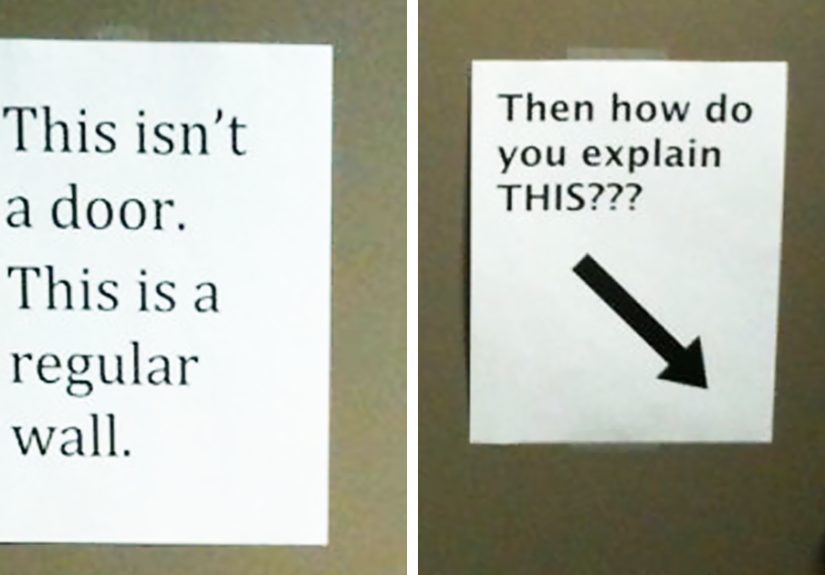
Literal jokers take the wording of a sign and follow it exactly in the most unhelpful way possible. A notice that says
“Use other door” might get an arrow pointing to the wall with the scribbled note “This one?” Or a sign reading
“No animals allowed (except service animals)” might get the response “So emotional support dragon is… out?”
3. The One-Liner Specialist
These are the comedians who treat public notices like a setup to their favorite stand-up routine. A strict note that says
“Do NOT write on this sign” might collect the reply “Okay, sorry” in tiny letters at the bottom. The joke is minimal, but
the timing is perfect.
4. The Office Prankster
In offices, public notices and passive-aggressive notes are practically a sport. A sign demanding “LABEL YOUR FOOD” can
inspire someone to slap a sticky note on their sandwich that says “Food.” An exasperated reminder about cleaning the
microwave might get a doodle of a tiny screaming microwave asking to be freed.
5. The Bathroom Philosopher
Bathrooms are a prime battlefield for passive-aggressive signage. “Please keep this bathroom clean” might be joined by
a response like “You’re asking too much of humanity.” Near the hand dryer, a polite “Please dry your hands thoroughly”
may gain an extra line: “On your pants, like everyone else.”
6. The Tiny Artist
Not every response is written; some are drawn. Someone might turn the “O” in “NO SMOKING” into a little angry face, or
add a cartoon dog begging under “Do Not Feed The Animals.” The best doodles feel like they’ve always belonged thereas if
the sign secretly wanted to be a comic strip.
7. The Rule-Bending Philosopher
These responders go for big questions. Under “No Loitering,” they might write “Define loitering” or “Aren’t we all loitering
through life?” Is it helpful? Absolutely not. Is it amusing? Completely.
Examples of Hilarious Responses to Public Notices
Below are some example “conversations” between serious public notices and the people who couldn’t resist adding a punchline.
They’re inspired by the kinds of sign fails and responses people share onlineoffice jokes, bathroom notes, street signs, and more.
-
“Please Keep This Door Closed” vs. “Challenge Accepted”
Original notice: “Please keep this door closed at all times.”
Response: Someone adds below, “How do we get in?” and another person arrows back to it with “Very quietly.” -
The Legendary “Do Not Touch” Button
Original notice: “Do not touch. Alarm will sound.”
Response: A handwritten addition: “Also, the floor is lava.” Suddenly it’s less security warning, more childhood playground. -
Office Fridge Showdown
Original notice: “Do not eat food that isn’t yours.”
Response: “Then whose is it?” followed by “Still not yours, Steve” in a different pen. Steve can’t catch a break. -
The Overly Honest Elevator Sign
Original notice: “Elevator temporarily out of order. Sorry for the inconvenience.”
Response: “Same” written underneath. Now the elevator and everyone reading it are emotionally out of order together. -
Strict Parking Rules, Loose Interpretations
Original notice: “Residents only. Violators will be towed.”
Response: “Violators will be tickled” scribbled over “towed.” One angry neighbor then crosses out “tickled” and writes
“reported,” restoring justice and ruining the joke. -
Bathroom Reality Check
Original notice: “Your mother doesn’t work here. Please clean up after yourself.”
Response: “She’s retired. Be kind.” Suddenly the sign goes from guilt trip to oddly heartwarming. -
The “Employees Must Wash Hands” Remix
Original notice: “Employees must wash hands before returning to work.”
Response: Someone adds: “Customers, wash your hands too. We believe in you.” Hygiene and wholesome encouragement in one. -
“Quiet Please” Meets Karaoke Night
Original notice outside a library room: “Quiet please.”
Response: Underneath it: “Unless you’re singing softly,” followed later by musical notes and lyrics from someone’s favorite ballad. -
“Wet Paint” With a Plot Twist
Original notice: “Wet paint. Do not touch.”
Response: “Don’t tell me what to do” followed by a smudged fingerprint. The sign was right; someone couldn’t resist. -
The Existential Recycling Bin
Original notice on a bin: “Recycling only.”
Response: “Also for hopes and dreams?” later amended with “No, those go to HR.” -
“No Food Beyond This Point” With a Loophole
Original notice: “No food beyond this point.”
Response: “What if I become the food?” followed by someone else adding “Then you’re beyond help, not just this point.” -
“Staff Only” and the Inner Child
Original notice: “Staff only past this point.”
Response: “I identify as a staff.” Another handwriting appears: “Nice try.” -
The Overexplaining Coffee Machine
Original notice: “Do not place spoon in dispenser.”
Response: “It’s a coffee machine, not a wishing well.” Now everyone picture themselves making a wish over the espresso button. -
Overly Dramatic Fire Door
Original notice: “Fire door. Keep closed.”
Response: “He’s been through a lot.” Someone adds a little crying face next to the word “door.” -
“No Loitering” Philosophers
Original notice: “No loitering.”
Response: “We’re not loitering, we’re existing with intention.” The sign just wanted emptier steps, not a dissertation. -
The Friendly Dog Sign
Original notice: “Please do not let your dog relieve itself here.”
Response: “He can’t read.” Someone later adds: “Teach him.” The negotiation continues. -
The “Break Room” Therapist
Original notice: “Break room is for employees only.”
Response: “Honestly, the room is already broken.” Cue groan from everyone who’s been through a stressful week. -
No Skateboarding, Just Wordplay
Original notice on a plaza: “No skateboarding.”
Response: “Only emotional skating through life.” The plaza becomes a metaphorical half-pipe. -
Public Transit Comedy
Original notice on a bus: “Please do not talk to the driver while the bus is in motion.”
Response: “He’s emotionally unavailable anyway.” No one talks, but everyone chuckles quietly. -
“For Your Safety” and Sass
Original notice: “For your safety, please remain behind the yellow line.”
Response: “For my drama, I will not.” The yellow line remains un-crossed, but the attitude is loud. -
The Printer That Has Had Enough
Original notice taped to a printer: “Do not hit the printer.”
Response: “Printer has feelings too.” Someone later adds “Barely.” -
Gym Motivation, Kind Of
Original notice: “Wipe down machines after use.”
Response: “Also wipe away your tears. You’re doing great.” Equal parts sanitation and encouragement. -
Vending Machine Wisdom
Original notice: “Machine does not give change.”
Response: “Neither does your ex.” A little too accurate for comfort. -
“No Smoking” With a Twist
Original notice: “No smoking within 25 feet of this entrance.”
Response: “No bad vibes within 25 feet either.” Reasonable policy, actually. -
Computer Lab Real Talk
Original notice: “No food or drink near computers.”
Response: “Your tears don’t count.” Tech support might disagree.
Why These Responses Make Us Laugh
It’s not just the jokes themselves that are funny; it’s the situation. A serious sign expects obedience, not a punchline.
When someone adds a clever twist, they break that expectation. Psychologists call this “incongruity” the mismatch between
what we expect and what we get. Here, the clash between formal notice and informal sass is exactly what makes us laugh.
These responses also create an instant sense of community. If you’ve ever spotted a funny note on a bulletin board and then
looked around to see if anyone else noticed, you know the feeling. It’s like sharing a private joke with strangers. People who
are stressed, bored, or frustrated by rules get a quick moment of relief and connection thanks to one anonymous comedian with a pen.
And finally, funny responses to public notices give people a way to push backsoftly. Instead of arguing directly with a person,
they argue with the sign. It’s a safe outlet for irritation with messy coworkers, bossy managers, or painfully bland corporate language.
How to Respond to Public Notices Without Crossing the Line
As entertaining as these jokes are, there’s a line between playful and destructive. If you’re tempted to leave your own witty
addition on a sign, keep a few common-sense rules in mind:
- Don’t ruin important information. Safety signs, medical notices, and emergency instructions are off-limits. No joke is worth confusing people in a serious situation.
- Aim up, not down. It’s more fun to tease “The System” or generic office rules than to attack a specific person or group.
- Skip anything cruel or offensive. Clever wordplay beats insults every time. If your joke depends on being mean, it’s not a good sign (pun fully intended).
- Consider the space. A silly addition in a university dorm might land very differently than the same joke in a hospital hallway.
Real-Life Experiences with Funny Public Notices and Responses
Once you start paying attention, you realize that funny public notices and their responses are everywhere: in office kitchens,
apartment lobbies, laundromats, parks, elevators, and bathrooms. People share stories about walking into a break room in a bad mood,
reading a sarcastic comment under a grumpy sign, and suddenly laughing out loud. That tiny moment of joy doesn’t fix everything,
but it does make the day feel a little lighter.
In shared living spaces, these signs can almost become a running sitcom. A landlord posts a stern message about trash:
“All garbage MUST be placed inside the bins with lids CLOSED.” A neighbor adds, “Yes, Karen, we heard you,” and another writes,
“Signed, the Council of Trash.” Soon, everyone is checking the notice board not just to see new rules, but to see whether the
“Council” has weighed in again.
In offices, the same thing happens with passive-aggressive kitchen notes. The first sign is usually sincere:
“Please wash your dishes after use.” When that fails, someone goes bigger: “We are not your parents. Clean up after yourself.”
Then the responses appear: “You’re not my parents? Does that mean I’m free?” or “Plot twist: we are all the problem.” Over time,
these notes become a record of the workplace cultureequal parts frustration and shared humor.
Public transit is another rich source of stories. Riders talk about seeing hand-written additions on train or bus notices that
perfectly capture commuter feelings. Under a sign that says “Service delays due to necessary maintenance,” someone scribbles,
“Necessary for whom?” On a poster reminding riders to “Be considerate of others,” a fellow passenger writes, “Especially before
8 a.m., we’re fragile.” People take photos, share them online, and suddenly that one little station becomes internet-famous for a day.
Even serious environments like hospitals or government buildings occasionally get caught in the crossfire of humor. A dry,
overexplained notice can invite a gentle joke that actually makes the space feel more humansomething like a small heart drawn
next to “Please be patient, our staff is doing their best,” or a simple “Thank you” added by a grateful visitor. These aren’t
mocking responses, but they still transform the sign into a tiny conversation.
What all of these experiences have in common is the way they turn one-way communication into a dialogue. A public notice is
designed to talk at people. A witty response talks back, and invites everyone who reads it to feel like part of
a shared joke. Whether it’s a sarcastic quip on an office fridge, a clever correction on a street sign, or an unexpectedly sweet
comment under a strict rule, these little moments remind us that humor is everywhereeven taped to a wall in black-and-white text.
Conclusion: Why We Can’t Get Enough of Hilarious Responses to Public Notices
“67 Of The Most Hilarious Responses To Public Notices Ever” isn’t just a catchy headlineit’s a snapshot of how people cope
with everyday rules, frustrations, and boredom. Serious signs will always exist. We need them for safety, structure, and
basic organization. But the responsesthe doodles, corrections, one-liners, and philosophical ramblingsare what make those
spaces feel alive.
In a world full of official language, legal disclaimers, and all-caps warnings, a tiny handwritten joke can feel like a breath
of fresh air. It doesn’t erase the rule, but it reminds us that behind every notice is a human being, and behind every response
is another human being who just wanted to make someone smile. And honestly? That might be the best public service announcement of all.