Table of Contents >> Show >> Hide
Some furniture collections arrive with a lot of marketing sparkle and not much soul. Then there are the rare ones that feel like they were sketched at a sun-faded breakfast nook in Los Angeles, refined over strong coffee, and finished with a healthy respect for wood grain, leather patina, and the idea that a room should actually be lived in. That is the energy behind Commune’s collection for West Elm.
If you know Commune, you already know the studio does not traffic in cold perfection. The Los Angeles design firm has built its reputation on interiors that feel layered, collected, and human. So when West Elm partnered with Commune on a broad home collection, the result was never going to be a stiff showroom exercise. It was always going to be warmer than that. Smarter, too. The collection translated Commune’s laid-back, artful point of view into pieces with more accessible prices, bringing a distinctly California style to a national audience without sanding off its character.
And that is what makes this collaboration so interesting. “California cool” gets tossed around like confetti in the design world, usually to describe anything beige, breezy, or sitting near a fiddle-leaf fig. Commune’s version is more thoughtful. It is less “influencer rental staged for a smoothie shoot” and more “well-traveled modernist who knows exactly where the good ceramics are.” This collection is a case study in how to make relaxed rooms feel intentional, how to make midcentury references feel fresh, and how to create furniture that looks sophisticated without acting like it is too important to hold a coffee mug.
Why This Collaboration Mattered
West Elm has long been good at turning designer language into retail reality. Commune, meanwhile, brought real design-world credibility: a studio known for architecture, interiors, graphics, hospitality work, and a certain kind of bohemian-modern sophistication that feels deeply tied to Southern California. Put them together, and the collaboration had a clear mission: make high-design ideas more attainable without making them bland.
That mission comes through in the scale of the collection. This was not a one-chair, one-lamp cameo. It was a substantial range of more than 50 pieces spanning furniture, lighting, decorative objects, textiles, mirrors, and planters. In other words, it gave shoppers enough pieces to build a mood, not just buy a single accent and call it a personality.
The larger achievement, though, was tonal. Commune did not simply slap its name on generic retail shapes. The collection carries the studio’s signature interest in texture, restraint, craft, and references that stretch beyond one narrow design lane. It is midcentury, yes, but not museum-piece midcentury. It is filtered through travel, climate, and memory. It feels relaxed, but never lazy.
What “California Cool” Means in This Collection
A Global Design Vocabulary With a West Coast Accent
One of the most compelling things about the collection is how openly it borrows from different traditions without becoming a visual traffic jam. Commune’s team spoke about being influenced by midcentury design by way of Japan, Mexico, and Denmark, as well as by figures such as Rudolf Schindler, Bruce Goff, Frank Lloyd Wright, Kaare Klint, the Eameses, Luis Barragán, Pierre Jeanneret, and Clara Porset. That sounds like a lot of names to fit into one living room, but somehow it works.
The magic is in the editing. You can see the Japanese influence in the lower profiles and the calm, uncluttered silhouettes. You can feel the Mexican thread in the sling chair and the warmth of the leather. Scandinavian and Danish cues show up in the functional clarity, the soft geometry, and the preference for natural materials over flashy decoration. The California part is what ties it all together: the sense of ease, the brightness, the lightness of palette, and the refusal to make the room feel too formal to put your feet up.
Materials That Do the Talking
This collection is also a reminder that “cool” does not have to shout. Many of the standout pieces rely on oak veneer, walnut finishes, stitched or undyed leather, copper-toned metal, marble, linen, terracotta, and graphic textiles. These materials age well, and that matters. California cool, at least in the Commune universe, is not about buying something that looks perfect forever. It is about living with pieces that get better when the edges soften, the leather deepens, and the room picks up stories.
That attitude gives the collection more depth than trend-driven furniture often has. Instead of leaning on novelty, it leans on touch. You want to run your hand across the leather wrapping. You notice the contrast between a copper-finished frame and a walnut shelf. You appreciate the heft of a storage bench that is practical without looking boring. Good design often starts when the materials are allowed to be themselves, and this collection understands that.
The Pieces That Define the Line
Seating That Floats Instead of Bulks Up
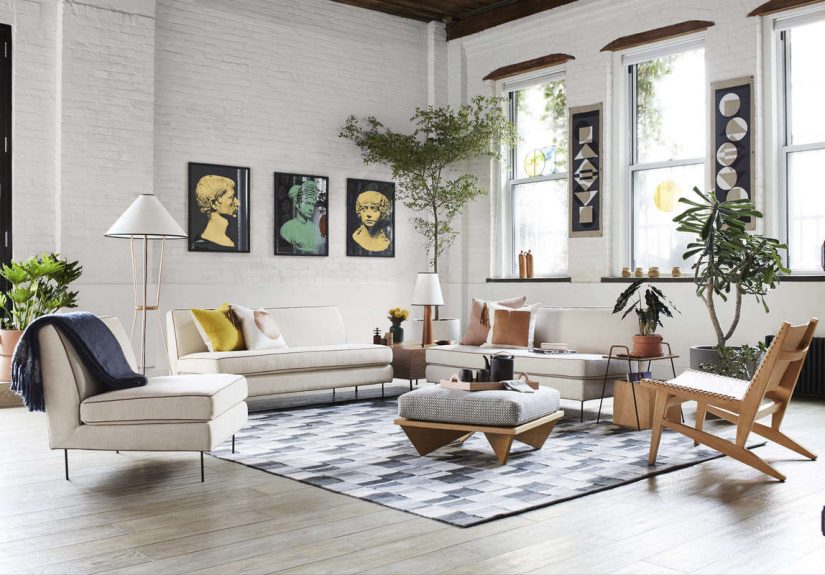
One of the smartest ideas in the collection is the armless sofa. On paper, that may not sound thrilling. In practice, it is the sort of piece that makes a city apartment breathe easier. Commune approached seating with a lighter touch, favoring profiles that did not feel overstuffed or physically heavy. Thin metal legs help the furniture look almost like it is floating, and the leather piping adds just enough detail to keep the silhouettes from becoming too spare.
The result is seating that feels architectural without being severe. The armless sofa and single chair can sit together almost like a sectional, but without the usual sectional bulk. That makes them more flexible for real homes, especially smaller ones where every visual inch matters. A later small-space design essay even singled out the compact armless sofa as the rare piece that made a tiny apartment layout finally click. That is not glamorous showroom talk. That is real-world success.
The Sling Chair and Low Ottoman
The sling chair may be the most textbook example of the collection’s design intelligence. It pulls from Mexican butacos, nods to Jeanneret’s leg structure, and uses leather in a way that feels honest rather than overworked. It is stylish, yes, but it also looks like the kind of chair you would actually want to sit in with a book and not just admire from three feet away like a design student guarding a thesis.
Then there is the low cushion ottoman, which doubles as a coffee table and shows how Commune handles references. Inspired in part by Frank Lloyd Wright and Bruce Goff, it transforms those touchstones into something cleaner and more approachable. The wide base, grounded shape, and floating cushion create an object that feels both sculptural and practical. That balance is hard to get right. Too sculptural and it becomes precious. Too practical and it becomes forgettable. This piece splits the difference beautifully.
Lighting, Wall Art, and the Little Character Moves
The lighting deserves special credit because it shows the collection’s range. The tripod floor lamp mixes midcentury and Japanese influence with leather-wrapped detail and copper-toned metal, creating something that looks deliberate from every angle. The wood and leather table lamps add warmth instead of screaming for attention, which is exactly what good lamps should do. A lamp is not supposed to audition for a leading role every night.
The wall pieces are equally telling. The Eclipse Tapestry, with its off-center circle and graphic simplicity, channels a seventies spirit without going full retro costume party. It reads as art, but approachable art. The collection’s mirrors, sconces, and decorative objects repeat that pattern: clean geometry, tactile finishes, and just enough eccentricity to keep a room from becoming generic.
Storage That Refuses to Be Boring
If there is a sleeper hit in the collection, it may be the storage bench. This is where Commune’s design thinking becomes especially useful. The piece nods to the Eames tradition, includes sliding panels, offers space for records, and even accounts for cord management. That last detail may not be sexy, but anyone who has ever tried to style a media area without letting wires ruin the mood knows it deserves a small standing ovation.
The arch mirror is another strong example of beauty meeting usefulness. Inspired by Spanish Colonial and Mission-style architectural arches, it includes a shelf that works as a landing spot for keys, jewelry, or the small clutter every home somehow manufactures before breakfast. It is elegant, but not fussy. In a small entry, it can do the work of a console without taking up the same footprint. That is a very California kind of practicality: graceful, but not performative.
The Design Debate Around the Collection
No honest conversation about the Commune for West Elm launch is complete without mentioning the debate it sparked. Some critics argued that a handful of pieces came very close to specific midcentury precedents, raising broader questions about where inspiration ends and imitation begins. That conversation, reported widely at the time, was not trivial. It pointed to an ongoing tension in accessible design: how brands can translate classic influences responsibly without crossing the line.
What is worth noting, though, is that the debate happened precisely because the collection was design-literate. These were not random shapes generated by a trend machine. They were clearly connected to an established design history. Whether a reader sees that as tribute, adaptation, or overfamiliarity may depend on the piece. But the discussion itself underscored that Commune and West Elm were operating in a serious design conversation, not merely selling trendy furniture with a pretty backstory.
Why the Collection Worked in Real Homes
For all its style credentials, this line really shines when you imagine it being used by actual humans. The scale is thoughtful. The materials are forgiving. The storage is smart. The silhouettes are low and visually light, which helps open up rooms instead of clogging them. The palette is warm enough to feel inviting and neutral enough to layer with vintage pieces, books, textiles, plants, and whatever odd little objects make a home look personal instead of purchased all at once.
That may be the collection’s secret weapon. It does not demand total control over the room. It plays well with other things. A Commune mirror can live with flea-market ceramics. A sling chair can sit next to inherited bookshelves. A storage bench can hold records, baskets, and the mild chaos of everyday life. The pieces are strong, but not bossy.
Experience: What This Kind of California Cool Feels Like in Daily Life
The easiest way to understand the appeal of Commune’s West Elm collection is not to stare at the product shots for twenty minutes like you are judging a design pageant. It is to imagine what these pieces feel like in motion, in a home that wakes up slowly, lets sunlight move across the floor, and does not panic when someone sets down a coffee cup without a coaster for three whole seconds.
Picture a modest apartment, not a sprawling fantasy house with a hidden citrus grove and a suspiciously tidy open shelf. You walk in and the first thing you notice is not one “statement piece,” but a mood. There is an arch mirror near the entry, and the little walnut shelf actually gets used. Keys land there. Sunglasses land there. Maybe a receipt you keep meaning to throw away lands there, too. The point is, the design is working. It is not posing.
In the living area, the low armless sofa does something many sofas fail to do: it makes the room look bigger instead of smaller. It does not have those giant rolled arms that eat square footage like they are at an all-you-can-eat buffet. It sits lightly on its metal legs, and that matters. In a small home, visual heaviness is real. A compact sofa with clean proportions can change how the whole room breathes.
Then your eye catches the storage bench. It looks composed, but it is not precious. Records go inside. Chargers disappear. A stack of books lives on top. On a good day, it is styled. On a normal day, it is simply useful, which is far more impressive. Commune seems to understand that the best “lived-in” interiors are not cluttered, but they are never sterile. They have evidence of life without looking defeated by it.
There is also something quietly satisfying about the materials in everyday use. Leather on the sling chair starts out handsome and only gets better as it wears in. The copper-toned finishes bring warmth without shouting for attention. The terracotta planters make plants look more intentional, even when the plant inside is trying its best to die for no clear reason. The tapestry or wall art gives the room personality without turning the space into a set for a retro reboot no one asked for.
And that, ultimately, is the experience of this collection: it makes design feel less intimidating. It tells you that a room can be thoughtful without being tense. It can reference Schindler, Barragán, Eames, and Jeanneret without requiring the homeowner to lecture dinner guests about them. It can be stylish and still welcome a blanket tossed over the arm of a chair. It can be edited, but not uptight.
That is probably why the collection has stayed memorable. It was never just about buying “California cool” as a label. It was about creating rooms that feel sun-warmed, useful, collected over time, and calm in the best possible way. Not empty. Not overly polished. Just lived in, with very good taste and maybe a record player somewhere nearby.
Final Thoughts
Commune’s collection for West Elm succeeded because it did something harder than making pretty furniture: it translated a worldview. It brought a Los Angeles design studio’s layered, globally informed, materially rich aesthetic into a retail environment without flattening it into trend soup. The line balanced warmth and restraint, history and accessibility, style and actual usefulness. That is a rare combination.
If you strip away the buzzwords, “California cool” here comes down to a few durable ideas: respect the materials, keep the silhouettes light, leave room for personality, and do not make comfort an afterthought. In a market full of fast furniture trying desperately to look important, Commune and West Elm delivered a collection that felt intelligent, grounded, and wonderfully easy to live with. Which, honestly, might be the coolest thing of all.