Table of Contents >> Show >> Hide
- Why This Combo Works So Well
- The Idea Behind the Original Build
- Breaking Down the Three Ingredients
- What You Can Actually Do With a Setup Like This
- Where the Setup Shines and Where It Still Has Limits
- Why Makers Love This Kind of Project
- Hands-On Experience: What a Setup Like This Feels Like in Real Use
- Final Thoughts
Some projects are useful. Some are clever. And some are the kind of glorious garage-born mashups that make you grin before they even power on. A microscope mounted on a CNC machine and driven with a game controller absolutely belongs in that last category. It sounds like the sort of idea invented at 1:17 a.m. by someone staring at spare parts and refusing to go to bed. But here is the funny part: it actually makes a ton of sense.
At first glance, a CNC machine seems like overkill for microscope work. After all, CNC rigs are usually associated with carving wood, engraving acrylic, and turning innocent sheets of material into sawdust confetti. A microscope, meanwhile, is supposed to sit there looking scientific and dignified. Add a game controller into the mix and the whole thing sounds like a dare. Yet this combination works because each part solves a real problem. The CNC provides precise, repeatable motion. The microscope supplies magnified vision. The controller makes movement intuitive, fast, and surprisingly fun.
That is why this DIY concept has so much appeal. It is not just weird for the sake of being weird. It is a low-cost, highly practical example of microscope automation using parts hobbyists already understand. It can help track tiny moving organisms, inspect printed circuit boards, scan small parts, and make detailed close-up work far less clumsy than the old “nudge the sample and hope for the best” method. In a world where professional motorized microscope stages can get expensive quickly, this kind of build feels refreshingly rebellious.
Why This Combo Works So Well
The magic starts with motion control. A small desktop CNC already knows how to move in controlled X, Y, and Z directions. That means it can act like a motorized microscope stage without needing a wildly custom mechanical system. Instead of moving a cutting tool over a workpiece, the machine moves a microscope over a specimen or moves the specimen under the microscope. Same dance, different music.
This matters because microscope work often becomes awkward the moment the target starts drifting, crawling, or hiding from your field of view like it owes you money. Manual stages are fine for basic use, but they can feel fiddly when you are trying to follow motion in real time or inspect a large area smoothly. A CNC platform gives you stepper-driven travel, controlled motion, and repeatability that a loose hand on a manual stage cannot always match.
Then there is the microscope. Digital microscopes have become far more accessible, which is a big reason projects like this now feel realistic instead of science-fair fantasy. A modern digital microscope can display live video on a screen, making it much easier to work comfortably for longer sessions. That is a huge upgrade over squinting through eyepieces while trying not to bump the stand and ruin your view. For electronics repair, biological observation, surface inspection, coins, jewelry, and other detail-heavy tasks, digital viewing is often the difference between “interesting tool” and “tool you will actually keep using.”
Finally, the game controller pulls off the neatest trick of all: it turns precision motion into something intuitive. CNC interfaces can be excellent, but typing commands or clicking arrow keys is not exactly a thrilling human-machine relationship. A controller changes the vibe immediately. Analog sticks feel natural for jogging motion. Buttons can trigger focus changes, macro moves, or speed modes. Instead of operating a machine, you feel like you are piloting a microscope. That sounds silly until you try it. Then it sounds correct.
The Idea Behind the Original Build
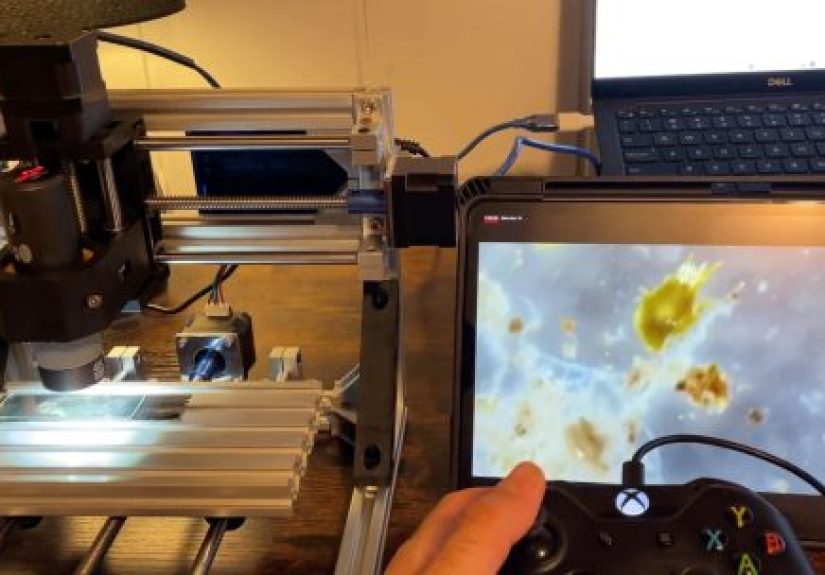
The title of this article comes from a wonderfully simple DIY concept that caught attention because it looked equal parts practical and delightfully overengineered. A small 1610-class desktop CNC machine was paired with a digital microscope and controlled through Universal G-Code Sender, with a game controller used to jog the motion. The result was a microscope system that could move smoothly enough to follow tiny organisms on a slide and stable enough to make the whole setup genuinely useful rather than just internet-famous for a weekend.
What makes that build memorable is not that it used elite industrial hardware. Quite the opposite. The charm is in how ordinary the ingredients were. A budget CNC platform. A consumer digital microscope. Open-source control software. A gamepad. No golden lab funding. No dramatic clean-room reveal. Just thoughtful tinkering and a sharp understanding of what each component could do when repurposed.
That is often where the best maker projects live. They do not wait for perfect tools. They repurpose available ones. And in this case, the idea worked because CNC motion systems and motorized microscope stages are cousins whether they admit it or not. Both revolve around controlled positioning. Both care about stability, travel range, and backlash. Both benefit from software that can repeat precise moves without complaint. The family resemblance was there all along.
Breaking Down the Three Ingredients
1. The CNC Machine: The Muscle With Good Manners
A small CNC machine is basically a motion platform with discipline. Even low-cost hobby models can offer controlled travel on multiple axes, which is exactly what microscope work needs. For scanning a sample, centering a target, or returning to a position you just found five seconds ago and immediately lost again, repeatable motion is a gift.
The biggest advantage is consistency. If you move left by a known increment, the machine does it. If you want to scan across a sample in a grid pattern, it can do that too. That opens the door to more advanced workflows such as image stitching, repeat inspections, or simple automation routines. In other words, the CNC is not just a fancy stand. It is the reason the project graduates from “look what I taped together” to “this could actually be part of a workflow.”
2. The Microscope: The Eye That Makes Tiny Things Feel Important
The microscope is where the project becomes useful instead of merely mechanical. A digital microscope turns the whole setup into a visual inspection system that can be more comfortable for beginners and more adaptable for tinkerers. You can display the image on a screen, record video, and evaluate samples without having your face physically pressed into the operation like a detective examining a breadcrumb.
This is especially useful for electronics, where stable close-up imaging can help with solder joints, component markings, trace inspection, and rework. It also matters in hobby biology, materials inspection, and curious-person science, where motion control helps keep the subject centered and reduces the frustration of manual repositioning.
3. The Game Controller: The Secret Sauce
This is the part that makes the setup awesome rather than merely effective. A controller is ergonomic, familiar, and built for responsive motion. That sounds obvious, but it is a huge deal. Good interfaces reduce friction. Bad ones make even smart hardware feel clumsy. A game controller lowers the barrier to operation immediately, because most people already understand how sticks, triggers, and buttons should feel.
For microscope navigation, that matters more than you might think. When you are following motion under magnification, every extra layer of awkward input becomes painfully obvious. A joystick-style interface lets you make fine or sweeping movements with much less mental overhead. It feels more like steering than commanding. That makes the system faster to learn, easier to enjoy, and more likely to get used regularly.
What You Can Actually Do With a Setup Like This
This is where the project stops being a novelty and starts earning bench space. One obvious use is biological observation. Tracking microorganisms or tiny moving creatures on a slide becomes much easier when the microscope can glide smoothly instead of being repositioned by hand. If you have ever tried to follow a lively specimen manually, you know the traditional method can feel like trying to film a squirrel through a paper towel tube.
Another strong use case is electronics inspection. A motorized microscope rig can be excellent for PCB repair, solder joint inspection, connector diagnosis, and close-up part analysis. You can move across the board more systematically, zoom into trouble spots, and reduce the wobble that comes from touching a manual stand or cheap microscope mount.
It is also useful for small-part metrology and surface inspection. Hobby machinists, jewelers, makers, and restorers often need to examine edges, wear patterns, finish quality, or tiny defects. A CNC-based microscope rig gives them a controlled way to scan, compare, and return to the same viewing position repeatedly. That repeatability is not glamorous, but it is often what separates “I think I saw something weird” from “yes, there is definitely a defect on this corner every time.”
And then there is the fun factor. Some tools invite experimentation. This is one of them. Once motion is automated, people start imagining add-ons: focus control, image capture triggers, scan routines, saved positions, better lighting, even stitching workflows. The project becomes a platform, not just a one-off hack.
Where the Setup Shines and Where It Still Has Limits
Let us be fair: this kind of DIY microscope rig is impressive, but it is not a magical replacement for professional lab equipment. A budget CNC machine still has the personality of a budget CNC machine. Rigidity, backlash, vibration, noise, and travel smoothness will vary by model and setup quality. Mounting also matters a lot. A microscope that is poorly attached will broadcast every tremor like it is auditioning for a disaster movie.
Focus is another challenge. Fine Z-axis control is possible, but practical usability depends on the mechanics of the machine, the weight of the microscope, and the software behavior. Lighting matters too. A good microscope image is not just about magnification; it is also about stable illumination, contrast, and working distance. In other words, the glamorous part of the build is motion control, but the boring details still decide whether the final experience feels smooth or janky.
There is also the matter of speed versus precision. A game controller makes motion easier, but users still need sensible mappings, speed limits, and a little restraint. Under magnification, even a tiny move can feel dramatic. This is one of those cases where “wow, it moves fast” is less useful than “wow, it lands exactly where I wanted.”
Still, the limitations do not cancel the idea. They simply define the upgrade path. Better mounts, improved bearings, software tuning, better lighting, saved-position macros, and cleaner cable management can all push the system from cool prototype toward reliable workstation.
Why Makers Love This Kind of Project
Because it represents the best kind of DIY engineering: practical creativity. It takes a machine designed for one task and reimagines it for another without forcing the hardware into nonsense. The motion platform is real. The imaging need is real. The controller solves a real user-interface problem. Nothing here is random. It is inventive, but grounded.
It also captures something makers adore: high-value repurposing. Instead of buying an expensive dedicated motorized microscope stage, the builder uses accessible CNC hardware and open-source tools to achieve much of the same core benefit. That is not just budget-conscious. It is empowering. It reminds people that advanced functionality is often a matter of system design, not just purchase price.
And yes, there is a little bit of gamer energy in the appeal too. Turning a microscope into something you can steer with a controller hits a sweet spot between science, engineering, and play. Serious tool, unserious grin. Those are often the best projects.
Hands-On Experience: What a Setup Like This Feels Like in Real Use
In real-world use, the biggest surprise is how quickly the setup stops feeling like a hack and starts feeling like a tool. The first few minutes are pure novelty. You move a microscope with a controller and your brain immediately says, “This is ridiculous.” Then, somewhere around the fifth smooth pan across a sample, your brain quietly changes its mind and says, “Actually, this is kind of brilliant.” That transition is the entire charm of the project.
For close-up inspection work, the experience becomes far more comfortable than many people expect. Instead of leaning in, nudging a stage, overshooting, correcting, bumping the stand, and repeating the cycle, you can stay relaxed and guide motion with your hands in a natural position. That sounds like a small ergonomic detail, but over a long session it matters. A tool that reduces physical awkwardness also reduces mental fatigue. You spend less attention on operating the hardware and more attention on what you are actually trying to see.
The smoothness of travel changes the mood of microscope work too. Manual systems can feel stop-and-start, especially when you are chasing a subject across a slide or moving across a dense PCB. A motorized stage gives motion a flowing quality. That does not automatically make the machine more precise, but it often makes the process more usable. You are no longer poking your way through a field of view. You are navigating it.
There is also a strong sense of control that comes from repeatable positioning. When you find an interesting area, move away, and then return to almost the same spot with confidence, the setup starts to feel smarter than its price tag suggests. That repeatability is one of the most satisfying parts of the whole experience. It creates trust. Once users trust the motion system, they begin experimenting more freely with routines, lighting angles, focus adjustments, and sample layouts.
Of course, the experience is not perfect. Cheap CNC hardware may vibrate a bit. Budget microscopes may not have the dream optics people imagine. Cable routing can turn into a tiny jungle if you are careless. And yes, if the mount is bad, the image may wobble like it drank three coffees. But that is part of the maker experience too. The system invites iteration. Every weakness is visible, which also means every improvement is rewarding.
Perhaps the best part is that the setup makes technical work feel playful without making it less serious. Inspecting solder joints, scanning specimen slides, and checking small mechanical parts are all legitimate tasks, yet doing them with a controller adds just enough delight to keep the process engaging. It is hard to overstate how valuable that is. People use tools more often when the tools feel good to use. Practical joy is not a gimmick. It is a feature.
That is why this project lands so well with hobbyists, educators, repair tinkerers, and curious bench scientists. It offers a rare combination: low-cost experimentation, visible results, and a user experience that is both functional and memorable. Many DIY projects are impressive once. This one has the potential to become part of a regular workflow, which is the real test of whether a build is clever or truly useful.
Final Thoughts
CNC plus microscope plus game controller equals awesome because it combines precision, visibility, and intuitive control in one refreshingly creative package. It proves that useful tool design does not always come from expensive catalogs or polished industrial branding. Sometimes it comes from looking at three unrelated pieces of hardware and realizing they have been trying to become friends this whole time.
More importantly, it points toward a broader truth in modern DIY engineering: open-source software, affordable motion hardware, and accessible digital imaging have lowered the barrier to building serious custom tools. That means a project like this is not just a cool one-off. It is a sign of how flexible hobby-grade technology has become. For makers, repairers, educators, and microscope nerds with a healthy appreciation for game controllers, that is very good news.