Table of Contents >> Show >> Hide
- So, What Exactly Got Confirmed?
- The Moment It Hit: A Ghost Particle Leaves a Very Non-Ghostly Signature
- Why 220 PeV Is Such a Big Deal (And Why Scientists Got Loud About It)
- Meet KM3NeT: The Deep-Sea Neutrino Telescope Doing Big Things Underwater
- The Confirmation Timeline: From “Wait, What?” to “Okay, This Is Real”
- Where Could a 220 PeV Neutrino Come From?
- How Scientists Estimate the Energy (Without Putting the Neutrino on a Scale)
- Why This Matters for the Future of Neutrino Astronomy
- Quick FAQ (Because Your Brain Deserves Closure)
- of “Experience” Around This Discovery (For the Humans Reading the Data)
- Conclusion
Imagine a particle so shy it can pass through planets like they’re made of fogyet so energetic it makes our best accelerators look like toy trains.
That’s the vibe of KM3-230213A, the record-setting ~220 peta–electron-volt (PeV) cosmic neutrino whose “hello” to Earth was first caught in 2023 and later
scrutinized, stress-tested, and ultimately treated as the real deal by the scientific community.
In other words: this wasn’t a sensor hiccup, a cosmic prank, or a spreadsheet error hiding behind a stylish plot. It was a genuine, ultra-high-energy visitor from deep spaceone that
opened a brand-new (and frankly wild) energy window for neutrino astronomy.
So, What Exactly Got Confirmed?
The headline version: a cosmic neutrino (or more precisely, the aftermath of its interaction) was detected by the KM3NeT/ARCA underwater neutrino telescope
in the Mediterranean Sea. The event is nicknamed KM3-230213A because it was recorded on February 13, 2023 (UTC), and it appears to correspond to a neutrino with an
estimated energy of roughly 220 PeV.
The confirmation story is a two-parter:
-
Initial scientific validation: After extensive reconstruction, simulations, and quality checks, the KM3NeT Collaboration reported the event in a high-profile peer-reviewed
publication, describing it as consistent with a cosmic neutrino and detailing the detector response and energy inference. -
Independent context and “does this make sense?” analysis: Follow-up work in the literature examined how this event fits (or doesn’t neatly fit) into the broader “global neutrino landscape,”
including comparisons with other observatories’ non-observations at similar energies and what that implies for flux models.
Translation: the particle didn’t just show up; it also survived the scientific equivalent of a TSA pat-down, a full background check, and a neighbor’s “yeah but are you sure?” interrogation.
The Moment It Hit: A Ghost Particle Leaves a Very Non-Ghostly Signature
Neutrinos are famously hard to catch because they rarely interact with matter. That’s why neutrino observatories are built like gigantic “traps” made of natural transparent material
Antarctic ice for IceCube, deep ocean water for KM3NeTinstrumented with sensitive light detectors.
In this case, the neutrino itself didn’t stroll up and hand over an ID card. Instead, it likely interacted in or near seawater close to the detector, producing a muon that streaked through the array.
That muon emitted Cherenkov lighta blue glow created when a charged particle moves through a medium faster than light travels in that medium.
KM3NeT’s optical sensors saw a fast, bright track consistent with an extremely energetic muon. From the observed light pattern and reconstruction, researchers estimated the muon energy at about
120 PeV (with substantial uncertainty), implying the original neutrino’s energy was even higheraround the now-famous ~220 PeV estimate.
Why 220 PeV Is Such a Big Deal (And Why Scientists Got Loud About It)
“PeV” stands for peta–electron-voltthat’s 1015 electron-volts. A 220 PeV neutrino carries an almost comical amount of energy for a single subatomic particle.
It’s the kind of number that makes physicists do two things in rapid succession: (1) grin, (2) ask what went wrong.
Here’s the punchline: this event appears to be roughly 20–30 times more energetic than previous record-holders seen in neutrino observatories.
IceCube has observed neutrinos up to about ~10 PeV in energy, and those were already considered extreme.
So a credible jump to ~220 PeV is like going from “fastest car in town” to “wait, why is that rocket parked at Starbucks?”
The scientific impact is twofold:
- Astrophysics: Something in the universe can accelerate particles and produce neutrinos at astonishing energies, likely beyond our galaxy.
- Particle physics: Ultra-high-energy neutrinos probe interactions at energies beyond human-made accelerators, offering a “natural laboratory” for testing physics in extreme regimes.
Meet KM3NeT: The Deep-Sea Neutrino Telescope Doing Big Things Underwater
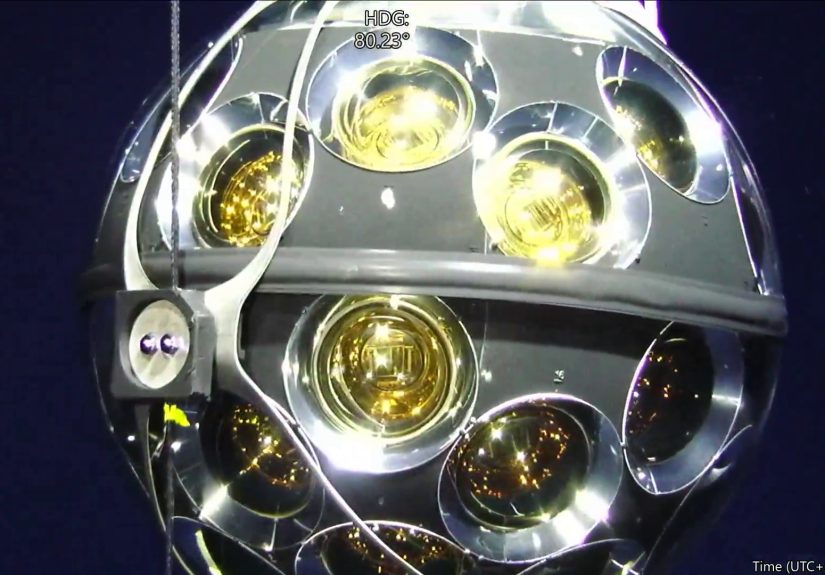
KM3NeT is not a single device so much as a sprawling, modular detector network anchored to the Mediterranean seabed. It uses vertical lines (“strings”) of optical modules to detect faint flashes of Cherenkov light.
Two major components are often discussed:
- ARCA (Astroparticle Research with Cosmics in the Abyss): optimized for high-energy cosmic neutrinos.
- ORCA (Oscillation Research with Cosmics in the Abyss): tuned for lower-energy neutrinos and neutrino oscillation studies.
The record event is associated with ARCA, which is designed to spot the kind of long muon tracks that help reconstruct direction and energy.
The detector was still under construction at the time, which makes the detection even more eyebrow-raising: it’s like catching a home-run ball while the stadium is still being built.
The Confirmation Timeline: From “Wait, What?” to “Okay, This Is Real”
1) February 2023: A track that looked way too bright to ignore
On February 13, 2023, KM3NeT recorded an exceptionally energetic muon-like track across the ARCA detector.
The event lit up a significant fraction of the active sensors, giving analysts a rich pattern to reconstruct.
2) The boring-but-essential phase: simulations, calibrations, and ruling out “oops”
High-energy neutrino claims don’t get confirmed by vibes. Researchers have to rule out instrumental artifacts, background muons from cosmic-ray air showers, reconstruction biases, and rare atmospheric neutrino scenarios.
They also test how robust the inferred energy is to uncertainties like the unknown interaction point and undetected energy carried away in particle showers.
3) 2025: Peer-reviewed publication and broader scientific scrutiny
The KM3NeT Collaboration published the event analysis and interpretation, describing it as consistent with a cosmic neutrino and presenting the energy inference (including uncertainty ranges).
After that, other scientists did what scientists do: they tried to break the storyby comparing it to limits from other observatories, testing flux expectations, and evaluating how “surprising” this event should be.
4) The “landscape” check: does it fit with what IceCube and others see?
Follow-up analyses in the literature examined whether a ~220 PeV event is consistent with diffuse neutrino flux models and with other experiments’ upper limits.
A recurring theme is that the event is both exciting and a bit awkward: depending on assumptions, it can look like a statistical fluke, a hint of a new component, or evidence we’ve underestimated rare ultra-high-energy neutrino production.
Where Could a 220 PeV Neutrino Come From?
This is the million-dollar questionexcept the currency is “years of telescope time” and the change in your pocket is “uncertainty bars.”
At these energies, most explanations point beyond the Milky Way.
Candidate source class #1: Monster engines (black holes, jets, and violent transients)
Neutrinos are often produced when ultra-relativistic cosmic rays interact with matter or radiation near powerful accelerators.
The usual suspects include active galactic nuclei (AGN) with jets, blazars, gamma-ray bursts (GRBs), and tidal disruption events
(when a star gets shredded near a supermassive black hole).
The challenge: a single neutrino is like a single raindropyou can tell it’s raining somewhere, but not which street corner unless you have more drops (or strong multi-messenger coincidences).
Candidate source class #2: Cosmogenic neutrinos (the “cosmic-ray road trip” effect)
A particularly tantalizing possibility is that KM3-230213A is cosmogenic, meaning it was produced when ultra-high-energy cosmic rays traveled through intergalactic space and interacted with background photons,
including the cosmic microwave background (CMB). This is related to the same physics behind the Greisen–Zatsepin–Kuzmin (GZK) effect that limits the distance the highest-energy cosmic rays can travel.
If confirmed as cosmogenic with future events, that would be huge: it would connect neutrino astronomy directly to the ultra-high-energy cosmic-ray mystery and help map how the universe accelerates particles to insane energies.
But waitwhy was this event “surprising”?
One reason is that other observatories have placed strong upper limits on ultra-high-energy neutrino fluxes. So the appearance of a single, very energetic event during an early KM3NeT observing period raises a natural question:
“If neutrinos this energetic are that common, why hasn’t everyone else seen them too?”
The honest answer right now: we need more statistics. One event can be extraordinary and still sit uncomfortably within expectations, especially given large uncertainties in energy inference and the steeply falling neutrino spectrum.
How Scientists Estimate the Energy (Without Putting the Neutrino on a Scale)
Energy estimation in neutrino telescopes is part physics, part detective work, and part humility.
For track events like this, what’s actually measured is the light produced by the muon and secondary particles.
Researchers then simulate many possible scenarios that could produce the observed light yield and geometry, accounting for:
- Muon energy losses along the track (stochastic at high energy)
- Unknown distance between neutrino interaction point and detector
- Hadronic showers that may be partially “invisible” to the detector depending on geometry
- Optical properties of water and detector calibration
This is why you’ll often see an energy “best estimate” with a broad uncertainty band. For KM3-230213A, the commonly cited headline value is ~220 PeV, but analyses discuss wide ranges for plausible true energies.
That uncertainty isn’t a weaknessit’s the scientific system being honest about what can and can’t be known from a single glorious streak of blue light.
Why This Matters for the Future of Neutrino Astronomy
Neutrino astronomy is a relatively young field. For decades, neutrinos were mostly famous for being elusive and for causing physicists to argue politely (and sometimes not-so-politely) about missing solar neutrinos.
Modern observatories changed that by catching high-energy neutrinos from beyond Earth and, in some cases, linking them to cosmic sources.
A 220 PeV-scale event pushes the frontier outward. If more such detections follow, we could:
- Constrain the origin of ultra-high-energy cosmic rays by connecting neutrino production to cosmic-ray propagation.
- Improve multi-messenger alerts, coordinating neutrinos with gamma-ray, X-ray, optical, and gravitational-wave observations.
- Test particle interactions at extreme energies that no collider can reach, using nature’s own accelerators.
And yes, it also means a lot more late nights for analysts staring at event displays, whispering, “Please don’t be a fluke,” like it’s the season finale of a prestige drama.
Quick FAQ (Because Your Brain Deserves Closure)
Did the neutrino “hit Earth”?
In practical terms, yes. It arrived at Earth and interacted in or near seawater, producing detectable secondary particles. Most neutrinos pass through Earth unnoticed; this one left receipts.
Is the source identified?
Not definitively. The event is consistent with an astrophysical origin and likely extragalactic, but a single event isn’t enough to pin down a specific object without stronger multi-messenger coincidence.
Is 220 PeV the exact energy?
It’s an estimate with substantial uncertainty. The measured muon energy is lower than the inferred neutrino energy, and the neutrino estimate depends on modeling and unknown geometry.
of “Experience” Around This Discovery (For the Humans Reading the Data)
If you want to understand why the confirmation of a ~220 PeV neutrino makes scientists giddy, picture the emotional arc of an analysis shift.
Someone opens a dashboard and sees an event that’s… loud. Not “caps lock” loud, but “why is the plot doing that?” loud.
In neutrino physics, the first feeling is never triumph. It’s suspicion. Because detectors are honest machines that sometimes have dishonest moments.
The experience becomes a ritual: replay the reconstruction, check calibration constants, compare to known background signatures, and run simulations until the event feels less like a jump scare and more like a story you can justify in public.
People trade screenshots the way sports fans trade highlightsexcept the highlight is a ghost particle leaving a neon-blue scribble through the Mediterranean.
Someone inevitably says, “It’s probably a weird atmospheric muon,” and someone else replies, “Sure, and I’m probably an astronaut.”
Then the real grind starts. Weeks turn into months because “confirmation” is not a vibe; it’s a paper trail.
Analysts test how the energy changes if the interaction happened closer, farther, slightly off-axis, or in a geometry that hides some of the shower energy.
Every assumption gets poked. Every uncertainty gets quantified. Your confidence grows, but it grows slowlylike sourdough starter, except with more statistics and fewer carbs.
For the broader community, following the discovery feels like watching a mystery unfold in real time.
Popular coverage focuses on the wow-factor (“most energetic ever!”), while researchers quietly obsess over the unsexy details: effective area, exposure time, and whether the inferred flux plays nicely with limits from other experiments.
That tension is part of the thrill. A single event can be both a breakthrough and a headachean invitation to rethink models or to wait for the universe to send another message.
And that’s the most relatable part: the waiting.
Neutrino astronomers can’t point a telescope and demand another 220 PeV particle on schedule. They build enormous detectors, keep them stable in brutal environments, and listen.
When something extraordinary arrives, the experience is half celebration and half responsibility. Because if the universe just handed you a record-breaking clue, the least you can do is make sure you’re reading it correctly.
So the “experience” of this confirmationwhether you’re on the collaboration or cheering from the sidelinesis a mix of awe and discipline.
Awe that something out there can forge a particle with that much energy, and discipline to prove you didn’t just fall in love with a beautiful glitch.
The best part? The story isn’t over. If more ultra-high-energy neutrinos show up, this first confirmed punch from the cosmos may read less like a one-off and more like the opening sentence of a whole new chapter.