Table of Contents >> Show >> Hide
Every few months, the internet finds a new relationship story to drag into the town square, squint at, and loudly label either genius or unhinged. This time, the main character is a woman whose dating policy is so specific, so permanent, and so gloriously incapable of being ignored that it practically arrived online wearing a spotlight. Her rule? If a man gets close enough to become part of her story, his mother’s name may end up tattooed on her body.
And just like that, the internet did what it does best: formed a jury in sweatpants. Some people called the idea brilliant performance art. Others called it creepy, invasive, manipulative, or just plain cringe. A few seemed impressed in the way people are impressed by a tornado: horrified, but unable to look away.
The fascination is not really about the ink alone. It is about power, gender, privacy, dating exhaustion, online spectacle, and the weirdly modern instinct to turn personal pain into content. It is also about a question that keeps resurfacing in the digital age: when a woman makes a provocative choice about her own body, does that automatically make it feminist, or does the label need a little more paperwork?
What Actually Happened?
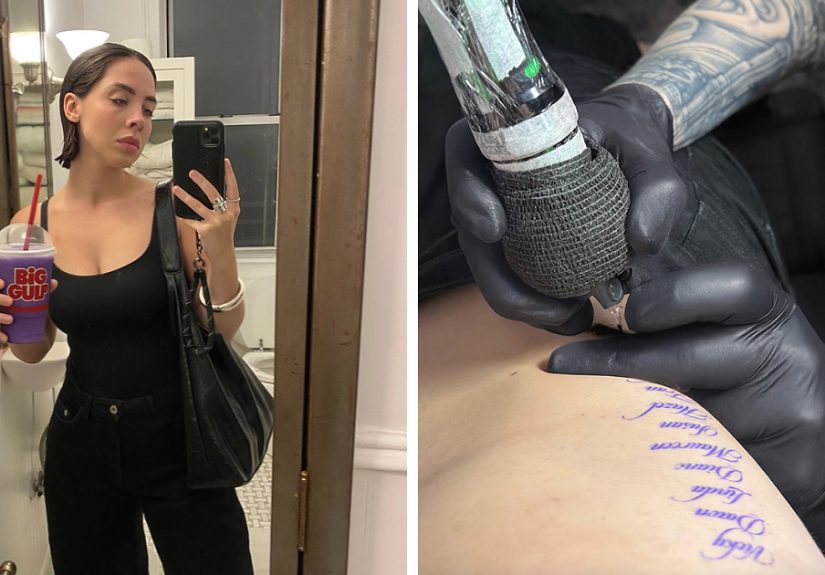
The viral debate centers on Harriet Richardson, a performance-oriented creator who revealed that she had tattooed the names of the mothers of 14 former partners on her torso as part of a project titled Temporary. According to published interviews and follow-up reporting, Richardson intentionally avoided using the men’s names. The point, as she framed it, was to spotlight the split between women men supposedly respect and women they treat as temporary.
In other words, she wasn’t trying to memorialize the men. She was trying to expose a social script. Mothers, in this framing, symbolize women who are revered. Casual partners, meanwhile, often get shoved into a more disposable category. By placing the mothers’ names on her own body, Richardson said she was collapsing that divide into one visual statement.
It is certainly a statement. Whether it is a coherent one is where the fireworks begin.
The controversy grew sharper when people learned she had pieced together some names through old records, social-media searches, and even a private investigator. She also said the tattoo had become a kind of boundary-setting device: future partners, she suggested, would need to provide their mother’s name upfront if they wanted to move forward. That is the point where many onlookers stopped debating art theory and started backing away from the screen like they had accidentally opened a haunted group chat.
Why The Internet Split So Fast
The reason this story exploded is simple: it presses on several cultural bruises at once.
First, it touches the never-ending argument over whether women’s choices should be read as empowerment, self-objectification, or both at the same time. Second, it taps into the online obsession with labeling relationship behavior as either a boundary or a red flag, with absolutely no middle ground allowed. Third, it combines sex, tattoos, family, privacy, and revenge-adjacent energy in one package. That is basically catnip for modern outrage.
To supporters, the tattoo reads like a sharp critique of how women are categorized. It says the supposedly respectable woman and the supposedly disposable woman are not opposites at all; they are connected through the same male-centered value system. To critics, though, the project looks less like feminist analysis and more like personal grievance with a needle attached.
That split matters because both readings contain a piece of the truth. Richardson is clearly making an argument about gender. But the performance also raises ethical questions that body autonomy by itself cannot erase. You can absolutely have the right to do something with your own body and still leave everyone else wondering why this felt like the best possible idea before breakfast.
The Tattoo Debate Is Bigger Than One Viral Story
Tattoos Are Mainstream Now, But Permanent Drama Still Freaks People Out
Americans are not exactly scandalized by tattoos anymore. They are mainstream, common, and often deeply personal. People get tattoos to honor loved ones, mark survival, celebrate identity, or make a statement they want to carry permanently. That makes this story especially interesting. The backlash is not really about ink itself. It is about what the ink represents.
A memorial tattoo for a grandparent? Sweet. A tattoo that quietly says, “I survived something hard”? Powerful. A tattoo that turns your former love life into a permanent conceptual art ledger? Suddenly everyone becomes an ethicist.
That reaction makes sense. Tattoos carry symbolic weight precisely because they are not just opinions you can delete after coffee. They are commitment. So when the commitment seems impulsive, invasive, or designed to provoke, people respond as if the permanence itself is part of the offense.
The Sexual Double Standard Is Still Alive, Just Wearing New Clothes
One reason the conversation got so heated is that stories involving women’s sexual choices still draw a different kind of scrutiny. The language changes with the era, but the old script often remains. Women are encouraged to be autonomous, bold, and expressive, right up until that expression makes people uncomfortable. Then the labels come out fast: desperate, unstable, attention-seeking, damaged, too much.
That does not mean every criticism of this tattoo project is sexist. Plenty of the objections are about privacy, intensity, and consent-adjacent concerns, and those are fair. But it would be naive to pretend gender plays no role in how the story is being consumed. If a male artist created a provocative body-based project tied to past partners, the reaction would likely be ugly too, but it would not necessarily travel through the same old cultural tunnel of women being judged as either respectable or disposable.
That is what makes the story so sticky. It invites criticism while simultaneously exposing the exact cultural habits that often fuel criticism of women in the first place. It is a debate trap with ink.
Social Media Loves Turning Messy Human Feelings Into Team Sports
Platforms are fantastic at flattening complicated subjects into tiny, loud categories. Is this empowering or psychotic? Boundary or threat? Art or stunt? Feminist icon or walking red flag? Pick one before the comments close.
But real life is more annoying than that. Real life insists on nuance. Social media, meanwhile, prefers slogans, screenshots, and courtroom energy.
This matters because dating discourse online has become incredibly performative. Relationship language gets borrowed from therapy, activism, and self-help until everything sounds profound while meaning less and less. People call ordinary incompatibility “trauma.” They call communication “vulnerability work.” They call one bad date a documentary series. In that atmosphere, a tattoo rule like Richardson’s does not just exist as a private decision. It becomes a shareable symbol for every argument people already want to have.
Is It Actually Feminist?
Here is the part where the internet usually starts throwing digital folding chairs.
There is a lazy version of feminism that says, “A woman chose it, therefore it is feminist.” That idea sounds supportive, but it is too thin to be useful. Choice matters. Bodily autonomy matters. The right to make strange, funny, dramatic, inconvenient, or even aesthetically questionable decisions matters. But feminism is not just a permission slip for individual behavior. It is also a framework for asking what power is doing, who is affected, and whether an action challenges or simply repackages the same old hierarchy.
By that standard, Richardson’s tattoo project is more interesting than the comment section gives it credit for, but it is also more flawed than its defenders sometimes admit.
Yes, the project critiques a genuine social pattern: men and society at large often sort women into categories of respectability. Yes, using the mothers’ names instead of the men’s names cleverly shifts attention away from male ego and toward the women orbiting it. And yes, reclaiming the body as a site of statement can be politically meaningful.
But feminism does not cancel out ethical tension. If the project depends on pulling uninvolved mothers into the symbolism, people are allowed to question that. If the performance blurs the line between art and emotional retaliation, people are allowed to notice that too. A piece can be provocative, intentional, and still not land the way its creator hopes.
So is it feminist? In part, yes. Is it also theatrical, ethically messy, and built to provoke disgust as much as thought? Also yes. Welcome to contemporary internet art, where several things can be true and nobody is emotionally prepared for that.
What The Story Says About Dating Culture Right Now
The real reason this tattoo saga resonated is that it translates modern dating fatigue into a literal mark on the body. Many people today are exhausted by unclear intentions, ghosting, performative intimacy, situationships with all the stability of a folding chair, and the general sense that romance has become half emotional roulette, half branding exercise.
In that landscape, extreme rules can feel weirdly appealing. They create certainty. They say, “You do not get access to me on autopilot.” That instinct is understandable. Plenty of women, especially online daters, report harassment, boundary-pushing, unwanted messages, and communication patterns that feel dehumanizing. When people are tired of being treated like they are disposable, they often look for rituals, rules, or symbols that make disposability harder.
But the healthiest version of that instinct usually looks like better communication, slower pacing, clearer standards, or opting out of bad dynamics altogether. It does not usually look like turning your ribcage into the world’s most niche spreadsheet.
That is the contradiction at the heart of the viral reaction. People understand the frustration. They just do not all support the method.
Related Experiences And Real-World Reflections
The experiences tied to this story are often far less theatrical than a viral tattoo reveal, but they are probably more familiar. A woman goes on a string of promising dates, only to be ghosted the minute intimacy enters the picture. Another decides she will no longer keep explaining obvious boundaries to men who treat basic respect like a limited-time offer. Someone else gets a tattoo after a breakup, not because she wants revenge, but because she needs to turn an invisible emotional chapter into something concrete and visible. These stories rarely trend, but they are everywhere.
There is also the experience of realizing that modern dating often encourages people to perform detachment while privately craving sincerity. Many women have described feeling as though they are expected to be fun, available, low-maintenance, emotionally aware, attractive, independent, and completely unaffected by ambiguity, all at once. That combination is exhausting. It can leave people searching for rules that restore a sense of agency, even if those rules look dramatic from the outside.
Another familiar experience is the internet itself. A person shares one unusual choice online and suddenly strangers begin diagnosing, praising, mocking, psychoanalyzing, and projecting. One camp says, “Queen behavior.” Another says, “Seek help.” Very few ask the slower question: what pain, idea, or contradiction is this person trying to name? Public reaction tends to flatten women especially fast. They become either empowered symbols or cautionary tales, with precious little room to just be complicated humans making debatable decisions.
Then there is the tattoo angle, which many people understand on a deeply personal level. Tattoos are often less about decoration than memory. They can represent grief, anger, rebirth, identity, survival, faith, family, or a version of the self you do not want to lose. But because they are permanent, they also expose a person’s judgment to public scrutiny in a way a haircut or a bad text never will. People who regret tattoos often say the regret is not only about the image. It is about who they were when they chose it. That is why stories like this strike such a nerve. They force everyone to imagine what it would mean to make a feeling permanent.
And finally, there is the experience of trying to protect your dignity in a culture that often turns intimacy into a transaction. Some women respond by becoming more selective. Some step back from dating entirely. Some get funnier, colder, stricter, or more openly political. Some turn their experiences into art. Richardson’s project may be unusually intense, but the emotional soil it grew from is not unusual at all. Plenty of people know what it is like to want a visible boundary after too many invisible disappointments.
That does not mean every response to frustration is wise. But it does mean the story resonates because it is speaking, in a very loud dialect, to real experiences many people have had in quieter ways.
Final Thoughts
The internet loves a simple verdict, but this story refuses to behave. Harriet Richardson’s tattoo rule is provocative, memorable, and undeniably effective at grabbing attention. It also sits at the crossroads of body autonomy, gender politics, privacy concerns, dating exhaustion, and online spectacle. That is why people cannot stop arguing about it.
If you think the project is brilliant, you probably see a woman refusing to remain emotionally disposable. If you think it is creepy, you probably see an ethically messy performance dragging other people into a private grievance. Most likely, the reason it went viral is that both reactions can coexist.
And maybe that is the most modern part of the entire story. In the age of public intimacy, even our boundaries have to perform. Some people do it with therapy language. Some do it by deleting apps. Some do it by staying single on purpose. And one woman, apparently, did it with a tattoo list made of other people’s mothers.
The internet called it cringe. The internet called it feminist. The internet called it art. But the strongest takeaway may be simpler: modern dating has become so chaotic that even the most bizarre coping mechanism can look, to somebody, like a completely reasonable reaction.