Table of Contents >> Show >> Hide
- A Mammoth Discovery in a Mississippi Creek
- Why This Mammoth Tusk Is So Rare
- Meet the Columbian Mammoth: The Ice Age Heavyweight
- Mammoth vs. Mastodon: Why the Difference Matters
- What the Tusk Reveals About Ancient Mississippi
- How Scientists Preserve a Fossil Tusk
- Why Amateur Fossil Hunters Matter
- Legal and Ethical Fossil Hunting: What to Remember
- Why the Public Loves Mammoth Discoveries
- Field Experiences: Lessons From a Mammoth-Sized Discovery
- Conclusion: A Rare Tusk, a Bigger Story
Every fossil hunter dreams of the moment when an ordinary day outdoors turns into a headline. For Eddie Templeton, that moment arrived in rural Madison County, Mississippi, when a curved shape sticking out of a creek bank turned out to be something far more exciting than a root, rock, or old piece of farm equipment. It was a massive, intact Columbian mammoth tuskroughly seven feet long, spectacularly preserved, and widely described as a once-in-a-lifetime Ice Age discovery.
The find has the kind of story science writers secretly love: a curious local collector, a muddy creek, a suspiciously tusk-like object, a quick call to experts, and then a full-scale rescue mission before heat, water, and gravity could ruin a fossil that had survived for thousands of years. In other words, Mother Nature left a treasure chest in the bank, and Templeton happened to be the person paying close enough attention to notice the lid was open.
Although “20,000-year-old mammoth tusk” makes a thrilling headline, the broader scientific context is even richer. The fossil belongs to the Pleistocene epoch, a time when giant mammals roamed what is now North America. Columbian mammoths, mastodons, ancient horses, giant bison, ground sloths, saber-toothed cats, and other Ice Age animals once shaped the landscapes that modern highways, farms, and neighborhoods now cover. This tusk is not just a big piece of ivory. It is a rare clue from a lost world.
A Mammoth Discovery in a Mississippi Creek
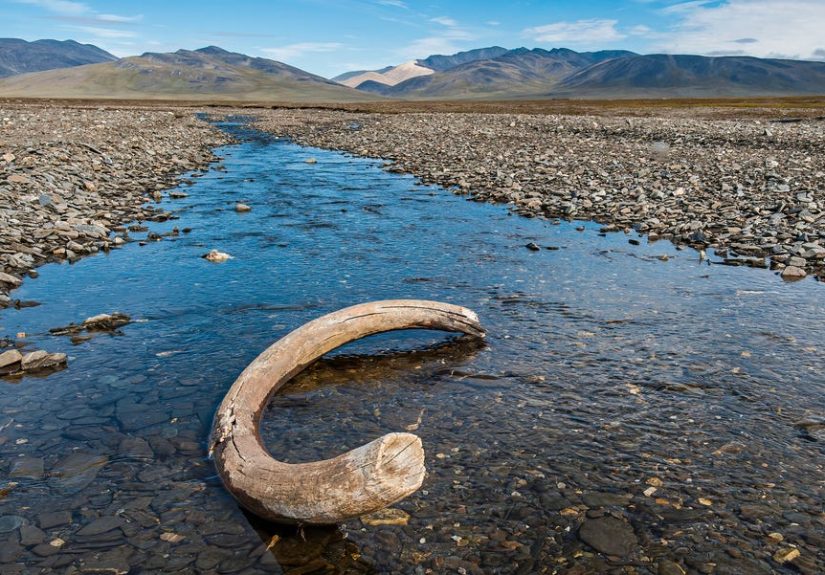
Templeton was exploring a creek in Madison County, Mississippi, when he noticed part of a tusk exposed in a steep bank near the water. Experienced fossil collectors know that rivers and creeks can be excellent places to spot fossils because erosion naturally cuts into old layers of sediment. In this case, the creek had revealed part of a fossil that had been buried in alluvial depositssediments laid down by moving water during the Pleistocene.
At first, Templeton reportedly suspected he had found a mastodon tusk. That was a reasonable guess. Mastodon fossils are more common in Mississippi than mammoth fossils, and both animals had impressive ivory tusks. But the shape of this fossil told a different story. Its strong curve suggested a Columbian mammoth, an animal larger than the woolly mammoth and one of the giants of ancient North America.
Recognizing the importance of the find, Templeton contacted experts rather than trying to remove the fossil casually. That decision mattered. A tusk that has rested underground for thousands of years can be surprisingly fragile once exposed. Sun, drying, shifting sediment, careless handling, or even a curious passerby with too much enthusiasm and not enough patience can damage a fossil quickly.
A team connected with Mississippi’s geological and natural science experts helped excavate the tusk by hand. They carefully removed the surrounding clayey sand and sediment, exposed the fossil, protected it with aluminum foil, burlap, and plaster, and transported it for study and preservation. Once jacketed, the specimen reportedly weighed hundreds of pounds. So yes, finding the tusk was excitingbut moving it was the part where everyone’s backs probably filed a formal complaint.
Why This Mammoth Tusk Is So Rare
The discovery is considered rare because intact mammoth tusks are not everyday finds in Mississippi. Fossil tusk fragments have been found in the state, and mastodon remains are more common, but a complete Columbian mammoth tusk is exceptional. In fact, reports described it as the first complete tusk of its kind officially documented in Mississippi.
That matters because fossils are not evenly distributed like coins in a parking lot. They preserve only under the right conditions. An animal must die in a place where its remains can be buried quickly enough to avoid total destruction by scavengers, weather, water movement, and decay. Then the chemistry of the surrounding sediment must be suitable for preservation. After thousands of years, erosion must expose the fossil again at just the right timepreferably when someone knowledgeable is walking by.
In this case, the tusk was preserved in a creek bank, where water had helped both bury and eventually reveal it. The surrounding geology gives scientists clues about how the tusk ended up there. It may have been separated from the animal’s skull after death, moved by water, and buried in sediment. Tusks can detach from skulls naturally, especially as remains break down or shift after burial.
Meet the Columbian Mammoth: The Ice Age Heavyweight
The Columbian mammoth, known scientifically as Mammuthus columbi, was one of the largest mammoths to roam North America. While woolly mammoths often get the celebrity treatmentprobably because “woolly” sounds adorable even when attached to a multi-ton animalColumbian mammoths were enormous. Adult males could stand around 13 feet or more at the shoulder and weigh close to 22,000 pounds. That is not an elephant in the room. That is the room.
Unlike woolly mammoths, which were adapted to colder northern environments, Columbian mammoths lived in more temperate and southern regions. They ranged across much of North America and preferred open habitats such as grasslands, savannas, and prairie-like environments. Their diet consisted largely of grasses and other tough vegetation, making them grazers rather than forest browsers.
This distinction helps explain why Columbian mammoth fossils may be less common in some parts of Mississippi than mastodon fossils. Mastodons were browsers, feeding on leaves, twigs, shrubs, and trees. They could live in more wooded habitats. Mammoths, by contrast, were more tied to open landscapes. That makes a Columbian mammoth tusk from central Mississippi especially useful for understanding where Ice Age prairie environments existed and how these animals used them.
Mammoth vs. Mastodon: Why the Difference Matters
To casual observers, mammoths and mastodons can look like prehistoric cousins who showed up to the same family reunion wearing different tusks. They were both proboscideans, relatives of modern elephants, and both lived in North America during the Ice Age. But they were not the same animal.
Different teeth, different diets
Mammoths had ridged molars suited for grinding grasses, much like modern elephants. Mastodons had bumpier, cone-shaped teeth better suited for crushing leaves, twigs, and woody plants. In fossil identification, teeth are often more informative than tusks because diet leaves clear evolutionary signatures in dental anatomy.
Different tusk shapes
Mammoth tusks were typically more curved, sometimes dramatically so. Mastodon tusks tended to be straighter. The strong curvature of Templeton’s discovery was one of the clues that pointed experts toward Columbian mammoth rather than mastodon.
Different habitats
Mastodons generally favored wooded or mixed environments, while Columbian mammoths were more associated with open grasslands and prairie habitats. This difference makes the Mississippi tusk especially interesting because it supports the idea that parts of the region once offered open landscapes suitable for mammoths.
What the Tusk Reveals About Ancient Mississippi
Today, Mississippi is known for rivers, forests, farms, wetlands, and warm Southern weather. During the Pleistocene, however, the landscape was different. Cooler global climates, shifting river systems, changing vegetation, and wind-blown glacial silts helped create environments that supported large grazing animals.
The Jackson Prairie region of central Mississippi is particularly important in this story. Prairie ecosystems would have provided food for grazers such as Columbian mammoths, extinct horses, and giant bison. These large herbivores, in turn, would have influenced plant communities by grazing, trampling, spreading seeds, and opening pathways through vegetation. Think of them as Ice Age landscapers, except with tusks and no hourly invoice.
Predators also lived in this world. Saber-toothed cats, dire wolves, and American lions were part of the broader Pleistocene ecosystem. The presence of mammoths in the region helps scientists reconstruct not just one animal’s life but an entire vanished community. A single tusk can point toward ancient food webs, migration routes, river behavior, climate conditions, and habitat boundaries.
How Scientists Preserve a Fossil Tusk
A fossil tusk may look solid when first discovered, but it can be extremely vulnerable. Ivory is organic material, and after thousands of years underground, it may crack, crumble, or dry out when exposed to air. That is why experts often stabilize fossils in the field before moving them.
In the Mississippi discovery, the recovery team used a protective jacket made with materials such as foil, burlap, and plaster. This is a standard fossil-recovery method. The jacket supports the fossil during transport, much like a cast supports a broken bone. Once the specimen reaches a lab or museum facility, preparators can slowly remove surrounding sediment, repair cracks, stabilize fragile areas, and document the fossil in detail.
That careful process can take months. It is not as dramatic as the initial discovery, but it is where much of the scientific value is protected. A fossil without proper documentation loses context. Where exactly was it found? What sediment surrounded it? Was it associated with other fossils? What was the orientation? These details help scientists interpret how the animal lived, died, and became preserved.
Why Amateur Fossil Hunters Matter
Templeton’s discovery highlights a key truth about paleontology: important fossils are not always found by professional scientists on formal expeditions. Many are discovered by hikers, farmers, construction workers, fishermen, fossil collectors, and outdoor enthusiasts who notice something unusual and report it responsibly.
Amateur fossil hunters often spend more time in local creeks, gravel bars, fields, and road cuts than professionals can. Scientists rely on public awareness because fossils are constantly being exposed by erosion and development. When people know what to doand what not to dothey can help preserve discoveries that might otherwise be lost.
The best fossil hunters are observant, patient, and humble. They learn local geology. They understand land ownership rules. They do not trespass. They avoid damaging fragile specimens. Most importantly, when they find something significant, they contact professionals. That is how a personal discovery becomes public knowledge.
Legal and Ethical Fossil Hunting: What to Remember
Fossil hunting can be fun, educational, and deeply rewarding, but it should always be done legally and ethically. Rules vary by state, land type, and fossil category. Collecting on private land requires permission from the landowner. Collecting on public lands may be restricted or prohibited, especially for vertebrate fossils such as mammoth, mastodon, horse, sloth, or bison remains.
In general, casual collectors should avoid removing large or scientifically important fossils without expert guidance. A fossil’s location and surrounding sediment are part of the evidence. Pulling it out too quickly can destroy information that scientists need. Photographing the fossil in place, recording the location, and contacting a museum, university, geological survey, or natural history agency is often the smartest move.
There is also a safety issue. Creek banks can collapse. Heavy fossils can injure people. Summer heat can be dangerous. Snakes, unstable mud, deep water, and sharp debris are not exactly rare in field settings. The romance of fossil hunting is real, but so is the possibility of slipping into a creek while holding a shovel and questioning your life choices.
Why the Public Loves Mammoth Discoveries
Mammoths occupy a special place in the American imagination. They are familiar enough to recognize but ancient enough to feel mysterious. Children learn about them in museums. Adults see them in documentaries. Their tusks, size, and Ice Age setting make them instantly dramatic.
Discoveries like the Mississippi tusk remind us that prehistory is not locked away in distant deserts or frozen Siberian permafrost. It can be under a farm, beside a creek, beneath a construction site, or tucked into a layer of sediment exposed after heavy rain. The past is not gone. It is buriedand occasionally it peeks out.
That is why this story resonates. It turns a local creek into a time machine. It shows that ordinary landscapes can hold extraordinary evidence. And it gives readers the irresistible thrill of imagining themselves spotting a curve in the mud and realizing it is not just a curve. It is a message from the Ice Age.
Field Experiences: Lessons From a Mammoth-Sized Discovery
The discovery of a 20,000-year-old mammoth tusk offers more than a science headline; it offers a practical field lesson for anyone who loves rocks, fossils, hiking, creeks, or the satisfying feeling of noticing what everyone else walks past. Fossil hunting is often less about luck than attention. Yes, Templeton was fortunate to be in the right place at the right time, but he also had the experience to recognize that the object in the creek bank deserved a closer look.
One major lesson is to train your eyes before you train your shovel. Fossils rarely announce themselves with museum lighting and a helpful label. They can resemble roots, stones, bones, shells, or odd textures in a bank. A tusk may appear as a curved, weathered surface with an unusual color or grain. A tooth may look like a strange rock until the ridges become obvious. The more you learn about local fossils, the better your chances of identifying something meaningful.
Another experience-based lesson is that location matters. Creeks, gravel bars, eroded banks, and freshly exposed sediment can reveal fossils because moving water acts like nature’s excavator. After storms or seasonal water changes, new material may become visible. However, those same places can be dangerous. Banks collapse without warning, water depth changes, and mud can be slick enough to make even a confident adult perform an accidental cartoon fall. Good boots, gloves, water, sun protection, and a cautious attitude are not optional accessories; they are part of the job.
Responsible fossil hunters also learn when to stop. That may sound strange, but it is crucial. If a fossil is large, fragile, rare, or still embedded in sediment, digging aggressively can ruin it. The better move is to photograph it, mark the location, note nearby landmarks, and contact experts. Professionals can stabilize the fossil and preserve its scientific context. In Templeton’s case, quick reporting helped save the tusk from exposure, drying, cracking, and possible loss.
There is also a deeper emotional experience in fossil hunting. Finding something ancient changes the way you see a place. A quiet creek is no longer just a creek. It becomes a layered record of vanished climates, extinct animals, shifting rivers, and ancient ecosystems. You begin to understand that every landscape has a memory. Some memories are written in shells, some in bones, some in teeth, and occasionally one appears as a seven-foot mammoth tusk waiting in the mud.
For beginners, the best advice is simple: learn local rules, get permission, go slowly, document everything, and never assume a fossil is “just a rock” until you have looked carefully. Most trips will not produce a mammoth tusk. Many will produce nothing more glamorous than wet socks. But every outing builds knowledge. And sometimes, if erosion, timing, patience, and curiosity all line up, a fossil hunter really does strike gold.
Conclusion: A Rare Tusk, a Bigger Story
The discovery of a massive Columbian mammoth tusk in Mississippi is more than a lucky find. It is a reminder that North America’s Ice Age past is still close beneath our feet. The tusk connects modern readers to a time when enormous mammals shaped the land, when prairie ecosystems supported giants, and when the region we know today looked dramatically different.
Templeton’s find also shows the value of responsible amateur fossil hunting. By recognizing the fossil’s importance and contacting experts, he helped preserve a rare piece of natural history for scientific study and public education. The tusk may have spent thousands of years hidden in sediment, but its story is now part of a much larger conversation about ancient life, changing environments, and the discoveries still waiting in America’s creeks and hillsides.
Note: This article is based on real public reporting and science information from reputable U.S. news, museum, and government sources. Source links are intentionally omitted according to the publishing brief.