Table of Contents >> Show >> Hide
- What Is a Star Tracker, Really?
- Why Open-Source Star Trackers Are Having a Moment
- How a DIY Star Tracker Works
- Printing the Parts: Do Not Let PLA Become Puddle Art
- Polar Alignment: The Tiny Step That Decides Everything
- What Can You Photograph With a DIY Open-Source Star Tracker?
- Suggested Camera Settings for Tracked Night Shots
- The Foreground Problem: Sharp Stars, Blurry Trees
- Open-Source Features That Make a Big Difference
- Common DIY Star Tracker Mistakes
- Why DIY Beats Buying for Some Photographers
- Field Experience: What Using a DIY Open-Source Star Tracker Teaches You
- Conclusion
Great night-sky photos look peaceful, but behind the scenes, Earth is doing its best impression of a spinning office chair. Leave your camera on a tripod long enough and the stars will smear into little lines. That is charming if you want star trails. It is less charming if you wanted a crisp Milky Way, a sharp Andromeda Galaxy, or Orion’s Nebula looking like a cosmic flower instead of a fuzzy sneeze.
That is where a DIY open-source star tracker becomes the quiet hero of astrophotography. A star tracker is a motorized camera mount that rotates at the same apparent speed as the night sky, canceling out Earth’s rotation during long exposures. Instead of forcing your camera to grab faint starlight in 10 or 20 seconds, a tracker lets you stretch exposures into minutes. More light, cleaner images, less noise, and fewer excuses to blame your lens, your tripod, or “probably atmospheric turbulence” when the real culprit was motion blur.
Open-source projects have made this once-expensive tool far more approachable. Designs using 3D-printed parts, Arduino-style controllers, stepper motors, belts, gears, and shared firmware give makers a path into serious astrophotography without needing to sell a kidney or a vintage guitar. Better yet, the community around these builds keeps improving them, adding modular features such as GoTo movement, autoguiding, Wi-Fi control, GPS support, and printable upgrades.
What Is a Star Tracker, Really?
In astrophotography, a star tracker is usually a compact equatorial mount for a camera and lens. It points one axis toward the celestial pole, then rotates the camera around that axis at sidereal speed. Sidereal speed is based on the time it takes Earth to rotate once relative to the stars, about 23 hours, 56 minutes, and 4 seconds. That tiny difference from a 24-hour day matters when you are chasing pinpoint stars instead of decorative space spaghetti.
With no tracker, a wide-angle lens can often shoot short exposures before star trailing becomes obvious. But the longer the focal length, the faster the motion shows up. A 14mm lens is forgiving. A 200mm lens is not. A star tracker gives your camera more time to collect light from faint targets, which is why it can dramatically improve images of the Milky Way, nebulae, star fields, and nearby galaxies.
Why Open-Source Star Trackers Are Having a Moment
Commercial trackers are excellent, but they can be expensive, especially for beginners who are already juggling costs for a tripod, camera, lens, intervalometer, batteries, memory cards, dew control, and enough coffee to stay awake until 3 a.m. Open-source star tracker projects attack the problem from a maker-friendly angle: publish the plans, share the files, document the build, and let people modify the design.
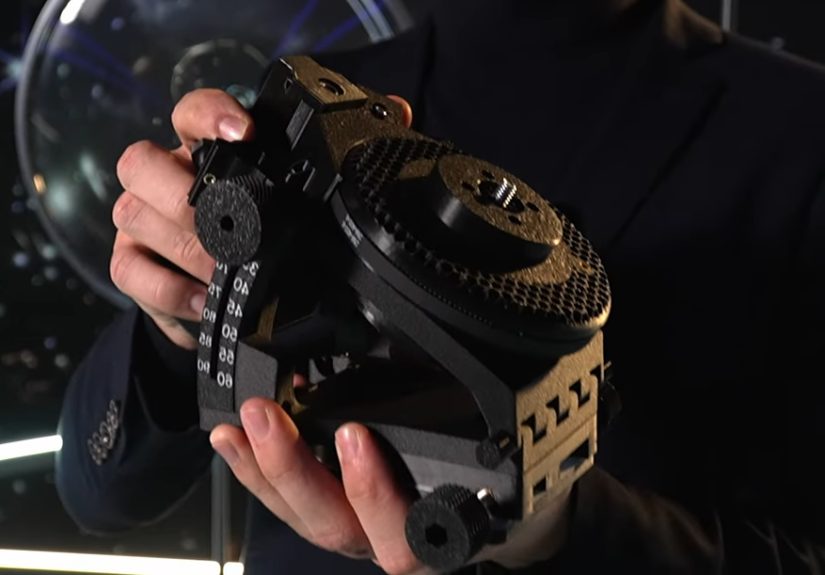
Projects such as OpenAstroTracker and newer modular DIY builds show why the idea has traction. They use 3D-printable parts, public CAD or STL files, affordable electronics, and firmware that can be inspected or improved. Some designs are simple barn-door trackers built around a hinge, threaded rod, and motor. Others resemble more capable equatorial mounts with motorized right ascension and declination axes, GoTo control, and optional guiding.
The open-source advantage is not just price. It is control. If a bracket cracks, you can print another. If you want a better knob, a sturdier base, or a cleaner cable path, you can change it. If the firmware needs a tweak, someone in the community may already have solved the problem. Commercial gear says, “Here is the product.” Open-source gear says, “Here is the product, the toolbox, and a friendly rabbit hole.”
How a DIY Star Tracker Works
Most DIY star trackers rely on a few core parts: a stable base, a rotating axis, a motor, a gear or belt system, a controller, and a way to align the axis with the sky. The motor turns slowly and smoothly, often through a reduction system that increases precision. A stepper motor is common because it can move in tiny controlled steps. The controller tells the motor how fast to turn. The mount holds the camera and lens at the correct angle.
Simple barn-door trackers use two boards connected by a hinge. A motor slowly opens the boards, causing the top board and camera to rotate. More advanced versions correct for tangent error, use curved rods, or add software compensation. 3D-printed open-source trackers often use a more mount-like design, where the camera rotates around a right ascension axis aligned with Earth’s axis. Some designs add a declination axis, which makes it easier to frame targets and support GoTo functionality.
The Main Parts You Will Usually Need
- 3D-printed structural parts: Mount bodies, brackets, knobs, gear housings, and accessory holders.
- Stepper motor and driver: The heart of the movement system.
- Microcontroller: Often Arduino-compatible, handling motor timing and controls.
- Bearings, belts, gears, or threaded rods: These translate motor motion into smooth tracking.
- Tripod or pier: Stability matters more than beginners expect.
- Ball head or camera mount: Lets you point the camera after the tracker is aligned.
- Power source: USB battery packs are popular for portable setups.
- Polar alignment aid: A polar scope, laser pointer where legal and safe, phone app, or built-in alignment system.
Printing the Parts: Do Not Let PLA Become Puddle Art
For indoor gadgets, PLA is convenient. For an astrophotography mount that may sit in a warm car, endure belt tension, or face temperature swings, PLA can be risky. Many DIY tracker builders prefer PETG, ABS, or ASA because these materials handle heat and mechanical stress better. ASA and ABS are frequently recommended for parts that need strength and temperature resistance, though they require better printer control and ventilation than PLA.
Print quality matters. A star tracker is a precision device pretending to be a weekend craft project. Sloppy layers, warped parts, loose belt paths, and rough bearing seats can cause tracking errors. You do not need a NASA-grade machine shop, but you do need patience. Print slowly where needed, check tolerances, and test-fit parts before final assembly. The night sky is very good at detecting “close enough.”
Polar Alignment: The Tiny Step That Decides Everything
Polar alignment is the process of pointing the tracker’s rotation axis toward the celestial pole. In the Northern Hemisphere, Polaris is the usual guide. In the Southern Hemisphere, photographers use Sigma Octantis and star patterns near the south celestial pole. If the tracker is not aligned well, your camera will still drift during long exposures, and your stars may become little dashes with attitude.
A basic alignment can be good enough for wide-angle Milky Way shots. Longer focal lengths demand more precision. Many astrophotographers use a polar scope, phone app, electronic polar alignment routine, or plate-solving software. The goal is simple: make the tracker rotate on the same axis that the sky appears to rotate around. The execution can feel like trying to park a shopping cart on a marble floor, but it gets easier with practice.
What Can You Photograph With a DIY Open-Source Star Tracker?
A small tracker is perfect for wide-field astrophotography. With a DSLR or mirrorless camera and a lens between 14mm and 50mm, you can capture rich Milky Way scenes, constellations, meteor showers, and colorful star fields. With careful alignment and a good lens, focal lengths around 85mm to 200mm can reveal larger deep-sky objects such as the Andromeda Galaxy, the Orion Nebula, the North America Nebula, the Pleiades, and the Rho Ophiuchi cloud complex.
Do not expect a lightweight DIY tracker to behave like a heavy observatory mount carrying a giant telescope. Payload matters. Balance matters. Wind matters. A tiny wobble that looks harmless in daylight can become a star-mangling gremlin during a two-minute exposure. Match the tracker to the camera setup. A light mirrorless camera and prime lens are usually much easier to manage than a long telephoto zoom that weighs as much as a suspiciously dense sandwich.
Suggested Camera Settings for Tracked Night Shots
There is no universal setting for astrophotography, but a tracked setup gives you more flexibility. For a wide Milky Way image, you might start around ISO 800 to 1600, aperture f/2.8 to f/4, and exposures from 60 to 180 seconds. For a longer lens aimed at a deep-sky target, you might use 30 to 120 seconds depending on alignment, focal length, lens sharpness, and how well the mount tracks.
Take test shots. Zoom in. Check the corners. If the stars trail, shorten the exposure, improve polar alignment, rebalance the camera, or reduce focal length. If the stars are sharp but the image is noisy, shoot more frames and stack them later. Image stacking combines multiple exposures to improve signal and reduce noise. It is one of the secret sauces of astrophotography, although “secret sauce” sounds tastier than spending an hour sorting light frames, dark frames, flats, and bias frames.
The Foreground Problem: Sharp Stars, Blurry Trees
A star tracker follows the sky. That means the ground moves relative to the camera during the exposure. If you are shooting a landscape with trees, rocks, mountains, or a lonely barn that looks like it has strong opinions, the foreground may blur in a tracked shot. The common solution is to shoot two sets of images: one tracked exposure for the sky and one untracked exposure for the foreground. Later, blend them carefully in post-processing.
This is not cheating. It is problem solving. The sky and the land move differently from the camera’s perspective when tracking is enabled. A blended image can look natural if processed responsibly. The goal is not to invent a fake universe. The goal is to represent what the camera cannot capture cleanly in one frame without help.
Open-Source Features That Make a Big Difference
Entry-level tracking is already useful, but open-source designs can grow with the photographer. Some projects support GoTo control, allowing the mount to point toward selected celestial objects. Others support autoguiding, where a guide camera monitors a star and sends corrections to the mount. Wi-Fi or USB control can connect the tracker to astronomy software. GPS can simplify time and location setup. Community-made add-ons may improve polar alignment, cable management, mounting options, or mechanical stability.
This modularity is why open-source star trackers are more than cheap alternatives. They are learning platforms. Building one teaches mechanical design, electronics, firmware, optics, astronomy, photography, and patience. Especially patience. The sky will be cloudy the moment your build is finished. This is not a bug; it is apparently part of the hobby’s installation process.
Common DIY Star Tracker Mistakes
Using a Weak Tripod
A tracker can only perform as well as the platform under it. A flimsy tripod will wobble in wind, sink into soft soil, and ruin otherwise good tracking. Use a sturdy tripod, keep the legs as low as practical, and hang weight from the center column if needed.
Skipping Balance
An unbalanced camera load makes the motor work harder and can introduce uneven tracking. Balance the camera and lens carefully, especially with telephoto lenses. Small shifts can matter.
Rushing Polar Alignment
Beginners often spend 20 minutes choosing ISO settings and 20 seconds aligning the tracker. Reverse that energy. A clean polar alignment makes every other step easier.
Expecting Perfect Results on Night One
Your first session may produce a few sharp frames, several confusing frames, and at least one photo of your shoe taken while testing the intervalometer. That is normal. Astrophotography rewards repetition.
Why DIY Beats Buying for Some Photographers
Buying a commercial tracker is the fastest route to shooting. Building one is the scenic route, complete with soldering, calibration, printer settings, and possibly muttering at tiny screws in the dark. But the DIY route gives you knowledge that buying cannot. When something fails, you understand the system. When tracking is slightly off, you can diagnose whether the issue is alignment, backlash, belt tension, motor timing, balance, or tripod movement.
There is also satisfaction in capturing a galaxy with a device you built yourself. The final image is not just a photograph. It is proof that plastic parts, open code, math, and stubborn curiosity can team up to catch photons that traveled for thousands or millions of years. Not bad for a gadget that may have started life as a pile of filament and a shopping cart full of bearings.
Field Experience: What Using a DIY Open-Source Star Tracker Teaches You
The first lesson is that setup always takes longer than expected. At home, the tracker looks simple. In the field, every knob becomes mysterious, every cable finds a way to snag, and your headlamp suddenly feels dimmer than a tired firefly. This is why a practice run in daylight is priceless. Assemble the tracker, mount the camera, balance everything, connect power, and run the motor before the actual night shoot. You will discover small problems while they are still easy to fix.
The second lesson is that the ground matters. A beautiful dark-sky location is not automatically a good tracking location. Soft sand, wet grass, wooden decks, and loose gravel can shift during a session. Even a small tripod movement can turn round stars into tiny commas. A stable patch of earth is worth more than a dramatic foreground if the whole rig slowly leans like it is reconsidering its career choices.
The third lesson is that dew is sneaky. A lens can look clear when you start and fog over halfway through the sequence. A simple dew heater or chemical hand warmer near the lens barrel can save the session. So can checking the front element every few exposures. Nothing builds character like stacking 80 images and realizing the last 60 were photographed through a tiny private weather system.
The fourth lesson is that tracked astrophotography changes how you think about light. Without tracking, you fight for every second before the stars trail. With tracking, you can lower ISO, stop the lens down slightly for sharper corners, and collect cleaner data. The difference may not look dramatic on the camera screen, but it becomes obvious in post-processing. Shadows lift more smoothly. Star colors look richer. The Milky Way dust lanes become more defined. Faint nebula regions start to appear instead of hiding in noise.
The fifth lesson is that post-processing is half the hobby. A tracker gives you better raw material, not a finished masterpiece. Stacking software, careful stretching, color balance, gradient removal, and noise reduction all matter. Beginners sometimes expect the camera to show a magazine-ready galaxy immediately. In reality, the raw frame may look underwhelming. The magic is in collecting enough clean exposures and processing them gently.
The sixth lesson is that open-source communities are part of the equipment. Documentation, build logs, forums, GitHub issues, Discord discussions, and shared printable upgrades can save hours of guessing. Someone has probably already fought the same belt tension problem, motor vibration, firmware setting, or polar alignment confusion. Reading before rebuilding is a powerful move.
Finally, using a DIY star tracker teaches humility in the best way. The stars do not care how expensive your camera is. They care about alignment, stability, timing, focus, and weather. The tracker helps, but it does not remove the craft. It simply gives you a better chance to capture the sky as cleanly as possible. When the first sharp, detailed frame appears on your screen, the late night suddenly feels worth it. Even the mosquitoes seem less annoying. Slightly.
Conclusion
A DIY open-source star tracker is one of the most rewarding tools a night-sky photographer can build. It solves the core problem of Earth’s rotation, unlocks longer exposures, and makes cleaner Milky Way and deep-sky images possible with ordinary cameras and lenses. More importantly, it turns astrophotography from a shopping contest into a learning adventure. With 3D-printed parts, accessible electronics, shared firmware, and community support, open-source trackers give beginners and makers a practical way to enter the world of long-exposure night photography.
Build carefully, align patiently, shoot generously, and process gently. The stars are already putting on the show. A good tracker simply helps your camera stop smearing the performance.
Note: This article is written as original publish-ready web content and is based on real information from reputable astronomy, astrophotography, maker, 3D-printing, and open-source hardware references.