Table of Contents >> Show >> Hide
- What Red Light Therapy Actually Is
- The Short Answer on Weight Loss
- Why People Think It Might Help
- What the Research Really Says
- Body Contouring vs. Weight Loss: The Distinction Marketing Loves to Blur
- Who Might Notice a Benefit?
- What a Typical Treatment Plan Looks Like
- Are the Results Permanent?
- Safety, Side Effects, and Smart Precautions
- Does Red Light Therapy Work Better With Exercise?
- Is It Worth the Money?
- The Bottom Line
- Experience Notes: What People Commonly Notice When They Try It
- SEO Tags
If you have spent more than six minutes on wellness TikTok, you have probably seen red light therapy marketed like a sci-fi shortcut to a smaller waistline. Lie under a glowing panel, let the photons do their thing, and somehow emerge looking like you meal-prepped for six straight months. It is a lovely fantasy. It is also, in most cases, a very enthusiastic oversell.
So, does red light therapy work for weight loss? The honest answer is: not in the way most people hope. Red light therapy may help with body contouring, temporary circumference changes, and possibly some metabolic markers in certain small studies. But it is not a magic fat-melting machine, it is not a substitute for diet and exercise, and it is not considered a proven stand-alone treatment for obesity or meaningful long-term weight loss.
That does not mean the treatment is useless. It means you need better expectations and less marketing glitter. Let’s break down what red light therapy actually is, what the research suggests, where the hype gets ahead of the facts, and whether it is worth your time, money, and willingness to glow like a human lava lamp.
What Red Light Therapy Actually Is
Red light therapy is often called photobiomodulation or low-level light therapy. It uses red or near-infrared light delivered through LEDs or low-level lasers. Unlike UV light, which can damage skin, red light is non-ionizing and is generally used for lower-risk therapeutic or cosmetic purposes.
The best-supported uses of red light therapy are not really about body weight at all. Medical and dermatology sources more consistently discuss red light therapy for concerns like skin rejuvenation, wound healing support, inflammation, pain relief, and certain hair-loss applications. In other words, red light therapy walked into the conversation wearing a skin-care badge, and then the internet handed it a weight-loss cape.
The Short Answer on Weight Loss
If by weight loss you mean “Will the number on the scale go down in a noticeable, reliable, lasting way?” the answer is usually not much, and not by itself.
If by weight loss you mean “Could this help reduce waist, thigh, or hip measurements a bit, especially when paired with exercise and a structured routine?” then the answer becomes more interesting. Some clinical studies suggest modest reductions in body circumference in treated areas. That is why many clinics market red light therapy as body contouring or body sculpting rather than as a true weight-loss treatment.
That distinction matters. A smaller waist measurement is not automatically the same as medically meaningful fat loss. Cosmetic improvement and health improvement are cousins, not twins.
Why People Think It Might Help
The Mechanism Sounds Pretty Good on Paper
Researchers think red and near-infrared light may influence mitochondria, the structures in cells that help produce energy. The working theory is that certain wavelengths may affect cellular energy production, inflammation, blood flow, and signaling pathways. In fat-related research, some scientists have proposed that light may temporarily change fat-cell behavior or help release stored lipids from adipocytes.
That sounds promising, and biologically it is not ridiculous. But a plausible mechanism is not the same thing as a guaranteed real-world result. Nutrition research has taught us this lesson many times, usually right before someone tries to sell celery juice as destiny.
The Research Shows Some Interesting Signals
Several small trials and reviews have reported reductions in circumference of the waist, hips, thighs, or upper arms after a series of treatments. Some studies also suggest that when red light therapy is combined with exercise, people may see improvements in fat mass, insulin resistance, or other metabolic markers compared with exercise alone.
That is the “maybe” part of the story. It is real enough to justify scientific interest. But it is not strong enough to call red light therapy a front-line weight-loss solution.
What the Research Really Says
What Looks Promising
Some of the better-known low-level laser studies found reductions in body circumference over several weeks of treatment. In practical terms, that can mean modest inch loss at the waist or thighs, especially in overweight adults seeking cosmetic body contouring. A few more recent reviews have also suggested that photobiomodulation may improve weight-related indicators such as BMI, waist circumference, inflammation markers, cholesterol, and insulin resistance.
There are also studies in women with obesity showing that phototherapy combined with structured exercise may enhance changes in body fat and metabolic flexibility. That is an important clue. When red light therapy appears to do something useful, it often shows up as an adjunct, not a solo act.
So yes, there is enough evidence to say red light therapy is not pure nonsense. The problem is that the evidence is still too inconsistent to support the wilder claims you see online.
What Is Still Weak or Unclear
The research has some major limitations. Sample sizes are often small. Treatment schedules vary a lot. Devices are not identical. Wavelengths, treatment times, and treatment areas differ from one study to another. Some studies focus on circumference, some on weight, some on blood markers, and some on subjective satisfaction. That makes the evidence messy.
It also means results are hard to compare. One trial may use repeated office sessions over a few weeks, while another combines therapy with diet coaching and exercise, and another uses a different device entirely. When studies are that different, bold conclusions become slippery.
In plain English: red light therapy may do something for some people, but science has not yet turned that into a clear, predictable, “Yes, this works for weight loss” answer.
Body Contouring vs. Weight Loss: The Distinction Marketing Loves to Blur
This is the part where we separate science from sparkle.
Body contouring means changing shape, appearance, or measurements in a targeted area. It may reduce visible bulges, smooth contours, or help clothes fit differently. That can absolutely matter to people. Feeling better in your body is not trivial.
Weight loss, on the other hand, usually means reducing total body mass over time, ideally with health benefits like improved blood sugar, lower blood pressure, better mobility, and reduced cardiometabolic risk.
Regulators and medical organizations do not treat those as the same thing. In fact, the FDA clearly states that non-invasive body contouring is not intended to treat obesity and will not result in weight loss. That should be the giant blinking sign over every ad promising “fat melting” while showing someone measuring their waist in dramatic lighting.
Who Might Notice a Benefit?
The people most likely to feel satisfied with red light therapy are usually not looking for a miracle. They are looking for a small cosmetic assist.
For example, someone who is already improving their nutrition, walking regularly, strength training a few days a week, sleeping decently, and staying consistent may like red light therapy as an extra nudge. They might notice a modest change in how a waistband fits or how a stubborn area looks. That can be motivating.
On the other hand, someone hoping to lose 30 pounds by reclining under a glowing panel while continuing to live on drive-thru fries and chaotic sleep is probably headed for disappointment. Light therapy cannot out-negotiate your daily energy balance.
What a Typical Treatment Plan Looks Like
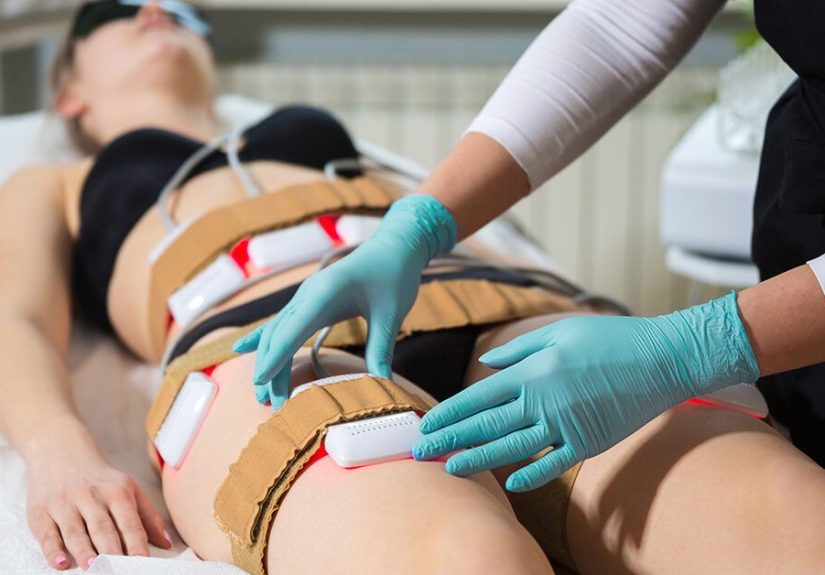
Protocols vary widely, which is part of the problem. Studies and clinics often use repeated sessions over several weeks. Some research on body contouring used multiple treatments weekly for a short period, while other protocols spread sessions out over six weeks. In-office devices are generally more powerful and more controlled than at-home tools.
At-home devices may still be useful, but they are usually lower intensity and require more consistency. If you go the home-device route, follow the instructions carefully. More light is not automatically better. “I ignored the manual because I’m a free spirit” is not a great treatment strategy.
Are the Results Permanent?
Usually, you should assume the answer is not necessarily.
Even when people see a cosmetic improvement, it may be temporary or dependent on maintaining the habits that support it. That is another reason red light therapy works best as part of a larger plan rather than as a stand-alone fix. If your routine slides, the results may slide right along with it.
Safety, Side Effects, and Smart Precautions
The good news is that red light therapy appears to be relatively low risk when used correctly. Short-term side effects are usually mild and may include temporary redness, irritated skin, mild discomfort, or bruising depending on the type of treatment and device.
That said, “low risk” does not mean “do whatever.” Eye protection matters when directions call for it. People with light-sensitive conditions or those taking medications that increase photosensitivity should check with a clinician first. Some dermatology guidance also suggests extra caution for people with darker skin tones, because visible light can sometimes trigger hyperpigmentation if the dose is not appropriate.
Also worth noting: FDA-cleared does not automatically mean highly effective. It generally means the device has met safety and regulatory standards for a specific use. It does not mean every claim floating around social media deserves a standing ovation.
Does Red Light Therapy Work Better With Exercise?
That is where the evidence gets more encouraging. Some studies suggest that photobiomodulation paired with exercise may improve outcomes more than exercise alone, especially in people with obesity or metabolic dysfunction. Researchers have looked at changes in fat mass, insulin resistance, inflammatory markers, and metabolic flexibility.
But let’s keep the excitement on a leash. Even here, the message is not “Skip the gym and buy a lamp.” The message is “If red light therapy helps, it may help most when the basics are already in place.”
Those basics are boring but undefeated: calorie awareness, enough protein, strength training, regular movement, stress management, and sleep. Wellness culture hates how unglamorous that list is, but biology keeps bringing it back like a greatest-hits album.
Is It Worth the Money?
That depends on your goal.
If your goal is major, lasting weight loss, red light therapy should not be high on your list. You will almost certainly get more return from evidence-based nutrition changes, physical activity, behavior support, and working with a qualified clinician if you have obesity, insulin resistance, or hormonal issues.
If your goal is subtle body contouring, improved adherence to a wellness routine, or a non-invasive add-on that may help a little around the edges, red light therapy may be worth considering. Just go in with clear expectations, ask what device is being used, ask what the treatment is actually cleared for, and be suspicious of anyone promising dramatic scale changes.
The Bottom Line
Red light therapy is not total hype, but it is definitely overhyped for weight loss.
The strongest honest answer is this: red light therapy may help with modest body contouring or localized circumference changes, and it may support metabolic improvements in some settings, especially alongside exercise. But it is not a proven stand-alone treatment for meaningful long-term weight loss.
If you want a healthier body, better energy, and lasting results, think of red light therapy as an optional accessory, not the engine. Nice headlights, maybe. But you still need the car.
Experience Notes: What People Commonly Notice When They Try It
One reason red light therapy keeps attracting attention is that the experience is easy to like. It is non-invasive, it usually does not hurt, and there is no dramatic recovery period. People often go in expecting something intense and leave thinking, “That was it?” A typical session can feel oddly uneventful. You lie down or sit still while the device shines light on the treatment area, and there is usually no big sensation beyond mild warmth or simple awareness that something very bright is happening near your body. For people who hate needles, surgery, or downtime, that alone makes the treatment appealing.
What many people notice first is not weight loss, but the difference between expectation and reality. People hoping for a dramatic drop on the scale after a few sessions are often disappointed. The scale may barely move. That can feel frustrating if marketing convinced them the therapy would “melt fat.” On the other hand, some people who approach it as body contouring rather than weight loss feel more satisfied. They are not waiting for a ten-pound miracle. They are paying attention to whether a fitted dress zips more easily, whether a waistline looks a little smoother, or whether measurements shift slightly over several weeks.
Another common experience is that results, when they happen, tend to feel subtle. People may say their midsection looks a bit less puffy, jeans fit a touch better, or tape-measure changes show up before mirror changes do. That can be encouraging, but it is rarely the cinematic reveal that before-and-after ads imply. Real life tends to look more like “My pants are less rude this week” than “I have become a new species.”
Consistency also shapes the experience. People using at-home devices often underestimate how repetitive the routine can be. A treatment that sounds effortless on day one can feel surprisingly easy to skip by week three. The novelty fades. Clinic-based sessions solve that problem by adding structure, but then cost and scheduling become the new annoyance. So one very real part of the red light therapy experience is not just biology. It is logistics. If the process does not fit your routine, even a decent device can become an expensive glowing coat rack.
People who combine red light therapy with better nutrition, more walking, strength training, and improved sleep often feel more positive about it. Part of that may be biological, and part may be behavioral. Once someone starts paying for a treatment, they sometimes become more disciplined everywhere else. They drink more water, snack less, move more, and suddenly the therapy gets all the credit. Human nature loves a shiny hero.
Emotionally, the most common arc seems to be this: curiosity, hope, skepticism, then one of two endings. Ending one is, “It helped a little, especially with contour and motivation, and I’m glad I tried it.” Ending two is, “It was fine, but it did not do enough to justify the money.” Both are reasonable. That may be the fairest way to describe the lived experience of red light therapy for weight loss: usually comfortable, sometimes encouraging, occasionally useful, but rarely the miracle people were promised.