Table of Contents >> Show >> Hide
- What Is the Elder Futhark?
- What Do Elder Futhark Runes “Mean”?
- The 24 Elder Futhark Runes (Names, Sounds, Helpful Keywords)
- How to Use Elder Futhark Runes (Practical, Beginner-Friendly Ways)
- Common Mistakes (and How to Avoid Them)
- Choosing a Rune Set (and Caring for It Without Making It Weird)
- Real-World Experiences: What Beginners Often Notice (and Learn the Fun Way)
- Conclusion
If you’ve ever seen runes on a necklace, in a fantasy game, or tattooed on someone’s forearm next to a very serious-looking wolf,
you’ve met the Elder Futhark in the wild. It’s the oldest widely known runic alphabet used by Germanic-speaking peoplesand yes,
it’s an alphabet first (letters with sound values), and only sometimes a mystical “vibe system” second.
In this guide, we’ll cover what the Elder Futhark is, what the rune names can suggest, what historians can say with confidence,
and how modern people use runes todaywithout turning them into a fortune-cookie printer or a prop from “Vikings: The Musical.”
What Is the Elder Futhark?
The Elder Futhark is an early runic writing system with 24 characters. The name comes from the first six runes in order:
F-U-TH-A-R-K (kind of like how “alphabet” comes from alpha and beta). Historically, these symbols were used to write short
inscriptionsnames, ownership marks, memorial messages, and sometimes things that look a lot like charms or formulaic statements.
Elder Futhark is generally associated with the first centuries of runic writing, before later runic alphabets developed (like the Younger Futhark
of the Viking Age, which has fewer characters). So if you’re trying to be era-accurate, Elder Futhark is “early runes,” not “every rune ever.”
Why Do Runes Look So Angular?
Runes were often carved into materials like wood, bone, metal, and stone. Straight lines and diagonals are carving-friendly;
big smooth curves are less fun when your “pen” is basically a knife. Think of runes as the original “designed for the medium” typeface:
sharp, practical, and surprisingly stylish.
What Do Elder Futhark Runes “Mean”?
Here’s the most important sanity-saving idea: runes have sound values (like letters), and many have names that
are tied to words (often reconstructed by scholars). Those rune names can suggest conceptslike “cattle,” “journey,” or “gift”but that doesn’t
automatically mean every rune was historically used like a modern oracle card.
In other words: historically, a rune could be used simply because you needed the sound it represents. Modern rune readers often add
symbolic layers for reflection or divination. That modern layer can be meaningful and usefuljust don’t confuse it with a perfectly preserved
instruction manual from 2,000 years ago.
A Quick Note on “One True Meaning”
You’ll see lots of rune-meaning lists online that sound extremely certainlike the rune itself personally signed off on the interpretation.
In real life, meanings vary by tradition, teacher, and context. Treat “rune meanings” as helpful prompts, not cosmic law.
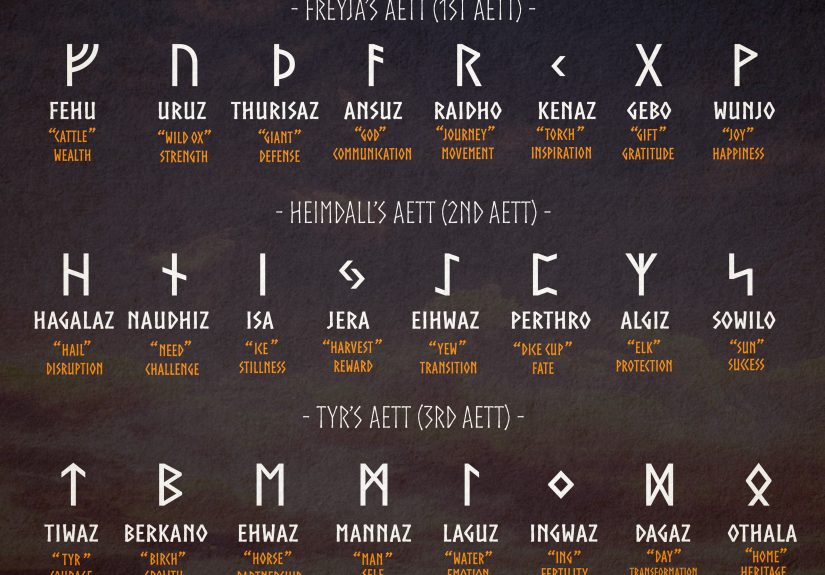
The 24 Elder Futhark Runes (Names, Sounds, Helpful Keywords)
Below is a beginner-friendly cheat sheet. The “keywords” are memory hooksa mix of historical name-associations and common modern
interpretations. (Different spellings exist; you’ll see variations like Kenaz/Kaunan, Othala/Odal, etc.)
First Group (First ætt)
- ᚠ Fehu (F) wealth, cattle, resources, “what you can actually use”
- ᚢ Uruz (U) strength, vitality, raw potential, resilience
- ᚦ Thurisaz (TH) protection, challenge, boundaries, “don’t poke it” energy
- ᚨ Ansuz (A) communication, insight, messages, learning
- ᚱ Raidho (R) journey, movement, rhythm, right timing
- ᚲ Kenaz/Kaunan (K) torch, clarity, skill, illumination
- ᚷ Gebo (G) gift, exchange, partnership, reciprocity
- ᚹ Wunjo (W/V) joy, harmony, morale, “finally, a win”
Second Group (Second ætt)
- ᚺ Hagalaz (H) disruption, hail, change you didn’t schedule
- ᚾ Nauthiz (N) need, friction, constraint, “make it work anyway”
- ᛁ Isa (I) stillness, pause, focus, a strategic freeze
- ᛃ Jera (J/Y) cycles, harvest, earned results, time doing its job
- ᛇ Eihwaz (EI/Ï) endurance, spine, deep protection, staying power
- ᛈ Perthro (P) chance, mystery, “what’s in the cup,” hidden factors
- ᛉ Algiz (Z) protection, alertness, defense, instincts
- ᛊ Sowilo (S) success, sun, wholeness, clarity after confusion
Third Group (Third ætt)
- ᛏ Tiwaz (T) integrity, justice, courage, doing the hard right thing
- ᛒ Berkano (B) growth, nurturing, beginnings, steady development
- ᛖ Ehwaz (E) teamwork, trust, movement with support
- ᛗ Mannaz (M) humanity, self, community, identity
- ᛚ Laguz (L) intuition, flow, emotion, “listen underneath the noise”
- ᛜ Ingwaz (NG) potential, incubation, stored energy, ready-to-bloom
- ᛞ Dagaz (D) breakthrough, daylight, perspective shift
- ᛟ Othala/Odal (O) home, heritage, belonging, what you inherit (good and complicated)
How to Use Elder Futhark Runes (Practical, Beginner-Friendly Ways)
1) Use Them as an Alphabet (The Most Historically Accurate Option)
Want to write in Elder Futhark? Start by thinking in sounds, not modern spelling. Runes don’t map perfectly onto modern English,
and transliteration systems vary, but a simple approach works for names and short phrases:
- Write the word as it sounds (example: “night” might be closer to N-I-TH-T, depending on your scheme).
- Use ᚦ for “th” sounds when you want that “thorn” value.
- Keep it short: runes shine in compact inscriptions.
Example (simple phonetic approach): “GIFT” could be ᚷ (Gebo) + ᛁ (Isa) + ᚠ (Fehu) + ᛏ (Tiwaz). Is it perfect historical runic English?
No. Is it a solid beginner way to understand sound values and build familiarity? Absolutely.
2) Use Runes for Reflection (Modern, Low-Drama, Surprisingly Effective)
If you like journaling, runes can be a compact “prompt generator.” You draw one rune and ask: “What does this rune invite me to notice?”
This is less “tell me the future” and more “help me think clearly.”
- Fehu: Where are my resources going? What’s being wasted?
- Raidho: What’s my next stepand is my timing right?
- Isa: What needs a pause so I don’t bulldoze the solution?
- Dagaz: What would a breakthrough look like if I stopped clinging to the old plan?
3) Rune Casting (A Simple Method You Can Try)
Rune casting is a modern spiritual practice that uses random selection to spark insight. People do it lots of ways; here’s a clean, beginner setup:
- Ask a grounded question. Good: “How can I prepare for my exam week?” Less good: “Should I become a famous millionaire by Friday?”
- Mix your runes. Use a pouch, a bowl, or your hands like you’re shuffling tiny wooden opinions.
- Draw 1–3 runes. Start small so you don’t drown in symbols.
- Interpret with context. Use the keyword list, then connect it back to your real situation.
- Write it down. Runes are great, but your memory is not a reliable archiveespecially before coffee.
A 3-Rune Spread That Doesn’t Feel Like Homework
- Rune 1: “What’s going on?”
- Rune 2: “What’s the challenge?”
- Rune 3: “What helps?”
Example reading: You pull Nauthiz (constraint), Raidho (movement), and Jera (cycles).
Translation: you’re dealing with limits (time, energy, money), you need a plan that moves steadily, and the payoff comes through consistent repetition.
It’s basically the rune version of “make a schedule and stick to it”but with more ancient-looking lines.
Common Mistakes (and How to Avoid Them)
Mistake 1: Mixing Rune Rows Like They’re All the Same
Elder Futhark, Younger Futhark, and Anglo-Saxon Futhorc are relatedbut not interchangeable. If you’re aiming for historical flavor (or accuracy),
pick one system and stick with it for that project.
Mistake 2: Treating “Meanings” as Universal, Fixed, and Mandatory
Rune meanings are best used as interpretive tools, not rigid definitions. Context matters: Fehu might be “wealth,” but your “wealth”
could mean time, friendships, or mental energynot just cash.
Mistake 3: Ignoring Modern Symbol Misuse
Some rune-like symbols (and a few actual runes) have been appropriated by extremist groups. That doesn’t mean the symbols “belong”
to those groupsbut it does mean you should be thoughtful about context, especially for tattoos, logos, or public-facing designs.
If you want to use runes visibly, do a quick check on modern hate-symbol databases and be mindful of combinations and styling.
Choosing a Rune Set (and Caring for It Without Making It Weird)
Rune sets come in wood, stone, resin, claypretty much any material humans have ever looked at and thought, “Yes, I can carve meaning into that.”
Historically, runes appeared on many materials; modern sets are a practical tool for study and reflection.
- Pick readability first. Clear carving/printing beats “mysteriously smudged aesthetics.”
- Learn the sound values. This is the fastest way to stop feeling like runes are random symbols.
- Journal your interpretations. Over time you’ll notice patternswhat you tend to draw, how you interpret, and where you’re consistent (or not).
If you have a spiritual practice, you can add a simple ritual (like a moment of focus before drawing). If you don’t, you can treat runes like
a compact study system and reflection tool. Either way, the goal is claritynot theatrical fog.
Real-World Experiences: What Beginners Often Notice (and Learn the Fun Way)
Let’s talk about the part most guides skip: the experience of learning and using Elder Futhark runeswhat it feels like when you’re new,
what surprises people, and what changes after a few weeks of practice. (No, you don’t need to own a cloak. Unless you want one. Cloaks are comfy.)
Experience #1: The “Oh…they’re letters” moment. Many beginners start with rune “meanings” and miss the alphabet part.
Then they learn the sound values and suddenly everything clicks. The symbols stop feeling like mysterious doodles and start behaving like a real
writing system. It’s the difference between staring at sheet music like it’s modern art and realizing, “Wait, this is how you play the song.”
Experience #2: Your first reading feels oddly accuratebecause you did the thinking. A common beginner story goes like this:
you draw Isa and immediately feel called out. “Pause. Stop pushing.” It feels spooky… until you realize you’ve been ignoring your own
fatigue for weeks. Runes often work best as a mirror: they bring a theme into focus, and you connect it to your real life. That “accuracy”
is frequently your brain finally getting a microphone.
Experience #3: You develop personal associations (and that’s not a failure). Over time, people build a relationship with their rune set.
Not in a “my runes are texting me” way, but in a practical memory way. Maybe Raidho becomes your “make a plan” rune because you kept drawing it
before travel days. Maybe Nauthiz turns into “budget week” because it shows up when you’re overcommitted. As long as you remember that these are
your associations layered onto a historical letter system, it can be a powerful learning tool.
Experience #4: The “I drew the scary rune again” spiraland how to stop it. Some beginners get stuck when a challenging rune repeats
(Hagalaz, Nauthiz, Thurisaz). They assume it’s a cosmic warning label. A healthier pattern is to treat repeated runes as repeated topics:
“What theme keeps coming up?” Often it’s not doom; it’s a nudge toward boundaries, planning, or patience. The rune isn’t sentencing youit’s
highlighting where your attention keeps returning.
Experience #5: You learn faster when you go small. People try to memorize all 24 runes in one sitting, burn out, and then blame the runes.
A more realistic approach is a “rune of the day” practice for two weeks. Draw one rune, learn its sound value, write its name, and use one journal prompt.
That’s it. The next day, repeat. After a month, you’re no longer guessingyou’re recognizing.
Experience #6: You start noticing runes in modern life. Once you know the shapes, you’ll spot runic aesthetics everywhereon album art,
jewelry, game UI, and branding. This can be fun, but it also teaches an important lesson: symbols carry context. When you see a rune used publicly,
you start asking: Is this historical? Decorative? Spiritual? Or someone’s attempt at looking “ancient and intense” on a protein supplement label?
(The world is full of choices.)
Experience #7: The best practice is the one that makes you clearer, not weirder. Whether you approach runes academically, spiritually,
or as a blend of both, the most helpful outcome is usually increased clarity: better decisions, better self-awareness, and better language for what
you’re experiencing. If a practice makes you anxious or obsessive, scale it back. If it helps you reflect, plan, and act with integrity, keep going.
Runes don’t have to be dramatic to be meaningful.
Conclusion
Elder Futhark runes are a real historical writing system with 24 charactersdesigned for carving, used for inscriptions, and later surrounded by
layers of story, symbolism, and modern spiritual practice. If you want to use them today, start with the basics: learn the sound values, treat “meanings”
as prompts (not commandments), and practice in small, consistent steps. Whether you’re writing a name, studying runic history, or doing a reflective rune draw,
the best rune work is grounded, curious, and respectfulno wolf-tattoo required (but still, your body, your rules).
![18 Best Types of Charts and Graphs for Data Visualization [+ How to Choose]](https://corkopencoffee.org/wp-content/uploads/2026/05/18-best-types-of-charts-and-graphs-for-data-visualization-how-to-choose-qKM1PBYG-thumb.jpg)