Table of Contents >> Show >> Hide
- The Discovery: A WWII Submarine Found Near Mykonos
- Meet the Jantina: Italy’s Lost Argonauta-Class Submarine
- The Final Voyage: Leros, Mykonos, and HMS Torbay
- Why This Submarine Battle Was So Unusual
- What the Wreck Reveals Today
- The Role of Greek Divers and Modern Technology
- A War Grave Beneath the Aegean
- Why the Aegean Sea Still Holds So Many WWII Secrets
- Historical Significance: More Than Rust and Rivets
- Experience Section: What This Discovery Feels Like From a Diver’s Perspective
- Conclusion
Note: This original article is written for web publication and synthesized from verified historical reporting, naval records, and maritime archaeology context about the Italian submarine Jantina.
Every now and then, the sea decides to return a page of history. Not a shiny page. Not a neat one with footnotes and perfectly preserved margins. More like a corroded, barnacle-dusted, 338-foot-deep page sitting silently in the Aegean Sea while fish treat a deck gun like premium waterfront real estate.
That is essentially what happened when Greek divers located the wreckage of the WWII-era Italian submarine Jantina, a vessel lost during one of the more unusual naval encounters of World War II: submarine versus submarine. The discovery, made south of Mykonos by Greek diver and researcher Kostas Thoctarides and his team, brought renewed attention to a dramatic wartime sinking that had remained hidden beneath the Aegean for roughly 80 years.
The story has everything a maritime mystery needs: a vanished submarine, a dangerous wartime route, a British hunter lurking below the surface, a handful of survivors swimming for their lives, and modern underwater technology finally giving historians a clear look at the wreck. It is not just a discovery for military history fans. It is a reminder that the sea is one of the world’s largest archivesand it does not hand over its files easily.
The Discovery: A WWII Submarine Found Near Mykonos
The wreck of the Italian submarine Jantina was found south of the Greek island of Mykonos at a depth of about 103 meters, or roughly 338 feet. That is far beyond the range of casual scuba diving and well into the world of technical exploration, remote-operated vehicles, and people who probably consider “just a quick dive” to mean something wildly different from the rest of us.
Thoctarides and his team used an ROV, known as Super Achilles, to inspect the wreck visually. The remotely operated vehicle allowed the team to examine the submarine without disturbing the site. At that depth, the pressure is intense, the light is limited, and the margin for human error is about as forgiving as a tax audit. Sending a robotic eye into the darkness was the right move.
The images revealed key features of the submarine, including the conning tower, the deck gun, and structural damage consistent with a violent sinking. Later exploration helped identify the separated bow section, adding another important piece to the puzzle. The wreck was not merely “found” in the treasure-hunter sense. It was documented, interpreted, and treated as a historic site.
Meet the Jantina: Italy’s Lost Argonauta-Class Submarine
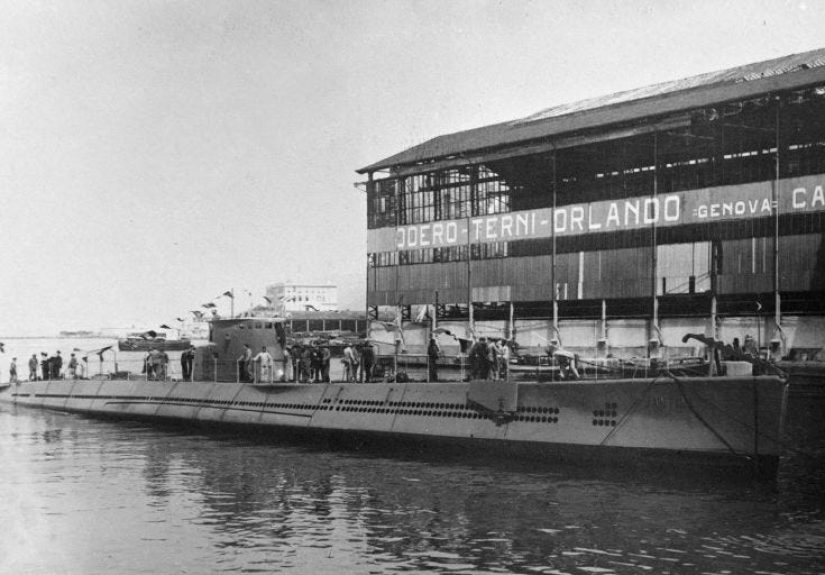
The Jantina was an Argonauta-class submarine built for the Regia Marina, the Royal Italian Navy, during the early 1930s. These submarines were part of Italy’s interwar naval modernization, designed for coastal and Mediterranean operations. They were not massive undersea giants, but they were capable, compact, and dangerous in the confined waters where World War II in the Mediterranean often played out.
The submarine was about 61.5 meters long, with diesel-electric propulsion, torpedo tubes in the bow and stern, and a 102 mm deck gun for surface engagements. In practical terms, the Jantina was built for a world where submarines spent much of their time on the surface and submerged when dangeror opportunityappeared. It was stealthy by 1930s standards, but not invisible. No submarine of that era was.
Before World War II, the Jantina saw service during the Spanish Civil War, a conflict that became a testing ground for weapons, tactics, and political alliances before the larger catastrophe of the 1940s. By 1941, the submarine was operating in the Aegean, a region where geography itself could feel like a combatant. Islands, channels, convoys, patrols, and airfields turned the sea into a chessboardexcept the chess pieces carried torpedoes.
The Final Voyage: Leros, Mykonos, and HMS Torbay
On July 5, 1941, Jantina was sailing from the island of Leros with 48 sailors aboard. Leros was strategically important because of its naval facilities and position in the Dodecanese, an island group then under Italian control. The submarine was reportedly heading toward Piraeus and then onward to Italy after damage from an earlier patrol.
But the Aegean was no friendly highway. The British Royal Navy submarine HMS Torbay, commanded by Lieutenant Commander Anthony Miers, was on patrol in the area. In a rare submarine-on-submarine encounter, Torbay spotted Jantina and launched a torpedo attack.
The first torpedoes missed or passed ahead of the target, but later shots struck home. The explosion was devastating. Jantina sank rapidly south of Mykonos. Of the 48 men aboard, only six survived. They managed to reach the island of Delos after hours in the wateran almost unimaginable ordeal in wartime seas.
Submarine warfare already has a grim intimacy. Surface ships can sometimes see their attackers. Aircraft announce themselves with sound and shadow. But a submarine attack often comes from nowhere. In this case, the drama was doubled: one undersea predator destroyed another. It was a lethal game of hide-and-seek, except nobody was playing for fun and the loser did not get a second round.
Why This Submarine Battle Was So Unusual
Submarines were designed primarily to attack merchant shipping, warships, and supply routes. Submarine-versus-submarine combat did happen during World War II, but it was relatively rare. Tracking a submerged or surfaced submarine was difficult, and attacks required timing, visibility, identification, and a healthy dose of luck. Even with skill, the ocean is very good at hiding things.
The sinking of Jantina by HMS Torbay stands out because it shows how crowded and dangerous the Mediterranean had become by 1941. The Aegean was a zone of overlapping ambitions: Italian forces, German operations, British patrols, Greek resistance, island garrisons, supply routes, and civilian shipping all moved through the same waters.
In that environment, a submarine could be hunter and hunted in the same afternoon. The Jantina may have been traveling on the surface, likely not expecting immediate attack from another submarine. Details visible on the wreck, including closed torpedo tubes and lowered periscopes, support the interpretation that the Italian crew did not appear to be in combat readiness when the attack came.
What the Wreck Reveals Today
The wreckage gives historians and naval experts a physical record of the sinking. The main body of the submarine rests on the seabed at a steep angle. The deck gun remains visible. The conning tower can still be recognized. The periscopes were observed lowered, and part of the bow was separated from the rest of the hull.
That separated bow became an important clue. When researchers later identified the missing bow section, it helped explain how the submarine broke apart. The bow likely detached during or shortly after the torpedo impact, while the remaining section continued moving before sinking. In other words, the wreck is not a single frozen objectit is a map of the final moments.
This is why underwater archaeology matters. A wreck is not just “a thing at the bottom.” It is evidence. Its angle, damage pattern, debris field, position, and condition can confirm or challenge written records. A logbook may say torpedoes struck; the wreck can show where. A survivor account may describe a sudden explosion; the hull can preserve the violence of that instant in twisted metal.
The Role of Greek Divers and Modern Technology
Greek waters are filled with ancient ruins, merchant ships, war wrecks, aircraft remains, and naval mysteries. That sounds romantic until you remember that finding anything underwater is difficult, expensive, and occasionally about as comfortable as trying to assemble furniture in the dark while wearing oven mitts.
Modern wreck discovery depends on a blend of historical research and advanced equipment. Teams compare wartime records, survivor testimony, naval coordinates, seabed maps, and local knowledge. Then come the tools: sonar, ROVs, underwater cameras, robotic lights, positioning systems, and patient searching. Lots of patient searching.
The discovery of Jantina shows how today’s marine explorers act as detectives. They are not simply diving until they bump into history. They narrow the search area, test assumptions, examine anomalies, and document what they find. The ROV Super Achilles allowed the Greek team to record the site in detail while avoiding unnecessary disturbance.
A War Grave Beneath the Aegean
It is easy to get excited about shipwreck discoveries. There is mystery, drama, technology, and that irresistible human fascination with lost things. But the Jantina is also a grave site. Forty-two men died when the submarine sank. That fact should sit at the center of every conversation about the wreck.
Responsible wreck exploration is not about souvenirs. It is about memory, documentation, and respect. Removing objects from a wreck can destroy historical context. Worse, it can turn a human tragedy into a trophy hunt. The best modern maritime archaeology treats wrecks as cultural heritage first and adventure stories second.
That does not make the discovery less exciting. It makes it more meaningful. The wreck gives families, historians, and naval communities a clearer understanding of what happened. It also reminds the public that World War II was not only fought in famous battles with familiar names. It was fought in narrow seas, on dark nights, by crews whose stories often disappeared below the surface.
Why the Aegean Sea Still Holds So Many WWII Secrets
The Aegean Sea is beautiful enough to make travel brochures faint, but during World War II it was a tense military theater. Its islands served as bases, observation points, supply stops, and contested territory. Control of sea lanes mattered because ships carried fuel, ammunition, troops, food, and intelligence. Submarines were central to that struggle.
Many wrecks remain undiscovered because the Aegean is complex. The seabed changes dramatically. Depths vary. Currents can be strong. Wartime coordinates were not always precise. Explosions could scatter debris far from the reported sinking position. A wreck can sit for decades in plain geological camouflage, waiting for better equipment or a luckier search pattern.
That is what makes each discovery valuable. One wreck can clarify a battle. One debris field can correct a map. One identified hull can turn a vague wartime loss into a known place. The discovery of Jantina is part of a broader effort to understand the underwater history of Greece, where ancient trade, modern war, and natural beauty overlap in spectacular fashion.
Historical Significance: More Than Rust and Rivets
The Jantina discovery matters because it connects technology, memory, and strategy. It tells us about submarine design in the 1930s. It shows how the Mediterranean campaign forced navies into close, dangerous engagements. It highlights the risks faced by submariners, who operated in steel cylinders where one successful attack could leave almost no chance of escape.
It also gives the public a tangible connection to events that can otherwise feel distant. “World War II naval warfare” sounds like a textbook heading. A submarine lying in the Aegean with its gun still visible feels different. It is specific. It has a name. It had a crew. It had a final course, a final alarm, and a final moment.
That specificity is powerful. History is easiest to ignore when it is abstract. A wreck makes it physical.
Experience Section: What This Discovery Feels Like From a Diver’s Perspective
For anyone who has spent time around wreck diving, even at recreational depths, the discovery of a submarine like Jantina creates a particular kind of silence. Not the ordinary quiet of being underwater, where bubbles rise and equipment hums. This is a mental silencethe moment when curiosity slows down and respect steps forward.
Imagine descending through blue water, watching sunlight thin above you until the sea becomes a darker, colder world. At shallow depths, a wreck might appear gradually: a shadow, then a line, then the outline of a rail or mast. At 103 meters, the experience is different. Human divers face serious limits, so an ROV becomes the explorer’s eyes. The camera light cuts through the dark, and suddenly metal appears where there should only be sand, rock, and fish.
The first recognizable shape is often the most emotional. A deck gun. A conning tower. A hatch. These are not random objects. They are parts of a machine built by people, operated by people, and lost with people inside. Even through a screen, the feeling can be intense. The wreck is both a discovery and an interruption. It interrupts the present with a message from 1941: something happened here.
That is the experience many maritime researchers describe in different ways. The excitement is real, of course. Finding a lost submarine after decades of uncertainty is a huge achievement. There is satisfaction in confirming coordinates, identifying design features, and matching the wreck to historical records. Researchers are human; they are allowed to feel the thrill of solving a mystery.
But the best wreck explorers also understand restraint. They know the difference between discovery and disturbance. A responsible team does not treat a submarine wreck like an underwater garage sale. It documents, photographs, measures, compares, and leaves the site intact. The goal is not to own the past. The goal is to understand it.
There is also something humbling about the ocean’s patience. On land, battlefields are marked, paved over, memorialized, or rebuilt. Underwater, history can remain almost impossibly still. The Jantina rested in darkness while generations passed above it. Tourists visited Mykonos. Ferries crossed the Aegean. Families grew, nations changed, technology leaped forward, and the submarine stayed where it fell.
For modern readers, that may be the most powerful experience connected to this discovery. You do not need to be a diver to feel it. The wreck asks us to slow down and think about the people behind military history: the Italian sailors aboard Jantina, the British crew aboard Torbay, the Greek waters turned into a battlefield, and the researchers who brought the story back into view.
In a world that scrolls quickly past everything, a shipwreck refuses to scroll. It waits. And when it is finally found, it does not shout. It simply shows us what remains.
Conclusion
The discovery of the WWII-era Italian submarine Jantina by Greek divers is more than a fascinating headline. It is a rare look into submarine warfare in the Aegean Sea, a confirmation of a dramatic 1941 sinking, and a reminder that the ocean still holds countless stories from the Second World War.
With modern tools like ROVs, sonar, and careful historical research, explorers can now investigate wrecks that were once unreachable. But technology alone is not the hero of this story. The real value lies in how the discovery deepens our understanding of the past while honoring those who never came home.
The Jantina rests beneath the Aegean not as a trophy, but as a time capsule, a battlefield, and a memorial. Its rediscovery proves that history does not always live in museums. Sometimes, it waits quietly below the waves, holding its breath until someone finally turns on a light.