Table of Contents >> Show >> Hide
- When Asking for a Raise via Email Makes Sense (and When It Doesn’t)
- Before You Write: Do the 20-Minute Homework That Changes Everything
- The Anatomy of a Great Raise Request Email
- How to Phrase the Ask: Range vs. Number
- Templates: How to Ask for a Raise via Email
- What to Do After You Send the Email
- Common Mistakes That Make a Raise Email Weaker
- Quick Examples: Strong, Specific “Value” Lines
- Conclusion: Ask Like a Pro, Not Like a Permission Slip
- Real-World Experiences People Commonly Have When Asking for a Raise via Email (500+ Words)
- 1) “I stared at the draft for two hours because it sounded… cringe.”
- 2) “My manager replied fast… but only to schedule a meeting. I panicked.”
- 3) “I got the dreaded ‘Let me think about it.’ It felt like a no.”
- 4) “They said no, but it wasn’t the end of the story.”
- 5) “I realized I was doing a bigger job than my title.”
- 6) “Negotiating felt awkward until I treated it like problem-solving.”
- 7) “I didn’t get the raise, but I got clarityand that mattered.”
Asking for a raise via email sounds a little like trying to high-five someone through a closed door. Can it work?
Yes. Is it always the best move? Not always. But when you do it well, an email can be the perfect “opening move”:
clear, professional, and (bonus) spell-checked.
This guide walks you through how to ask for a raise via email with smart timing, the right tone,
specific examples, and ready-to-customize templatesso your message reads like a confident professional
and not like a panicked late-night text.
When Asking for a Raise via Email Makes Sense (and When It Doesn’t)
Email works best when:
- You’re requesting a meeting to discuss compensation (email is great for scheduling and setting context).
- Your manager is remote or you rarely share live 1:1 time.
- You want to document accomplishments and set a clear agenda in writing.
- Your company culture is email-forward (some teams practically live in Outlook).
Consider a live conversation first when:
- The topic is emotionally charged (yours or theirs).
- You’re negotiating a complex change (promotion + title + scope + comp plan).
- Your manager prefers real-time discussions for sensitive topics.
A strong approach is the hybrid: use email to request the conversation, then handle the actual negotiation live.
Think of the email as the movie trailer, not the entire film.
Before You Write: Do the 20-Minute Homework That Changes Everything
1) Know your “why” (and make it business-friendly)
Your rent going up is real, valid, and painfully relatable. But in a raise request email, focus on
business reasons: outcomes, scope, and value. Managers can advocate for performance more easily than personal need.
2) Build a mini brag sheet (not a novel)
Collect 3–6 bullets that show impact. Great bullets are specific and ideally measurable:
revenue influenced, costs reduced, time saved, risk avoided, customer satisfaction improved, projects shipped,
processes fixed, fires prevented.
Examples of “brag sheet” bullets that actually help:
- “Reduced onboarding time from 14 days to 9 days by rebuilding the training guide and automating checklists.”
- “Led the Q3 product launch; shipped on time and exceeded the adoption target by 18%.”
- “Took over vendor management, negotiated new terms, and cut monthly costs by $3,200.”
- “Handled escalations for two regions during staffing changes; kept SLA compliance above 97%.”
3) Research market pay (so your ask is grounded)
Look at compensation data for your role, level, and location. Your goal: understand a reasonable range.
If your pay is below market, you may be asking for a market adjustment, not a routine raise.
4) Pick timing that helps your manager say “yes”
- Best timing: after a win, after strong performance feedback, during goal planning, or ahead of review cycles.
- Hard timing: during layoffs, budget freezes, or right after a major miss (unless your case is exceptionally strong).
- Smart move: give a heads-up and ask for a meetingdon’t “surprise” your manager with a money conversation.
The Anatomy of a Great Raise Request Email
A good raise request email is short, clear, and easy to forward to HR without embarrassment.
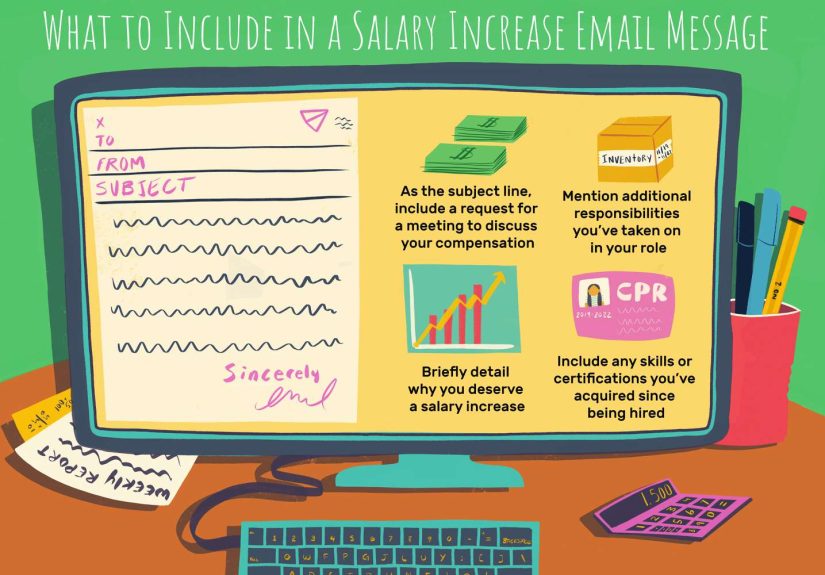
It typically includes:
- A clear subject line (no mystery, no drama).
- A respectful opener and a request for a time to talk.
- Your value summary (3–6 bullets, not your entire LinkedIn history).
- The ask (a range or a specific target, depending on your situation).
- A collaborative close (you’re aligning, not issuing a decree).
Subject lines that work (choose one)
- “Request for a compensation review”
- “Salary discussion / compensation review (meeting request)”
- “Compensation adjustment conversation”
- “Follow-up: compensation and role scope”
Keep it professional. Your subject line is not the place for “Quick question 👀” or “Can we talk…”
(that’s how you accidentally recreate a suspense thriller in someone’s inbox).
How to Phrase the Ask: Range vs. Number
Option A: Ask for a range (often safest)
A range signals you’ve done research and you’re flexible. It also gives your manager room to work with internal bands.
Example: “Based on my responsibilities and current market rates, I’d like to discuss adjusting my salary to the $X–$Y range.”
Option B: Ask for a specific number (useful for market corrections)
If you’re clearly underpaid or you know the band, a specific target can be appropriate.
Example: “I’d like to discuss moving my salary to $X to align with my role scope and market data.”
Option C: Ask for a percentage (simple and clear)
This can work if your company talks about comp in percentages.
Example: “I’d like to discuss a 8–10% adjustment based on expanded scope and results.”
Templates: How to Ask for a Raise via Email
Copy, paste, customize. Keep your voice natural. If you wouldn’t say it out loud without laughing, revise it.
Template 1: The “Request a Meeting” Raise Email (Most Recommended)
Subject: Request for a compensation review
Hi [Manager Name],
I’d like to schedule time to discuss my compensation and role scope. Over the past [X months/year], my responsibilities and impact have grown,
and I’d appreciate the chance to review an adjustment that reflects that.
- [Accomplishment #1 with metric/result]
- [Accomplishment #2 with metric/result]
- [Accomplishment #3 with metric/result]
- [Optional: expanded responsibility, leadership, cross-team impact]
Based on these contributions and market data for similar roles in [location/industry], I’d like to discuss moving my compensation to
[target number or range].
Would you be open to a 20–30 minute meeting next week? I’m happy to come prepared with additional context and make this easy to evaluate.
Thank you,
[Your Name]
Template 2: The “After a Strong Review / Big Win” Raise Email
Subject: Follow-up: compensation discussion
Hi [Manager Name],
Thanks again for the feedback in our recent review. I’m excited about the goals we discussed for the next cycle.
I’d also like to talk about aligning my compensation with my current performance and responsibilities.
Highlights from the last [time period]:
- [Win #1]
- [Win #2]
- [Win #3]
Based on these results and the scope of my role, I’d like to discuss a compensation adjustment to [range or %].
Could we set aside time this week or next to talk?
Thanks,
[Your Name]
Template 3: The “Market Adjustment” Raise Email (When You’re Underpaid)
Subject: Compensation alignment / market adjustment discussion
Hi [Manager Name],
I’d like to request a conversation about aligning my compensation with the current scope of my role and market rates.
I’ve researched compensation for comparable roles in our industry and location, and it appears my salary is below the typical range.
Here are a few examples of my current responsibilities and impact:
- [Responsibility/impact example]
- [Responsibility/impact example]
- [Responsibility/impact example]
I’d like to discuss an adjustment to [target/range] to bring my compensation in line with the market and my role scope.
Would you be open to meeting next week to review this?
Thank you,
[Your Name]
Template 4: The “Polite Follow-Up” Email (If You Haven’t Heard Back)
Subject: Follow-up on compensation review meeting
Hi [Manager Name],
Quick follow-up on my request to discuss compensation. I know schedules get packed, so I wanted to see if we could
find a time on the calendar to talk through it.
I’m available [two windows], but I’m happy to work around your schedule. Thanks again.
Best,
[Your Name]
What to Do After You Send the Email
Prepare for the meeting like it’s a collaboration
- Bring your brag sheet and a one-paragraph “value summary.”
- Know your target, your acceptable minimum, and your “not ideal but workable” options.
- Be ready for questions: “Why now?” “What changed?” “How does this compare to your original role?”
Expect the “not today” response (and don’t panic)
Many managers can’t approve raises instantly. Often, they need to check budget, bands, timing, and HR process.
If you hear “Let me look into it,” that can be normal.
If the answer is “no,” get a “not yet” plan
A “no” is frustratingbut it’s also valuable information if you turn it into a path forward. Ask:
- “What would need to be true for this to become a yes?”
- “What goals or milestones should I hit, and by when?”
- “Can we revisit this in [60/90] days or at the next review cycle?”
If a raise truly isn’t possible now, consider negotiating alternatives:
a title change, bonus, additional PTO, professional development budget, flexible schedule, or a defined promotion timeline.
Common Mistakes That Make a Raise Email Weaker
- Writing a novel: keep it skimmable. Busy managers reward clarity.
- Leading with emotions: feelings are real; your email should lead with value.
- Comparing yourself to coworkers: focus on your role scope and market data.
- Vague asks: “I’d like more money” is not a strategy. Provide a range or target.
- Accidental ultimatums: even subtle threats can backfire unless you truly mean them.
- Ignoring timing: if raises happen annually, you may need to align with that process.
Quick Examples: Strong, Specific “Value” Lines
- “Since taking ownership of [process], we’ve reduced turnaround time by [X%], and I’ve trained two teammates to maintain it.”
- “In the last two quarters, I’ve led [initiative], resulting in [measurable result].”
- “My role has expanded to include [new responsibility], which aligns more closely with [higher-level role/title].”
- “Based on market data and my current scope, I’d like to discuss adjusting my salary to [range].”
Conclusion: Ask Like a Pro, Not Like a Permission Slip
A great salary increase email doesn’t beg. It doesn’t apologize for existing. It calmly connects the dots:
here’s my impact, here’s how my scope has grown, and here’s a reasonable compensation adjustment.
The goal isn’t to “win an argument.” It’s to make it easy for your manager to advocate for you.
If you take one thing from this: send an email that requests a conversation, backs it up with proof, and keeps the tone collaborative.
You’re not asking for a favoryou’re asking for alignment.
Real-World Experiences People Commonly Have When Asking for a Raise via Email (500+ Words)
Even with the perfect words, asking for a raise can feel weirdly personallike your paycheck is getting graded in public.
In reality, many professionals report that the emotional “storm” is the hardest part, not the email itself.
Here are common experiences people run into, plus what tends to help.
1) “I stared at the draft for two hours because it sounded… cringe.”
This is extremely common. People often swing between two extremes: overly formal (“Greetings, respected compensation decision-maker”)
or overly casual (“Heyyy quick thing!”). What usually works is a simple, human tone with business content.
A practical trick: read your email out loud. If you wouldn’t say it in a calm meeting, edit it until you would.
2) “My manager replied fast… but only to schedule a meeting. I panicked.”
Scheduling a meeting is a good sign. Many managers prefer discussing compensation live, and some are required to.
People who feel calmer going into that meeting often prepare a one-page summary: top wins, expanded responsibilities,
market range, and their request. Having that sheet reduces rambling and helps you sound confident even if your stomach
is doing gymnastics.
3) “I got the dreaded ‘Let me think about it.’ It felt like a no.”
A delay is not automatically a rejection. Raise approvals frequently involve budget, HR bands, and timing.
Many professionals say the most helpful move is to follow up with a friendly question that keeps momentum:
“What’s the best next step from here?” or “Is there any info you’d like me to send to support the review?”
This keeps the process moving without sounding impatient.
4) “They said no, but it wasn’t the end of the story.”
A common experience is receiving a “not now” because of timing (review cycle, budget freeze, reorg).
People who eventually get a yes often turn the no into a roadmap:
“What goals would justify this adjustment?” and “When can we revisit?”
Setting a specific check-in date30, 60, or 90 daysgives the conversation a future, not a dead end.
5) “I realized I was doing a bigger job than my title.”
This happens a lot, especially after team changes. People take on extra work gradually (“temporary help” that becomes permanent),
and then one day they look up and realize their role has quietly leveled up.
In those situations, professionals often find it effective to frame the raise as role alignment:
“My responsibilities now match [next level] expectations.” That’s easier to evaluate than a vague “I want more.”
6) “Negotiating felt awkward until I treated it like problem-solving.”
Many people report that the conversation gets easier when they stop trying to “convince” and start collaborating.
Instead of pushing harder, they ask smarter questions:
“What constraints are you working with?” “Is this a compensation issue, or a leveling issue?”
“Would a bonus, additional PTO, or a defined promotion timeline be more feasible right now?”
This shifts the tone from confrontation to options.
7) “I didn’t get the raise, but I got clarityand that mattered.”
Not every story ends with a bigger number immediately. But a well-written raise request email often produces something valuable:
clearer expectations, stronger visibility, and a better understanding of how decisions are made.
Many professionals say that once they had clarity (even disappointing clarity), they could make informed choicespursue growth internally,
adjust their goals, or explore opportunities elsewhere with confidence.
The big takeaway from these experiences: the email is rarely the “magic spell.”
It’s the start of a professional process. When you pair a solid email with strong preparation and calm follow-through,
you dramatically increase your odds of getting a raiseor at least getting a clear path to one.