Table of Contents >> Show >> Hide
- What Is a Square Root?
- Method 1: Calculate Square Roots by Recognizing Perfect Squares
- Method 2: Estimate a Square Root by Hand
- Method 3: Use Prime Factorization
- Method 4: The Square Root Long Division Method
- Method 5: Newton’s Method for Fast Approximation
- How to Calculate Decimal Square Roots by Hand
- Common Mistakes When Calculating Square Roots by Hand
- Which Method Should You Use?
- Practice Problems
- Conclusion: Square Roots by Hand Are Not as Scary as They Look
- Experience Notes: What Calculating Square Roots by Hand Teaches You
- SEO Tags
Calculating a square root by hand sounds like one of those old-school skills your math teacher keeps in a secret wooden box labeled “Things Students Think Calculators Do Automatically.” But here is the good news: you do not need a calculator, a magic wand, or a suspiciously confident friend named Kevin. You only need a few number sense tools, some patience, and a method that breaks the problem into small, manageable steps.
A square root answers one simple question: what number multiplied by itself gives the original number? For example, the square root of 49 is 7 because 7 × 7 = 49. The square root of 100 is 10 because 10 × 10 = 100. Things get more interesting when the number is not a perfect square, such as 50, 72, or 200. That is where estimation, long division, prime factorization, and Newton’s method come in.
In this guide, you will learn how to calculate a square root by hand using practical methods that actually make sense. We will cover perfect squares, estimation, the square root long division method, decimal square roots, and a clever approximation trick called Newton’s method. By the end, you may not throw your calculator away, but you might look at it with slightly less emotional dependence.
What Is a Square Root?
A square root is the number that produces a given value when multiplied by itself. In math notation, the square root of a number is written with the radical symbol: √. So √64 = 8 because 8 × 8 = 64.
Most people focus on the positive square root, also called the principal square root. Technically, both 8 and -8 are square roots of 64 because both numbers squared equal 64. However, when you see √64 by itself, it usually means the positive answer: 8.
Perfect Squares Make Life Easier
A perfect square is a number with a whole-number square root. Learning common perfect squares is the fastest way to calculate many square roots by hand.
| Number | Square |
|---|---|
| 1 | 1 |
| 2 | 4 |
| 3 | 9 |
| 4 | 16 |
| 5 | 25 |
| 6 | 36 |
| 7 | 49 |
| 8 | 64 |
| 9 | 81 |
| 10 | 100 |
| 11 | 121 |
| 12 | 144 |
| 13 | 169 |
| 14 | 196 |
| 15 | 225 |
If you memorize these, you can quickly estimate nearby square roots. For instance, √80 is between √64 and √81, so it is between 8 and 9. Since 80 is very close to 81, √80 is just under 9.
Method 1: Calculate Square Roots by Recognizing Perfect Squares
The simplest way to calculate a square root by hand is to check whether the number is a perfect square. This method is fast, clean, and wonderfully low-drama.
Example: Find √144
Ask yourself: what number times itself equals 144?
Since 12 × 12 = 144, the answer is:
√144 = 12
Example: Find √225
Since 15 × 15 = 225:
√225 = 15
This method works best when the number is familiar. If the number looks intimidating, such as 3,969, do not panic. It may still be a perfect square, but you may need a stronger method.
Method 2: Estimate a Square Root by Hand
Estimation is the everyday method for calculating square roots without a calculator. It is especially useful when the number is not a perfect square.
Step-by-Step Estimation
- Find the perfect square below the number.
- Find the perfect square above the number.
- Place the square root between those two whole numbers.
- Adjust based on how close the number is to either perfect square.
Example: Estimate √50
The closest perfect squares are 49 and 64.
√49 = 7 and √64 = 8, so √50 is between 7 and 8. Since 50 is only 1 away from 49, √50 is a little more than 7. A good estimate is:
√50 ≈ 7.1
In fact, √50 is about 7.07, so 7.1 is a strong mental estimate. Your brain deserves a tiny parade.
Example: Estimate √120
The closest perfect squares are 100 and 121.
√100 = 10 and √121 = 11, so √120 is between 10 and 11. Since 120 is very close to 121, the square root is just under 11.
√120 ≈ 10.95
Estimation is not always exact, but it gives you a reliable answer quickly. It is perfect for checking whether a calculator result makes sense, solving multiple-choice problems, or impressing someone who still uses their fingers for 9 × 7.
Method 3: Use Prime Factorization
Prime factorization is useful when you want an exact square root for a perfect square or when you want to simplify a radical. The idea is to break the number into prime factors, pair identical factors, and pull one number from each pair outside the square root.
Example: Find √324
Start by factoring 324:
324 = 2 × 162
162 = 2 × 81
81 = 3 × 3 × 3 × 3
So:
324 = 2 × 2 × 3 × 3 × 3 × 3
Now group the factors into pairs:
(2 × 2) × (3 × 3) × (3 × 3)
Take one number from each pair:
2 × 3 × 3 = 18
Therefore:
√324 = 18
Example: Simplify √72
Factor 72:
72 = 2 × 2 × 2 × 3 × 3
Group the pairs:
(2 × 2) × (3 × 3) × 2
Take one number from each pair and leave the unpaired 2 inside the radical:
√72 = 6√2
This does not give a decimal, but it gives the exact simplified form. In algebra, exact form is often preferred because it avoids rounding errors. It also makes you look calm and sophisticated, like someone who owns a reusable water bottle and knows where it is.
Method 4: The Square Root Long Division Method
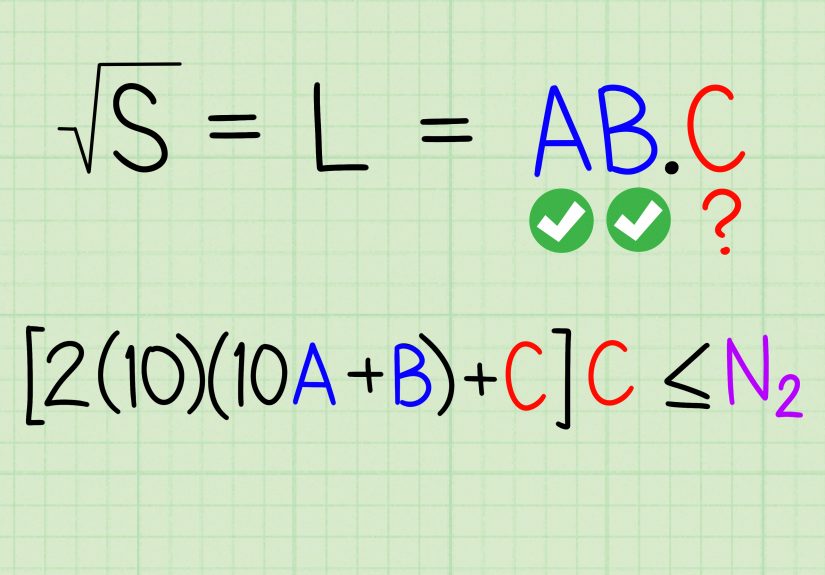
The square root long division method is the classic hand-calculation technique for finding square roots digit by digit. It looks a little strange at first, but it is systematic and powerful. You can use it for large numbers and decimals.
How the Long Division Method Works
- Separate the number into pairs of digits, starting from the decimal point. Move left for whole numbers and right for decimals.
- Find the largest square less than or equal to the first group.
- Subtract that square and bring down the next pair.
- Double the current quotient to form a trial divisor.
- Find the largest digit that works when placed beside the trial divisor and multiplied by that same digit.
- Repeat until you have enough digits.
Example: Find √529 by Hand
First, group the digits: 5 | 29
The largest square less than or equal to 5 is 4, and 2 × 2 = 4. Write 2 as the first digit of the answer.
Subtract:
5 – 4 = 1
Bring down the next pair, 29, to get 129.
Now double the current answer, 2:
2 × 2 = 4
We need a digit x such that 4x × x is less than or equal to 129. Try 3:
43 × 3 = 129
Perfect. Add 3 to the answer.
√529 = 23
Check it: 23 × 23 = 529. No calculator, no sweat, no mysterious math fog.
Example: Find √2 to Two Decimal Places
Write 2 as 2.0000 and group it as:
2 | 00 | 00
The largest square less than or equal to 2 is 1, so the first digit is 1.
Subtract:
2 – 1 = 1
Bring down 00 to get 100. Double the current answer, 1, to get 2. Now find x such that 2x × x is less than or equal to 100. Try 4:
24 × 4 = 96
So the next digit is 4. The answer is now 1.4.
Subtract:
100 – 96 = 4
Bring down another 00 to get 400. Double 14 to get 28. Find x such that 28x × x is less than or equal to 400. Try 1:
281 × 1 = 281
Try 2:
282 × 2 = 564, too high.
So the next digit is 1.
√2 ≈ 1.41
The actual value begins 1.414…, so the long division method gives an accurate hand-calculated answer.
Method 5: Newton’s Method for Fast Approximation
Newton’s method is a smart approximation technique. For square roots, the formula is surprisingly friendly:
New guess = (old guess + number ÷ old guess) ÷ 2
This method works because it averages your guess with the number divided by your guess. If your first guess is too high, the division result tends to be too low, and the average moves toward the correct square root.
Example: Estimate √10
Start with a guess. Since 3 × 3 = 9 and 4 × 4 = 16, √10 is a little more than 3. Let us start with 3.
New guess = (3 + 10 ÷ 3) ÷ 2
10 ÷ 3 ≈ 3.333
(3 + 3.333) ÷ 2 = 3.1665
Now repeat:
New guess = (3.1665 + 10 ÷ 3.1665) ÷ 2
10 ÷ 3.1665 ≈ 3.158
(3.1665 + 3.158) ÷ 2 ≈ 3.162
√10 ≈ 3.162
That is extremely close. Newton’s method is fast, elegant, and a little show-offy in the best way.
How to Calculate Decimal Square Roots by Hand
Decimal square roots follow the same logic as whole-number square roots. The key is to group digits in pairs from the decimal point.
Example: Find √7.29
Notice that 7.29 has two decimal digits. You may recognize that:
27 × 27 = 729
Since 7.29 is 729 divided by 100, its square root is 27 divided by 10.
√7.29 = 2.7
This shortcut works because square roots interact neatly with powers of 10. Since √100 = 10, moving the decimal two places in the number moves the decimal one place in the square root.
Common Mistakes When Calculating Square Roots by Hand
Mistake 1: Treating Square Roots Like Division by 2
The square root of 64 is not 32. A square root is not half of a number. It asks what number multiplied by itself gives the original number. Think “same factor twice,” not “cut it in half.”
Mistake 2: Forgetting the Negative Square Root in Equations
When solving equations such as x² = 25, the answer is x = 5 or x = -5. But when evaluating √25, the principal square root is 5. Context matters.
Mistake 3: Rounding Too Early
If you are using Newton’s method or long division, wait until the final step to round your answer. Rounding early can push your final result away from the true value.
Mistake 4: Ignoring Perfect Squares Inside Radicals
Do not leave √48 untouched if you can simplify it. Since 48 = 16 × 3, you can write:
√48 = 4√3
Simplifying radicals makes later calculations easier and cleaner.
Which Method Should You Use?
The best method depends on the number and your goal.
| Goal | Best Method |
|---|---|
| Find the square root of a familiar perfect square | Memorized perfect squares |
| Approximate a non-perfect square quickly | Estimation |
| Simplify a radical exactly | Prime factorization |
| Find digits one by one | Long division method |
| Get a fast decimal approximation | Newton’s method |
If you are doing schoolwork, the long division method and prime factorization are especially useful because they show clear work. If you are estimating in your head, use nearby perfect squares. If you want speed and accuracy, Newton’s method is hard to beat.
Practice Problems
Try these by hand before checking the answers:
- √196
- √361
- Estimate √30
- Simplify √98
- Estimate √15 using Newton’s method
Answers
- √196 = 14
- √361 = 19
- √30 is between 5 and 6, closer to 5.5; a good estimate is about 5.48
- √98 = 7√2
- √15 ≈ 3.873
Conclusion: Square Roots by Hand Are Not as Scary as They Look
Learning how to calculate a square root by hand gives you more than an answer. It builds number sense, strengthens mental math, and helps you understand what your calculator is doing behind the screen. For perfect squares, memorize the common roots. For quick approximations, use nearby perfect squares. For exact simplification, use prime factorization. For digit-by-digit precision, use the square root long division method. For fast decimal estimates, use Newton’s method.
The best part is that all these methods support one another. Estimation helps you choose a good starting point. Prime factorization helps you simplify. Long division gives structure. Newton’s method gives speed. Put them together, and square roots stop feeling like math monsters hiding under the bed. They become puzzles with rules, patterns, and surprisingly satisfying answers.
Experience Notes: What Calculating Square Roots by Hand Teaches You
One of the most valuable experiences related to calculating square roots by hand is learning how much power comes from estimation. At first, many students want the exact answer immediately. That is understandable. Exact answers feel safe. But square roots teach an important lesson: before you chase precision, understand the neighborhood. If you know that √70 must be between 8 and 9 because 64 and 81 are the nearby perfect squares, you already understand the size of the answer. That single insight prevents wildly wrong calculations.
Another useful experience is discovering that mistakes are easy to spot when you know the logic behind the method. Suppose someone says √90 is 30. Even without calculating the exact value, you know that cannot be right because 30 × 30 = 900, not 90. Hand calculation trains your internal “math alarm.” It helps you notice when an answer is too large, too small, or just wandering around with no adult supervision.
Working by hand also teaches patience. The long division method can feel slow the first time you try it. You group digits, subtract, double the quotient, test a digit, and repeat. It is not instant. But that slowness is actually useful. Each step shows why the next digit appears. Instead of accepting an answer from a machine, you build the answer piece by piece. That process makes square roots less mysterious.
Prime factorization offers a different kind of experience. It teaches structure. When you simplify √72 into 6√2, you are not merely changing the way the number looks. You are revealing what is hidden inside it. You see that 72 contains square factors, and you learn how those factors come out of the radical. This is especially helpful later in algebra, geometry, and trigonometry, where simplified radicals appear everywhere.
Newton’s method gives another lesson: a rough guess can become excellent through repetition. Your first guess does not need to be perfect. It just needs to be reasonable. Each round improves the answer. That idea applies beyond math. Drafts become essays. Sketches become designs. Practice becomes skill. Square roots, oddly enough, can become a tiny life coach with better algebra.
The biggest takeaway is that calculating a square root by hand is not about rejecting calculators. Calculators are useful. The point is to understand the calculation well enough that technology becomes a helper, not a black box. When you can estimate, simplify, and verify square roots yourself, you gain confidence. You also become much harder to fool by a typo, a rushed answer, or a calculator result entered incorrectly. That confidence is the real prize.