Table of Contents >> Show >> Hide
- The Story That Sparked the Debate
- Why This Hit Such a Nerve Online
- The Bigger Reality: Weddings Are Expensive Now
- What Etiquette Actually Suggests
- Where the Single Mom Went Wrong, and Where the Bride Might Have Too
- How This Could Have Been Handled Better
- The Real Lesson Behind the Viral Wedding Dress Drama
- Related Experiences: When Wedding Joy Runs Into Real-Life Budgets
- Conclusion
- SEO Tags
Weddings are supposed to come with cake, dancing, and at least one uncle who thinks he invented the electric slide. They are not, in theory, supposed to come with a side order of credit card dread. But that is exactly why one viral bridesmaid story struck such a nerve online. A single mom, already stretching her budget to attend a destination wedding, found herself staring down the cost of an expensive bridesmaid dress and wondering whether friendship now came with a payment plan.
The internet, being the internet, did what it always does best: it turned a personal dilemma into a public debate. Some people sympathized immediately. Others dragged her for agreeing to a wedding she clearly could not afford. And plenty of readers landed somewhere in the middle, basically saying, “Nobody is a villain here, but somebody needs to have an honest conversation before this turns into a satin-covered disaster.”
That tension is what makes this story feel bigger than one dress. It taps into a very modern problem: weddings are becoming more elaborate, more expensive, and more emotionally loaded, while many guests and bridal party members are trying to survive ordinary life in an economy that is not exactly handing out free champagne. Add single-parent finances, destination travel, and the pressure to “show up properly,” and suddenly a dress is not just a dress. It is a stress test for friendship, etiquette, and plain old math.
The Story That Sparked the Debate
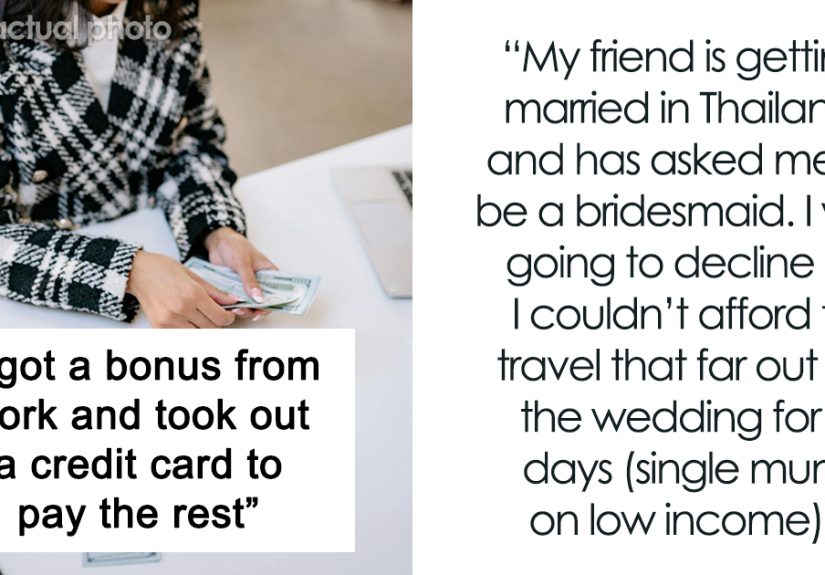
At the center of the drama is a single mother who said she initially planned to turn down her friend’s invitation to be a bridesmaid in a wedding in Thailand because the trip was simply too expensive. Then a small work bonus arrived, and she used that plus a credit card to cover the trip. The bride, to her credit, was paying for accommodations, which made the whole thing feel just barely possible.
Then came the dress.
The bridesmaid learned that the dress the bride had chosen cost around $335. Her reaction was not subtle. She said she was “in shock,” and honestly, who among us has not looked at a price tag and briefly felt our soul leave our body? She asked whether she could buy a less expensive alternative in the same general style, and the bride agreed. Problem solved, right? Not exactly.
The woman then worried that anything she could afford would look noticeably cheaper than the other bridesmaids’ dresses. Instead of feeling included, she felt trapped between two bad options: overspend and make her finances worse, or save money and feel like the discount bin plus-one in formal photos that will outlive us all.
That is where the internet came in. Some commenters argued that she should never have taken on debt for someone else’s wedding in the first place. Others thought the bride should have been more mindful of what she was asking, especially from a close friend she knew was on a tight budget. A more measured group pointed out that bridesmaids often do pay for their own dresses, but that good etiquette also requires budget sensitivity and actual communication. In other words, everybody needed less passive stress and more straightforward talking.
Why This Hit Such a Nerve Online
This story blew up because it sits right at the intersection of three things people feel deeply about: money, friendship, and weddings. Money is rarely just money. It is identity, security, guilt, status, sacrifice, and, occasionally, the reason someone cries in a dressing room under fluorescent lighting.
For a single mother, that pressure can feel even sharper. Financial decisions are often not about splurging versus saving; they are about prioritizing rent, food, child-related costs, transportation, and whatever fresh emergency the week decides to fling through the front door. When wedding participation enters that equation, the emotional stakes go up fast. Saying no can feel disloyal. Saying yes can feel reckless. And doing both halfway usually creates the worst kind of stress: expensive stress.
That is also why the online response was so divided. One side saw personal responsibility. They thought the bridesmaid should have protected her own budget from the beginning. The other side saw social blindness. They thought a bride asking people to spend heavily on a destination event should build in flexibility, not aesthetic pressure. Both views contain a piece of the truth, which is probably why the argument refused to die.
The Bigger Reality: Weddings Are Expensive Now
This bridesmaid dilemma did not emerge in a vacuum. Wedding culture in the United States has become startlingly pricey, and not just for the couple getting married. Recent industry data shows the average wedding cost has climbed into the tens of thousands of dollars, and wedding guests themselves are spending more just to attend. Once travel, lodging, gifts, attire, and event add-ons enter the chat, the budget starts sweating.
Being a bridesmaid is especially expensive because it often comes with a full menu of costs. There is the dress, of course, but also alterations, shoes, accessories, bridal shower contributions, bachelorette events, hair and makeup, transportation, hotel stays, and the wedding gift. By the time all of that is done, what began as “I’d love you to stand beside me” can quietly morph into “Congratulations, you have accidentally enrolled in an unpaid subscription service.”
And the pressure is not just anecdotal. Finance and wedding-planning surveys have found that many couples face serious money stress during planning, and many newlyweds take on debt for the event itself. Guests and attendants are feeling the squeeze too. In one striking snapshot of modern celebration economics, the combined cost of attending a wedding and a bachelor or bachelorette trip has been compared to roughly a month’s rent in the U.S. That is not a cute little budget hiccup. That is a real tradeoff.
When “Just One Dress” Is Not Just One Dress
On paper, $335 may sound manageable to some people. In real life, it depends entirely on context. For someone with disposable income, it might be annoying but doable. For someone already carrying travel costs on a credit card, it can be the financial equivalent of a chair collapsing beneath you at a dinner party: sudden, embarrassing, and impossible to ignore.
That is the part wedding conversations often miss. Cost is never just about the number. It is about timing, income, obligations, and what else that money was supposed to do. A dress might be “worth it” in quality terms, but still be unrealistic in actual human terms.
And once a person has already committed to flights, time off, childcare planning, and emotional support, the dress can feel like the final straw rather than the first ask. That is why this story resonated with so many readers. It is not about fashion. It is about the moment generosity collides with financial limits.
What Etiquette Actually Suggests
Traditional etiquette generally says bridesmaids are often expected to pay for their own attire. That part is not shocking. But good etiquette does not stop there. Modern guidance from wedding experts is much more nuanced: couples should be upfront about costs, sensitive to budgets, and careful not to turn participation into a financial endurance event.
In practical terms, that means the bride is not automatically wrong for asking bridesmaids to buy their own dresses. But she does take on some responsibility if she chooses a highly specific, expensive option without first checking what people can realistically afford. The healthiest version of bridesmaid etiquette is collaborative, not dictatorial. Think conversation, not decree.
Experts also tend to agree on another point: if a service is mandatory, the couple should strongly consider covering it. If professional hair and makeup are absolutely required, for example, many etiquette-minded planners say the couple should pay or offer alternatives. The same spirit applies to custom looks, very specific styling rules, or travel-heavy pre-wedding events. If the wedding vision has a luxury price tag, the people funding that vision should not be surprised when some loved ones cannot participate fully.
In other words, wedding etiquette is not just about who technically pays. It is about whether the request is fair, clearly communicated, and made with grace.
Where the Single Mom Went Wrong, and Where the Bride Might Have Too
Let’s be honest: the single mom did make one risky choice. She agreed to something that was already outside her comfort zone and used debt to bridge the gap. That is understandable on an emotional level, but shaky on a financial one. When people online called her out, this is the part they were reacting to. If you are already stretched thin, hoping the rest of the costs will somehow behave themselves is not a great plan. Wedding expenses, like glitter, tend to spread.
Still, the bride may have misread the situation too. A close friend’s tight finances should make a couple more thoughtful, not less. Even if bridesmaids usually cover attire, a bride who values the friendship more than the exact embellishment count on a gown will usually build in some flexibility. A color palette, approved retailers, mix-and-match options, or a “wear what works within this budget” approach can preserve both the look and the relationship.
That is why this situation does not read as a clean case of hero versus villain. It reads as a painfully common mismatch in assumptions. One person thought she could make it work if she stretched. The other likely assumed the dress request was normal. Nobody set a clear financial boundary early enough, and then the dress became the lightning rod for every unspoken worry.
How This Could Have Been Handled Better
For the bridesmaid
The best move would have been honesty from day one. Something like: “I love you, but I have a strict budget. I can come as a guest, or be a bridesmaid only if the costs stay within X range.” Not glamorous, but wildly effective. Boundaries are cheaper than regret.
For the bride
The smarter approach would have been transparency before anyone agreed. A simple cost outline could have prevented the whole mess: approximate dress cost, travel expectations, beauty expenses, and anything else non-negotiable. That kind of clarity may feel awkward for five minutes, but it saves five months of resentment.
For both of them
The healthiest compromise may still be the obvious one: attend as a guest instead of a bridesmaid. It lowers the financial burden, removes the dress pressure, and gives the friendship a better chance of surviving the wedding. Sometimes the kindest solution is not “make it work.” It is “change the role and keep the peace.”
The Real Lesson Behind the Viral Wedding Dress Drama
The most important takeaway here is not whether $335 is objectively too much for a bridesmaid dress. In some weddings, it may be completely normal. In others, it may be absurd. The real question is whether the people involved can afford it without stress, shame, or debt.
Too often, modern wedding culture treats emotional closeness as a blank check. If you love me, come to the destination wedding. If you love me, buy the dress. If you love me, join the trip, the shower, the glam appointment, the welcome dinner, the themed brunch, the gift exchange, and whatever else appears on the ever-expanding itinerary. But love is not proven by financial strain. Friendship is not measured in sequins per dollar.
That is why this story resonated. It exposed the quiet absurdity hiding inside many wedding expectations. The woman was not only worried about a dress. She was worried about being judged, standing out, disappointing a friend, and making an already tight financial situation worse. That combination is painfully relatable.
And maybe that is the internet’s accidental gift in all of this. Every time one of these stories goes viral, it reminds people planning weddings to ask a simple question before making another beautiful, expensive demand: is this actually reasonable for the people I love?
Related Experiences: When Wedding Joy Runs Into Real-Life Budgets
This story feels familiar because it is familiar. Similar experiences keep surfacing, and they all point to the same underlying problem: wedding expectations are often discussed as if everyone has the same savings account, the same rent, the same schedule, and the same emotional tolerance for financial chaos. Real life, of course, laughs in the face of that assumption.
Take the bridesmaid who reportedly received a spreadsheet listing more than $1,000 in expected costs just to participate in her best friend’s wedding. It was not one dramatic charge that bothered her; it was the cumulative effect. A dress here, a styling fee there, gifts, parties, travel, themed extras. Nothing felt outrageous in isolation. Together, it looked like a second monthly budget with better stationery. That kind of experience is common because wedding costs rarely arrive all at once. They trickle in until your wallet starts seeing ghosts.
Then there are the stories where financial strain turns into social punishment. One woman said she was effectively demoted after she could not afford a bachelorette trip. Another described being expected to spend thousands on pre-wedding events while unemployed and already in debt. In situations like those, the pain is not just financial. It is emotional. People start wondering whether they were wanted for their friendship or their spending capacity. That is a brutal thing to realize while trying to celebrate someone you care about.
Guests feel the pressure too. There have been complaints about being asked to cover venue costs, meal charges, and other expenses that used to be considered part of hosting. Again, the issue is not only the money. It is the social awkwardness. Most people do not want to be the person who says, “Actually, I can’t afford your wedding.” So they stall, overspend, borrow, or quietly bow out and feel terrible about it. None of those options feels good, which is why even small requests can spark big reactions online.
For single parents, renters, younger adults, and anyone managing debt, these experiences hit especially hard. A celebration that might feel merely expensive to one person can feel destabilizing to another. That is why the most compassionate wedding planning is not the most photogenic. It is the most realistic. It gives people room to say yes without panic and no without punishment.
The encouraging part is that many friendships do survive these moments when people talk honestly. Brides switch to more flexible dress rules. Friends step down from the bridal party and attend as happy guests. Costs get trimmed. Expectations get clarified. Nobody has to pretend that money is irrelevant, and nobody has to confuse “supporting the marriage” with “funding the production.” That is probably the healthiest lesson hidden inside all these viral wedding stories: the best weddings make people feel included, not invoiced.
Conclusion
So, was the single mom wrong to feel shocked? Not at all. Was she wise to take on debt for someone else’s wedding? Also no. Was the bride automatically unreasonable for expecting bridesmaids to pay for dresses? Not necessarily. But a friendship-centered wedding should leave room for different budgets, honest conversations, and graceful compromises.
That is the real answer to this whole online uproar. The dress was not just fabric and embellishments. It was a flashing warning light about money, expectations, and the danger of assuming everyone can “just make it work.” In wedding season, that phrase should probably be retired and buried under a tasteful arrangement of peonies.
If there is one rule worth keeping, it is this: people should leave a wedding with good memories, not a bigger balance on their credit card.