Table of Contents >> Show >> Hide
- Fireflies 101: What’s Actually Flashing?
- From Blink to Beat: Treating a Firefly Like an Oscillator
- The Classic Math Move: Coupled Oscillators and the Kuramoto Idea
- Why Fireflies Aren’t Just Kuramoto With Wings
- A Real-World Example: The Great Smoky Mountains’ Synchronous Stars
- So… Why Sync at All? The Evolutionary Math of Attention
- What the Math Predicts (and Nature Sometimes Confirms)
- Why You Should Care (Besides the Obvious: They’re Cute)
- Conclusion
- Experience Add-On (Approx. ): How to “Feel” the Math During a Firefly Night
If you’ve ever watched a meadow at dusk start blinking like a living Christmas display, you’ve probably had two thoughts: (1) “This is magical,” and (2) “Who gave the bugs a schedule?” The funny part is that, in a sense, they do have a schedule and math is one of the best ways to describe it.
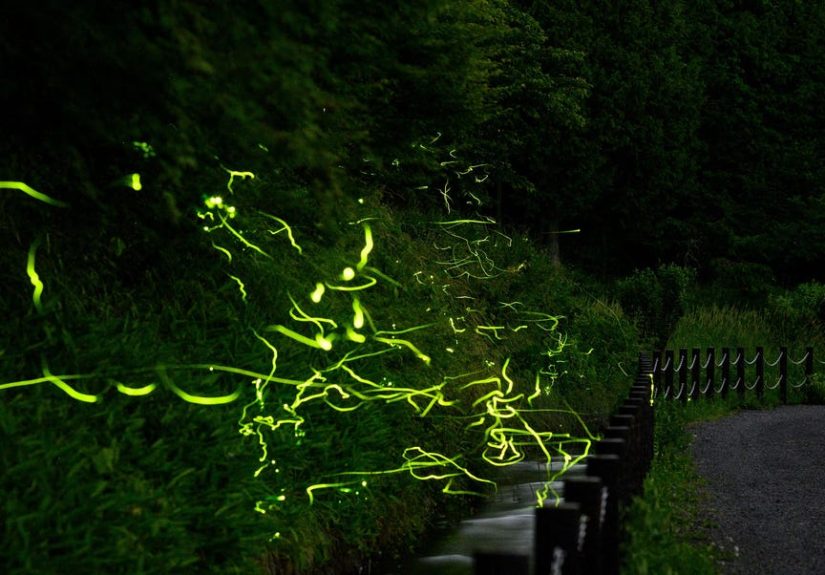
Fireflies (aka lightning bugs, aka “tiny flying lanterns with better PR than mosquitoes”) aren’t just glowing at random. Many species flash in species-specific patterns to find mates. In a few famous cases, large groups can synchronize so tightly that the whole forest seems to pulse as one organism. That’s not just a nature flex; it’s a full-on demonstration of collective behavior, the same kind of phenomenon that shows up in clapping crowds, heart cells beating together, and networks keeping time.
This article breaks down the “how” in plain American English, with just enough math to feel smart and not enough to feel trapped in a surprise midterm. We’ll meet oscillators, phases, thresholds, and the models that turn a chaotic sparkle into a coherent light show.
Fireflies 101: What’s Actually Flashing?
A firefly’s glow is biochemistry doing a mic drop. Inside the light organ, the molecule luciferin reacts with oxygen in a process catalyzed by the enzyme luciferase. The reaction uses cellular energy (ATP) and typically involves magnesium ions. The result is lightastonishingly efficient light, with much less wasted heat than an old-school incandescent bulb.
But chemistry alone doesn’t explain the timing. Fireflies don’t just “glow”; they produce controlled flashes. Think of each insect as having a biological timing circuit that decides when to send a signal. That signal is visible to other fireflies, and those neighbors can adjust their own timing in response. The key ingredients for synchronization are:
- A repeatable rhythm (even if it’s flexible)
- A way to sense others (mostly vision)
- A rule for adjustment (“If I see a flash, I shift my next flash a bit”)
In other words: a firefly is a blinking agent in a neighborhood of blinking agents, all nudging each other toward a shared tempo. Which is basically a group chat, but with fewer typos and more romance.
From Blink to Beat: Treating a Firefly Like an Oscillator
Mathematicians love a good simplification. One of the most useful is to treat each firefly as an oscillatoranything that cycles through a repeating process. A pendulum swings. A metronome ticks. Your phone battery anxiety rises and falls daily. All oscillators.
For a flashing firefly, the cycle might be: “charging up” → “flash” → “reset” → repeat. A convenient way to represent this is with a phase, usually written as an angle on a circle. Imagine each firefly has an internal hand on an invisible clock:
- Phase = 0: just flashed
- Phase increases steadily as time passes
- Phase = 1 (or 2π): reaches the threshold and flashes again
- Then phase resets back to 0
If fireflies never interacted, each would run its own internal rhythm and the meadow would look like random twinkling. Interaction changes everything.
The Phase Response Curve: “How Much Does a Flash Mess With Me?”
When one firefly sees another flash, it may adjust its own timingspeeding up or slowing down the next flash depending on where it is in its cycle. That relationship is often summarized by a phase response curve (PRC): a function that maps “my current phase” to “how much I shift because I saw a flash.”
The PRC is a big deal because it’s where biology meets math. It’s also why different species can synchronize differently: their “adjustment rules” aren’t identical.
The Classic Math Move: Coupled Oscillators and the Kuramoto Idea
One of the best-known mathematical frameworks for synchronization is the family of coupled oscillator models, including the famous Kuramoto model. You don’t need to memorize the equation to get the intuition:
Each oscillator has its own preferred pace, but it also tries to align with its neighbors.
In Kuramoto-style thinking, every firefly has:
- Natural frequency: how fast it would blink alone
- Coupling strength: how strongly it responds to others
- Phase differences: whether it’s ahead or behind neighbors
When coupling is weak, everyone keeps their own rhythm and the group stays messy. When coupling gets strong enough, a tipping point can occur: many individuals phase-lock, meaning they maintain steady phase relationships. The light show snaps into orderlike a crowd that finally finds the beat and starts clapping together.
A Useful “How Synchronized Are We?” Score
Synchronization researchers often describe the group’s coherence with an “order parameter,” a number from 0 to 1:
- 0: total disorder (phases spread all over the circle)
- 1: perfect lockstep (phases clustered together)
It’s the mathematical equivalent of walking into a room and instantly knowing whether the karaoke is coordinated or just fifty people confidently singing fifty different songs.
Why Fireflies Aren’t Just Kuramoto With Wings
Real fireflies don’t gently “pull” each other’s phases continuously like a slow tide. They communicate in bursts: discrete flashes at specific moments. That leads to a different mathematical flavor: pulse-coupled oscillators.
A particularly intuitive version is the integrate-and-fire concept (borrowed from neuroscience):
- The firefly’s internal state “integrates” upward over time.
- When it hits a threshold, it “fires” (flashes).
- Seeing someone else flash can bump its state forward (or sometimes delay it), changing when it hits threshold next.
This approach matches what you see in many synchronous species: clusters of flashes followed by a darker pause, repeated in bursts. The math can naturally produce “bursting” rhythms when the system has fast and slow internal processesone controlling rapid flashes, another controlling the longer quiet interval.
Noise, Delays, and the Fact That Forests Are Not Flat Graph Paper
Even with a good model, nature adds complications:
- Delays: light takes time to be seen and processed (tiny, but not zero), plus reaction times vary.
- Visibility networks: a firefly doesn’t interact with “everyone,” only those it can see through leaves and terrain.
- Noise: individuals are not identical; temperature and physiology change timing.
- Density effects: synchronization tends to strengthen as more males join, because the “signal” gets harder to ignore.
Those details matter because they can produce patterns beyond perfect unitylike traveling waves of flashes, local pockets syncing up, or a mix of synchronized and unsynchronized subgroups at the same time. (Mathematicians call some of these mixed states “chimera” patterns, because the group looks like a creature made of mismatched parts.)
A Real-World Example: The Great Smoky Mountains’ Synchronous Stars
The celebrity of American fireflies is Photinus carolinus, famous for its synchronous displays in Great Smoky Mountains National Park. If you’ve ever seen video of a forest pulsing like it’s breathing, odds are it’s this species (or it’s a very committed holiday decorator).
The pattern is not “blink once together.” It’s more dramatic: males produce a sequence of several flashes and then a dark pause, repeating the cycle. The park describes it as a burst of roughly five to eight flashes followed by about an eight-second gap, and as more males participate, the timing becomes increasingly aligned so the bursts and pauses feel communal.
From a modeling viewpoint, that’s gold. The burst-and-pause rhythm is a clue that a simple one-speed oscillator might not be enough; you need something that can naturally generate multi-flash burstsexactly what bursting or integrate-and-fire-style dynamics can capture.
What “Synchronization” Looks Like in Math Terms
In the field, you can think of the show as two layers of timing happening at once:
- Macro timing: the group agrees on when the “burst window” happens (the forest pulses on/off together).
- Micro timing: within that window, individuals may still have slight offsets, producing texture rather than a single instant flash.
That two-layer structure helps explain why the display can feel both perfectly synchronized and richly alive, like a choir holding the same beat while each voice has its own tone.
So… Why Sync at All? The Evolutionary Math of Attention
Synchrony is a risky strategy. Flashing makes you easier to findnot just for potential mates, but for predators. So why would evolution encourage a behavior that screams “I AM HERE” in neon bug language?
A few math-flavored ideas show up again and again:
1) Signal Amplification (a.k.a. “Find Me, I’m Sparkly”)
If many males flash together, the combined signal can travel farther and stand out against background noise. From an information perspective, synchrony can raise the signal-to-noise ratioespecially in cluttered habitats.
2) Female Choice Efficiency (a.k.a. “Stop Making Me Scroll Forever”)
If females prefer certain timing features, synchrony could help them compare suitors more easily, or help them localize the swarm and then pick an individual.
3) Competition Through Timing (a.k.a. “I’ll Win by Being Slightly Better at the Beat”)
Even in a synchronized swarm, small timing differences might matter. If a female is tuned to a particular offset, individuals could compete by positioning themselves and timing their flashes just rightlike dancers in formation still trying to be the one the judge notices.
What the Math Predicts (and Nature Sometimes Confirms)
Once you have a model, you can ask questions that sound philosophical but are secretly mathematical:
- How many fireflies do you need before synchrony becomes likely?
- How strong must coupling be (how responsive are individuals)?
- What happens if visibility is local instead of global?
- How does noise change the patterndoes it destroy synchrony or just soften it?
Researchers studying natural swarms have reported that density can help “pull” the group into a more periodic, predictable collective rhythm, even when individuals are less regular alone. That’s a classic collective behavior story: the group becomes more orderly than its parts.
Another prediction is that local interactions can create wavesa pulse that sweeps across space rather than switching on everywhere at once. If you’ve ever watched a stadium “wave,” you already understand the vibe.
Why You Should Care (Besides the Obvious: They’re Cute)
Fireflies are not just nature content for your camera roll. Their timing rules inspire tools and ideas in:
- Swarm robotics: lots of simple agents coordinating without a bossy central controller.
- Wireless networks: devices synchronizing schedules using minimal communication (a “flash” becomes a timing ping).
- Complex systems science: understanding how order emerges from local rules.
In a world where coordination problems range from traffic flow to distributed computing, a bug that solves timing with a tiny flash is basically an unpaid consultant.
Conclusion
Fireflies don’t need calculus to put on a synchronized spectacle, but we often need math to explain how they do it. By treating each insect as an oscillatorsometimes continuous, often pulse-drivenwe can capture how individual timing plus neighbor-to-neighbor adjustment yields emergent patterns: bursts, pauses, waves, partial synchrony, and those jaw-dropping moments when a forest seems to blink on a shared heartbeat.
The next time you see that shimmer at dusk, you’re not just watching bugs flirt. You’re watching a living demo of synchronization theory, complete with real-world noise, messy networks, and the kind of beauty that makes mathematicians grin in the dark.
Experience Add-On (Approx. ): How to “Feel” the Math During a Firefly Night
Want the math to stop feeling like something trapped in a textbook and start feeling like something happening in your own eyeballs? Try this the next time you’re out on a warm evening in a park or backyard (somewhere dark, calm, and mosquito-managed if possible). Don’t bring a lab coat. Bring curiosity and maybe a snack.
Step 1: Count like a friendly nerd. Pick a single firefly and quietly count “one-Mississippi” between flashes. You’re not aiming for perfectionjust a rough rhythm. That rhythm is the firefly’s “natural frequency” in the simplest oscillator sense. Now pick a different firefly nearby and do the same. You’ll notice they’re similar but not identical. Congratulations: you just observed variability, the reason synchrony is mathematically interesting in the first place.
Step 2: Watch the neighborhood effect. Instead of tracking one bug, widen your view to a small patch of air (like a window in the darkness). Notice how flashes sometimes “cluster” closer together when more individuals appear. Your brain is basically estimating an order parameter without telling you. When it feels random, your mental “sync score” is low. When it feels like a beat, your “sync score” rises.
Step 3: Look for burst-and-pause structure. Some nights (and in some species), you’ll see a flurry of flashes, then a lull. If you time the lullcount the seconds of darknessyou’re picking up on a second timescale in the system. That’s the same kind of clue mathematicians use to decide whether a simple continuous model is enough, or whether you need a pulse-coupled, integrate-and-fire, or bursting style of dynamics.
Step 4: Make a “phase” game out of it. Imagine each firefly carries a circular progress bar from 0% to 100%. Every second, the bar fills. When it hits 100%, the firefly flashes and resets to 0%. Now here’s the twist: when a neighbor flashes, the bar might jump forward a bit (“Oh! Time to hurry!”). Try to catch moments where one flash seems to trigger others soon after. That’s you seeing coupling in the wild.
Step 5: Do the simplest data experiment ever. On your phone (brightness turned way down), open a notes app and write down ten timestamps for flashes you observe in one area: “0s, 2s, 4s, 6s…” or “0s, 3s, 5s, 9s…” You don’t need fancy equipment; you’re just building intuition for regularity versus randomness. If the gaps tighten toward a steady spacing, your little dataset is whispering, “Synchrony is emerging.”
The best part is that you’ll start noticing patterns your eyes used to smooth over. You’ll spot local clusters syncing up, tiny waves traveling through a patch of trees, and those moments where everything aligns so cleanly it feels like the night itself is blinking. That’s the mathnot as symbols on paper, but as structure in the air.