Table of Contents >> Show >> Hide
- The quick answer
- Why the dining room matters in feng shui
- Why mirrors are considered powerful in feng shui
- When a dining room mirror is good feng shui
- When a dining room mirror is NOT good feng shui
- Best feng shui placements for a dining room mirror
- Common dining room mirror mistakes (and easy fixes)
- Dining room mirror ideas by layout
- What about different feng shui “schools”?
- A 10-minute feng shui mirror checklist (dining room edition)
- FAQ
- Real-life experiences: what people notice after adding a dining room mirror (about )
- Conclusion
- SEO tags (JSON)
If you’ve ever hung a mirror in your dining room and immediately thought, “Did I just invite abundance… or did I
accidentally create a portal to seeing myself chew?”welcome. You’re asking the exact right question.
In feng shui, mirrors aren’t just décor. They’re considered powerful “energy multipliers,” meaning they amplify
whatever they reflect. That’s why dining-room mirrors are often praised (hello, symbolic abundance) and occasionally
side-eyed (goodbye, peaceful dinner) depending on placement, reflection, and how the room feels in real life.
The quick answer
Yesa mirror in the dining room can be good feng shui, especially when it reflects your dining
table, a beautiful centerpiece, or warm lighting. The “not-so-great” version happens when the mirror reflects
clutter, a bathroom door, sharp corners, or turns dinner into an accidental self-portrait session.
Why the dining room matters in feng shui
Feng shui is a traditional Chinese practice that focuses on how qi (often described as life-force energy)
moves through a space. The dining room is closely tied to nourishment, family connection, and the kind of everyday
wealth that looks like “there’s enough for everyone.”
Think of the dining room as your home’s “shared table” energy: where people gather, conversations happen, and food
(literal nourishment) meets togetherness (emotional nourishment). When feng shui practitioners talk about a dining
room representing abundance, it’s not only about moneyit’s about feeling supported, resourced, and able to share.
Why mirrors are considered powerful in feng shui
Mirrors do three big things that feng shui folks care about:
- They amplify what they reflect (the good, the bad, and the laundry you forgot to fold).
- They expand a space visually, which can make a room feel more open and welcoming.
- They redirect attention and energysometimes helpfully, sometimes like a toddler with a flashlight.
That “amplify” part is why you’ll often hear that a mirror reflecting the dining table can symbolically “double”
the food, the gathering, and the sense of abundance in the home. But it’s also why mirrors can backfire if they’re
reflecting stress, mess, or an awkward angle that makes everyone feel like they’re being watched by their own cheekbones.
When a dining room mirror is good feng shui
1) It reflects the dining table (or something that symbolizes nourishment)
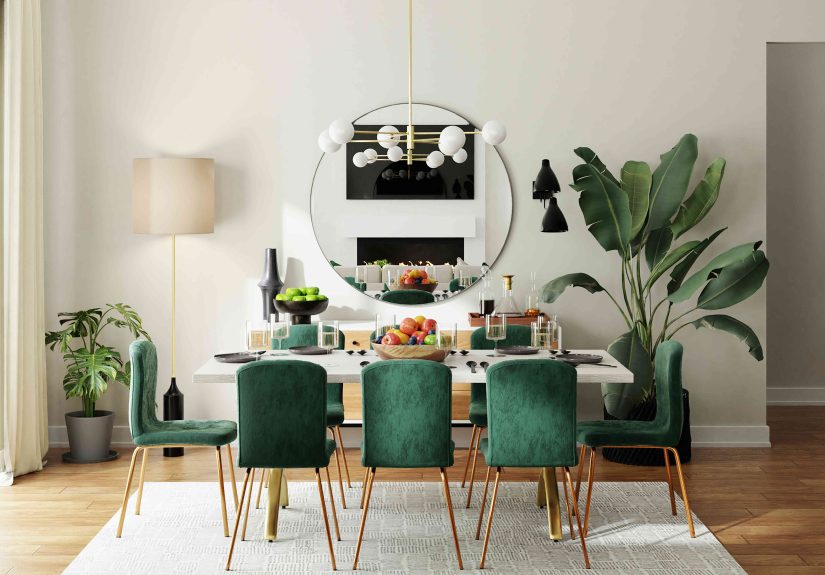
The classic feng shui “yes” is a mirror that reflects the dining table, a centerpiece, a fruit bowl, or a meal setup.
The idea is simple: mirrors multiply what they reflect, so reflecting nourishment and hospitality emphasizes “we have enough.”
Example: A mirror on the wall behind a buffet reflects your table with a vase of fresh flowers and a bowl of citrus.
Even on non-hosting days, it keeps the room’s energy focused on warmth and welcome.
2) It reflects beautiful light
Mirrors that bounce natural light or reflect a chandelier, pendant lights, or candlelight can make the dining room feel more
vibrant and uplifting. In feng shui terms, that can support an open, inviting flowespecially in darker rooms.
3) It helps a small dining room feel less cramped
If your dining room is small, a well-placed mirror can make it feel more spacious. Feng shui often connects “more space” with
“more opportunity”not in a magical way, but in a practical, lived-in way: people relax more when they don’t feel squeezed.
4) It reflects something you actually want more of
A peaceful piece of art. A plant that thrives. A calm, tidy vignette. A mirror that reflects these can reinforce the vibe you’re
trying to cultivate. Mirrors are like hype-menmake sure they’re cheering for the right team.
When a dining room mirror is NOT good feng shui
1) It reflects clutter (because clutter gets “doubled”)
If your mirror reflects a pile of mail, a messy counter, or a corner that collects random stuff “just for now,” the mirror can
visually magnify that chaos. Feng shui emphasizes clarity and flowso you want the reflection to feel intentional.
2) It reflects a bathroom door, laundry room, or trash area
Mirrors draw attention. If the mirror highlights a space associated with waste, mess, or “get-this-out-of-my-life,” it’s usually
considered less supportive energeticallyand it’s also just not the vibe during dinner.
3) It’s placed too low and guests see themselves while eating
This is a big one in real-world homes. Many people don’t love watching themselves chew, sip, or try to laugh gracefully with spinach
in their teeth. If the mirror creates self-consciousness, it undermines the dining room’s purpose: comfort and connection.
4) It faces a doorway in a way that feels “too direct”
Many feng shui guidelines advise against mirrors directly facing main doors because the reflected energy can feel like it “bounces back.”
In a dining room, the same idea can apply if the mirror strongly reflects an entry point and creates a jarring, straight-shot line of sight.
5) The mirror is distorted, broken, chipped, or visually harsh
Feng shui generally favors mirrors that provide a clear, clean reflection. Distorted or damaged mirrors can create visual “noise,” and in feng shui
language, they’re thought to distort the quality of energy in the space.
Best feng shui placements for a dining room mirror
Place it where it reflects the tablewithout turning dinner into a selfie shoot
The sweet spot is often a side wall or a wall that catches the table at an angle, especially if it reflects:
the tabletop, a centerpiece, and warm light.
Pro tip: Stand in multiple spotsentry, table, and the seat where your most self-conscious guest would sit.
If the mirror makes people feel watched or distracted, shift it higher or move it slightly off-center.
Hang it a little higher than “face level” for seated diners
A practical rule: if someone sitting at the table can’t easily see their full face while eating, you’ve reduced the “I am now in a restaurant
with mirrors on every wall” effect. You still get the light and spaciousnesswithout turning dinner into a performance.
Pick a mirror size that fits your table scale
A tiny mirror over a huge table can look like décor that got lost on the way to its real home. A mirror that’s too large can feel intense.
Aim for balance: the mirror should feel like it belongs in the room’s “visual conversation.”
Choose frames and shapes that support the mood
- Round or oval mirrors: Often read as softer and more harmonious (great for lively family dinners).
- Rectangular mirrors: Clean and classic, especially above a sideboard or buffet.
- Frames in wood tones: Warm, grounding, and easy to blend with dining furniture.
- Metal frames: Crisp and polishedgreat if your dining room leans modern or glam.
Feng shui uses the idea of five elements (wood, fire, earth, metal, water) as a balancing tool. You don’t need a PhD in Elemental Vibes, but you can
choose a frame that complements the room: warm wood for cozy, metal for clarity, darker tones for depth.
Common dining room mirror mistakes (and easy fixes)
Mistake: The mirror reflects the “drop zone”
Fix: Move the mirror or upgrade what it reflects. Even a simple tray, a plant, or a piece of art can transform the reflection.
Mistake: The mirror creates glare from lights
Fix: Tilt slightly (with proper hardware) or reposition so the mirror reflects light softly instead of beaming it into everyone’s eyes.
No one wants to squint through dinner like they’re staring into the sun.
Mistake: The mirror faces a door and feels “pushy” energetically
Fix: Try placing it on a perpendicular wall, or offset it so the reflection is calmer and less direct.
Mistake: The mirror is too low
Fix: Raise it a few inches. This small tweak can improve comfort fastespecially for seated guests.
Dining room mirror ideas by layout
Small dining room (or apartment dining nook)
Use one medium-to-large mirror to expand the space and bounce light. Place it so it reflects the table and a bright element (like a pendant light
or a window), but not a messy kitchen counter in the background.
Open-concept kitchen + dining
Be extra mindful of what the mirror “captures.” Open concept often means the dining room mirror can accidentally reflect the sink full of dishes.
If that’s your reality (no judgment), position the mirror so it reflects a calmer zonelike a plant wall, art, or a well-styled sideboard.
Formal dining room
A mirror above a buffet or credenza is a classic move. Style the surface with a lamp or candles, a bowl, and something natural (flowers or greenery).
The reflection becomes a “double vignette,” which feels abundant without feeling busy.
What about different feng shui “schools”?
Feng shui isn’t one single rulebook. Some approaches use compass directions and time-based systems; others (like BTB feng shui) emphasize intention and
symbolic adjustments. The good news: both tend to agree on the most practical mirror guidance for dining rooms
make sure the mirror reflects something you want more of, and avoid reflections that feel stressful or chaotic.
Translation: You don’t need to panic about one “perfect” placement. A mirror that makes the room feel brighter, calmer, and more welcoming is already doing
a lot of the work.
A 10-minute feng shui mirror checklist (dining room edition)
- Check the reflection: Does it show the table, light, art, or plants?
- Remove “reflection offenders”: Clutter, trash, and awkward door views.
- Test seated comfort: Sit downdo you see your face while eating?
- Adjust height: If it feels distracting, raise it a bit.
- Clean it: Smudges dull the effect (and the vibe).
- Confirm stability: Use proper anchors; dining room energy shouldn’t include “mirror falling mid-taco.”
- Set intention: Keep it simple“This room supports connection and nourishment.”
FAQ
Is it good feng shui for a mirror to face the dining table?
Often, yesespecially if it reflects meals, a centerpiece, and warm light. It’s one of the most commonly recommended dining room mirror placements.
What if a mirror makes people uncomfortable during meals?
Then it’s not “good” for your home, regardless of rules. Raise it, shift it, or choose a different wall. Feng shui is meant to support real life,
not make dinner feel like a live-stream.
Should I avoid antique or distressed mirrors in the dining room?
Not automatically. But if the mirror is heavily distorted, cracked, or gives an uneasy feeling, consider using it elsewhere. A clear reflection is usually preferred.
Can I use a mirror to bring more light into the dining room?
Yes. Many designers use mirrors to bounce natural light and make rooms feel brighter and larger. Feng shui often supports thisso long as the reflection is pleasant.
Real-life experiences: what people notice after adding a dining room mirror (about )
When people add a mirror to the dining room for feng shui, the first “result” they notice is usually not mystical wealth raining from the ceiling.
It’s something more immediate: the room feels different. Brighter. Larger. More “alive.” In smaller homes and apartments, that shift can be dramatic
a mirror that catches a window’s daylight can turn a dim corner into a space that actually feels inviting at 6 p.m., not like a cave where leftover pizza goes to retire.
Another common experience is that hosts feel more motivated to keep the dining area “ready.” Because mirrors reflect and amplify, they also
highlight whatever’s going on in the space. People often realize, “Ohmy mirror is doubling my centerpiece. Cute.” Or, a week later: “My mirror is doubling
the mail pile. Not cute.” That awareness tends to nudge habits in a positive direction. A tray appears. A bowl for keys gets assigned.
Suddenly the dining table stops being an unpaid internship for clutter.
Comfort is the big make-or-break. Many people love how a dining room mirror looksuntil the first sit-down meal. If the mirror is placed at just the wrong height,
diners can feel like they’re being observed by… themselves. Some people don’t mind, but plenty report a subtle tension, like they can’t fully relax. The fix is usually
simple: raise the mirror a few inches, move it to a side wall, or angle it so the mirror reflects the table and chandelier but not faces. After that adjustment,
the mirror tends to feel supportive againlike it’s adding sparkle rather than commentary.
People also notice the “energy” of what the mirror reflects. When a mirror captures a beautiful, intentional scenefresh flowers, a bowl of fruit, candlelight, a clean
sideboardthe dining room often feels warmer and more generous. It becomes easier to linger after dinner, and the room starts to feel like a place for connection,
not just consumption. On the flip side, when a mirror reflects a sharp corner, an open bathroom door, or a busy hallway, many people describe the room as feeling
unsettled or distracting. Even if you don’t use feng shui language, your nervous system notices what your eyes keep catching.
One of the nicest “quiet wins” people mention is how mirrors can support hosting. When the dining room looks brighter and more spacious, guests tend to spread out,
conversation flows more easily, and the room feels more celebratory. It’s not that the mirror “makes” your friends funnierbut it can remove the subtle friction of a cramped,
dim environment. And if the mirror reflects a well-set table, many people say it feels like the gathering is “bigger” in a good way: more abundant, more festive, more alive.
The most consistent takeaway from real homes is this: the dining room mirror works best when it supports the experience you want at the table. If your goal is warmth,
nourishment, and connection, let the mirror reflect exactly that. And if it ever starts reflecting stress, chaos, or a face-full of salad mid-chew, don’t overthink it
move it. Feng shui is flexible. Dinner should be, too.
Conclusion
A mirror in the dining room is often considered good feng shui because it can reflect nourishment, expand the space, and amplify warmth and abundance
especially when it reflects the dining table and beautiful lighting. The key is simple: mirrors multiply what they show, so make sure the reflection supports how you want
the room to feel. Prioritize comfort, avoid reflections of clutter or awkward doors, hang the mirror at a height that doesn’t turn meals into a self-review session,
and keep it clean and clear.
If your dining room mirror makes the room feel brighter, more welcoming, and easier to gather in, you’re doing it right. Feng shui isn’t about fearit’s about creating
a home that supports you. And yes, that includes letting everyone enjoy their dinner without accidentally locking eyes with themselves mid-bite.