Table of Contents >> Show >> Hide
- What Exactly Is an “Over-Dyed Sling Chair”?
- The Still + Co. x Sit and Read Version: A Brooklyn Mashup
- Why Over-Dye a Rug in the First Place?
- The Sling Chair Comfort Science (and the Design History Nerd Stuff)
- Styling an Over-Dyed Rug Sling Chair Without Turning Your Room Into a Highlighter Accident
- Where It Works Best at Home
- Care and Maintenance: Keep the Color Bold, Not Blotchy
- What to Look for If You’re Buying One
- Comparable Sling Chairs If You Love the Shape but Want Different Materials
- Is It Sustainableor Just “Instagram Sustainable”?
- Quick FAQ
- Real-World Living: of “Experience” With Over-Dyed Sling Chairs
- SEO Tags
There are chairs you buy because you need a place to sit. And then there are chairs you buy because your living room needs a
plot twist. The Over-Dyed Sling Chairs from Still + Co. fall hard into the second category: they’re part lounge chair,
part upcycled textile art, and part “waityour chair is made from a rug?”
If you’ve ever stared at a vintage Persian rug and thought, “Beautiful… but I don’t have the emotional bandwidth to decorate around
fifty-seven colors,” overdyeing is basically the cheat code. Now take that freshly saturated rug, cut it, hem it, stitch it, and sling it
onto a metal frame like a hammock for grownups. Congratulations: you’ve arrived at the design sweet spot where comfort meets conversation piece.
What Exactly Is an “Over-Dyed Sling Chair”?
Let’s translate the term, because design language can get… dramatic. “Over-dyed” refers to a process where an existing rug
(often vintage) is recolored in a way that preserves hints of the original pattern while pushing the overall tone toward a bold, modern shade.
“Sling chair” describes a seat where the support is a suspended piece of materialleather, canvas, fabric, or in this case,
a rugstretched across a frame so your weight is cradled rather than perched.
The result is different from a typical upholstered chair. Instead of foam and springs doing all the work, the sling does the heavy lifting
distributing your weight, flexing with your posture, and giving you that relaxed “I could read here for hours” posture (even if you mostly scroll).
The Still + Co. x Sit and Read Version: A Brooklyn Mashup
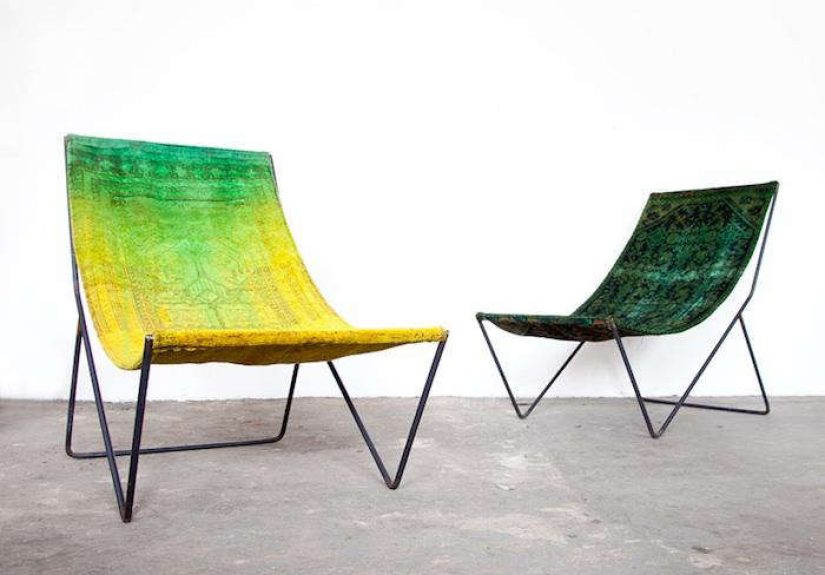
The chairs that put this idea on the radar came from a collaboration between Still + Co. and Sit and Read in Brooklyn.
The concept is elegantly simple and mildly genius: take vintage Persian rugs, overdye them into vivid new color stories,
and turn them into sling seats attached to welded wrought iron frames.
Vintage rugs, reimagined (not erased)
Overdyeing doesn’t have to wipe out historyit can remix it. In many overdyed pieces, the original pattern still peeks through like a bassline under a new track.
That’s what makes overdyed textiles feel layered rather than flat: you get bold color and subtle complexity.
Industrial frame, soft landing
Structurally, these chairs lean into contrast: the frame reads crisp and architectural, while the rug sling brings texture, warmth, and a touch of imperfection
(the good kind, like handmade pasta). One description that nails the vibe: an angular steel frame paired with brightly over-dyed rugs,
creating something “industrially artful” without losing the whole point of a chairwhich is, you know, sitting.
Limited edition energy
Part of the appeal is scarcity. These weren’t churned out like folding chairs at a banquet hall. The rug itself is the limiter: every vintage textile has
its own age, wear, and pattern, and overdyeing introduces even more variation. If you love owning something that feels like “this exists because a person made it,”
that’s the lane.
Why Over-Dye a Rug in the First Place?
Overdyeing started as a practical fix and turned into an aesthetic movement. The basic idea: when a rug’s colors feel datedor it’s faded, worn, or just not loved anymore
you can give it a second life by saturating it with new color. It’s the rare trend that can be both visually loud and materially respectful:
you keep the craftsmanship and structure of an older piece while changing how it shows up in a room.
From “dead inventory” to design centerpiece
One reason overdyed rugs blew up is that they transform “almost” rugs into “absolutely” rugs. That hand-me-down you never liked? The rug you bought for the price, not the pattern?
Overdyeing can turn it into something you’d actually build a room around.
Color that behaves like modern art
Solid color can be easier to decorate with than a multi-color traditional rugbut it can also feel flat. Overdyed rugs split the difference:
they give you a dominant hue (great for cohesion) with faint pattern showing through (great for depth). That’s why an overdyed sling chair doesn’t just “match”
a spaceit animates it.
The Sling Chair Comfort Science (and the Design History Nerd Stuff)
The “hammock effect”
Sling chairs are comfortable for a reason that’s refreshingly low-tech: a suspended seat distributes pressure more evenly than a hard, flat plane.
Many sling designs support the body’s natural curves, and the flexible seat reduces point pressure at the hips and thighs. It’s a small shift that can feel
like a big upgradeespecially if you’re used to chairs that treat your spine like an afterthought.
Yes, this form has pedigree
Sling seating has been refined for decades, from modernist leather-and-metal icons to outdoor-ready canvas loungers. The famous Butterfly (BKF) chair,
for example, popularized the idea of a simple metal frame holding a suspended sling seatand became wildly copied because it was both sculptural and practical.
This lineage matters because Still + Co.’s rug sling chair doesn’t feel gimmicky; it feels like a clever material swap within an established, proven form.
Campaign furniture DNA
There’s also a “campaign” influence that shows up across sling furniture: pieces designed to be sturdy, portable, and straightforward, where the material seat
is the comfort layer and the frame is the structure. That mindsethonest structure + flexible comfortpairs perfectly with the rug-as-seat concept.
Styling an Over-Dyed Rug Sling Chair Without Turning Your Room Into a Highlighter Accident
Overdyed chairs can look fearless. Styling them is less about “matching” and more about giving the chair a clean stage to perform on.
Here are approaches that work in real rooms, not just in perfectly lit photos.
1) Use the chair as your color anchor
If the sling is a bold green, yellow, cobalt, or magenta, let that be the loudest color in the zone. Then echo it softlyone ceramic vase,
one throw pillow, one book spine that looks suspiciously curated.
2) Keep the supporting cast matte and tactile
Overdyed rugs have visual energy. Balance that with materials that absorb light rather than fight it: matte paint, linen curtains, plaster walls,
unfinished oak, blackened steel, or a chunky wool throw. Texture calms color.
3) Pair pattern with restraint
Yes, the sling contains pattern (even if it’s subtle). If you add other patterns, keep them in the same family:
stripes with stripes, geometrics with geometrics, or one bold pattern plus several quiet textures.
Where It Works Best at Home
These chairs shine where you want a functional object that doubles as sculpture.
- Reading corner: Add a floor lamp and a small side table, and the chair becomes an instant “nook.”
- Living room accent seat: Perfect when your sofa is neutral and your room needs a focal point that isn’t another piece of wall art.
- Bedroom corner: The chair works as a landing zone for morning coffee, evening podcasts, or the clothes you swear are “not dirty.”
- Covered porch or sunroom: Rug slings prefer protection from the elements; think “outdoor vibe,” not “left in the rain.”
Care and Maintenance: Keep the Color Bold, Not Blotchy
A rug-as-seat is durable, but it’s still a textile with dye. Treat it like a premium rug that happens to be shaped like a chair.
Rug sling care
- Vacuum gently (with an upholstery attachment): Dust dulls color. Regular light cleaning keeps the saturation looking intentional.
- Spot-clean fast: Blot, don’t rub. If the chair is heavily saturated, test any cleaner in a hidden corner first.
- Mind the sun: Direct sunlight can fade textiles. If the chair lives near a window, rotate its position occasionally.
Frame care
- Wipe down metal: A damp cloth usually handles fingerprints and dust.
- Protect floors: Add felt pads or glides if the frame sits on hardwood; metal feet can be unforgiving.
What to Look for If You’re Buying One
1) Construction details that tell the truth
For this specific Still + Co./Sit and Read concept, the “tell” is in the making: the rug is cut, hemmed, and stitched to fit the framerather than loosely
draped or stapled in a way that screams “craft fair hot glue.” A well-made sling will feel taut, supportive, and deliberately finished at the edges.
2) Comfort measurements (don’t skip this)
Sling chairs vary wildly in posturefrom upright conversation seating to full lounge mode. As a reference point, Sit and Read’s sling chair has been listed with
dimensions around 25 inches wide, 38 inches tall at the back, and 40 inches long. If you’re tall, that “long”
measurement matters more than you think.
3) Dye integrity and transparency
Overdyed rugs can be done beautifully or badly. A quality process typically includes thorough cleaning and repeated dye baths to build saturation.
The best makers are also honest about what you’re getting: vintage material means variation, and that’s part of the point.
Comparable Sling Chairs If You Love the Shape but Want Different Materials
If the overdyed rug version is your dream chair but your lifestyle includes sticky fingers, shedding pets, or a talent for spilling espresso, you can still get
the sling-chair comfort in other materialsand keep the “wow” in a different way.
-
Leather sling icons: Some classic designs use leather slings paired with steel, trading textile texture for a sleek, tailored look.
Knoll’s Pollock Armchair (often nicknamed the “657” sling chair) is a prime example of the steel-and-leather approach. -
Campaign-inspired craftsmanship: Moore & Giles makes a sling chair that explicitly nods to campaign furniture, pairing a shaped wood frame
with a leather sling for a refined, built-to-last vibe. - Outdoor-ready slings: If portability matters, modern sling camp/beach chairs use breathable fabrics and lightweight framesless heirloom, more “take it anywhere.”
Is It Sustainableor Just “Instagram Sustainable”?
Upcycling a vintage rug into furniture can be a genuinely smart way to extend the life of a well-made textile. You’re not just reusing materialyou’re preserving
labor and craft embedded in the original rug. That’s the good news.
The complicated news: popularity can lower standards. As overdyed rugs became trendy, some sellers started cutting cornersdistressing rugs aggressively or patching
pieces together to simulate age and “character.” The sustainable version of this trend is the one rooted in quality: solid vintage material, careful dye work,
and transparent construction.
Quick FAQ
Will an overdyed rug sling bleed color onto clothes?
High-quality overdye processes aim for stable color, but any heavily saturated textile deserves a little caution early on. If you’re concerned, test with a white cloth
in an inconspicuous area and ask the maker about colorfastness and finishing.
Is a rug sling chair a good “everyday” chair?
It can beespecially as an accent seat, reading chair, or occasional lounge chair. If you need all-day ergonomic task seating, that’s a different category.
Sling chairs are about relaxed support, not desk-chair performance.
Can I use it outdoors?
A rug sling is happiest indoors or in covered outdoor spaces. Rain, constant UV exposure, and moisture swings aren’t friendly to vintage wool and saturated dyes.
Real-World Living: of “Experience” With Over-Dyed Sling Chairs
Picture the first week an over-dyed sling chair moves into your home. Day one, it behaves like a chair. Day two, it becomes a roommate. By day three,
it has a personality, and you’re casually introducing it to people like, “This is the chair. The chair is staying.”
The most immediate “experience” people report with statement sling chairs is how they change traffic patterns. Guests drift toward them. Kids treat them like a
pirate throne. Adults do the polite hover-sittesting the sling like it might suddenly turn into a hammock (it won’t, but it will cradle you in a way
that makes standard dining chairs feel emotionally unavailable).
Comfort-wise, the sling effect is real. The seat gives just enough to distribute weight without the dead feel of an overly soft cushion. It’s the kind of comfort
that nudges you into a longer sit: one chapter becomes three, one playlist becomes a whole album, and suddenly you’re considering whether you need a second chair
for “symmetry” (you don’t; you want it).
Then there’s the color experience. Over-dyed rugs don’t just sit in a roomthey tint it. In daylight, the saturation can read crisp and almost graphic; at night,
under warm lamps, it softens and looks more like a pigment wash. Owners often find themselves adjusting lighting to flatter the chair the way people adjust lighting
to flatter themselvesdim it a touch, warm it up, pretend that overhead lights never existed.
Practical living brings a few predictable realities. Pet hair shows up like it’s auditioning for a role, especially on bright slings. A handheld vacuum becomes a
normal part of the relationship. Jewelry can snag if the rug pile is textured. And if you’re a person who eats on the couch (no judgment), you’ll learn quickly
that “I’ll be careful” is not a cleaning strategy. The best approach is a calm, fast response: blot spills, don’t panic-rub, and treat the sling like a rug you
genuinely want to keep looking good for a long time.
The final experience is the one you can’t measure: satisfaction. A great over-dyed sling chair gives you the feeling that you chose something with a point of view.
It’s functional art that earns its footprintan object that says “I like comfort,” but also “I like stories,” because a vintage rug turned into a chair is basically
a second career in furniture form. And honestly? That’s the kind of glow-up worth sitting down for.