Table of Contents >> Show >> Hide
- What Is PivotHouse, Exactly?
- Why Remodelista Paid Attention: “Considered” Design in Real Life
- The “Pivot” Idea: From Isolated Rooms to Open Interconnectedness
- Glazing, Views, and the Power of a White Interior (Yes, Really)
- The Roof as a Yard: Outdoor Living, San Francisco Edition
- LEED-Minded Renovation: Sustainability That’s Not Just a Sticker
- Flexible Living: One House, Multiple Ways to Use It
- What You Can Learn From PivotHouse (Even If You Don’t Have a Rooftop Spa)
- Real-World Experiences: The “PivotHouse” Feeling (A 500-Word Field Guide)
- Conclusion: A House That Pivots Toward Better Living
- SEO Tags
Some homes are designed to impress. PivotHouse was designed to connectto light, to views, to the people
who live there, and (because this is San Francisco) to the very real question of how a house can “pivot” between
past and future without falling off the hill.
Featured as a professional entry on Remodelista’s Considered Design Awards, PivotHouse reads like a love letter to
open-plan livingonly with better insulation, smarter detailing, and a roof that acts like a full-on outdoor “yard.”
If you’ve ever stared at a floor plan and thought, “Why do I have to walk through three rooms to make coffee?”you’re
exactly the target audience for this story.
What Is PivotHouse, Exactly?
PivotHouse is a rebuilt-and-reimagined San Francisco residence that’s been described as a mindful reconstruction
designed to earn LEED certification. In Remodelista’s submission write-ups, the designers highlight a crisp palette,
strategic glazing, and a concept they call “social flow”architecture working like a social pattern that makes
everyday life smoother and more connected.
It sits at a literal and figurative pivot point between neighborhoods (the Mission and Noe Valley) where topography
opens up dramatic city views. The project leans into that geography: bright interiors, an open layout, and a roof level
designed as a usable outdoor destination rather than a “nice-to-have” afterthought.
In the broader press around the property, PivotHouse has been described as a multi-level home (four main floors plus
a roof deck) with elevator accessbuilt for modern city living where vertical space is often the only space you get.
The result is a house that’s both urban and airy: tall, light, and deliberately organized around how people actually move.
Why Remodelista Paid Attention: “Considered” Design in Real Life
Remodelista’s whole vibe is the “considered home”spaces that feel edited, functional, and quietly confident rather than
loud or trend-chasing. PivotHouse fits that ethos because it’s not just pretty; it’s purposeful. The Remodelista submission
text calls out a clean, crisp palette, thoughtful glazing, and open-plan relationships that improve how rooms “talk” to each other.
This is the Remodelista sweet spot: design choices that look effortless, but are actually the product of a thousand micro-decisions.
(Like: where the light lands at 9 a.m. when you’re making toast, and whether your dining table blocks the path to the fridge.
Glamour? Sometimes. Logistics? Always.)
Remodelista’s lens, translated
- Restraint over razzle-dazzle: bright surfaces, refined detailing, and warmth added in selective, intentional places.
- Spaces that work together: open-plan doesn’t mean empty-planit means connected zones with clear purpose.
- Light as a building material: glazing and white interiors used to amplify shadow, depth, and day-to-day mood.
The “Pivot” Idea: From Isolated Rooms to Open Interconnectedness
The project’s name isn’t just branding. On the architect’s project description, PivotHouse is framed as a remodeling effort that
pivots the home from an older style of livingcompartmentalized roomsinto “open interconnectedness.” That’s more than a layout trend.
It’s a social philosophy: fewer dead ends, fewer “back-of-house” vibes, more shared space that still feels livable.
Open-plan done well isn’t a giant echo chamber. It’s a sequence of zones: cooking, eating, lounging, workingeach distinct, each
visually and physically connected. In the Remodelista entries, that’s the point of “social flow.” The kitchen isn’t a service corridor;
it’s the anchor for conversation, homework, snacks, and the ceremonial opening of takeout containers.
Design moves that make the open plan feel human
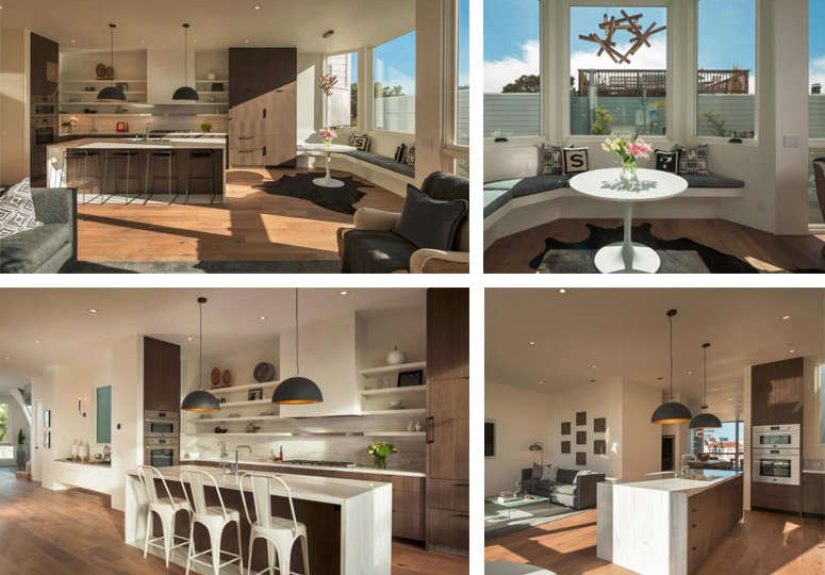
PivotHouse is described as bright and generally white to capture the play of light and shadow. Then, instead of cluttering the palette,
the warmth arrives through selective materials, built-ins, and the kind of details you notice more with timehidden-hinge doors, a floating
curved stair, and storage that looks like architecture rather than an afterthought.
- The breakfast nook effect: a small, defined place for daily rituals inside a larger, open setting.
- Walk-in pantry logic: keep visual calm while still being able to store the real-life stuff (cereal, appliances, the “mystery jar”).
- Built-ins as clutter insurance: integrated storage means the house stays calm even when life isn’t.
Glazing, Views, and the Power of a White Interior (Yes, Really)
Remodelista’s submission text emphasizes strategically placed glazing in the open plan. Translation: windows are not just “holes in the wall.”
They’re choreography. They pull you toward certain areas, borrow light from one zone to brighten another, and keep the interior feeling open even
when the footprint is constrained by a dense city lot.
A white interior can sound sterile, but the architect’s description hints at why it works here: white is used to capture light and shadow, then
“luxurious materials” are used selectively to warm the palette and make the home feel domestic. In other words: white isn’t the star. Light is.
White just happens to be the best supporting actor.
If you want the look without living in a blank canvas
- Mix whites: pair warm white walls with slightly cooler trim so the space has dimension.
- Use texture as color: matte plaster, honed stone, rift-sawn wood, linen, and wool do a lot of emotional heavy lifting.
- Let one feature be “the moment”: a curved stair, a sculptural pendant, or a single piece of art can anchor the whole room.
The Roof as a Yard: Outdoor Living, San Francisco Edition
One of the most Remodelista-friendly moves in the PivotHouse story is the roof: it’s described as fully developed as a “yard,” complete with space
for cooking, dining, lounging, and soakingplus generous planting and an outdoor fireplace. That’s not just a luxury flex. In a city where ground-level
yards are rare and fog is a frequent guest, a well-planned roof deck becomes a mental-health upgrade disguised as a design feature.
This is also where the home earns its “pivot” reputation: the roof turns the building’s verticality into an advantage. Instead of stacking floors
and calling it a day, the project turns the top into a destinationeffectively adding an outdoor room (or three) without asking the lot to do something
it can’t.
Steal the rooftop-yard concept at any scale
- Start with one zone: a small dining area beats an oversized “someday” deck with nowhere to sit.
- Go big on wind-friendly planting: tough grasses, hardy shrubs, and container strategies that won’t tip over at the first gust.
- Add one comfort feature: heat lamp, outdoor fireplace, or wind screeningpick one and use it well.
LEED-Minded Renovation: Sustainability That’s Not Just a Sticker
The PivotHouse narrative repeatedly points to LEED certification as a goalan important clue about priorities. LEED is a green building framework
that looks holistically at a project: energy, water, materials, waste, and indoor environmental quality, earned through prerequisites and credits.
When a home aims for LEED, the design team is typically making decisions that are measurable, not just aesthetic.
In the PivotHouse orbit, the partners involved have a track record with high-performance retrofits. Eco+Historical describes work that brings older homes
into a carbon-free future by improving water and energy efficiency, using solar and high-efficiency heat pumps, and paying attention to toxins common in older
housing stock (like lead and asbestos). That mindset aligns neatly with what LEED tends to reward: better performance, healthier interiors, smarter resource use.
What “LEED-minded” can look like inside a design like PivotHouse
- Energy efficiency first: air sealing + insulation + efficient systems (because the cleanest energy is the energy you don’t waste).
- Electrification and efficient hot water: heat pump technology can dramatically improve efficiency compared with older electric resistance approaches.
- Indoor air quality: low-emitting materials and thoughtful ventilation strategies to reduce exposure to VOCs and other indoor pollutants.
- Water savings: efficient fixtures, leak awareness, and smart landscapingespecially meaningful in California’s climate reality.
A quick reality check: sustainability doesn’t have to ruin your design
If you’re worried a sustainable renovation will force you into an “eco-aesthetic” you didn’t order, relax. The trick is to treat performance upgrades
like the foundation of your style, not a competing theme. A bright, crisp kitchen and a low-VOC paint spec can coexist peacefully. In fact, they make
each other better: the clean look is more convincing when the air feels clean, too.
Flexible Living: One House, Multiple Ways to Use It
One of the more interesting practical notes in outside coverage is that the property has been described as two legal units (#1156 and #1158) even if it’s
marketed and experienced as one large home. That detail matters because it reflects real urban constraints: cities often resist projects that reduce housing stock,
and legal unit structure can make or break approvals.
From a homeowner perspective, a “flexible use” layout can be a superpower. A lower unit can become a multigenerational suite, a work-from-home zone with an actual
door, a guest apartment that doesn’t turn your living room into an Airbnb lobby, or a long-term rental when you want the house to help fund itself.
How to borrow the flexibility idea without building a second unit
- Design one room to be self-sufficient: add a powder room nearby, a closet, and good sound control.
- Plan circulation: “Social flow” includes the ability to bypass the party when you’re not in the mood.
- Prioritize storage at transitions: mudroom-style drop zones prevent the open plan from becoming an open mess.
What You Can Learn From PivotHouse (Even If You Don’t Have a Rooftop Spa)
PivotHouse is a high-end project, but the ideas scale surprisingly well. The Remodelista appeal isn’t “go spend millions.” It’s “make deliberate choices that
improve daily life.” If you remember nothing else, remember the PivotHouse mantra: design the house around how you move, gather, and reset.
Takeaways you can apply this month
-
Map your “social flow.” Stand in your kitchen and trace the paths: fridge → sink → prep → stove → table. If you crash into a chair
or a corner every time, that’s not charming; it’s fixable. - Create one “anchored” spot in an open room. A nook, a built-in bench, a reading chair with a lampsomething that gives the space a heartbeat.
- Use glazing strategically. If you can’t add windows, borrow light: interior glass, transoms, or widening a doorway can change everything.
- Upgrade performance quietly. Air sealing, insulation, efficient hot water, and low-emitting finishes are the behind-the-scenes heroes of comfort.
- Make your top level count. If you can’t build a roof yard, make your balcony or patio act like one: seating, greenery, and a reason to go outside daily.
Real-World Experiences: The “PivotHouse” Feeling (A 500-Word Field Guide)
Even if you never set foot in PivotHouse, you can recognize the experience it’s designed to create: that satisfying sense that your home is working with you,
not against you. Homeowners who chase an open-plan, LEED-minded renovation often describe a similar before-and-after shiftnot just in looks, but in daily rhythm.
Suddenly, you’re not “navigating” your house like it’s an obstacle course. You’re living in it like it’s a well-edited playlist: fewer skips, more flow.
The first “pivot” usually happens during planning, when you stop thinking in rooms and start thinking in moments. Coffee in the morning. Kids (or pets, or partners)
migrating through the kitchen. A laptop opened at the table while dinner simmers. That’s where the “social flow” idea becomes real: you design sightlines so people can
be together without being on top of each other, and you build paths that let someone pass through without bumping into a bar stool like it’s a personal nemesis.
The second “pivot” is emotionaland it’s often powered by light. When glazing is placed with intention (or when existing openings are simply made to work harder),
the house changes mood across the day. Morning light turns a white wall into something soft and warm. Afternoon sun draws you toward a nook. Evening shadows make the
same room feel calmer, not colder. People expect new cabinets to be the big reveal, but frequently it’s daylightfree, dramatic, and slightly bossy about where you sit.
Then there’s the sustainability side, which can feel less like a design decision and more like a series of grown-up choices you’ll be grateful for later. Air sealing
isn’t glamorous, but it’s the difference between “cozy” and “drafty but photographed well.” Low-emitting materials don’t make your friends gasp at a dinner party,
but they can make the home feel noticeably fresherespecially after a renovation when smells and off-gassing can linger. Efficient hot water and heating/cooling upgrades
are rarely the first thing you post online, yet they’re the reason you’re comfortable on a foggy night without turning the thermostat into a negotiation.
Finally, the rooftop-yard concept (or any outdoor “destination” space) tends to create a surprising habit: you use your home differently. Instead of waiting for a “special”
weekend, you go upstairs on a Tuesday. You eat outside more. You step out for five minutes and return feeling reset. That’s the real PivotHouse lesson: great design isn’t
only about beauty. It’s about making the best version of your daily life the easiest version to choose.
Conclusion: A House That Pivots Toward Better Living
PivotHouse, as captured through Remodelista’s lens, isn’t just a modern San Francisco showpiece. It’s a case study in how thoughtful layout, strategic glazing,
refined detailing, and performance-minded renovation can add up to something bigger than the sum of its parts: a home that supports connection and comfort without
sacrificing clarity and calm.
If you’re renovating, you don’t need five levels or a rooftop spa to borrow the best ideas here. Start with “social flow,” protect your light, build in storage,
and treat sustainability like a design asset. Your house can pivot, toopreferably without anyone tripping on the way to the coffee.