Table of Contents >> Show >> Hide
Weekend Update is the part of Saturday Night Live that somehow feels both ancient and weirdly new every week. It is half fake newscast, half national stress ball, and half excuse for somebody in a costume to ruin Colin Jost’s evening. Yes, that is three halves. That is also the most accurate math available for a segment that can go from political satire to a squirrel widow screaming at the anchor desk in under 90 seconds.
So it makes sense that whenever fans sense even a whisper of transition, they start doing what fans do best: building dream lineups, arguing online like assistant producers, and treating Weekend Update succession like it is a constitutional process. Colin Jost and Michael Che have held the desk for more than a decade, which is long enough for an entire generation of viewers to think of them as the default setting. But long runs create two things at once: comfort and curiosity. The comfort says, “Don’t touch it.” The curiosity says, “Okay, but what if somebody else did?”
That curiosity has only gotten louder as SNL has shuffled cast members, celebrated its 50th-anniversary era, and kept producing performers who feel born to either sit behind the desk or burn it to the ground for a laugh. Fans have not been shy about naming favorites. Some want a deadpan traditionalist. Some want chaos. Some want two smart weirdos with instant chemistry. And some, frankly, just want to watch somebody new roast the audience, the news, and the anchors in fresh ways.
Here are the cast members fans have lobbied for most often, and why each choice makes a surprising amount of sense.
Why the Weekend Update succession talk refuses to die
The reason this conversation keeps resurfacing is simple: Weekend Update is not just another recurring segment. It is one of the show’s clearest star-making positions. You are not buried in a crowded sketch. You are not wearing a giant shrimp costume while waiting for one line and a reaction shot. You are front and center, live, reading jokes with rhythm, control, and a built-in sense of authorship. The audience learns your voice fast. If it works, it really works.
That is why fans obsess over potential replacements differently than they obsess over cast additions in general. A great sketch performer can thrive in ten different lanes. A great Weekend Update anchor has to do something more specific. The job demands authority without stiffness, wit without desperation, and enough point of view to make the jokes sound like they came out of a real human brain instead of a cue-card vending machine.
Viewers also know the desk can reinvent itself. Different eras of Update have worked for different reasons. Some versions leaned on swagger. Some leaned on newsroom polish. Some ran on chemistry, some on friction, and some on the thrill of watching a performer look like they were getting away with something on live television. Fans are not just asking who is funniest. They are asking who could define the next version of the segment.
That is why the lobbying has been so intense. This is not fantasy casting for a random sketch. This is fans arguing over who gets one of the crown jewels in American comedy.
The names fans keep bringing up
Bowen Yang: the flashy choice with an actual public pitch
Bowen Yang became the easiest headline in this conversation for one very obvious reason: he basically volunteered. In a half-joking, half-not-joking way, Yang publicly floated the idea of taking over Weekend Update with Matt Rogers, and fans reacted exactly the way you would expect: with delight, chaos, and the online equivalent of pounding a conference-room table. It was the kind of pitch that felt unserious in tone but extremely serious in instinct. Of course people could picture him there.
Yang’s case has always been less about “Could he read jokes?” and more about “How big a swing would the desk become if he did?” He brings a hyper-articulate style, cultural specificity, and a very modern comic rhythm that can pivot from icy precision to gleeful absurdity without blinking. On Weekend Update, he has already proven he knows how to weaponize the form. His desk appearances often feel like tiny, fully engineered events, whether he is playing a creature, a celebrity-adjacent oddball, or a deeply annoyed public figure with an extremely specific grievance.
The biggest argument for Yang is that he understands the desk as both structure and playground. He can respect the format while also making it feel unstable in the best possible way. The biggest argument against him is almost a compliment: he may be too explosive a performer to sit still every week. Some comics are race cars. Some are great at hosting the traffic report. Yang feels like both, which is rare.
Even with his status changing after the peak of the succession chatter, his name still lingers over this debate because he represents the boldest possible version of a post-Jost-and-Che era. He would not maintain the temperature. He would reset it.
Michael Longfellow: the deadpan purist pick
If Yang is the glamorous chaos choice, Michael Longfellow has long been the “comedy nerds are nodding knowingly in the corner” choice. Fans who kept bringing up Longfellow were not doing it by accident. They were responding to something very specific in his on-camera energy: the cool, dry, slightly detached delivery that makes a desk setup feel less like joke reading and more like somebody quietly informing you that civilization is already over.
That style has real Weekend Update DNA. Longfellow never needed huge physical business to land a line. He could let the joke breathe, then put a tiny extra sting on the end of it. Fans who wanted him at the desk were essentially asking for a return to a more stripped-down version of the format, where the power comes from attitude, timing, and the confidence to let silence work for you instead of panicking and sprinting to the next punch line.
There is also something practical about the case for Longfellow. He always looked comfortable at the desk. Not “comfortable” in the lazy sense, but comfortable in the dangerous sense, like the setting actually suited his comedic metabolism. The camera liked him there. The material sounded native there. And in a cast full of larger, louder sketch energies, his restraint stood out.
That is why so many fan discussions kept circling back to him even when his broader sketch footprint felt lighter than some of his castmates. In the Weekend Update debate, fans were not looking for the most versatile utility player. They were looking for the performer whose comic center of gravity already leaned toward the desk. For a lot of viewers, that was Longfellow.
Sarah Sherman: the desk anarchist
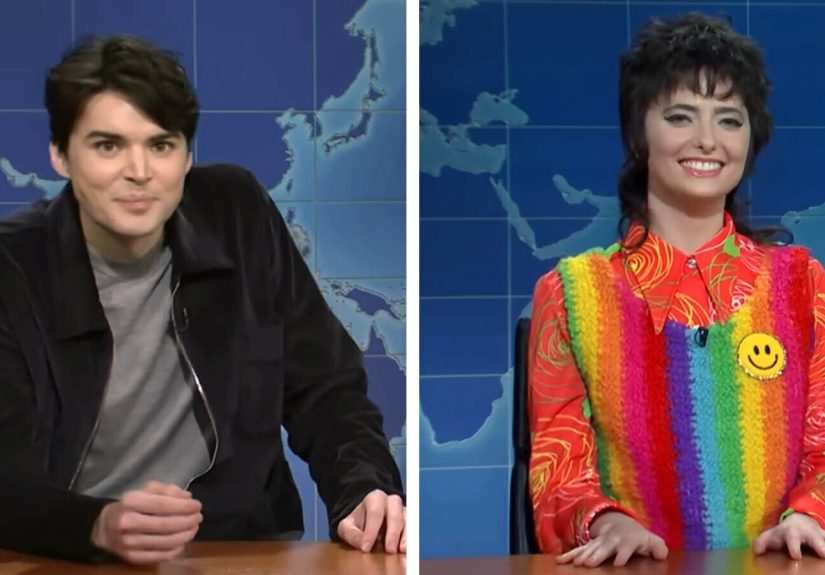
Sarah Sherman is the candidate for people who hear the phrase “news parody” and think, “Nice start, now make it feral.” Her recurring appearances opposite Jost have become their own mini-genre on SNL. She does not merely visit Weekend Update. She invades it. She humiliates the anchor. She turns the desk into a hostage situation made out of insult comedy, body horror, and gleeful nonsense.
That recurring dynamic is why so many fans keep tossing her name into the succession pile. Sherman already understands how to dominate that space. She knows how to use the desk as a prop, a battleground, and a rhythm machine. More importantly, she knows how to make live discomfort funny without losing control of the bit. That is a serious skill, even when it arrives wearing an owl veil or a giant squirrel tail.
The question with Sherman is not talent. It is format. Could she translate her wonderfully unhinged correspondent energy into the steadier weekly discipline of anchor work? Some fans say absolutely, because her chaos is more controlled than it looks. Others say no, because making her sit in the “straight person” chair would be like storing fireworks in a file cabinet. Both arguments are fair.
But there is a powerful case for her anyway. Weekend Update has always benefited from anchors who feel a little dangerous. Sherman would not make the segment safer, smoother, or more respectable. She would make it unmistakably alive. And for fans tired of polished sameness, that is the whole point.
Ego Nwodim: the crowd commander
If there is one quality that instantly sells a future Weekend Update anchor, it is command. Not just joke delivery. Not just charisma. Command. The sense that the room belongs to you the moment you start talking. Ego Nwodim has that. Her standout desk appearances have repeatedly shown that she can seize attention, shape the audience’s energy, and turn a segment into a live-wire event without ever looking rattled.
That is why so many fans saw her as a genuine candidate rather than a fun hypothetical. Nwodim has range, but she also has control. She can go broad without getting messy. She can play heightened without losing the human point of the bit. And when she pushes the audience into a response, it feels intentional, not accidental. That matters on live television, where one second of hesitation can feel like a pothole.
What makes Nwodim especially intriguing is that she could have taken the desk in multiple directions. She has enough warmth to build rapport, enough bite to sell sharper material, and enough performance authority to keep the segment from turning too cute or too precious. She would not need to imitate any past era. She could create a version of Update that felt looser and more theatrical without losing the core joke engine.
For many fans, she represented the ideal balance: not too traditional, not too chaotic, not too detached, not too eager. Just deeply capable. In succession conversations, that kind of capability often becomes more appealing the longer people argue.
Mikey Day: the stealth professional’s choice
Mikey Day is not always the first name people shout in a dream-casting thread, but he may be the one that makes the most producer-brain sense. He is seasoned, technically sharp, and deeply fluent in the show’s rhythms. He has the kind of on-camera control that can make even a silly character feel structurally sound. If some fans were looking for the “safe” choice, that is underselling him. The better phrase is the “secretly very smart” choice.
Day also has something every Weekend Update anchor needs: timing that can survive interruption. He knows how to toss off a line, respond to a reaction, reset, and land the next beat without making the recovery visible. That skill is easy to miss because he makes it look routine. It is not routine. It is what separates a performer who is funny from a performer who can reliably steer live comedy traffic.
His desk bits have also shown that he can needle Jost effectively, which matters more than it sounds. A good Update era often depends on micro-chemistry: the eye roll, the hesitation, the little one-second stare that tells the audience everybody knows the joke got personal. Day can play that game. He can be absurd, but he can also be crisp. He feels like someone who could keep the machine running while still putting his own fingerprints on it.
In other words, Mikey Day is the pick for viewers who do not want Weekend Update to become a laboratory experiment. They want it to stay funny, fast, and structurally dependable. Day could do that in his sleep. Which, in television terms, is a compliment.
What fans really want from the next Weekend Update era
The funniest thing about all this lobbying is that fans are not actually united around one personality type. They are united around a feeling. They want the next desk to feel necessary, not inherited. They do not want a replacement who merely resembles the last successful duo. They want somebody who makes the audience say, “Oh, right, this is what the segment can be now.”
That is why the fan favorites look so different from one another. Yang promises reinvention. Longfellow promises dry precision. Sherman promises comic danger. Nwodim promises command. Day promises craft. Every one of those options speaks to a different fantasy about what Weekend Update should do in the next chapter.
And maybe that is the healthiest possible sign for SNL. It means the bench has been interesting enough for viewers to imagine multiple futures. A show in trouble usually produces one obvious answer or none at all. A show with life in it creates arguments.
Related fan experience: why imagining a post-Jost-and-Che desk is so weirdly emotional
Here is the part that makes the whole topic more interesting than a standard “who should replace whom” debate: for a lot of viewers, the argument is not just about comedy mechanics. It is about ritual. People do not watch Weekend Update like they watch an average sketch. They watch it as a checkpoint in the episode. It is the moment when the night settles into focus, when the host nonsense pauses, when the cast stops pretending to be senators, baristas, and haunted dolls for a minute and starts pretending to be journalists. That rhythm becomes familiar in a surprisingly intimate way.
So when fans imagine someone new behind the desk, they are not just swapping out performers. They are imagining a different weekly feeling. That is why the discussion gets emotional fast. Some fans want the comfort of continuity because they have spent years hearing Jost and Che deliver the week’s headlines with that particular blend of smugness, exasperation, and “we cannot believe we are reading this on network television.” The duo’s chemistry has become part of the furniture. Replacing them would feel less like changing a segment and more like rearranging the living room in the dark.
Other viewers experience the same long run differently. For them, comfort eventually turns into staleness, and the fantasy of a new desk becomes thrilling. They start imagining how the jokes would sound in another voice, how the segment’s pace might change, how a new anchor pair might shift the center of gravity away from irony and into something stranger, sharper, warmer, or more openly chaotic. Watching that future in your head is fun. It is also a little addictive. Once you start doing succession math during every standout desk appearance, it is hard to stop.
There is also a communal side to it. SNL fans love a good argument, but Weekend Update arguments are a special subgenre because everybody is secretly auditioning their own taste. When someone says they want Longfellow, they are usually revealing they value deadpan control. When they want Sherman, they are admitting they enjoy danger and mess. When they want Day, they are saying craft matters. When they want Nwodim, they are responding to command. When they want Yang, they are asking for a reset with style. The debate becomes a personality test with punch lines.
And then there is the live-TV factor. Fans remember desk moments differently because the format makes them feel immediate. A sketch can be silly and disposable. A great Weekend Update appearance can feel like it happened at you. The audience erupts. The anchor breaks for half a second. A line lands harder than expected. Suddenly the internet is full of people insisting they just saw the future of the segment. That happened with several of the names in this discussion. One strong desk piece can launch a whole week of “Okay, hear me out” posts.
In that sense, the experience of following the Weekend Update succession chatter is almost as entertaining as the succession itself would be. Fans get to play scout, critic, historian, and chaos goblin all at once. They rewatch clips, compare eras, overanalyze delivery styles, and argue about chemistry that does not even exist yet. It is wildly unserious and completely sincere at the same time, which is basically the most SNL thing possible.
So yes, the lobbying can look dramatic from the outside. But inside the fandom, it makes perfect sense. Weekend Update has always been one of the show’s most iconic proving grounds. When viewers start imagining who should sit there next, they are not just predicting change. They are participating in the mythology of the show. And for comedy fans, that mythology is half the fun.
Conclusion
For now, the desk still belongs to the familiar faces who helped define its current era. But the fan lobbying is not random noise. It is a sign that viewers see real possibilities in the cast and recent alumni orbiting SNL. Bowen Yang offered the headline-grabbing fantasy. Michael Longfellow brought the deadpan case. Sarah Sherman brought beautiful menace. Ego Nwodim brought command. Mikey Day brought craftsmanship. None of those campaigns came out of nowhere.
And that is the real takeaway. The next Weekend Update era, whenever it arrives, does not have to be a downgrade or a copy. If anything, fan debate suggests the opposite. There are enough strong comedic identities in the mix to make the eventual handoff feel less like an ending and more like a fresh pilot light. In true SNL fashion, the question is not whether the desk will survive a transition. It is who can make the audience laugh hard enough to forget they were nervous about it in the first place.