Table of Contents >> Show >> Hide
- Why the Sound of Space Invaders Still Hits So Hard
- Meet the SN76477: The Space Invaders Sound Chip
- Going Old School With Integrated Injection Logic (I2L)
- Inside the 76477: What the Reverse Engineering Revealed
- The Bigger Hardware Picture: CPU Limits and Sonic Personality
- What I2L and the SN76477 Teach Modern Makers
- Hands-On Experiences: Recreating Space Invaders Sound Today
Long before game soundtracks became full orchestral scores and licensed pop anthems, a single chip full of tiny transistors made the universe of
Space Invaders feel absolutely terrifying. That chip was Texas Instruments’ SN76477 “complex sound generator,” the heart of the
classic arcade cabinet’s audio. Thanks to detailed reverse engineering work by engineer and blogger Ken Shirriff, highlighted in a Hackaday feature,
we now know that the chip hides something delightfully nerdy inside: integrated injection logic, or I2L, a 1970s
logic technology that tried to leapfrog TTL right before CMOS stole the show.
Put another way: the spooky “heartbeat” thump of the alien march, the UFO howl, and those crunchy laser blasts were all driven by a clever mix of
analog circuitry on top of very early low-power digital logic. It’s a beautiful example of how constraints in 1970s hardware forced designers to
be creative and accidentally set the template for what “retro arcade sound” still means today.
Why the Sound of Space Invaders Still Hits So Hard
Space Invaders landed in 1978 and quickly became a cultural phenomenon. On paper, it’s simple: a fixed cannon at the bottom of the screen, rows of
aliens marching downward, and a UFO that occasionally glides by to tempt you with bonus points. But the experience would feel strangely empty without
its signature sounds.
The game’s audio palette is small but iconic:
- The slow “thump… thump… thump…” of the alien march that speeds up as enemies disappear.
- The sharp, slightly noisy cannon blast when you fire.
- The crunchy impact when an invader is destroyed.
- The eerie, sliding tone of the mystery ship (UFO) sailing across the top of the screen.
Interestingly, that famous accelerating march wasn’t originally a fancy audio design choice. It was a side effect of the Intel 8080 CPU struggling to
keep up with drawing 55 aliens and checking collisions. As you blast aliens away, the CPU has less work to do, so the game loop and the sound
timing tied to it runs faster. That “bug turned feature” became part of what made the whole experience so tense and memorable.
Meet the SN76477: The Space Invaders Sound Chip
Under the hood, the original Taito Space Invaders hardware uses a suite of boards: a CPU board, video shifter hardware, and a sound/IO board that
includes the SN76477 chip for sound effects. TI marketed the SN76477 as a “complex sound generator,” and it quickly found its way
into arcade games, toys, and even hobbyist projects.
What makes the SN76477 special is the way it combines multiple building blocks in a single package:
- A voltage-controlled oscillator (VCO) for pitched tones like the cannon shot or UFO sound.
- A super-low-frequency (SLF) oscillator used for sweeps and slow modulations.
- A noise generator to create explosions, static-like hits, and other gritty textures.
- An envelope generator to shape attack and decay, making sounds “punchy” or “whooshy.”
- A mixer and amplifier that blends these elements into a final audio output.
Designers typically wired external resistors, capacitors, and logic inputs to set the chip’s behavior everything from pitch ranges to how quickly a
sound faded out. You can think of it as an analog synth module with a digital steering wheel: the arcade hardware toggled control pins while the
analog parts did the heavy sonic lifting.
Analog Soul, Digital Brains
Inside the SN76477, the “sound” part (oscillators, noise, envelopes) is mostly analog circuitry. But something has to coordinate what happens when
a particular event occurs when the player presses fire, when an alien is hit, or when the UFO appears. That’s where the chip’s internal digital
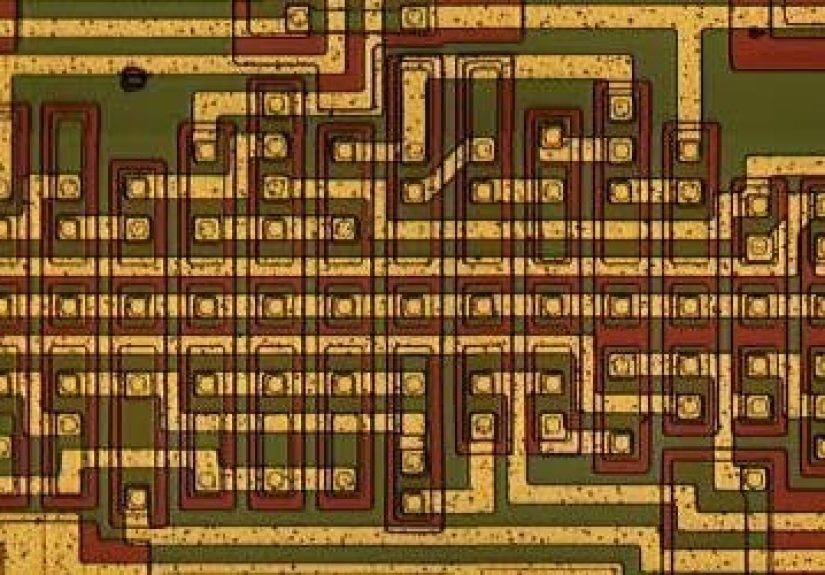
logic comes in. Shirriff’s die photos show how these blocks are laid out and connected, with sections of random logic steering which sound elements
turn on, how they trigger, and in what combination.
If all of this had been implemented with traditional TTL logic, the die area and power consumption would have been higher. Instead, the designers
turned to a lesser-known logic family: I2L.
Going Old School With Integrated Injection Logic (I2L)
Integrated injection logic often written as I2L or just I2L is a bipolar digital logic family that
emerged in the early 1970s. Developed by Siegfried Wiedmann and Horst Berger, it promised the best of both worlds: close to TTL’s speed, but with
much lower power consumption and high integration density.
Instead of using resistors for biasing and loading, I2L uses current-injection transistors. Its logic levels are much closer together than TTL
roughly 0.7 V for a “high” and 0.2 V for a “low” but it gains decent noise immunity by working in terms of current, not just voltage levels.
That makes it especially attractive for large on-chip logic arrays where you want lots of gates without a huge power bill.
At the time, some engineers expected I2L to take over as the dominant logic family, but CMOS ramped up quickly and ultimately won the low-power
logic war. That’s part of what makes I2L-based chips like the SN76477 so interesting: they’re snapshots from a moment when the industry was still
experimenting with which technology would rule.
Why I2L Was a Smart Choice for a Sound Chip
In a sound-effects chip, you want a lot of control logic gates, flip-flops, state machines without blowing the transistor count or power budget.
I2L is great at dense logic, so it lets designers pack many gates into a relatively small area. That helps keep the die smaller, which reduces cost,
and helps keep heat and power under control inside an arcade cabinet that already has a CRT, a power supply, and a busy 8-bit CPU.
The Hackaday write-up on Shirriff’s work points out that the random logic section he mapped out on the die is full of I2L structures:
densely packed, recurring patterns that implement functions like NOR gates and flip-flops. It’s like discovering a secret digital city hiding under
the analog suburbs.
Inside the 76477: What the Reverse Engineering Revealed
Reverse-engineering a 1970s sound chip isn’t as simple as reading a PDF. Shirriff used high-resolution photographs of the silicon die, then
painstakingly traced out transistors, resistors, and interconnect layers to deduce how the chip works. For the SN76477, his analysis uncovered both
the analog building blocks and the I2L-based digital glue tying them together.
Some highlights from his findings:
-
The noise generator uses structured transistor networks to produce pseudo-random noise, which is then filtered and mixed to produce explosions and
“alien hit” sounds. -
The VCO and SLF sections rely on capacitor charging/discharging circuits to set frequency and modulation. These are controlled by external
component values but orchestrated by internal logic. -
The logic implemented with I2L handles mode selection, gating, and combination of various signals inside the mixer, effectively mapping game
events to sound recipes.
Together, this design allowed Taito’s hardware to generate a whole library of distinct sounds without needing a dedicated CPU just for audio. You
get rich, expressive effects from a single chip plus a bit of clever analog circuitry a very 1978 kind of elegance.
From Die Photos to Documentation
The reverse-engineering work doesn’t just satisfy curiosity; it provides detailed documentation that modern tinkerers can use to emulate the chip in
FPGAs, software, or discrete hardware. Combined with schematics and pinout documents for Taito’s multi-board Space Invaders hardware, it gives a
nearly complete map for rebuilding or repairing original sound boards today.
The Bigger Hardware Picture: CPU Limits and Sonic Personality
While the SN76477 handled sound, Space Invaders still relied on the Intel 8080 to orchestrate gameplay and timing. Recent analysis has shown that
the famous “speed up as you clear the aliens” behavior really came from the 8080 being so close to its performance limits. With fewer sprites to
update, it simply ran the main loop faster and the sound effects tied to that loop sped up too, reinforcing the rising tension.
Add in the dedicated Fujitsu MB14241 video shifter and Taito’s layered boards for CPU, sound, ROM, and power, and you get a system where every
component is doing just enough work to feel like more than the sum of its parts. Arcade techs and hobbyists still rely on detailed pinout
documentation for these boards when troubleshooting sound issues or replacing parts.
What I2L and the SN76477 Teach Modern Makers
For today’s developers, it’s easy to shrug and say, “Why not just throw a microcontroller and a DAC at it?” But looking at the SN76477’s use of I2L
reveals several useful lessons:
- Design within constraints. Limited die area and power forced clever reuse of analog blocks and ultra-dense logic.
- Hybrid analog-digital thinking. The chip leans on analog where it’s strong (oscillators, envelopes) and on digital logic for
coordination a pattern still common in mixed-signal ICs today. - Deterministic hardware behavior. Once configured, the chip behaves predictably without firmware bugs or updates.
Reverse-engineering resources break down how the analog and digital sections interact, offering a fantastic study guide in mixed-signal design.
If you’re used to thinking purely in code, the SN76477 and its I2L core are a reminder that sometimes the best “software” is baked right into
silicon.
Hands-On Experiences: Recreating Space Invaders Sound Today
So what does all of this mean if you’re a DIYer, game dev, or hardware nerd today? In short: you can absolutely bring that Space Invaders sound
aesthetic into modern projects and you don’t necessarily need a crate of rare vintage chips to do it.
Experimenting with Real or Replica SN76477 Chips
Original SN76477 parts are long out of production, but they still show up as new-old stock or salvaged components, and detailed datasheets and
hobbyist write-ups are widely available. The chip’s block diagram reads almost like a modular synth: oscillators, noise, envelope, mixer. With a
handful of potentiometers and switches, you can dial in:
- Short, percussive “laser” shots by setting a fast envelope and a mid-range VCO frequency.
-
Slow, descending UFO sweeps by using the SLF oscillator to modulate the main VCO, giving that gliding “whoop” that instantly screams
“late-’70s arcade.” - Grainy explosions by pushing the noise generator through a longer decay envelope and filtering it for extra “thud.”
Many makers build tabletop sound boxes around these functions effectively turning the SN76477 into a one-chip retro FX synthesizer. Whether or not
you care about Space Invaders specifically, it’s a fun way to explore how early mixed-signal ICs worked in practice.
Emulating the Chip in Software or on FPGAs
If you don’t have access to the real silicon, Shirriff’s die-level analysis and subsequent write-ups provide enough detail to emulate the chip’s
behavior. FPGA recreations and software models can implement the oscillators, noise generator, and I2L-like logic blocks using modern tools while
preserving the quirks that make the original sounds feel so “hardware authentic.”
Some emulator authors go even further, modeling not just the functional blocks, but also the nonlinearities and limitations for example, slightly
unstable oscillators or temperature-sensitive parameters that make repeated sounds subtly different each time. Those imperfections are part of what
separates a truly retro-sounding system from a sterile modern recreation.
Capturing the “Feel” with Modern Tools
You can also steal ideas from the SN76477 and I2L era using entirely modern hardware:
- Use a microcontroller timer to clock an audio routine that speeds up as “load” decreases, echoing the accidental Space Invaders difficulty curve.
-
Pair a small microcontroller with a simple analog noise circuit and a VCO to mimic the chip’s hybrid structure rather than relying solely on
pre-baked WAV files. -
Limit yourself to a handful of basic sounds march beats, whoops, zaps, and booms and reuse them creatively instead of designing a giant
library. Constraints can help a game world feel more cohesive.
Whether you’re building a homebrew arcade cabinet, designing a retro-styled indie game, or just hacking together a weird noise box on your workbench,
understanding how the SN76477 and its I2L logic worked gives you a deeper appreciation for that era’s ingenuity. The next time you hear the
slow-then-fast footsteps of the invading aliens in a cabinet, emulator, or YouTube clip, you’ll know there’s a tiny 1970s logic experiment humming
away underneath the hood.
And yes, it’s still perfectly acceptable to blame your lost quarter on “hardware limitations.”