Table of Contents >> Show >> Hide
- What Non-Planar FDM Actually Means
- Why So Many People Still Care About It
- What 3-Axis Non-Planar Printing Can Really Do
- What Changes When You Move to 6 Axes
- 3 Axes vs. 6 Axes: The Real Difference
- Why It Still Is Not Mainstream
- Where Non-Planar FDM Makes the Most Sense
- The State of the Technology Right Now
- Hands-On Reality: What the Experience Around Non-Planar Printing Feels Like
For years, desktop FDM 3D printing has lived by a simple rule: stack flat layers, one on top of another, and hope nobody looks too closely at the staircase effect. It works, it is affordable, and it has made modern prototyping gloriously accessible. But it also comes with familiar headaches: visible layer lines, weak spots between layers, awkward supports, and the occasional part that looks like it was carved by a very determined waffle iron.
That is why non-planar FDM remains one of the most exciting “still not quite mainstream” ideas in additive manufacturing. Instead of printing only flat layers, non-planar printing allows the toolpath to curve, tilt, or conform to the shape of the part. In a 3-axis setup, that often means gently curved layers and smarter top surfaces. In a 6-axis setup, it can mean reorienting the nozzle in space so material follows complex geometry much more naturally. The promise is huge: smoother finishes, fewer supports, better load paths, and parts that look less like stacked pancakes and more like actual engineered objects.
The catch? The hardware is only half the story. The real challenge is software, motion planning, collision avoidance, calibration, and making all of that practical for real users who would rather print parts than earn a second degree in computational geometry. That is exactly why non-planar FDM is still up and coming. It is no longer science fiction, but it is not yet a click-and-print feature for most makers either.
What Non-Planar FDM Actually Means
Traditional FDM slices a model into flat horizontal layers. Every path lies on a plane, and the nozzle mainly moves in X and Y while Z steps upward. Non-planar FDM breaks that flat-layer rule. The nozzle path can rise and fall continuously, or the part and nozzle can be reoriented so extrusion follows curvature instead of merely approximating it with a stack of terraces.
That change sounds small on paper, but it is a pretty big deal in practice. A curved toolpath can reduce the visible stepping effect on upward-facing surfaces. It can also improve how filaments align with the actual shape and stress flow of a part. When you move from a simple 3-axis machine to a 6-axis robot or rotary system, the design space opens even wider. The nozzle can stay more perpendicular to the deposition surface, which makes support-free printing of certain curved shells and thin-walled structures far more realistic.
In other words, planar FDM says, “I will build this shape by approximation.” Non-planar FDM says, “I would like to at least try building it the way it wants to be built.” It is a little more ambitious, a little more dramatic, and occasionally a lot more stubborn.
Why So Many People Still Care About It
Non-planar FDM keeps attracting attention because the benefits are not cosmetic fluff. Yes, smoother surfaces are part of the appeal. Curved top layers and conformal deposition can make parts look better straight off the printer, which means less sanding, filling, and muttering under your breath. But the bigger story is performance.
Standard FDM parts are famously anisotropic. They are usually weaker through the build direction because the bond between layers is the vulnerable point. Non-planar and multi-axis strategies try to improve that by changing how filaments are laid down. Interlocking or curved layers can distribute loads more favorably, and multi-axis toolpaths can align material with major stress directions rather than trapping geometry inside flat slices.
There is also the support question. Flat-layer printing often demands supports for overhangs and curved forms. That adds material, print time, and cleanup. Non-planar strategies can improve self-support by changing the layer orientation, and multi-axis systems can go even further by pivoting the nozzle or reorienting the build direction to avoid support-heavy geometries altogether.
Put all that together and the interest makes perfect sense. Designers want better surfaces. Engineers want stronger parts. Manufacturers want less waste. Makers want fewer ugly supports fused to the underside of their prints like plastic barnacles. Non-planar FDM promises something useful to all of them.
What 3-Axis Non-Planar Printing Can Really Do
The most accessible version of non-planar FDM still happens on machines that are basically normal 3-axis printers. That is the beauty of it. You do not always need a robot arm the size of a refrigerator to get meaningful results. With the right slicing strategy, enough nozzle clearance, and some willingness to tinker, a standard Cartesian printer can produce gently curved or conical toolpaths.
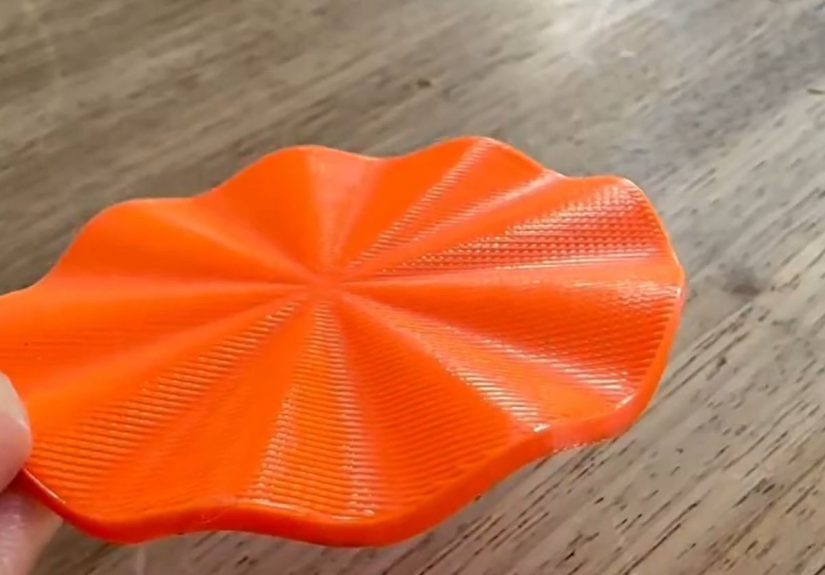
This is where approaches like curved slicing, conical slicing, and active-Z style motion come in. Instead of stepping upward layer by layer in strict flats, the nozzle moves through subtle height changes within the same pass. For certain geometries, this improves top-surface quality and reduces the stair-step look that makes many printed parts scream, “Hello, I was made one layer at a time.”
But 3-axis non-planar printing is not magic. The nozzle still cannot tilt freely, so collision risk becomes a real limitation. The more dramatic the surface curvature, the more likely a standard nozzle body will crash into already printed material. That is why modified hot ends, pointier nozzles, and extra-clearance setups matter so much. There is also a practical angle limit to what a typical machine can handle. For some conical slicing workflows, the printable angles are modest rather than heroic.
Even so, this flavor of non-planar printing is appealing because it offers a realistic on-ramp. You can experiment without rebuilding your entire shop. You can improve certain surfaces and geometries without committing to full robotic multi-axis manufacturing. And for many users, that is enough to make 3-axis non-planar FDM feel like a genuinely useful step forward rather than a lab-only curiosity.
What Changes When You Move to 6 Axes
Six-axis printing is where non-planar FDM starts to feel less like a slicer trick and more like a new manufacturing category. With a robotic arm or another multi-axis platform, the nozzle can change orientation while printing. That means the extrusion head is no longer stuck approaching every surface from the same direction. Suddenly, curved shells, tubular parts, and conformal features become much more practical.
This matters because many hard-to-print shapes are not difficult only because of shape; they are difficult because the nozzle is forced to approach them from the wrong angle. A 6-axis system can keep the nozzle closer to normal to the surface, reduce support requirements, and follow geometry in a way that planar machines simply cannot. Researchers have already shown supportless printing of complex thin-walled structures and curved shells by dynamically reorienting the nozzle during deposition.
Mechanical performance also becomes more interesting in the 6-axis world. Multi-axis path planning can align filaments along load paths or around curved features in ways that are impossible with standard flat slicing. That opens the door to stronger parts, better controlled anisotropy, and smarter reinforcement strategies, especially for composite or high-performance applications.
Of course, six axes do not hand out free miracles. They hand out new responsibilities. Kinematics get harder. Post-processing gets harder. Collision checking gets much harder. Calibration becomes less forgiving. The software pipeline has to manage orientation, toolpath generation, machine constraints, and nozzle-body clearance all at once. So yes, six axes can do more, but they also demand more.
3 Axes vs. 6 Axes: The Real Difference
| Category | 3-Axis Non-Planar FDM | 6-Axis Non-Planar FDM |
|---|---|---|
| Hardware barrier | Lower; often based on modified desktop printers | Higher; usually robotic or rotary multi-axis hardware |
| Toolpath freedom | Moderate; curved paths without free nozzle tilt | High; nozzle orientation can change during deposition |
| Surface quality gains | Often noticeable on top surfaces and gentle curvature | Potentially dramatic on complex conformal geometry |
| Support reduction | Helpful in selected geometries | Much stronger potential for support-free strategies |
| Software complexity | High | Very high, and occasionally “bring snacks” high |
| Best use case | Accessible experimentation and improved finishing | Advanced parts, research, robotics, and serious geometric freedom |
Why It Still Is Not Mainstream
If the benefits are so compelling, why is everybody not already doing this? Because non-planar FDM has a classic emerging-tech problem: the idea is ahead of the everyday workflow.
First, slicing remains the bottleneck. Traditional slicers are built around flat layers because flat layers are computationally simple, machine-friendly, and broadly compatible. Non-planar slicing requires geometry analysis, path optimization, orientation logic, and collision awareness. A universal, robust, consumer-friendly pipeline still is not standard across the hobby and prosumer market.
Second, nozzle geometry matters more than most people expect. A standard hot end is not designed to glide gracefully over a previously printed hill. It is designed to print flat layers and keep its body out of trouble. Once you start curving paths, nozzle clearance, heater block shape, cooling duct placement, and mounting all become part of the printability conversation.
Third, the machine has to know where it is very precisely. Non-planar prints can be less tolerant of calibration errors because the nozzle is often working closer to existing surfaces. In six-axis systems, that sensitivity increases again because you are managing orientation and position simultaneously.
Finally, there is the adoption problem. Most users want reliability, not adventure. The mainstream desktop market has spent the last few years racing toward easier calibration, cleaner user interfaces, and faster print success. Non-planar workflows can absolutely get there, but today they still lean more toward expert users, researchers, and ambitious tinkerers than casual plug-and-play owners.
Where Non-Planar FDM Makes the Most Sense
This technology shines when geometry and performance both matter. Airfoils, shells, orthotics, helmets, ducts, fairings, furniture components, and thin-walled structures are all obvious candidates. Any part where curved surfaces dominate can benefit from reduced stair-stepping and smarter path orientation.
It also makes sense in cases where supports are expensive, messy, or mechanically harmful. Large-format material extrusion, fiber-reinforced printing, and robotic deposition are especially promising here. Once the part gets bigger, more structural, or more material-intensive, reducing supports and orienting beads more intelligently starts to pay off fast.
There is also a quieter but important design implication: non-planar FDM encourages people to stop designing only for the limitations of flat slicing. That shift matters. As toolpaths become more flexible, the design language of printed parts can become more natural, more organic, and more performance-driven. In that sense, non-planar printing is not just a process upgrade. It is a design upgrade too.
The State of the Technology Right Now
The clearest way to describe the current moment is this: the concept has outgrown the “crazy experiment” phase, but it has not fully entered the “ordinary workflow” phase. Researchers are publishing stronger computational frameworks. Industry software is adding multi-axis deposition tools. Makers are building clever desktop hacks, custom slicers, and modified nozzle setups. Even newer work is focused on making non-planar FFF more accessible, which is a sign the field is moving from pure capability toward usability.
That is why the phrase “still up and coming” fits so well. Non-planar FDM is no longer waiting for proof that it can work. It already works. What it is waiting for is simplification, standardization, and integration. Once those pieces catch up, the technology could move from niche fascination to normal option much faster than people expect.
Hands-On Reality: What the Experience Around Non-Planar Printing Feels Like
The practical experience around non-planar FDM is almost always a mix of excitement, humility, and tiny victories that feel weirdly heroic. On paper, the idea sounds elegant: let the nozzle follow the shape more intelligently. In the workshop, that often translates to a much messier sentence: spend an afternoon adjusting nozzle clearance, rerunning paths, checking collision risk, and wondering whether the printer is about to create a beautiful part or a modern art installation.
For people experimenting on 3-axis machines, the first surprise is usually that the printer itself is not always the biggest problem. The path is. A standard printer can often move in the needed way, but getting a safe and useful toolpath takes more effort than expected. You quickly learn that a normal-looking model can become complicated the moment the nozzle has to pass over already printed curved features. A path that seems clever in simulation may turn reckless once real nozzle geometry enters the scene. This is where modified hot ends, slimmer nozzles, and custom mounts stop sounding optional and start sounding like the difference between progress and heartbreak.
Another common experience is that non-planar printing rewards restraint. The best early results often come from subtle curvature rather than dramatic geometry. A user may start with dreams of printing impossible overhangs and fully conformal shells, only to discover that the most satisfying win is a smoother top surface, a better airfoil, or a curved feature that needs less finishing. That is not failure. It is maturity. Non-planar FDM tends to reward people who respect the machine’s limits instead of trying to dunk on physics in the first weekend.
The 6-axis experience is different, but no less humbling. When a robotic setup works, it feels amazing. Watching the nozzle reorient itself around a curved part can make ordinary Cartesian printing suddenly look very flat and very old-fashioned. But the setup burden increases fast. Tool center point calibration, kinematic accuracy, post-processing, and safe nozzle orientation become part of everyday life. Success depends on the whole pipeline behaving well, not just the extruder.
What keeps people coming back is that the results can justify the trouble. Better surfaces, fewer supports, more natural bead placement, and parts that simply look smarter are powerful motivators. The experience of working with non-planar FDM today feels a lot like standing near the start of something important. It is not fully polished. It is not yet effortless. But it is far enough along that you can see the future from here, and that future looks much less flat.