Table of Contents >> Show >> Hide
- Why Look for a Microsoft Clarity Alternative?
- How We Picked the “Best” Microsoft Clarity Alternatives
- The Best Microsoft Clarity Alternatives (Our Recommendations)
- 1) Hotjar (Best “All-Around” Upgrade for UX + CRO Teams)
- 2) Fullstory (Best for Deep, Searchable Session Replay + Enterprise-Grade Insights)
- 3) Crazy Egg (Best for Landing Pages, Click Patterns, and Quick A/B Tests)
- 4) Mouseflow (Best for Funnels + Form Analytics + Behavior “Diagnostics”)
- 5) Lucky Orange (Best for Small Businesses and E-Commerce Teams Who Want “Everything in One Place”)
- 6) Contentsquare (Best for Enterprise Digital Experience Analytics)
- 7) Heap (Best for “Product Analytics + Replay” in One Platform)
- 8) Amplitude (Best for Analytics-First Teams That Want Replay for Context)
- 9) PostHog (Best Developer-First, Flexible AlternativeEspecially If You Like Open Source)
- 10) LogRocket (Best for Session Replay + Debugging + Performance Context)
- 11) Quantum Metric (Best for Real-Time Experience Analytics in Large Organizations)
- 12) Smartlook (Best for Quick Visual Insights Across Web and Apps)
- Honorable Mentions (Great in Specific Scenarios)
- How to Choose the Right Clarity Alternative (Quick Matchmaker)
- Practical Tips for Migrating Away from Microsoft Clarity
- Real-World Experiences: What Using Clarity Alternatives Actually Feels Like (500+ Words)
- Experience #1: “We thought we needed more data. We actually needed better filters.”
- Experience #2: “Heatmaps didn’t fix the page. A hypothesis fixed the page.”
- Experience #3: “Support teams became power users… and changed our priorities.”
- Experience #4: “We underestimated governanceand it bit us.”
- Experience #5: “The best stack wasn’t one tool. It was two tools that talk to each other.”
- Conclusion
Microsoft Clarity is the “free pizza at the office” of behavior analytics: it shows up, it’s helpful, and nobody complains
until they realize they also need plates, napkins, and a plan. Clarity gives you session recordings (aka session replay) and
heatmaps so you can see where real humans rage-click, scroll-panic, and lovingly ignore the button your designer swore was “obvious.”
But as soon as you want morericher segmentation, better collaboration workflows, deeper product analytics, stronger enterprise governance,
or debugging details for dev teamsyou start looking for Microsoft Clarity alternatives. This guide rounds up the best options we recommend,
with honest “best for” scenarios and the trade-offs you’ll actually feel after the honeymoon period.
Why Look for a Microsoft Clarity Alternative?
Clarity is great for getting quick, visual insight into behaviorespecially if you’re starting from “We have Google Analytics, and vibes.”
But teams typically outgrow a single tool when they need:
- More ways to answer “why” (surveys, feedback widgets, on-page polls, and guided UX research workflows).
- Product analytics depth (funnels, retention, cohorts, event-based reporting, and feature adoption).
- Developer-grade debugging (errors, console logs, network traces, performance metrics inside the replay).
- Enterprise controls (privacy tooling, permissions, governance, data ownership, compliance, and SSO).
- Scalability (high traffic, multi-site organizations, and teams that need shared dashboards and repeatable workflows).
How We Picked the “Best” Microsoft Clarity Alternatives
There’s no universal “best”only “best for your goals, team size, and tolerance for dashboard fatigue.” Here’s the rubric we used:
1) Session Replay Quality
You want replays that load fast, help you find the right sessions quickly, and show meaningful context (not 37 minutes of someone cursor-drifting
while they reheated leftovers).
2) Heatmaps That Answer Real Questions
Click maps, scroll maps, and attention maps are table stakes. Extra credit goes to tools that connect heatmaps to replays and funnels,
so you can move from “what” to “why” without opening seventeen tabs.
3) Funnels, Form Analytics, and Friction Signals
If conversion rate optimization (CRO) is your thing, you’ll want drop-off analysis, form analytics, and automatic friction detection
(think: rage clicks, dead clicks, errors, or suspicious hesitation).
4) Privacy and Governance
Session replay is incredibly usefuland also incredibly capable of capturing sensitive data if you’re not careful. The best tools make it easy to
mask, exclude, and control what’s recorded, with sensible defaults and strong admin controls.
5) Integrations and Workflow Fit
Great insights are useless if they can’t reach the people who fix things. We favored platforms that connect to analytics stacks, ticketing tools,
experimentation platforms, and collaboration workflows.
The Best Microsoft Clarity Alternatives (Our Recommendations)
1) Hotjar (Best “All-Around” Upgrade for UX + CRO Teams)
If your team likes Clarity but wants a broader toolkitespecially for qualitative UX researchHotjar is a classic next step. It combines
heatmaps and session replay with UX-friendly extras like funnels and feedback tools, which makes it easier to go beyond “watch replays”
and actually collect explanations from visitors.
- Best for: Marketing, UX, and CRO teams optimizing landing pages and key journeys.
- Why we recommend it: A balanced “observe + ask” workflow that helps you validate hypotheses faster.
- Watch-outs: Costs can rise with scale and team usage; treat it as a workflow tool, not a “set-and-forget” widget.
2) Fullstory (Best for Deep, Searchable Session Replay + Enterprise-Grade Insights)
Fullstory is for when you want session replay to feel less like “watching videos” and more like “querying reality.” It’s known for
making user sessions searchable and for pairing replay with product analytics-style insights. If you have multiple teams (Product, UX,
Engineering, Support) looking at the same customer problems, Fullstory can become a shared source of truth.
- Best for: Mid-market to enterprise teams that need powerful replay search, collaboration, and governance.
- Why we recommend it: Great for diagnosing friction, validating UX changes, and aligning teams around evidence.
- Watch-outs: You’ll want solid admin ownership and privacy configurationthis is not a “randomly install it Friday” tool.
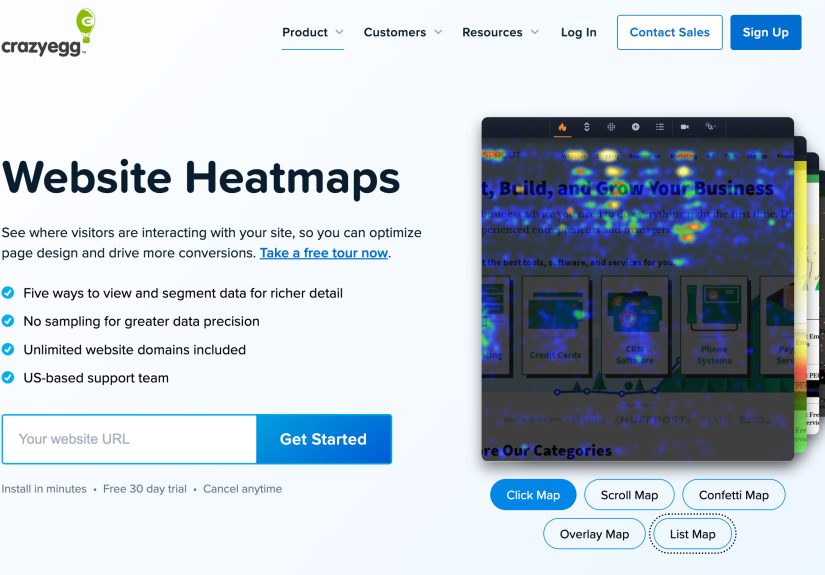
3) Crazy Egg (Best for Landing Pages, Click Patterns, and Quick A/B Tests)
Crazy Egg is a heatmap OG that still earns its spot, especially if your work revolves around pages where small tweaks create big outcomes.
It’s famous for heatmap variety (including click segmentation views) and for making it easy to move from insight to experiment.
- Best for: Marketers and e-commerce teams optimizing landing pages, pricing pages, and conversion flows.
- Why we recommend it: Heatmaps that help you spot “why nobody clicked the thing,” plus testing support for fast iteration.
- Watch-outs: If you need robust product analytics or enterprise governance, you’ll likely pair it with another platform.
4) Mouseflow (Best for Funnels + Form Analytics + Behavior “Diagnostics”)
Mouseflow is a strong pick when your biggest question is, “Where do people get stuckand what exactly is the sticking point?”
Beyond session replay and heatmaps, Mouseflow emphasizes funnels and form analytics, which makes it especially useful when forms and checkouts
are your main conversion bottlenecks.
- Best for: CRO programs, lead-gen sites, and teams optimizing multi-step forms.
- Why we recommend it: Practical analytics for friction (funnels + forms) that translate directly into fixes.
- Watch-outs: Like all replay tools, it’s only “easy” if you build a habit of tagging pages and reviewing insights consistently.
5) Lucky Orange (Best for Small Businesses and E-Commerce Teams Who Want “Everything in One Place”)
Lucky Orange is great when you want visual behavior analytics plus a few extra “help me sell things” features. It blends heatmaps and recordings
with tools that support conversion work and customer support workflows, which is why it’s popular with smaller teams that don’t want to stitch
together five different subscriptions.
- Best for: SMBs, e-commerce stores, and marketing teams that want insight + action tools in one platform.
- Why we recommend it: Easy-to-understand visuals and a feature set that supports practical CRO decisions.
- Watch-outs: If you’re doing complex product analytics, you may still need a dedicated event-based analytics platform.
6) Contentsquare (Best for Enterprise Digital Experience Analytics)
Contentsquare is built for organizations that treat digital experience like a serious business discipline (because it is).
It emphasizes experience analytics: journey analysis, zone-based insights, and session replay tied into a larger platform approach.
If you want to understand behavior across complex customer journeysespecially at scaleContentsquare is a top contender.
- Best for: Large orgs with multiple journeys, channels, and stakeholders.
- Why we recommend it: Strong “journey-first” analysis that goes beyond page-level heatmaps.
- Watch-outs: Implementation and rollout typically require coordination; it shines when the org commits to using it.
7) Heap (Best for “Product Analytics + Replay” in One Platform)
Heap is a strong Clarity alternative when you want session replay tightly integrated with product analytics. Instead of treating replay as a separate
world, Heap aims to connect “the chart” to “the session,” so teams can quickly jump from a funnel drop-off to the sessions that explain it.
- Best for: SaaS teams that need product analytics depth and qualitative session context.
- Why we recommend it: Helpful for cross-functional alignment: Product sees trends, UX sees sessions, Engineering sees friction.
- Watch-outs: Analytics platforms take ownershipplan for taxonomy, governance, and long-term reporting needs.
8) Amplitude (Best for Analytics-First Teams That Want Replay for Context)
If your organization already lives in funnels, cohorts, and retention curves, Amplitude is a natural alternative path: you can add session replay
as qualitative proof around your quantitative insights. It’s especially valuable when you run experiments, iterate features frequently, and need to
validate why changes worked (or didn’t).
- Best for: Product analytics teams, growth teams, and orgs that run frequent experiments.
- Why we recommend it: Strong analytics foundation, plus replay to explain anomalies and “mystery drops.”
- Watch-outs: It’s best when you already have (or want) disciplined event tracking and analytics practices.
9) PostHog (Best Developer-First, Flexible AlternativeEspecially If You Like Open Source)
PostHog is a favorite when teams want product analytics, session replay, and experimentation-adjacent capabilities without feeling locked into a single
black box. It’s especially popular with engineering-led organizations that want control, transparency, and modern workflows (and who don’t mind getting
their hands a little dirty).
- Best for: Developer-first teams, startups, and product orgs that want flexibility and usage-based growth.
- Why we recommend it: A strong “build your stack your way” option with session replay and product analytics under one roof.
- Watch-outs: You’ll get the most value if you invest in clean event naming and governance.
10) LogRocket (Best for Session Replay + Debugging + Performance Context)
If your main pain is “users report bugs we can’t reproduce,” LogRocket is the Clarity alternative that speaks fluent Engineering.
It combines session replay with debugging signals so developers can see what happened and whywithout asking support to play twenty questions.
- Best for: Product engineering teams and companies where web app reliability affects revenue.
- Why we recommend it: Great for squashing issues faster and prioritizing what’s actually harming users.
- Watch-outs: It’s developer-oriented; pair it with UX research tools if you need surveys and qualitative feedback too.
11) Quantum Metric (Best for Real-Time Experience Analytics in Large Organizations)
Quantum Metric is designed for teams that need to connect digital analytics with replay-based truthoften in high-volume environments where speed matters.
It’s widely used in large orgs that want to reduce friction, improve conversions, and coordinate teams around real customer experience signals.
- Best for: Enterprise digital teams, especially with complex journeys and high traffic.
- Why we recommend it: Strong focus on understanding the “why” behind analytics through replay.
- Watch-outs: Like most enterprise platforms, success depends on rollout, training, and ownership.
12) Smartlook (Best for Quick Visual Insights Across Web and Apps)
Smartlook is a solid alternative when you want fast access to visual insights, including heatmaps connected to recordings. It’s often chosen by teams
that want a straightforward experience: watch sessions, generate heatmaps, spot friction, repeat.
- Best for: Teams that want a simpler toolset and quick visual analysis.
- Why we recommend it: Efficient “recordings + heatmaps” workflow that’s easy to adopt.
- Watch-outs: For advanced enterprise governance or deep analytics, you may prefer a larger platform.
Honorable Mentions (Great in Specific Scenarios)
Matomo (Best for Data Ownership and Self-Hosted Control)
If “we want full control of our data” is a non-negotiable requirement, Matomo is worth serious consideration. It’s known for privacy-forward positioning
and for offering heatmaps and session recording as part of its ecosystem. This can be appealing for organizations with stricter internal data rules.
Glassbox (Best for Enterprise-Scale Session Replay and Customer Support Enablement)
Glassbox is often used in enterprise contexts where “what happened” needs to be provable, shareable, and tied to business impact. It’s especially relevant
when support, operations, and digital teams collaborate on experience issues at scale.
Pendo (Best When “Adoption” and In-App Guidance Matter as Much as Analytics)
Pendo isn’t a straight “Clarity clone.” It’s a broader product experience platform where analytics meets in-app guidance. If your biggest challenge is
onboarding, feature adoption, and reducing “how do I do this?” support tickets, Pendo can be the better alternativebecause it helps you change outcomes,
not just observe them.
How to Choose the Right Clarity Alternative (Quick Matchmaker)
- Want the most balanced UX/CRO tool: Hotjar
- Need enterprise-grade replay search and governance: Fullstory or Contentsquare
- Optimizing landing pages and running fast experiments: Crazy Egg
- Form drop-offs are killing you: Mouseflow or Lucky Orange
- Analytics-first product org that needs replay context: Heap or Amplitude
- Dev-first, flexible, modern stack: PostHog
- Bug reproduction and performance debugging: LogRocket
- Big enterprise, real-time experience intelligence: Quantum Metric
Practical Tips for Migrating Away from Microsoft Clarity
Don’t Migrate “Tools.” Migrate “Questions.”
The fastest way to waste money is to buy a platform and hope insight happens automatically. Instead, write down your top 10 questions:
“Where do people drop off in checkout?” “Which page causes confusion?” “Which form field triggers abandonment?” Then pick the tool that answers those
questions most directly.
Keep a Clean Measurement Habit
Most teams start strong (“We’ll watch sessions every day!”) and then vanish into meeting-land. Set a realistic cadence: for example, review replays twice
a week, publish a short “insights memo,” and create tickets tied to evidence.
Make Privacy a First-Class Citizen
Mask sensitive fields, restrict access, and align with internal policies. Session replay is powerful, but you should treat it with the same seriousness
as any data collection practiceespecially if your site includes personal or payment-related information.
Real-World Experiences: What Using Clarity Alternatives Actually Feels Like (500+ Words)
Tool comparison posts love to list features like they’re trading cards. Real life is messierand funnier. Here are practical, experience-based lessons
teams commonly run into when moving beyond Microsoft Clarity. (No, this is not the part where everyone magically “increases conversions by 300% by Tuesday.”)
Experience #1: “We thought we needed more data. We actually needed better filters.”
A common pattern: a team installs a tool, records a mountain of sessions, and then realizes they’re drowning in irrelevant replays. The problem isn’t
a lack of datait’s a lack of a search strategy. Tools like Fullstory, Heap, and LogRocket tend to feel transformative here because the value
shows up the moment you can say, “Show me sessions where users hit this event, then dropped off, and also experienced an error.”
The “aha” is that session replay is only useful when it’s findable. Teams that win set up a consistent way to tag key journeys:
checkout steps, pricing page interactions, onboarding milestones, and support-triggering actions. Once those are searchable, replays stop being random
entertainment and start being a diagnostic tool.
Experience #2: “Heatmaps didn’t fix the page. A hypothesis fixed the page.”
Heatmaps are amazing at showing you where attention goesbut they don’t tell you what to do next unless you turn insight into a hypothesis.
For example: a scroll map reveals most visitors never reach your FAQ section. The lazy conclusion is “move the FAQ up.”
The useful conclusion is “Visitors may have unanswered objections before they commitlet’s test a shorter objections block above the fold,
and compare conversion.”
This is why tools like Crazy Egg (with experimentation-friendly workflows) or platforms that pair funnels + replay can feel more “actionable.”
Teams that get value don’t just screenshot heatmapsthey write down a guess, change something, and measure outcomes.
Experience #3: “Support teams became power users… and changed our priorities.”
When session replay is shared beyond Marketing and UX, it gets interesting. Customer Support teams often become the most consistent users because they
live in the land of “I can’t reproduce your issue.” Tools like Quantum Metric, Glassbox, and LogRocket can shift the workflow from
“ask the customer for a screen recording” to “pull up the session and see exactly what happened.” That reduces back-and-forth and helps engineering
prioritize issues based on real user impact.
The surprise benefit: once Support can attach replays to tickets, vague complaints become specific actions. “Checkout is broken” turns into
“Users clicking ‘Pay’ with Safari on iOS hit a failure after address validation.” That clarity changes roadmaps.
Experience #4: “We underestimated governanceand it bit us.”
The moment a company grows past “three people and a dream,” replay data becomes a governance topic. Who can view recordings? How are sensitive inputs masked?
How long is data retained? Can teams export sessions? What happens when a contractor needs access?
Enterprise-leaning tools typically offer more controls, but they also require ownership: a named admin, documented policies, and periodic audits.
Teams that treat privacy as an afterthought often end up pausing their rollout to fix configuration. Teams that treat privacy as part of the project
ship faster and sleep better.
Experience #5: “The best stack wasn’t one tool. It was two tools that talk to each other.”
Many teams end up with a simple, effective pairing:
- A product analytics platform (Amplitude, Heap, Mixpanel-style workflows, or PostHog) to quantify behavior and track outcomes.
- A replay/experience tool (Fullstory, LogRocket, Quantum Metric, Hotjar/Mouseflow) to understand the “why” behind the numbers.
The best setup is the one that fits how your team works. If your org is engineering-led, you’ll lean toward developer-friendly platforms.
If your org is marketing-led, you’ll favor tools that make CRO and feedback easy. And if your org is enterprise, you’ll pick the platform that can
survive compliance conversations without breaking into a cold sweat.
Conclusion
Microsoft Clarity is a fantastic starting pointespecially if you want free session replays and heatmaps to uncover obvious friction.
But when you need richer UX research, deeper product analytics, better debugging, or enterprise-grade governance, the right alternative can turn
“interesting recordings” into a repeatable optimization engine.
Pick the tool that matches your primary goal, build a review cadence, and treat privacy as part of the projectnot a footnote. Do that, and you’ll stop
guessing what users do. You’ll know. (And you’ll probably laugh at least once a week at the creativity of human clicking behavior.)