Table of Contents >> Show >> Hide
- What “Renovating a Bus” Really Means (Spoiler: It’s Not Just Cute Throw Pillows)
- Meet the Trio: Three Friends, One Bus, and a Shared Dream
- The Build: A Realistic Renovation Timeline (With the Messy Middle Included)
- Step 1: The Great Demolition (a.k.a. “Why Are There 900 Screws?”)
- Step 2: Rust Repair and Sealing (Unsexy, Essential, Non-Negotiable)
- Step 3: Layout Planning (Where Friendships Are Made… or Briefly Suspended)
- Step 4: Insulation and Ventilation (The Comfort Combo)
- Step 5: Electrical and Solar (Power Without Panic)
- Step 6: Plumbing and Water (The Part Where You Learn New Words)
- Step 7: Kitchen Build-Out (Where the Bus Becomes a Home)
- Step 8: Safety Systems (Boring Until They Save the Day)
- Paperwork Reality: Title, Registration, and Insurance Aren’t Optional
- Budget and Time: The Numbers You Actually Need to Hear
- Life on the Road: How Three People Travel Without Losing Their Minds
- Specific Examples: The Moments That Made the Trip Feel Real
- Lessons Learned: If You Want to Renovate a Bus With Friends, Read This Twice
- Conclusion: The Real Renovation Was the Confidence They Built Along the Way
- Extra : Real-World Experiences From Renovating and Traveling in a Bus
Imagine buying a retired yellow school busyes, the same kind that once carried a thousand backpacks and exactly one mysterious banana smell
and turning it into a cozy rolling home. Now imagine doing it with two best friends, a shared toolkit, and enough opinions about paint colors to
start a minor civil war in the aisle. That’s the magic (and occasional madness) of a skoolie build.
This story is inspired by real skoolie conversion patterns: the budget surprises, the “why is everything sticky?” demolition phase, the triumphant
first night sleeping inside your own build, and the deep bonding that happens when you’ve sanded rust together for six hours straight.
If you’ve ever wondered how three friends could renovate a bus and actually still like each other afterward, buckle upliterally.
What “Renovating a Bus” Really Means (Spoiler: It’s Not Just Cute Throw Pillows)
A “skoolie” is a decommissioned school bus converted into a DIY RV or tiny house on wheels. The dream is simple: build a small, functional space
with sleeping, cooking, storage, and ideally a bathroom situation that doesn’t ruin friendships. The reality is also simple:
buses are giant metal boxes, and giant metal boxes require planning, insulation, wiring, plumbing, ventilation, and safety systems.
The payoff is huge. Compared with many RV layouts, a bus conversion can be customized down to the inchbed placement, kitchen flow, work desk,
gear storage, and even a mini “mudroom” area by the door so you’re not tracking sand into the sheets. You can build it rugged for national-park
life, pretty for Instagram, or both (as long as you accept that you’ll be vacuuming glitter out of corners until the end of time).
Meet the Trio: Three Friends, One Bus, and a Shared Dream
Let’s call them Maya, Jordan, and Elisethree friends in their 20s who wanted a travel life that felt more intentional than “two days off, five
airports, one sad salad.” They weren’t trying to be influencers. They were trying to be free. They pooled savings, set a “no ego” rule for the build,
and made one important decision early:
the bus would be their fourth roommateso it needed boundaries, systems, and a chore chart like any shared apartment.
Their goals were practical:
- Sleep three comfortably (no nightly rock-paper-scissors for the “good corner” of the bed).
- Cook real food (because a road trip fueled by gas-station pastries is not a personality).
- Work remotely when needed (with a table that doesn’t double as the sink lid).
- Travel on a budget without feeling unsafe or constantly broken down.
The Build: A Realistic Renovation Timeline (With the Messy Middle Included)
Most skoolie builds follow a similar order for a reason: if you do the pretty stuff first, you’ll end up ripping it out later when you realize you forgot
to run a wire or seal a leak. Maya, Jordan, and Elise leaned into a “build smart, decorate later” approach.
Step 1: The Great Demolition (a.k.a. “Why Are There 900 Screws?”)
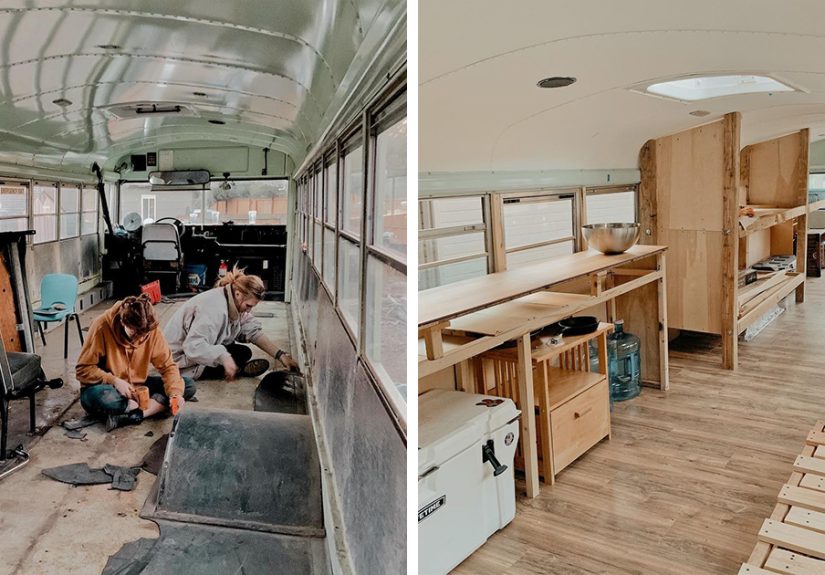
Seats come out first. Then old flooring. Then the walls and ceiling panels if you’re going all-in. This is where you discover the bus’s past life:
mystery stains, unexpected rust, and at least one coin from a year that makes you feel ancient.
They wore proper safety geargloves, eye protection, and masksbecause sanding and scraping can kick up dust and debris you don’t want in your lungs.
They also labeled everything. Not because labeling is fun, but because unlabeling later is a spiritual test.
Step 2: Rust Repair and Sealing (Unsexy, Essential, Non-Negotiable)
Rust is the sworn enemy of bus life. The trio treated rust spots, sealed seams, and patched any holes. Water intrusion is what turns a bus from “cozy”
to “wet trombone case.” Fixing it early saves money and sanity later.
Step 3: Layout Planning (Where Friendships Are Made… or Briefly Suspended)
They taped the floor with painter’s tape to map zones:
kitchen on one side, a compact bathroom near the middle, and sleeping in the back. They planned for weight distribution, storage, and a clean walking path.
A bus is long, but it’s not wideevery inch matters, and doors that collide are the fastest route to daily annoyance.
Their rule: Design for real life, not just photos. That meant:
- Enough countertop to chop vegetables without balancing a cutting board on a knee.
- Dedicated storage for tools and spare parts (because bus life is “bring a wrench” life).
- A spot to hang wet towels without turning the bus into a mildew museum.
Step 4: Insulation and Ventilation (The Comfort Combo)
Insulation matters because a bus is basically a metal popsicle in winter and a toaster in summer. They insulated the floor, walls, and ceiling and
prioritized ventilationespecially roof ventingto manage heat and moisture. Condensation is sneakier than it looks:
you’ll think you’re fine until you wake up and your windows are auditioning to be a rainforest.
Step 5: Electrical and Solar (Power Without Panic)
Electrical is where “DIY confidence” should meet “respect for physics.” They planned an electrical system that matched their actual needs:
charging laptops, powering lights, running a small fridge, and occasionally using appliances without tripping into darkness.
They built around a battery bank and, like many skoolie owners, looked to solar as a way to stay off-grid longer. The key is sizing:
you don’t want to discover your power budget is “two hours of laptop time and one dramatic sigh.”
Step 6: Plumbing and Water (The Part Where You Learn New Words)
Their water system included fresh water storage, gray water handling, and a simple sink setup. For the bathroom, they considered multiple options and
chose what fit their travel style and comfort level. The “right” choice is personalbut whatever you choose, plan for maintenance.
Bathrooms aren’t just installed; they’re managed.
Step 7: Kitchen Build-Out (Where the Bus Becomes a Home)
A functional kitchen changed everything. They installed a counter, a sink, a compact fridge, and safe cooking equipment.
They also designed storage for pots, spices, and pantry basicsbecause living on the road feels dramatically more stable when you can make a real meal.
Step 8: Safety Systems (Boring Until They Save the Day)
Skoolies are homes, but they’re also vehiclesand safety needs to be designed in. The trio treated safety as part of the build, not an afterthought:
- Smoke alarm and a well-placed fire extinguisher.
- Carbon monoxide detection and proper ventilation around any combustion sources.
- Propane safety measures if using propane appliances, including leak awareness and detection.
- Secure furniture mounting so cabinets don’t become projectiles.
They joked that safety devices are like flossing: nobody posts about it, but everyone regrets skipping it.
Paperwork Reality: Title, Registration, and Insurance Aren’t Optional
One of the biggest surprises for first-time builders is that the legal side can be as complex as the construction side. Rules vary by state, but many
people aim to re-title or register the bus as a motorhome/RV once it meets certain criteria (often related to permanent cooking, sleeping, and
sanitary facilities). Some states publish guidance, and others make you feel like you’re explaining skoolies to someone who’s never seen a rectangle.
Insurance can also be tricky during and after the build. Some insurers want documentation, photos, or a completed conversion before offering
certain coverage. That’s why the trio kept a build binder (digital and physical) with receipts, photos, and a clear list of installed systems.
It helped them stay organizedand made any “So what exactly did you do in there?” conversations much easier.
Budget and Time: The Numbers You Actually Need to Hear
Skoolie builds can span a wide cost range depending on bus condition, tools, materials, and how many systems you install. Some builds are lean and
practical; others are full-on tiny luxury apartments with tile showers and custom cabinetry that makes you whisper, “Who are you people?”
Maya, Jordan, and Elise created a budget framework rather than a fantasy number. They separated costs into:
- Bus purchase + initial mechanical work (tires, brakes, fluids, inspection items)
- Build materials (lumber, insulation, fasteners, flooring)
- Systems (electrical, solar, water, ventilation, heating/cooling)
- Safety + compliance (alarms, extinguishers, hardware)
- Comfort + finish (paint, textiles, lighting, décor)
Their best trick was planning for the “hidden” costs: replacement tools, extra hardware runs, unexpected repairs, and the mysterious phenomenon
where you buy three versions of the same part because the first two were “almost right.”
Life on the Road: How Three People Travel Without Losing Their Minds
Once the bus was road-ready, the trio discovered the real secret of traveling together:
systems beat vibes. Vibes are great, but systems keep dishes from becoming a passive-aggressive art installation.
The Three Systems That Saved Their Friendship
- A rotating chore schedule: dishes, water refill, trash, and general tidy-up.
- A “quiet hour” rule: headphones on, minimal talking, everyone decompresses.
- A weekly check-in: what’s working, what’s annoying, what needs fixingbus or human.
They also learned to plan travel days like adults (tragic, but effective). They drove shorter distances when possible, arrived at spots before dark,
and kept a short list of backup locations. They treated their bus like a home first and a travel flex second.
Specific Examples: The Moments That Made the Trip Feel Real
The best travel memories weren’t always the big scenic overlooks (though those helped). They were the small, oddly satisfying wins:
- The first successful “bus dinner”: a real meal cooked inside their own build, eaten at their own table.
- A rainy-day reset: everyone reading, the vent fan running, soup simmering, and the bus feeling like a cabin.
- Fixing a loose cabinet latch in ten minutes instead of “living with it forever” like past versions of themselves.
- Meeting other skoolie folks who shared practical advice like tire checks, parking etiquette, and “don’t ignore weird noises.”
Over time, they became more capable, more patient, and weirdly proud of mundane skillslike knowing exactly how much water they had left based on
“sink vibes” alone. (Do not cite that scientifically. It’s a feeling.)
Lessons Learned: If You Want to Renovate a Bus With Friends, Read This Twice
1) Build for maintenance
Make panels removable. Keep access to wiring. Don’t permanently trap anything you might need to repair later.
Your future self will thank you, probably with tears.
2) Don’t skip safety planning
Ventilation, alarms, and responsible installation aren’t optional. Safety is what lets “adventure” stay fun instead of becoming a cautionary tale.
3) Expect the timeline to expand
A skoolie build is a marathon with power tools. Plan breaks. Plan setbacks. Plan for the fact that “simple” projects become “why is this bolt fused
to the concept of time?” projects.
4) Protect the friendship
Name roles. Rotate tasks. Talk early. Laugh often. And if someone needs silence, let them have silence.
A bus is small. Feelings get big fast.
Conclusion: The Real Renovation Was the Confidence They Built Along the Way
By the end of their build-and-travel chapter, Maya, Jordan, and Elise had more than a renovated bus. They had proof that they could learn hard skills,
solve problems under pressure, and create a home from scratch. They also had a shared vocabulary of inside jokes that only makes sense when you’ve
spent a year arguing about drawer slides.
Renovating a bus together isn’t the easiest path. But for three friends who wanted freedom, simplicity, and a front-row seat to the country,
it was a path that made them strongerand gave them stories they’ll be telling forever.
Extra : Real-World Experiences From Renovating and Traveling in a Bus
The first big “bus life” lesson usually arrives in a parking lot, not a postcard view. For the trio, it was a windy night when the bus rocked gently
like a cradle and not gently like a cradlemore like a giant metal swing set. They learned that parking orientation matters. Facing into the wind can
reduce rocking. Parking near natural windbreaks (without blocking access or being “that bus” in the lot) can help too. And if you’re boondocking,
a little weather humility goes a long way.
Next came the moisture reality check. In a small space, humidity builds fast: boiling pasta, shower steam, wet jackets, even breathing overnight.
They discovered condensation collecting on windows and metal framing whenever temperatures dropped. Their fix wasn’t glamorous, but it was effective:
crack a vent, run airflow, wipe down windows in the morning, and avoid drying soaked gear inside without ventilation. They started treating airflow
like a daily habit, not a special occasion.
Mechanical moments also shaped the journey. A bus is a real vehicle with real maintenance needs, and it doesn’t care that you scheduled a cute hike
for tomorrow. One afternoon, a strange vibration turned into a “pull over and check it now” situation. It ended up being a tire issue they caught early.
That day changed their routine: quick pre-drive checks became automatic. Tires, fluids, lights, anything obviously loose. It was the difference between
minor inconvenience and an expensive rescue story.
Traveling together taught them how to share space respectfully. In a house, you can stomp off to another room. In a bus, “another room” is usually
three feet away and occupied by someone’s laundry basket. They got good at micro-boundaries: headphones meant “I’m offline,” a certain seat was
designated as “work mode,” and the kitchen became a one-person-at-a-time zone during cooking. They also learned the underrated power of stepping
outside. If tensions rose, someone would simply go for a short walk. It’s hard to stay annoyed when you’re staring at a sunset and realizing you’re
lucky enough to live in a home you built with your own hands.
Then there were the unexpected joys. Like the first time they hosted friends for coffeeinside the buswhile rain tapped the roof and the whole place
smelled like cinnamon. Or the night they parked near a quiet overlook and ate dinner with the door open, feet dangling out, feeling like the world had
slowed down just for them. They also loved the “tiny wins”: a drawer that finally stopped sticking, a storage solution that worked perfectly, a meal
that didn’t involve eating over the sink.
Most of all, they learned that bus travel isn’t an endless vacation. It’s a lifestyle built on small decisions: where to park, when to refill water,
how to manage trash, when to rest, and how to stay safe and kind to each other. The magic isn’t that everything goes perfectly. The magic is that even
when something breaksor the weather turnsor the route changesyour home is still with you. And if you built it together, the story is too.