Table of Contents >> Show >> Hide
- The Big Idea: Build a Home That Works in 3D
- What Makes a “Catopia” Work: 10 Design Principles You Can Steal
- 1) Catwalks That Create Multiple “Traffic Lanes”
- 2) High Perches Everywhere (Because Cats Love a Vantage Point)
- 3) More Resting Spots Than Cats (Yes, More)
- 4) Separate Feeding Stations (No One Should Guard the Buffet)
- 5) Litter Box Planning That Treats Bathrooms Like Infrastructure
- 6) Hiding Spots: The Secret Sauce of Peace
- 7) Scratching Zones That Double as Communication Boards
- 8) Enrichment That Feels Like Hunting (Without Releasing a Mouse Indoors)
- 9) “Cat TV” Windows, Plant Rooms, and Sensory Variety
- 10) Cleanability, Airflow, and “Real Life” Maintenance
- How to “Catify” Your Home Like a Pro (Even If You’re Not Building a Cat Palace)
- Safety Checklist for Wall Shelves, Catwalks, and Multi-Cat Living
- What the “Purrfect House” Story Really Teaches Us
- Experience Notes: What Living in a House Built for 20-Plus Rescue Cats Feels Like
- Conclusion
Most of us buy a cat tree and call it interior design. Peter (a longtime rescuer and builder) looked at a regular house and said, “Cute. But what if the
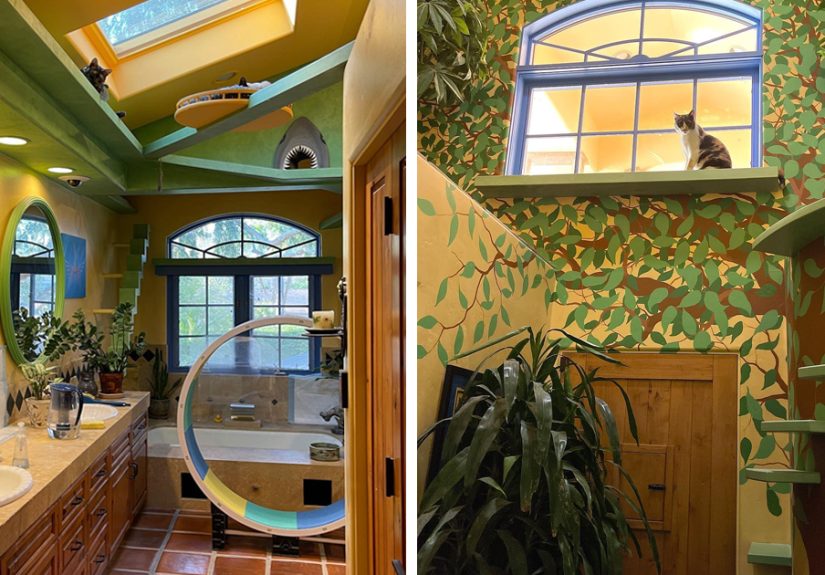
cats could also have a second floor… on the walls?” The result is a real-life “catopia”: a home built to help a big group of indoor rescue cats live with
less stress, more movement, and fewer dramatic disagreements over who owns the sunny spot (spoiler: everyone thinks it’s them).
This article breaks down what makes a multi-cat “purrfect house” actually workwhat’s smart about the design, what’s essential for harmony, and what you
can copy in your own home (even if you only have two cats and a healthy fear of installing shelves).
The Big Idea: Build a Home That Works in 3D
When you live with a lot of cats, floor space becomes prime real estate. And cats don’t negotiate rent politely. One of the smartest principles behind
cat-friendly home design is using vertical territoryperches, shelves, ramps, and “catwalks” that let cats move above the action instead
of through it.
Vertical routes do two things at once: they create more usable space, and they reduce conflict. Cats can pass each other without a hallway standoff.
Shy cats can observe from a safe height. Confident cats can patrol like tiny security guards who are extremely concerned about plastic bags.
What Makes a “Catopia” Work: 10 Design Principles You Can Steal
1) Catwalks That Create Multiple “Traffic Lanes”
Think of a busy home like a small city. If there’s only one road (the hallway), you get traffic jams (and by traffic, I mean hissing). Catwalks and
wall-mounted shelves create alternative routes so cats can move from room to room without forcing interaction.
Practical tip: Design at least two ways in and out of your most-used rooms (living room, kitchen-adjacent areas). Even one shelf “bridge”
can stop a lot of drama.
2) High Perches Everywhere (Because Cats Love a Vantage Point)
Cats naturally gravitate to the highest safe spot in a room. That’s not them being bossyokay, it’s partly thatbut it’s also about feeling secure and
having control over their environment.
Practical tip: Mix “big destination perches” (cat trees, wide shelves) with “stepping stones” (smaller shelves or sturdy ledges) so cats
can climb and move comfortably.
3) More Resting Spots Than Cats (Yes, More)
In multi-cat living, the magic number is “enough that nobody has to fight for it.” If two cats want the same bed, you can solve it with diplomacy…
or by adding three more beds and letting them choose based on vibes.
Practical tip: Spread cozy options around the house: window beds, covered hideouts, open loungers, and “I’m pretending I don’t like you”
corner mats.
4) Separate Feeding Stations (No One Should Guard the Buffet)
In a big rescue-cat household, feeding can become a competitive sport. The solution is to create multiple feeding zones so timid cats can eat without
being stared at like they owe someone money.
Practical tip: Put feeding stations in different rooms or far-apart corners, and avoid placing food next to litter areas. If you can’t
do separate rooms, use visual barriers (a small screen, furniture placement, or a baby gate setup).
5) Litter Box Planning That Treats Bathrooms Like Infrastructure
If you have multiple cats, litter boxes aren’t optionalthey’re a system. A common rule of thumb is one box per cat, plus one extra. Another approach
used by cat-care guidelines is one box per social group, plus one extra (if you know which cats are truly bonded).
Practical tip: Spread boxes across multiple locations so a nervous cat doesn’t have to walk past a “hallway bouncer” to use the bathroom.
Choose boxes large enough for your cats to turn comfortablymany standard store-bought boxes are smaller than ideal, so large storage totes can be a
surprisingly great upgrade.
6) Hiding Spots: The Secret Sauce of Peace
Hiding isn’t a “bad behavior.” It’s a coping tool. When cats can retreat, they feel saferand when they feel safer, they act nicer. In group housing
design, plentiful hiding spots are often treated as essential because they help cats avoid stress and conflict.
Practical tip: Give every room at least one hide option (covered bed, cube, tunnel, under-sofa blocker with an intentional “cat cave”).
Bonus points if the hideout has two exits so a cat can leave without getting cornered.
7) Scratching Zones That Double as Communication Boards
Scratching isn’t just about clawsit’s also scent marking and stretching. In a multi-cat home, scratching posts are like community bulletin boards:
“I was here. I feel fine. Also, this couch is mine unless you provide alternatives.”
Practical tip: Offer both vertical and horizontal scratchers, and place them where cats already like to scratch (near entrances,
favorite resting spots, and the area where you stand and look disappointed).
8) Enrichment That Feels Like Hunting (Without Releasing a Mouse Indoors)
Indoor cats still need mental and physical workouts. Great cat houses don’t just give cats places to napthey give them things to do. That can include
puzzle feeders, “hunt for kibble” games, wand-toy play, or rotating toys so the house doesn’t feel like the same sitcom rerun every day.
Practical tip: Try feeding part of a meal in several small bowls hidden around the house, or use treat puzzles to slow down fast eaters.
This turns meals into naturalistic “foraging” and reduces boredom.
9) “Cat TV” Windows, Plant Rooms, and Sensory Variety
A purrfect cat home usually includes a way to watch the world: secure window perches, safe screened views, or designated “bird TV” spots. Some cat
households also lean into sensory enrichment with cat-safe plants (double-check toxicity), textures, and different room “themes” that encourage exploring.
Practical tip: Create at least one premium observation point: a perch with a view and a soft landing nearby. Keep windows secure and
consider a feeder outside the window if it’s safe and permitted in your area.
10) Cleanability, Airflow, and “Real Life” Maintenance
With 20-plus cats, design isn’t just about aestheticsit’s about sanitation and sustainability. Materials that wipe clean, washable bedding, and
thoughtful placement of resources make daily care realistic.
Practical tip: Choose surfaces you can disinfect, vacuum-friendly layouts (minimize clutter zones where fur gathers like it’s holding a
convention), and storage that keeps toys and supplies organized. If you’re building permanent structures, think about durability and cleaning access.
How to “Catify” Your Home Like a Pro (Even If You’re Not Building a Cat Palace)
You don’t need a construction background to borrow the best ideas. Start small, observe how your cats use the space, and expand based on what actually
works (not what looks cute on social mediacats are famously unimpressed by your design mood board).
Step 1: Map the Daily Hotspots
Where do your cats already hang out? Where do conflicts happen? Common friction zones include narrow hallways, doorways, and the route to the litter box.
Your first upgrades should reduce forced “face-to-face traffic.”
Step 2: Add Vertical Options Before Adding More Cats
Vertical space makes a small home feel larger to cats. It also reduces stress because cats can choose distance. If you’re planning to foster or adopt
more cats, adding perches and pathways first is one of the kindest “preparations” you can do.
Step 3: Multiply Resources, Then Spread Them Out
Food bowls, water stations, beds, scratchers, litter boxeswhen cats must share too few resources, tension rises. When they have choices in multiple
locations, social pressure drops.
Step 4: Build a “Decompression Room”
Whether you’re introducing a new rescue cat or managing a busy household, a quiet room with essentials (litter, food, water, hiding spots, a perch) can
be life-changing. It’s not isolationit’s a safe start.
Safety Checklist for Wall Shelves, Catwalks, and Multi-Cat Living
- Anchor everything. Shelves should be installed into studs or with heavy-duty anchors rated well above the cat’s weight.
- Provide traction. Add carpet treads, textured coverings, or grippy mats so cats don’t slip during zoomies.
- Plan “exit routes.” Avoid dead-end shelves that trap a cat with another cat.
- Remove hazards. Keep string, ribbon, and small swallowable items out of reach unless supervised.
- Use cat-safe materials. Avoid finishes with strong fumes during curing; ventilate well after painting or staining.
What the “Purrfect House” Story Really Teaches Us
The most impressive part of a home designed for 20-plus rescue cats isn’t the wow-factor (though catwalks are objectively cool). It’s the mindset:
treat the home like an ecosystem.
In a healthy ecosystem, everyone has access to the basics, there are multiple ways to move through the space, and stress has somewhere to go besides
“spray the wall behind the couch.” Multi-cat households can thrive, but they do best with intentional design, steady routines, and a realistic plan for
daily maintenance.
Experience Notes: What Living in a House Built for 20-Plus Rescue Cats Feels Like
If you’ve ever visited a truly “catified” home (or even just a home with a serious multi-cat setup), the first thing you notice isn’t the shelves.
It’s the soundtrack. There’s the gentle thump of a cat landing somewhere above you. The soft scratch-scratch-scratch of someone leaving an
important scent memo. The tiny chirp that means, “I saw a bird, and I would like everyone to know.”
Then your eyes adjust and you realize the house operates on two levels at once: the human level (couch, table, doorways) and the cat level (catwalks,
tunnels, perches, hidden nap pods). In a well-designed cat house, cats don’t just “hang out” in a roomthey circulate like they’re running errands.
One cat trots along a shelf highway to check the window perch. Another disappears into a hideout like a secret agent avoiding paparazzi. A third sits at
a high lookout with the calm confidence of a manager who does not respect your timeline.
The most surprising “experience” detail is how much calmer it can feel than you’d expect. People assume more cats equals more chaos. Sometimes, yes.
Sometimes it’s a whirlwind of whiskers. But good design changes the vibe: when cats have choices, they don’t have to compete as much. You’ll see cats
sharing space without touching, coexisting like polite neighbors on separate balconies. The shy cat has a route that doesn’t require crossing the bold
cat’s path. The energetic youngster has a climbing circuit that burns off steam before it turns into “let’s ambush Grandma’s ankles.”
Feeding time in a big rescue-cat home can feel like running a restaurant where all the customers are adorable and none of them tip. The trick is setting
up stations so it’s not one loud buffet line. When meals are split across zones, cats eat more peacefullyand you spend less time playing “bodyguard”
while someone tries to steal kibble like it’s a heist movie.
Litter box life is its own chapter. In a multi-cat household, you learn that litter boxes are less about “having a box” and more about “managing
traffic.” The best setups feel like a network: multiple locations, easy access, and a layout where a cat never feels trapped. It’s not glamorous, but
it’s the difference between a home that smells like a home and a home that smells like a strongly worded complaint.
And finally, there’s the emotional experienceespecially when the cats are rescues. You start recognizing little milestones: a formerly timid cat choosing
a window perch instead of hiding; a shy cat taking the “high road” shelf route past another cat without fear; a cat who once had a rough start now
sprawling belly-up in a sunbeam like they personally invented relaxation. A house designed for many rescue cats isn’t just a fun project. It’s an
environment that gives cats room to heal, explore, and live like the tiny, fuzzy kings and queens they’ve always believed themselves to be.
Conclusion
A “purrfect house” for 20-plus rescue cats isn’t about spoiling cats (though they’re absolutely fine with that interpretation). It’s about designing a
home that supports natural feline behaviorclimbing, hiding, scratching, observing, and moving through space without constant conflict.
Whether you’re building an epic wall of catwalks or just adding one sturdy window perch and an extra litter box, the goal is the same: give cats choices.
Choices reduce stress, and lower stress makes everything easierhealth, behavior, introductions, and yes, your ability to sit on your own couch without a
cat declaring it “theirs” with their whole body.

![18 Best Types of Charts and Graphs for Data Visualization [+ How to Choose]](https://corkopencoffee.org/wp-content/uploads/2026/05/18-best-types-of-charts-and-graphs-for-data-visualization-how-to-choose-qKM1PBYG-thumb.jpg)