Table of Contents >> Show >> Hide
- Are Fruit Stickers Toxic?
- What Actually Happens in Your Body When You Swallow a Fruit Sticker
- The Real Concern: Choking, Especially in Young Children
- Fruit Sticker Myths, Debunked
- What to Do If You Accidentally Eat a Fruit Sticker
- How to Avoid Eating Fruit Stickers in the Future
- What Those Numbers on Fruit Stickers Actually Mean
- The Environmental Side of Fruit Stickers
- Real-Life Experiences: “I Swallowed a Fruit Sticker, Now What?”
- Bottom Line
You’re halfway through a juicy peach, life is good, and then you see it: the little oval
sticker stuck to the bite you just swallowed. Cue panic, frantic Googling, and the
sudden belief that this tiny piece of plastic is about to change your destiny.
Take a breath. Accidentally eating a fruit sticker is almost never an emergency. These
stickers are designed to sit directly on something you eat, and in most cases your body
just treats them as an annoying but harmless hitchhiker. Still, it’s worth understanding
what fruit stickers are made of, what really happens when you swallow one, and when (in
rare cases) you should take it seriouslyespecially for kids or people with
certain health conditions.
Are Fruit Stickers Toxic?
The short answer: No, fruit stickers are not considered toxic. In the United States,
the materials used in produce stickers are regulated as “food-contact substances.”
That means they must meet safety standards set by agencies like the U.S. Food and Drug
Administration (FDA) for things that touch food, such as packaging, labels, and
adhesives.
What Fruit Stickers Are Made Of
Most fruit stickers use three basic components:
-
The label itself – usually thin paper or a very thin plastic film
(often polypropylene or similar). -
Food-grade ink – used to print the brand name, logo, and PLU code.
It’s designed not to leach harmful chemicals into food under normal conditions. -
Food-contact adhesive – a pressure-sensitive glue that’s specifically
approved for use on raw fruits and vegetables, where it will be in direct contact
with edible skin.
These materials are tested and regulated so that if a sticker ends up in your mouth
once in a while, it’s not expected to cause poisoning or systemic toxicity.
Why “Food-Grade” Doesn’t Mean “Edible Snack”
There’s an important distinction:
“not harmful if accidentally swallowed” is not the same as “meant to be eaten.”
Fruit stickers are designed for trace, incidental contactnot as a food ingredient.
They:
- Don’t offer any nutritional value.
- Aren’t meant to break down like food.
- Can pose a choking risk in some situations, especially for children.
So, while one rogue sticker won’t usually hurt you, turning them into a crunchy “topping”
is a very bad idea.
What Actually Happens in Your Body When You Swallow a Fruit Sticker
How Your Digestive System Handles It
Think of a fruit sticker as similar to swallowing a very small, flexible piece of paper
or plastic. Your digestive system doesn’t have enzymes to break down plastics or coated
papers the way it does for proteins, fats, and carbohydrates. So, in most healthy adults:
- The sticker travels from your mouth down your esophagus with the fruit.
-
It passes through your stomach and intestines largely unchangedmaybe folded or crumpled,
but structurally intact. -
Eventually, it exits in your stool without you ever noticing (unless you’re the type who
checks, in which case: no judgment).
For the vast majority of people, there are no symptoms at all. You might not even remember
it happened until someone posts a meme about fruit stickers on social media.
Possible (But Uncommon) Minor Symptoms
While most people feel nothing, a few might notice:
-
Mild stomach discomfort or queasiness – usually from anxiety about what
you swallowed rather than the sticker itself. -
A brief “something stuck” feeling in the throat if the sticker folded or
stuck to the mucosal lining on the way downbut this usually passes on its own, especially
after drinking water.
In people with pre-existing digestive conditions, strictures (narrowing of the intestines),
or prior surgeries, any non-food object can theoretically pose a slightly higher risk of
obstruction. That’s still extremely rare for something as small and flexible as a fruit
sticker, but if someone has a history of bowel obstruction, persistent pain or vomiting
after swallowing any foreign object deserves medical evaluation.
The Real Concern: Choking, Especially in Young Children
Where fruit stickers get more serious is not in the stomach, but in the airway. A small,
flexible, slightly sticky oval is exactly the kind of object that can accidentally seal a
child’s airway if inhaled while laughing, crying, or running around with food in their mouth.
For toddlers and young kids:
- Fruit stickers are about the right size to lodge in a small airway.
- They’re flat and can act like a flap over the windpipe, making them tricky to dislodge.
-
Kids often put random objects in their mouths and may not be able to explain what
happened if they suddenly can’t breathe well.
Signs a fruit sticker (or any small object) may be in the airway include:
- Sudden coughing or gagging while eating fruit.
- High-pitched or noisy breathing.
- Difficulty breathing, wheezing, or turning blue.
- Inability to speak or cry but clear distress.
Those are emergency signs. If you suspect choking or airway obstruction,
seek emergency care immediately and follow age-appropriate first-aid guidelines for
choking while help is on the way.
Fruit Sticker Myths, Debunked
Myth #1: Fruit Stickers Are Loaded with Dangerous Toxins
Rumors online sometimes claim fruit stickers are soaked in “toxins” that seep into the fruit.
That’s not how these labels are designed or regulated. The materials used have to meet safety
standards for food contact, and the inks and adhesives are formulated for minimal migration
into food under normal use.
Does that mean you should eat them on purpose? No. Does it mean that accidentally ingesting
one or two is likely to cause poisoning? Also no.
Myth #2: Fruit Stickers Are “Edible” and Eco-Friendly
You might see claims that fruit stickers are fully edible or biodegradable. While a few
experimental compostable or laser-label systems exist in limited use, most common produce
stickers on the market today are:
- Not designed to be eaten regularly.
- Not compostable in standard municipal or home compost systems.
- Best treated as trash (preferably landfill, not the recycling bin).
Myth #3: The PLU Number Tells You If Your Fruit Is GMO
Many social media posts claim that a five-digit PLU starting with 8 means “GMO.” In reality,
that system was proposed but never widely adopted. Today:
-
Four-digit PLU codes usually indicate conventionally grown produce
(for example, 4011 for a standard banana). -
Five-digit codes that start with 9 typically indicate certified organic produce
(e.g., 94011 for organic bananas). - Codes starting with 8 are rarely used and are not a reliable GMO marker for consumers.
The PLU system is more about pricing and inventory than genetic modification.
What to Do If You Accidentally Eat a Fruit Sticker
If you just realized you swallowed a sticker, here’s a practical, calm approach:
-
Check your breathing. If you can talk, cough normally, and breathe
easily, it’s very unlikely the sticker is stuck in your airway. -
Drink water. Sipping water or another beverage can help wash the
sticker down into your stomach so it can move through your digestive tract. -
Monitor how you feel. Most people will feel completely fine. If you
develop persistent chest pain, trouble swallowing, ongoing vomiting, or severe
abdominal pain, you should contact a healthcare professional. -
Watch kids closely. If a child may have swallowed or inhaled a sticker
and then starts coughing, choking, or breathing abnormally, treat it as an emergency.
For healthy adults, there’s usually no need to rush to the emergency room just because
a fruit sticker slipped by. But when in doubtespecially for children, older adults, or
people with underlying health issuestalk to a doctor or nurse for personalized advice.
How to Avoid Eating Fruit Stickers in the Future
The best fruit sticker is the one that never makes it to your mouth in the first place.
A few simple habits help:
-
Make sticker removal your first step. Before washing or cutting fruit,
remove the sticker and toss it in the trash. -
Wash after removing, not before. If you wash fruit with the sticker on,
water can push the adhesive into tiny creases around the label. Peel first, then wash. -
Slice fruit for kids and older adults. When preparing fruit for toddlers
or anyone with swallowing difficulties, slice it into small, manageable pieces and double-check
that every sticker is gone. -
Use a “sticker parking lot.” Keep a small dish or an empty spot on the
counter as the designated sticker drop zone, so stray labels don’t end up on plates or in salads.
What Those Numbers on Fruit Stickers Actually Mean
Since you’re now unintentionally bonded to fruit stickers for life, you might as well learn
to read them:
-
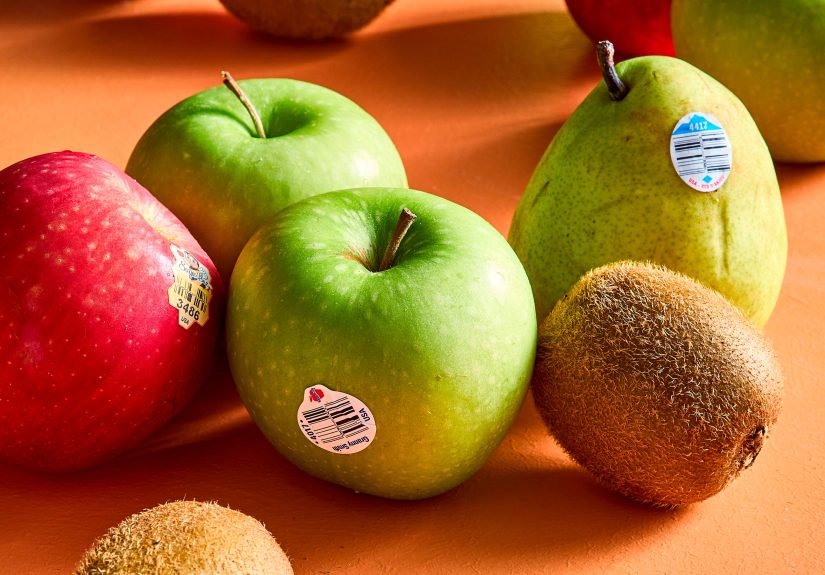
4-digit PLUs (e.g., 4011) – conventionally grown produce. This is what
you’ll see most often in a typical supermarket. -
5-digit PLUs starting with 9 (e.g., 94011) – certified organic produce.
The “9” is your clue that the item was grown under organic standards. -
Barcodes or logos – help retailers track brands, varieties, and origin
(like specific apple varieties or farm labels).
It’s a tiny sticker, but it carries a surprising amount of informationjust not nutritional
information for your body.
The Environmental Side of Fruit Stickers
While fruit stickers are usually safe for your body, they’re not so great for the planet.
Most are:
-
Not biodegradable – they often contain plastic that doesn’t break down
in compost. -
Contaminants in composting systems – large composters sometimes have to
reject loads of produce because stickers contaminate the material. -
Difficult to recycle – the combination of adhesive, ink, and mixed
materials makes them a poor fit for standard recycling processes.
The most responsible thing to do with a fruit sticker is simple but boring:
put it in the trash. Until fully compostable or laser-etched labeling is
universal, that’s the least damaging option.
Real-Life Experiences: “I Swallowed a Fruit Sticker, Now What?”
To make all this a little more relatable, imagine a few very normal scenarios that play
out in kitchens and office break rooms every single day.
The Commuter and the Banana
You’re driving to work, already late, peeling a banana with one hand and steering with
the other (again, no judgment). You take a big bite, and only then notice the empty spot
where the sticker used to be. There is a brief moment of horror, followed by
the realization that pulling over to Google “banana sticker poison” might make you even
later.
In reality, nothing dramatic happens. You drink some coffee or water, the sticker sails
through your digestive system, and your biggest regret is not taking two seconds to peel
it off first. By lunchtime, you’ve mostly forgottenuntil someone in the office kitchen
does the same thing and you get to say, “Oh yeah, I survived that last week.”
The Parent and the Strawberry Sticker Scare
Now picture a parent prepping strawberries for a toddler. They rinse the berries, slice
them into tiny pieces, and put them on a cute plate. Five minutes later, they notice a
lone sticker stuck to the cutting board and can’t remember whether they took it off before
or after slicing.
Cue internal panic: Did the baby eat a sticker? Is it stuck somewhere? Is this a call-the-pediatrician
moment or a “calm down and observe” moment?
If the child is laughing, breathing normally, and gleefully smashing strawberries into
their hair, the danger is probably minimal. The parent might monitor for coughing or any
choking signs, but in a typical scenario the worst outcome is that the sticker passed
quietly through the child’s systemor was never eaten at all. The whole experience,
however, often turns that parent into a lifelong sticker-removal vigilante.
The Salad Bar Surprise
At the office salad bar, you pile your plate high with greens, sliced apples, and grapes.
Halfway through lunch, you spot a small oval sticker hiding under a piece of lettuce.
Suddenly, every bite you took earlier becomes suspicious. Did you miss one? Did you eat one?
If you did, the odds are good that your body will treat it like an uninvited guest who
quietly leaves later. What the experience really does is make you more mindful: you start
checking apples and avocados before cutting them, and you learn to trustbut verifyany
prepped fruit in buffets and salad bars.
The Takeaway from These Little Everyday Stories
Across stories like these, a pattern emerges:
-
Accidentally eating a fruit sticker is common, mildly embarrassing, but almost never
harmful in healthy people. -
The real riskschoking, airway obstruction, or issues in people with specific medical
conditionsare rare but important to know about. -
Most anxiety comes from not knowing what the sticker is made of or how the body will
handle it. Once you understand that it’s a regulated, non-toxic food-contact material,
that anxiety usually drops.
And maybe the best “side effect” of accidentally eating a fruit sticker is that it nudges
you toward better habits: washing produce more carefully, cutting fruit more safely for
kids, and giving those tiny labels the respect they weirdly deserve.
Bottom Line
If you accidentally eat a fruit sticker, don’t panic. For most healthy adults, it’s a
harmless, forgettable event. The sticker is made from non-toxic materials, your digestive
system treats it like a small piece of indigestible material, and it moves through without
causing trouble.
The main concerns are chokingespecially in young childrenand rare issues in people with
certain medical or digestive conditions. If there’s any sign of breathing difficulty,
severe pain, or persistent symptoms, that’s the time to seek medical care.
Otherwise, the experience is mostly a reminder to slow down, peel off the sticker, and
give your fruit a quick wash. Your future selfand your compost binwill thank you.

![18 Best Types of Charts and Graphs for Data Visualization [+ How to Choose]](https://corkopencoffee.org/wp-content/uploads/2026/05/18-best-types-of-charts-and-graphs-for-data-visualization-how-to-choose-qKM1PBYG-thumb.jpg)