Table of Contents >> Show >> Hide
- Before You Roll Anything: Set Yourself Up for Success
- Method 1: The Classic Tight Cylinder Roll
- Method 2: The Ranger Roll (a.k.a. the Pocket-and-Tuck Roll)
- Method 3: The Flat-First “File Roll” for Better Visibility
- Method 4: The Outfit Burrito Roll (Mini Bundle)
- Method 5: The Full Bundle Wrap Inside a Packing Cube (Wrinkle-Minimizer)
- How to Arrange Rolls Inside Packing Cubes (So They Stay Put)
- Rolling vs. Folding: A Quick Reality Check
- Small Tips That Make a Big Difference
- Frequently Asked Questions
- Traveler Experiences: What Actually Works in Real Life (and What Doesn’t)
- Conclusion
Packing cubes are basically drawers for people who refuse to unpack (hi, it’s meemotionally). But cubes only work
their magic when what goes into them is compact, consistent, and not shaped like a crumpled paper ball of regret.
That’s where rolling comes in: the right roll can save space, improve visibility, and keep your suitcase from becoming
a textile crime scene.
Still, rolling isn’t a one-size-fits-all hack. Some fabrics roll beautifully; others roll like a croissant and arrive
with the wrinkles to prove it. The goal of this guide is simple: give you five practical rolling methods
you can match to the clothes you actually travel withplus a few packing-cube strategies that make those rolls stay put.
Before You Roll Anything: Set Yourself Up for Success
1) Pick the right cube for the job
Small cubes are great for tees, underwear, socks, and gym gear. Medium cubes shine for tops and lightweight bottoms.
Large cubes are best for bulk (think: sweatshirts) or for “I don’t want to think about it” categories like pajamas.
If you’re using compression packing cubes, remember: they don’t create space out of thin airthey reduce bulk by squeezing
out air, so the shape of what you pack matters.
2) Smooth the fabric first
Lay the item flat, smooth it with your hands, and align seams. This takes about eight seconds and can save you from
wearing a shirt that looks like it fought a suitcase and lost.
3) Decide: roll, fold, or use a garment folder
Rolling often works best for casual, lightweight pieces (tees, athletic wear, pajamas). Folding or using a garment folder
tends to win for structured, wrinkle-prone items like crisp button-downs, blazers, and some dresses. A smart suitcase
usually uses both approachesrolling where it helps, folding where it protects.
Method 1: The Classic Tight Cylinder Roll
This is the “everyday” roll: fast, tidy, and ideal for stacking in rows inside a cube. It’s the method most people mean
when they say “I roll my clothes.”
Best for
- T-shirts, tanks, leggings, thin pajamas, workout tops
- Lightweight cotton, synthetics, merino blends
How to do it
- Lay the item face down and smooth it flat.
- Fold sleeves or edges inward to create a clean rectangle.
- Starting from the bottom hem, roll upward tightlylike you’re making a fabric sushi roll.
- Press out air as you go, then place seam-side down in your cube so it doesn’t unwind.
Packing cube tip
Stand these rolls upright like little cylinders (think: a row of burritos) so you can see everything at a glance.
This “vertical packing” style reduces rummagingaka the #1 cause of suitcase chaos.
Method 2: The Ranger Roll (a.k.a. the Pocket-and-Tuck Roll)
If classic rolling is a sticky note, the Ranger Roll is a paperclip. It’s designed to lock the roll
so it won’t pop open when you pull out one item. This is especially handy in packing cubes, where tight space can make
items spring loose the second you unzip.
Best for
- T-shirts, underwear, socks, lightweight base layers
- Anyone who wants rolls that stay rolled through airport acrobatics
How to do it
- Lay the item flat.
- Fold about 1–2 inches of the bottom hem inside out to create a “pocket” cuff.
- Fold sleeves/edges inward into a rectangle.
- Roll tightly from the top down toward the pocket.
- Stretch the pocket over the roll to secure it (like you’re putting a fitted sheet over… well, anything).
Why it works in cubes
The tuck keeps each roll compact and self-contained. That means you can pull out one tee without detonating the entire cube.
If you’re “team carry-on,” this is one of the most reliable ways to keep your packing cube organized mid-trip.
Method 3: The Flat-First “File Roll” for Better Visibility
Some people roll and end up with lumpy, uneven shapes that waste space. The “file roll” fixes that by making a uniform
rectangle firstthen rolling so the final shape stacks neatly. It’s also a great compromise for fabrics that crease if you
roll too tightly.
Best for
- Blouses, thin button-ups, knits, travel dresses made from wrinkle-resistant fabric
- Outfits you want to see quickly (no digging, no drama)
How to do it
- Lay the item flat and smooth it.
- Fold into a clean rectangle sized to your cube’s width (not your dresser’s width).
- Roll gently from one short end to the othertight enough to hold, not so tight it creases.
- Place rolls side-by-side in the cube like files in a cabinet.
Pro move
Try keeping “like with like” in each cube (tops together, bottoms together) so you’re not fishing for a shirt in a cube
full of socks. Categorizing cubes also makes repacking faster on the way home, when your brain is already on vacation.
Method 4: The Outfit Burrito Roll (Mini Bundle)
This is the roll for people who want to wake up, grab one compact bundle, and get dressed without doing suitcase math.
You roll multiple items together so each bundle equals one outfit (or one “base outfit” with variations).
Best for
- Weekend trips, business-casual travel, family packing
- Anyone who wants “grab-and-go” outfits inside cubes
How to do it
- Lay your main piece flat (example: a T-shirt or top).
- Place smaller items on top: underwear, socks, or a thin tank.
- Fold sleeves/edges in to create a neat rectangle.
- Roll the entire stack together into one firm bundle.
- Repeat for each day/outfit and stack bundles in a medium cube.
Example: 3-day weekend cube
- 3 outfit burritos (tee + underwear + socks)
- 1 separate roll for lightweight shorts/leggings (to mix and match)
- 1 small pouch/cube for chargers or accessories so they don’t migrate
This method pairs especially well with packing cubes because cubes keep the outfit bundles compressed and prevent them from
shifting into a tangled pile.
Method 5: The Full Bundle Wrap Inside a Packing Cube (Wrinkle-Minimizer)
Bundle wrapping is famous for reducing wrinkles because it avoids sharp folds. The traditional method wraps clothes around
a soft “core,” building a layered bundle. Here’s the twist: using a packing cube as the container keeps the bundle compact
and easier to handle.
Best for
- Wrinkle-prone items (button-downs, chinos, dresses) that still need to fit in a cube
- People who prefer fewer creases over quick access
How to do it (cube-friendly version)
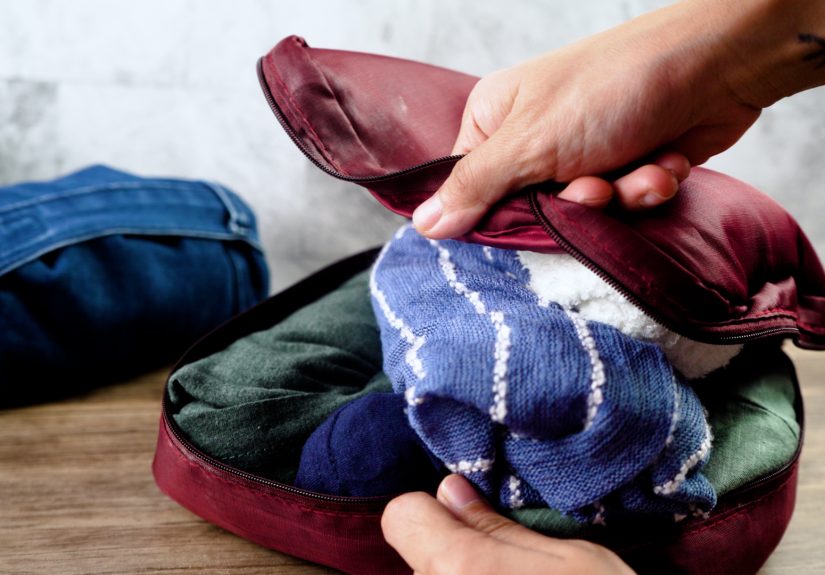
- Create a soft core: socks, underwear, or a thin tee rolled into a compact ball.
- Lay your most wrinkle-prone item flat (example: button-down) and place the core in the center.
- Fold one side over the core, then the other side (no sharp creaseskeep it smooth).
- Layer additional items around it (tees, lightweight pants), wrapping each one over the growing bundle.
- When finished, place the bundle into a cube that fits it snugly without forcing the zipper.
Trade-off (be honest with yourself)
Bundle wrapping can be less convenient if you need one item in the middleyou may have to unwrap and rewrap. If you’re the
type who changes outfits like you’re starring in a music video, you might prefer the outfit burrito method instead.
How to Arrange Rolls Inside Packing Cubes (So They Stay Put)
Row-and-fill strategy
Pack rolls in tight rows with minimal gaps. If there’s space left, fill it with small items (socks, belts, a swimsuit).
The goal is a cube that’s full enough to hold shape but not so packed that the zipper is begging for mercy.
Stack strategically
Heavier items (like jeans) belong at the bottom of your suitcase, closer to wheels in a roller bag. Lighter cubes sit on top.
This keeps weight balanced and reduces pressure wrinkles on softer fabrics.
Don’t force a “perfect fit”
Packing cubes work best when they’re organizednot when they’re stuffed like a Thanksgiving turkey. If you have to body-slam
a cube to zip it, you’re not compressing; you’re negotiating with physics.
Rolling vs. Folding: A Quick Reality Check
Rolling is excellent for many casual clothes, but some experts and frequent travelers point out that rolling can sometimes
create more wrinkles or even take up more room for certain items. The smartest approach is mixed:
- Roll: tees, underwear, socks, athletic wear, soft knits, lightweight travel fabrics.
- Fold/file-fold: structured tops, linen, stiff cotton button-downs, items that show creases easily.
- Garment folder or protective layer: dress shirts, special-occasion pieces, anything you want crisp.
If you’re packing for business or an event, consider dedicating one cube to folded “nice” items and another to rolled casual pieces.
Your future self (the one racing to dinner reservations) will be grateful.
Small Tips That Make a Big Difference
Use compression cubes for soft itemsnot stiff ones
Compression cubes can be amazing for tees and base layers because those fabrics squash down well. For structured items,
compression can set wrinkles into place. If your cube has a compression zipper, don’t treat it like a hydraulic press.
Separate clean and dirty
Many travelers use one cube for clean clothes and a separate cube (or a laundry bag) for dirty items. It keeps your suitcase
from smelling like “airport + sunscreen + that one sandwich you regret.”
Keep cubes clean
Packing cubes touch hotel drawers, floors, and the inside of your bagall places that collect grime. Clean them regularly
(and always after spills or illness). Many cubes are machine washable, but check the label and air-dry when possible.
Build a mini packing system
- Cube 1: Tops (rolled cylinders or file rolls)
- Cube 2: Bottoms (rolled or folded depending on fabric)
- Cube 3: Underwear/socks (Ranger roll if you want tidy “grab one” access)
- Pouch: Toiletries/cables so they don’t roam free
Frequently Asked Questions
Do rolled clothes actually save space in packing cubes?
Often, yesespecially for lightweight, flexible fabrics. Rolling also improves organization because you can pack items in
tight rows. But for some garments (stiff fabrics, bulky knits), folding can be more space-efficient and less wrinkly.
What’s the best rolling method for carry-on packing?
For pure stability, the Ranger Roll is hard to beat. For speed and visibility, classic cylinder rolls or file rolls work great.
For wrinkle control on nicer items, try bundle wrapping in a cube.
How do I keep rolls from unrolling?
Pack them snugly, place seam-side down, and use the Ranger Roll for slippery fabrics. Also: don’t leave big gaps in the cube.
Empty space is where rolls go to start new lives as chaos.
Traveler Experiences: What Actually Works in Real Life (and What Doesn’t)
If you ask a room full of frequent travelers how to pack, you’ll get a lively debate that feels strangely like a sports rivalry:
Team Roll versus Team Foldwith packing cubes refereeing the whole thing. In practice, most people end up on
Team “It Depends”, because different trips demand different strategies.
On short trips, travelers often love rolling because it’s fast and forgiving. You can roll a few tees, line them up in a cube,
and you’re basically done. The big win here isn’t just spaceit’s access. People report that when shirts are rolled
upright, they stop “excavating” their cube like it’s an archaeological dig. You open the zipper, see the options, grab one, and
move on with your day. That convenience matters most when you’re living out of a carry-on and repacking every couple of days.
The Ranger Roll gets rave reviews from travelers who hate the “one shirt pulled, whole cube explodes” problem. The tuck makes each
roll feel like a self-contained unit. That’s especially helpful for underwear and socksitems that otherwise multiply into a messy
pile the moment you’re in a hurry. People who switch hotels frequently (or travel with kids) also like that Ranger-rolled bundles
survive rough handling better.
But rolling isn’t always the hero. Some travelers find that rolling certain shirts creates more wrinklesespecially stiff cotton,
linen, or anything with structure like collars and plackets. The common workaround is a hybrid: fold those “needs to look nice” pieces
into thin, flat layers (or use a garment folder), then roll everything casual. This is also where bundle wrapping earns fans: by reducing
sharp creases, it helps nicer items arrive looking less crumpled. The downside, as many people discover, is accessbundle wrapping is
fantastic until you want the third layer down, at which point you’re basically unwrapping a clothing lasagna.
Compression packing cubes introduce another real-world lesson: they’re great for soft clothes and questionable for stiff ones.
Travelers often report that compression helps them fit more tees and base layers, but if they crank down compression on dress shirts,
the wrinkles become “extra committed.” The best experience tends to come from compressing only the cube that holds soft items and leaving
the “nice clothes cube” uncompressed (or lightly compressed).
Finally, there’s the “systems” insight: travelers who enjoy packing cubes the most usually treat them like categories, not like random bins.
One cube for tops, one for bottoms, one for underwear/socks, one for workout gear or pajamas. Even if your rolling method changes from trip to trip,
that simple structure keeps packing from spiralingespecially on the return trip, when you’re tired, you have souvenirs, and your suitcase is somehow
smaller than it was on the way out. (Science cannot explain this. Only acceptance can.)
Conclusion
The best way to roll clothes for packing cubes is the one that matches your wardrobe and your trip. Use classic cylinder rolls for speed,
Ranger rolls for stability, file rolls for tidy stacking, outfit burritos for grab-and-go days, and bundle wrapping when wrinkles are the enemy.
Mix rolling and folding where it makes sense, keep cubes categorized, and you’ll spend less time wrestling your suitcase and more time doing the fun part:
actually going somewhere.