Table of Contents >> Show >> Hide
- Why Modify? The Science (Briefly) Backs You Up
- 1) Swap High-Impact Cardio for Low-Impact Machines & Water Work
- 2) Scale Range of Motion (ROM) and Use External Support
- 3) Use Intervals Sized for Recovery (RPE Beats the Stopwatch)
- 4) Prioritize Strength Training with Machines, Bands & Tempo Control
- 5) Footwear, Surfaces, and Stance: Your Joint-Friendly “Grip Tape”
- 6) Upgrade Warm-Up & Recovery: Heat, Mobility, and Data You’ll Actually Use
- Bonus: Weight Loss, Even Modest, Lightens the Load
- Putting It All Together (Sample 2-Week Plan)
- Common Questions (Answered Quickly)
- Conclusion
- of Real-World Experience: What Actually Works
Let’s be honest: starting (or restarting) exercise when you’re living with obesity can feel like showing up to a spin class where the bikes are all three inches too high and the playlist is 90% bagpipes. The good news? You don’t need to “go hard or go home” to get results. Smart, evidence-informed modifications can protect your joints, keep your heart rate in the right zone, and make workouts sustainableso you can actually stick with them long enough to feel amazing.
Below you’ll find six practical tweakstested by coaches, supported by health organizations, and friendly to real lifeto help you move more while dialing down injury risk. Think of them as the comfy insoles of your fitness plan.
Why Modify? The Science (Briefly) Backs You Up
For overall health, U.S. guidelines recommend about 150 minutes of moderate aerobic activity per week plus two days of strength training. You can meet those targets with low-impact choices and scaled strength movesno burpee bootcamps required. The key: the right dose, the right mechanics, and the right recovery.
There’s also a physics reason to go low-impact: every step can load the knees with forces greater than body weight, and extra pounds multiply that load. Translationchoose movements that train your heart and muscles without pounding your joints.
1) Swap High-Impact Cardio for Low-Impact Machines & Water Work
Instead of: jogging and jump-squats
Try: brisk walking on level ground, stationary or recumbent cycling, elliptical, or water aerobics.
Why it helps: Low-impact modalities keep joint stress manageable while still building cardio capacity. Water supports body weight and cushions movement; cycling and elliptical smooth out impact peaks. If stairs inflame knees, keep treadmill incline low (0–2%) and prioritize duration over steepness.
Coach’s cue
Use “able-to-talk” pacing (you can speak full sentences but not sing) for 15–25 minutes, three to five days a week. Add 2–5 minutes total each week. If you feel joint grumbling after a session, dial the intensity back next time by 5–10% and add a minute of gentle pedaling for every minute of work during the cooldown.
2) Scale Range of Motion (ROM) and Use External Support
Instead of: deep squats, floor push-ups, unassisted step-downs
Try: box squats to a sturdy chair, incline push-ups (hands on bench or wall), and step-ups to a low box with a handrail or TRX.
Why it helps: Reducing ROM to a pain-free zone keeps your spine neutral and improves force distribution through the hips and glutes. Using boxes, benches, handles, and rails adds stability without sacrificing training effectespecially early on, when technique beats ego every time. (General safety and progression principles are emphasized across ACSM resources.)
Micro-progression plan
- Weeks 1–2: Chair-height squats (tap and stand), 2–3 sets of 6–8 reps, full rest.
- Weeks 3–4: Lower the box by 1–2 inches or slow the lowering phase to 3 seconds.
- Weeks 5–6: Hold a light dumbbell or add one extra setnot both in the same week.
3) Use Intervals Sized for Recovery (RPE Beats the Stopwatch)
Instead of: fixed 1:1 work-to-rest intervals that leave you gasping
Try: effort-based intervals using Rating of Perceived Exertion (RPE) 4–6/10 for work, then recover to RPE 2–3/10 before the next bout.
Why it helps: RPE personalizes intensity on any day and any machine, accommodating sleep, stress, and meds. It keeps you in the moderate to vigorous “sweet spot” the guidelines endorse, without overshooting into form-breaking fatigue that spikes injury risk.
Starter template
5-minute warm-up → 60 seconds at RPE 5 → recover until RPE 3 (usually 60–120 seconds) → repeat 8–10 rounds → 5-minute cool-down. If joints flare, shorten the work to 30–45 seconds and extend recovery.
4) Prioritize Strength Training with Machines, Bands & Tempo Control
Instead of: complex barbell lifts right away
Try: machine leg press, cable row, chest press, banded deadlifts from risers, and supported split squats.
Why it helps: Strength training preserves lean mass, improves insulin sensitivity, and supports joints. Machines and bands guide motion, reduce balance demands, and let you slow the tempo (3 seconds down, 1 up) to get more stimulus from lighter loads. Aim for two sessions per week (nonconsecutive days), 1–3 sets of 6–12 controlled reps per exercise.
Form audit
- Neutral spine: ribs stacked over pelvis, no swayback.
- Knees track over the middle toes (not caving inward).
- Stop 1 rep before form breaksquality > quantity.
5) Footwear, Surfaces, and Stance: Your Joint-Friendly “Grip Tape”
Instead of: worn-out sneakers on concrete
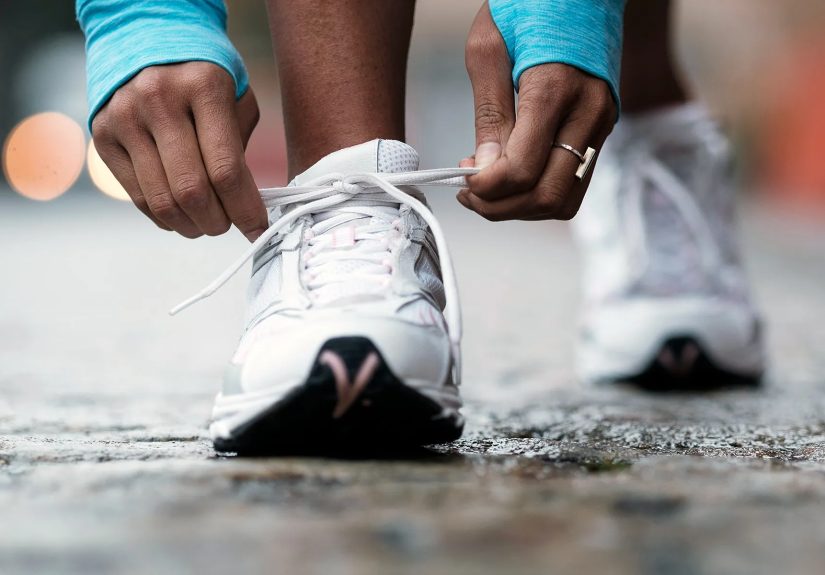
Try: cushioned, supportive shoes; rubberized tracks; wooden floors; or treadmill walking. Consider a slightly wider stance for squats and deadlifts to create space for the torso and improve balance.
Why it helps: Simple environmental tweaks reduce impact spikes and let you focus on alignment. Many orthopedic programs recommend walking, swimming, and biking on even terraingreat options while capacity builds.
Quick wins
- Replace shoes every ~300–400 miles of walking or when the midsole feels “dead.”
- Choose level routes first; add gentle inclines later if knees agree.
- Use handrails for step work; balance gains come after safety.
6) Upgrade Warm-Up & Recovery: Heat, Mobility, and Data You’ll Actually Use
Instead of: cold starts and guesswork
Try: 5–8 minutes of heat (warm shower or heating pad) for stiff joints, then dynamic moves (marching in place, hip circles, shoulder CARs). Track sessions with a simple log or a wearablejust enough data to see trends and respect recovery days. Heat and low-impact motion help reduce stiffness; modern wearables make it easier to pace effort and avoid redlining.
Bonus: Weight Loss, Even Modest, Lightens the Load
Every bit of weight loss can reduce stress on your kneesestimates suggest that each pound lost can translate to several pounds less force at the knee during walking. That means lifestyle changes add up in your favor, especially when paired with low-impact, strength-forward training.
Putting It All Together (Sample 2-Week Plan)
Goal: build consistency, protect joints, and practice form.
Week 1
- Mon: Recumbent bike 15–20 min at RPE 4–5; finish with 5 minutes easy.
- Tue: Strength A (machine leg press, cable row, incline push-ups) 2×8 slow reps each.
- Wed: Water aerobics or easy walk 20–25 min.
- Thu: Mobility (10 min) + balance holds at a counter (3×20 sec per leg).
- Fri: Strength B (banded hip hinge from risers, chair squats, cable pulldown) 2×8.
- Sat/Sun: Active recovery (yard work, gentle swim, long grocery lap).
Week 2
- Cardio sessions: add 2–3 minutes total time each.
- Strength: keep weight the same, slow tempo (3 seconds down) or add one set to ONE exercise.
- Track RPE and any joint feedback with a 1–5 smiley scale. If pain > 3 for 24 hours, regress one step.
Common Questions (Answered Quickly)
“Can I still get a great workout without jumping?”
Absolutely. Your heart and muscles care about intensity and time under tension, not whether both feet leave the floor. Ellipticals, bikes, rowing with good form, and water workouts are legit cardio.
“Is strength training safe for my knees and back?”
With controlled tempo, scaled ROM, and smart setup, yesoften safer than repetitive high-impact cardio. Machines and bands are your friends early on. If a move hurts, modify the position or swap the exercise.
“How fast should I progress?”
One variable at a time (time, load, or range), 5–10% per week at most. Finish sessions feeling you could do one more set or a few extra minutes. That’s the recovery margin that keeps you coming back.
Conclusion
You don’t have to train like an action hero to get heroic benefits. Choose low-impact cardio that respects your joints, scale your strength moves, use RPE to keep effort honest, upgrade your warm-up and recovery, and tweak footwear and surfaces to your advantage. Do this consistently and the risk of “I overdid it” drops while your energy, confidence, and capacity climb.
sapo: Starting exercise with obesity doesn’t have to hurt. Discover six joint-friendly modificationslow-impact cardio swaps, scaled strength moves, effort-based intervals, smarter warm-ups, and smart footwear/surface tweaksthat reduce injury risk while accelerating progress. With evidence-backed tips and clear examples, you’ll build a sustainable routine that feels better from the very first week.
of Real-World Experience: What Actually Works
I’ve coached plenty of beginners who told me, “I’m scared to move because moving is what hurts.” That feeling is valid. Here’s what repeatedly worked in practice:
1) Start with “wins you can’t miss.” The first cardio choice is usually the recumbent bike or water aerobics. Both feel safe right away. Clients who began with 10-minute bouts (morning and evening) often doubled their weekly activity without noticing the time investment. Consistency beats heroics every day of the week.
2) Build a “home base” circuit. Three moves that always feel comfortable become the fallback plan on low-energy days. A favorite trio: chair squats, cable rows (or band rows at home), and a short walk. When expectations are realistic, you don’t skipyou scale.
3) Train the pattern before the muscle. We practice the hinge and squat using dowels, boxes, and rails until alignment becomes automatic. Only then do we add load. People are surprised how fast strength climbs when the movement is dialed in. The body loves repeatable patternsit rewards them with stability.
4) Make RPE your superpower. Instead of chasing numbers, clients learn to match breath and talk-test cues to RPE levels. On days after poor sleep or higher stress, they stay at RPE 3–4 and feel successful. On good days, they nudge to RPE 6. This self-regulation keeps progress steady and injuries rare.
5) Respect the warm-up (and the calendar). Five minutes of heat and easy motion melts stiffness. Then we use dynamic mobility for hips, ankles, and thoracic spine. Sessions land on a weekly template with autopilot slots (e.g., Mon/Wed/Fri 7:30 p.m.). When exercise has a “home” in the calendar, it stops competing with everything else.
6) Footwear solves more than you think. Cushioned, supportive shoes plus kinder surfaces quiet knee and back chatter. If someone says, “my shins bark after 8 minutes,” we change the surface first, not the goal. It’s remarkable how often discomfort is an equipment or environment problem, not a you problem.
7) Progress like a scientist. We change one variable a week: either add two minutes of cardio total, or one set to a single lift, or lower the seat one notch to increase range. If symptoms flare, we reverse that one change and move on. This keeps confidence high and detective work simple.
8) Keep score the easy way. A pocket notebook or basic wearable tracks sessions, RPE, and any joint notes. People love seeing the streak build. More important, it turns vague memories (“I think last week hurt?”) into data (“knees felt tight only after adding inclinewent back to level and it resolved”).
9) Celebrate performance, not scale drama. First we chase wins like: walked 20 minutes without stopping; finished three sets with perfect form; slept better. Weight loss, when it happens, is a side effect of a routine that already improves life. That reframe keeps motivation sturdy when the scale is moody.
10) The gentlest plan is often the fastest plan. When you avoid setbacks, you don’t lose weeks to soreness or frustration. A year from now, the person who never missed two workouts in a row is miles ahead of the one who went hard for two weeks, quit for four, and started over. Go gentle, go far.
Key supporting sources cited inline:
CDC Physical Activity basics (150 min + strength): turn0search10.
Joint load and weight: Harvard Health: turn0search4.
Low-impact/water guidance: Mayo Clinic Arthritis page: turn0search8.
Strength training benefits: Mayo Clinic strength training: turn0search13.
Wearables/personalization reducing injury risk: ACSM trends 2026: turn0search11.
Additional safety & guideline context: HHS PAG 2nd edition: turn0search2.
![18 Best Types of Charts and Graphs for Data Visualization [+ How to Choose]](https://corkopencoffee.org/wp-content/uploads/2026/05/18-best-types-of-charts-and-graphs-for-data-visualization-how-to-choose-qKM1PBYG-thumb.jpg)