Table of Contents >> Show >> Hide
- The Discovery That Started With “What’s That Bump?”
- Why This Dinosaur Highway Is Such a Big Deal
- Meet the Dinosaurs Behind the Footprints
- How Footprints Survived for 166 Million Years
- Why Trackways Can Tell Us More Than Bones
- Oxfordshire’s Jurassic Reputation Just Got Even Better
- What the Dinosaur Highway Reveals About Jurassic Life
- The Human Side of the Find
- Additional Experiences Related to the Topic
- Conclusion
Most people head to work hoping for a decent lunch break and maybe a machine that behaves itself. Quarry worker Gary Johnson got something a little more dramatic: a brush with deep time. While stripping clay at Dewars Farm Quarry in Oxfordshire, England, he noticed a series of odd, evenly spaced bumps. That moment, which could have ended with a shrug and a stronger cup of coffee, instead led to one of the most remarkable dinosaur track discoveries in modern Britain.
What emerged from the quarry floor was not just a few fossilized prints. It was a sprawling “dinosaur highway” dating back roughly 166 million years to the Middle Jurassic, complete with multiple trackways, giant sauropod footprints, and the three-toed marks of a carnivorous predator. In other words, the ground was basically keeping a Jurassic guestbook, and someone had finally opened it.
This discovery matters because footprints do something bones often cannot. A skeleton tells us what a dinosaur was. A trackway tells us what it was doing. Was it walking alone? Moving with others? Crossing a shoreline? Following prey? Avoiding it? At Dewars Farm, paleontologists suddenly had a rare chance to study dinosaur behavior on a large scale, preserved in stone like a prehistoric freeze-frame.
The Discovery That Started With “What’s That Bump?”
The story has the kind of beginning science writers love and mystery novels envy. Johnson was working with heavy machinery when he felt unusual humps beneath the surface. They were too regular to be random and too intriguing to ignore. Once experts from the Oxford University Museum of Natural History and the University of Birmingham got involved, the scale of the find became clear.
A major excavation followed in June 2024, involving more than 100 researchers, students, and volunteers. Over the course of a week, the team uncovered about 200 footprints spread across five major trackways. The longest continuous route stretched more than 150 meters, or nearly 500 feet. That is not a footprint trail. That is a fossilized traffic lane.
The quarry itself sits in a region already famous for dinosaur history, so the find did not appear out of nowhere. Oxfordshire has been tied to dinosaur science for generations. Still, this site raised the stakes. It was bigger, better preserved, and documented with modern tools that earlier generations of paleontologists could only dream about.
Why This Dinosaur Highway Is Such a Big Deal
Calling the site a “dinosaur highway” is not just a flashy headline. The phrase fits because the trackways suggest repeated movement across a shared landscape. The footprints were laid down on muddy ground near warm, shallow lagoons in a tropical environment that looked nothing like modern England. Imagine broad mudflats, water nearby, and enormous reptiles leaving crisp impressions in soft sediment. Now picture those impressions getting buried quickly enough to survive for 166 million years. Nature really knows how to save receipts.
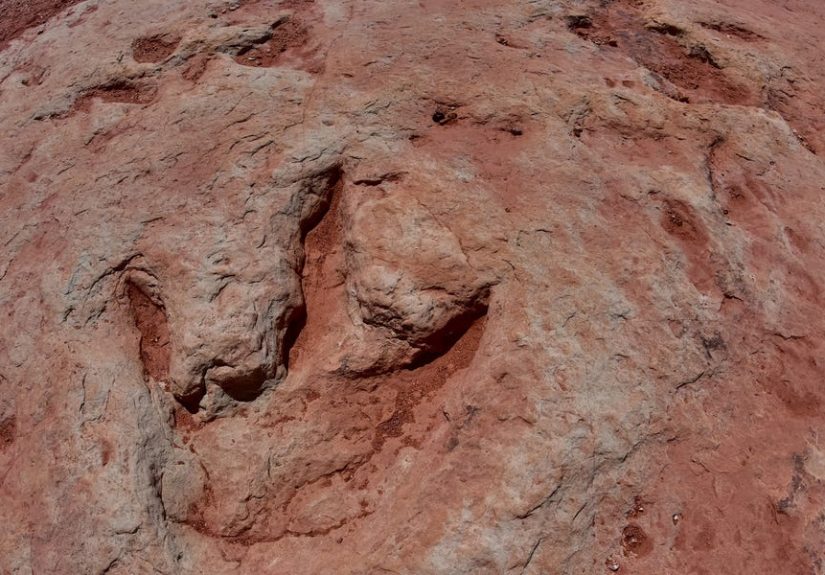
The site is especially valuable because it captures multiple animals in motion. Four of the trackways appear to have been made by long-necked herbivorous sauropods, most likely Cetiosaurus, an enormous plant-eater that could reach around 60 feet in length. A fifth trackway is linked to Megalosaurus, a meat-eating theropod that measured around 30 feet long and left distinct three-toed prints with claws.
One of the most tantalizing details is that the carnivore and herbivore tracks cross in at least one area. That does not prove a dramatic chase scene worthy of a blockbuster trailer, but it does raise juicy scientific questions. Were these animals moving through the same area hours apart? Days apart? Was the predator following the herbivores, or was this simply a busy piece of Middle Jurassic real estate? Science does not always hand over a neat ending, but it does love a strong plot twist.
Meet the Dinosaurs Behind the Footprints
Cetiosaurus: The Gentle Giant With Serious Foot Size
The likely makers of four trackways were sauropods, probably Cetiosaurus. These were big-bodied, long-necked herbivores built like walking cranes with appetites. In the Middle Jurassic, they would have been among the largest animals on land in what is now the United Kingdom. Their footprints at the quarry are broad, deep, and impossible to mistake for anything dainty.
Sauropod tracks matter because they help scientists estimate body size, stride length, gait, and speed. They also reveal how such massive animals distributed their weight across soft ground. At Dewars Farm, the preserved mud deformation around some prints offers extra clues, showing how the sediment squished and shifted as these giants stepped in and lifted out. It is the closest thing paleontology gets to slow-motion replay.
Megalosaurus: The Famous Predator Still Making Headlines
The fifth trackway likely belongs to Megalosaurus, which holds a special place in paleontology. It was the first dinosaur ever to be scientifically named, back in 1824. So yes, this predator has been a celebrity in dinosaur science for two centuries, and it is apparently still finding ways to grab attention.
Its tracks are striking because they are three-toed and clawed, classic theropod prints that look exactly like the sort of thing that would make a Jurassic herbivore reconsider its walking route. The Dewars Farm trackway gives researchers an unusually vivid look at how this predator moved across the landscape. Rather than a scattered bone or tooth, they have a direct record of where it went and how it stepped.
How Footprints Survived for 166 Million Years
Fossil preservation is picky. It is the geological version of baking: if the timing, texture, and conditions are even a little off, the whole thing falls apart. For tracks to survive, the ground has to be soft enough to take an impression but firm enough to hold it. Then the print needs to be buried fast enough to avoid erosion, trampling, or simple bad luck.
At Dewars Farm, scientists think the tracks formed on mudflats beside tropical lagoons. The dinosaurs walked across wet sediment, pressing their feet into the surface. Soon after, fresh mud buried the impressions. Over immense spans of time, those layers hardened into rock and locked the tracks in place.
That preservation is unusually detailed. Researchers can see not only the footprints themselves, but in some cases how the surrounding mud was pushed outward and reshaped. Add in associated fossils such as shells, burrows, and plant remains, and the site begins to feel less like a collection of isolated prints and more like a recovered ecosystem.
Why Trackways Can Tell Us More Than Bones
Dinosaur skeletons are spectacular, but they usually represent the end of an animal’s story. Trackways capture life in progress. They show motion, behavior, direction, and interaction. That is why sites like this one are so scientifically powerful.
From the spacing and shape of prints, paleontologists can estimate pace and walking speed. From the arrangement of tracks, they can infer whether animals were moving alone, loosely grouped, or crossing the same corridor at different times. From the depth and sediment deformation, they can learn about weight distribution and ground conditions. Footprints are like field notes written by the animals themselves, only with fewer vowels and much more mud.
This site also benefits from modern documentation. The team created more than 20,000 images and built detailed 3D models using drone photography and digital mapping. That means researchers can keep studying the trackways long after parts of the quarry are reburied or become inaccessible. It also means the public gets a far more complete record than was possible in earlier decades.
Oxfordshire’s Jurassic Reputation Just Got Even Better
The Dewars Farm discovery did not happen in a vacuum. Oxfordshire is already one of the most important regions in the history of dinosaur research. Megalosaurus itself was first described from Oxfordshire fossils in the early 19th century, helping launch dinosaur science as a discipline.
Then, in 1997, another major footprint site was discovered nearby in Ardley Quarry. That earlier find was hugely important, but much of it became difficult to access later, and it was documented before the age of today’s drones, high-resolution digital imaging, and advanced 3D modeling. Dewars Farm effectively gives researchers a second shot at studying a Jurassic track landscape in extraordinary detail.
That continuity matters. Instead of a one-off curiosity, Oxfordshire now looks even more like a long-term hotspot for understanding Middle Jurassic life. For paleontologists, it is the scientific equivalent of finding out your favorite old bookstore has a secret basement full of first editions.
What the Dinosaur Highway Reveals About Jurassic Life
One reason this story has traveled so well is that it makes the Jurassic feel surprisingly real. The site is not just about giant animals; it is about an environment. The mudflats, lagoons, shells, plants, and burrows all help reconstruct a warm coastal ecosystem where large herbivores and predators shared space.
That matters because the Middle Jurassic is not as richly documented as some later dinosaur ages. The Late Jurassic and Cretaceous tend to hog the spotlight, thanks to famous names and flashy fossils. The Dewars Farm trackways help fill in a less famous chapter of dinosaur history and remind us that plenty was happening long before Tyrannosaurus rex ever stomped onto the evolutionary stage.
Researchers are especially interested in movement patterns. Were these animals following shoreline routes? Moving between feeding grounds? Using the same landscape repeatedly over time? The site cannot answer every question on its own, but it gives scientists a much stronger foundation for asking them in smarter ways.
The Human Side of the Find
There is also something wonderfully human about the discovery. It started not with a dramatic expedition into a remote wilderness, but with somebody doing a job and paying attention. That detail matters. Science often advances because someone notices the unusual thing, resists the urge to ignore it, and asks a better question.
Then came the collaboration: quarry staff, museum experts, university researchers, students, volunteers, photographers, drone operators, and paleontologists all working together. That is a good reminder that major discoveries are rarely solo acts. Even when a find begins with one observant worker, understanding it takes a team.
There is also an emotional pull here that is hard to fake. Standing on a quarry floor and realizing that the marks below you were made by living animals 166 million years ago is the sort of moment that can make even the most serious scientist sound like an excited kid at a museum sleepover. Honestly, fair enough.
Additional Experiences Related to the Topic
To really appreciate why this story resonates, it helps to imagine the experience from several angles. Start with the quarry worker. One minute, you are doing routine industrial work. The next, the ground starts behaving oddly beneath your machine. The bumps are too evenly spaced, too deliberate-looking, too strange to dismiss. There is a quiet thrill in that kind of realization. Not a fireworks thrill. More like a slow electrical hum that says, “Something here is very old, very unusual, and possibly very important.” Those are the kinds of moments people remember for the rest of their lives.
Then there is the experience of the excavation team arriving on site. At first glance, a quarry may not look romantic. It is rock, dust, equipment, and practical boots doing practical things. But the moment a trackway starts to appear, the place changes. Suddenly the floor is not just stone. It becomes a surface that once held weight, motion, and living intent. Every brushstroke and every careful scrape reveals one more step in a path last used in the Jurassic. That shift in perception must be extraordinary. The quarry stops being only a worksite and becomes a time portal with a hard hat policy.
Visitors and readers experience the discovery differently, but the effect can be just as powerful. Dinosaur bones are amazing, of course, yet footprints feel personal. A footprint is intimate. It is evidence of presence. You can look at it and think, “A living creature stood here.” That idea lands differently than a fossilized femur in a display case. Tracks make prehistory feel less abstract and more immediate, almost like overhearing a conversation across impossible time.
There is also the emotional experience of scale. Photos of these trackways are striking because the prints are enormous, but scale becomes even more vivid when people stand beside them. A human foot looks tiny next to a sauropod impression. That size comparison does what statistics alone cannot. It makes the body understand the story. You stop thinking in measurements and start thinking, “That animal was absurdly huge.” Scientific language is useful, but sometimes the most accurate response is simply respectful disbelief.
For paleontologists, discoveries like this also come with a bittersweet experience: excitement mixed with urgency. Trackways are precious, but they are vulnerable. Weather, quarrying, erosion, and time itself can damage them. That is why documentation matters so much. Capturing thousands of high-resolution images and building 3D models is not just clever science. It is a way of preserving access to a fleeting window into the past. The emotional tone is not only wonder; it is stewardship.
Finally, there is the larger public experience of stories like this one. They remind people that Earth still holds surprises. Even in landscapes that are worked, mapped, and studied, there are discoveries waiting under a thin layer of clay. That is deeply encouraging. It suggests the world is not done being interesting. A quarry worker notices bumps. Scientists arrive. A lost Jurassic shoreline comes back into focus. And suddenly a modern audience gets to feel something rare and wonderful: the shock of realizing that the ancient world is not gone. In some places, it is still right under our boots, quietly waiting for someone to pay attention.
Conclusion
The story of the Dewars Farm dinosaur highway is more than a catchy fossil headline. It is a powerful example of how major discoveries can begin with ordinary attention and end by reshaping scientific understanding. A quarry worker noticed something odd. Researchers followed the evidence. What they uncovered was one of the most important dinosaur track sites in the United Kingdom, a place where giant herbivores and a famous predator left behind a remarkably detailed record of Middle Jurassic life.
For scientists, the site offers rare insight into movement, behavior, environment, and preservation. For readers, it delivers something just as valuable: perspective. The world beneath us has a very long memory. Every now and then, it shares a page.