Table of Contents >> Show >> Hide
- The Cave, the Drone, and the Blue Roof: What Actually Happened
- Why a Drone Beat 17 Years of Hiding
- Life in a Two-Square-Meter World: How Do You Survive 17 Years?
- The Bigger Trend: Police Drones Are Becoming Normal
- Could a Drone Find a Cave Fugitive in the United States?
- What This Cave Capture Teaches About Drone Policing
- Conclusion
- Field Notes: Practical Experiences Around Police Drones and Fugitive Searches (Approx. )
Seventeen years is a long time to keep a low profile. It’s long enough for hair to turn gray, for a world to swap flip phones for face scans, and for “I’ll be back soon” to age into “please stop asking.” Yet one fugitive managed to stay off the grid for nearly two decadesby doing what most of us only do on weekend hikes: disappearing into the mountains.
The twist? It wasn’t a super-sniffer dog, a dramatic stakeout, or a detective with a corkboard and red string that ended the run. It was a drone. And not even a dramatic sci-fi dronemore like a hardworking flying camera that looked down, spotted something that didn’t belong, and quietly said, “Hey… what’s that blue rectangle doing on a cliff?”
The Cave, the Drone, and the Blue Roof: What Actually Happened
The case centers on a convicted human trafficker who escaped a Chinese prison camp in March 2002 and stayed on the run for 17 years. Authorities eventually received a tip that he might be hiding in the mountainous area behind his hometown in Yongshan County, in China’s southwestern Yunnan Province. The terrain was steep, rugged, and heavily vegetatedexactly the kind of place where “just go look” becomes “pack snacks, bring ropes, and tell someone you love them.”
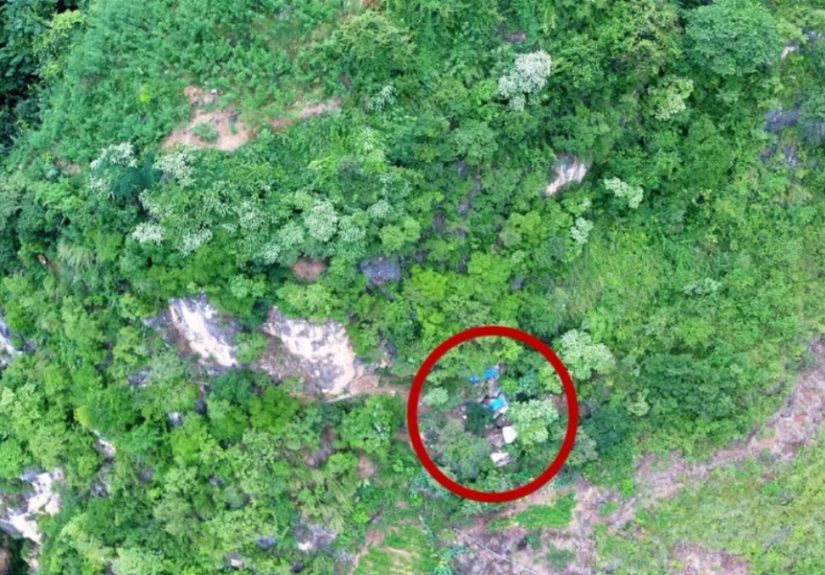
Ground teams searched but came up empty. So police escalated to an aerial search using a police drone. After hours of scanning from above, the drone spotted a small, unnatural pop of color: a blue metal tile or roof-like covering tucked into dense greenery along a cliff face. Nearby, there were signs of human activitytrash and debris that don’t exactly grow naturally like wildflowers.
Officers then hiked into the area and found the fugitive living in a tiny cave-like shelterreported at roughly two square meters (about 21–22 square feet). Inside was a makeshift setup that looked less like a home and more like the world’s worst studio apartment: cramped, dirty, and definitely not listed on any rental site.
Reports from authorities described him as unkempt and physically worn down by years in isolation. Police also noted he struggled to communicate clearlyunsurprising after years of living without regular human contact. He was taken into custody and returned to jail to complete his sentence.
Why a Drone Beat 17 Years of Hiding
If you’ve ever tried to find your car in a packed parking lot, you already understand the value of altitude. From the ground, everything is trees, rocks, shadows, and “I swear it was right here.” From above, patterns jump outespecially the kind made by humans, who can’t resist straight lines, sharp edges, and materials that shout “I’m not from this forest.”
The low-tech clue that gave it away
Ironically, the biggest giveaway wasn’t some advanced AI magic. It was basic contrast. A blue tile/roof in a sea of greens and browns is like wearing a neon hoodie to hide in a cornfield. Drones excel at spotting these inconsistencies: the geometry of a shelter, the unnatural sheen of metal, the disturbed vegetation around an entry point, or the scattered “domestic garbage” that screams, “A person lives here.”
The high-tech part: persistence, vantage point, and smart searching
Modern law enforcement drones can hover, zoom, orbit, and methodically cover search gridsespecially useful when the ground is too dangerous, too slow, or too easy to miss things. Even without specialized sensors, a stabilized camera and a patient operator can do a lot when paired with a credible tip and a clear search area.
In other words: the drone didn’t replace detective work. It multiplied it. It turned a “needle in a mountain” problem into a manageable visual scanand once that blue tile appeared, the search became less about guessing and more about confirming.
Life in a Two-Square-Meter World: How Do You Survive 17 Years?
This part of the story is as grim as it is fascinating. Living in a cave for years isn’t the rugged, cinematic fantasy people imagine. It’s cold, damp, cramped, and relentlessly uncomfortable. And it forces one obsession above all others: water.
Water: the real currency of survival
Reports describe the fugitive using plastic bottles to fetch water from a nearby ravine or river. That detail matters because it reveals the most practical truth about long-term hiding: you don’t survive on bravado. You survive on logistics. If your shelter isn’t close enough to water, you’re not hidingyou’re just rehearsing dehydration.
Food: the unglamorous daily grind
Public reporting didn’t provide a complete menu of how he ate over 17 years, and it’s worth resisting the urge to invent a dramatic “mountain man diet.” What we can say is this: long-term survival requires routine access to foodwhether through foraging, scavenging, occasional purchases, or help from others. Sustaining life for that long typically means a mix of strategies, not one heroic trick.
Isolation changes the brain (and the voice)
Authorities said he had trouble communicating after so many years alone. That’s believable on a human level: conversation is a muscle, and without practice, it weakens. Extended isolation can also amplify anxiety, paranoia, and disorientationespecially for someone constantly worried about discovery. Even if you “win” by staying hidden, your mind keeps paying the bill.
Key takeaway: A cave can hide you from people, but it can’t protect you from timephysical decline, social erosion, and the simple reality that humans leave traces.
The Bigger Trend: Police Drones Are Becoming Normal
This capture grabbed headlines because it’s dramatic: a fugitive, a cave, and a drone that basically played hide-and-seek from the sky. But the underlying theme is bigger than one case. Police drones are increasingly common in public safety work, including in the United States.
Drones as First Responders in the U.S.
In many American cities, law enforcement agencies now deploy drones for rapid situational awarenesssometimes launching to 911 calls before officers arrive. Programs often called Drone as First Responder (DFR) aim to reduce response times, improve officer safety, and help determine whether a situation is genuinely dangerous or merely loud.
The advantage is simple: a drone can arrive quickly, provide a live view, and help teams make smarter decisionsespecially in complex environments where “what’s happening?” is the most urgent question. The tradeoff is also simple: a flying camera raises understandable privacy concerns.
Where drones shine (and why departments keep buying them)
- Search and rescue: scanning large areas fast, especially in rough terrain.
- Missing persons: aerial sweeps, sometimes with thermal imaging in appropriate conditions.
- Fugitive searches: identifying shelters, tracks, or evidence of human presence from above.
- Disasters and hazardous scenes: floods, fires, chemical spills, structural collapsesplaces humans shouldn’t rush into.
- Active incidents: reducing blind approaches and improving perimeter coordination.
The controversy: privacy, oversight, and “mission creep”
The same features that make drones usefulspeed, vantage point, persistent observationalso make them sensitive tools. Civil liberties advocates worry about overuse, unclear data retention policies, and the possibility that “responding to emergencies” slowly expands into broad surveillance. Public trust rises when agencies publish clear policies, limit data retention, log flights transparently, and restrict drone use to defined purposes.
Could a Drone Find a Cave Fugitive in the United States?
The specific “17 years in a cliffside cave” storyline is rare anywhere. But the mechanicsremote terrain, tips about a hideout, and drones used to scan areas too dangerous or time-consuming for ground teamsabsolutely apply in the U.S.
In an American context, a fugitive might hide in wooded private land, desert canyons, abandoned structures, or makeshift camps. Drones can help spot unusual rooflines, disturbed vegetation, trails that don’t belong, or heat signatures (when appropriate and legally authorized). They don’t replace warrants, due process, or ground workbut they can change the speed and safety of an operation.
What This Cave Capture Teaches About Drone Policing
Whether you see drones as a public safety upgrade or a privacy headache (or both, depending on the day), the cave capture highlights a few practical lessons:
1) Tips still matter
The drone didn’t randomly stumble into a cave fugitive. Police had information that narrowed the search. Technology works best when it’s focused.
2) Humans can’t stop leaving evidence
Shelter materials, trash, paths, smoke marks, footprintslife leaves signatures. From above, those signatures become easier to see.
3) Aerial tools reduce risk in ugly terrain
Cliffside environments are dangerous. Drones can scan first, letting teams choose safer approaches rather than charging into unknown hazards.
4) Policies need to keep pace with capability
The more drones can do, the more important it is to define what they should doespecially in democratic societies where transparency and accountability are the price of legitimacy.
Conclusion
A fugitive survived for 17 years in a cramped cave, tucked into mountains, relying on isolation as camouflage. In the end, it wasn’t a cinematic showdown that ended the story. It was a small aerial camera noticing an unnatural blue shape and the telltale mess of human life.
The case is part cautionary tale, part technology story, and part reminder that hiding from the modern world is harder than it used to bebecause the modern world now comes with wings, a camera, and excellent battery management. As police drone use expands, the challenge will be balancing legitimate public safety benefits with clear rules that prevent overreach. The sky may be helpful, but it shouldn’t be lawless.
Field Notes: Practical Experiences Around Police Drones and Fugitive Searches (Approx. )
Talk to enough public safety drone teams and you’ll hear the same refrain: drones don’t perform miraclesthey perform reality checks. The most common “aha” moment in the field isn’t spotting something dramatic. It’s discovering that the scene is smaller, calmer, or simply different than the initial report. That matters in policing because the first story is often incomplete, emotionally charged, or just plain wrong.
One recurring operational experience is how quickly a drone can turn a chaotic call into an organized response. Operators describe arriving overhead (sometimes within minutes), identifying safe access routes, and helping ground units avoid blundering into hazardsloose dogs, unstable terrain, or a suspect’s line of sight. In rugged environmentshills, ravines, cliff edgesthe drone’s biggest contribution can be preventing injuries during the search itself. A cave hideout is an extreme example, but the principle is the same: it’s easier to choose a safe approach when you can see the landscape.
Another field reality: searching is mostly boredom punctuated by seconds of adrenaline. Drone operators learn patienceslow, methodical sweeps; repeated passes; re-checking a suspicious rectangle that turns out to be a tarp; then circling back because “wait, did that shadow move?” The work rewards teams that treat scanning like a discipline, not a joyride. Good programs build in checklists: battery swaps, lens cleaning, map grid assignments, communication protocols, and decision points for when to call in ground teams.
Thermal imagingwhen usedadds another layer of “useful but tricky.” Operators often talk about false positives: warm rocks after a sunny day, animals, vehicle engines, even rooftop vents. The best outcomes happen when thermal is paired with confirmation steps: zoomed visual checks, multiple angles, and coordination with ground units. In other words, thermal doesn’t end uncertainty; it helps prioritize where humans should investigate.
Then there’s the “human footprint” lesson that shows up in almost every long-hunt story. People trying to stay hidden still need water, food, and some version of shelter. That creates patterns: footpaths through brush, disturbed vegetation, small clearings, trash, makeshift roofing, smoke stains, or repeated movement between a hideout and a water source. Drone teams often say the breakthrough isn’t “finding the person” at firstit’s finding the evidence of a person. Once you’ve got that, searches become targeted instead of hopeful.
Finally, experienced teams stress the social side: drones can build trust or burn it. Communities respond better when agencies explain why drones launch, how footage is handled, how long data is kept, and what safeguards exist to prevent routine surveillance. Clear policy language, flight logs, and transparency pages don’t just satisfy criticsthey reduce confusion among supporters, too. A police drone can be an “eye in the sky,” but it doesn’t have to feel like a spy in the sky. The best programs treat public confidence as part of the equipment listright alongside spare propellers.