Table of Contents >> Show >> Hide
- The Decoy That Turned a Missile Into an Expensive Mistake
- Why HIMARS Became Such a Big Deal
- Old-School Trick, New-School Battlefield
- What the Wooden HIMARS Story Reveals About Ukraine
- Russia’s Problem: Precision Weapons Are Too Valuable to Waste
- The Real Future of War Might Look a Little Fake
- Experiences Behind the Decoys: What This Tactic Feels Like in Real Life
- Conclusion
In war, the flashiest weapon does not always win the most important battle. Sometimes the real star is a fake one made of wood, paint, and a healthy disrespect for your enemy’s budget. That is part of what made the story of Ukraine’s wooden HIMARS decoys so irresistible when it first surfaced in August 2022. It sounded almost too clever to be true: take one of the most prized weapons on the battlefield, build a convincing knockoff, set it where Russian drones can spot it, and wait for Moscow to spend a very real missile on a very fake target.
But the appeal of the story is not just that it is clever. It reveals something larger about how modern war actually works. Precision weapons matter. Mobility matters. Drones matter. Yet deception still matters just as much, maybe more. In Ukraine, the battlefield has become a brutally expensive contest between high-tech surveillance and low-cost improvisation. Wooden decoys, inflatable launchers, fake radar signatures, and misleading visual cues all fit into the same hard truth: when every valuable weapon is hunted, making the enemy misread the picture can be as useful as firing the next rocket.
So yes, the wooden HIMARS story is a little funny in a dark, battlefield-MacGyver sort of way. But it is also deeply serious. It helps explain why Ukraine has often managed to punch above its weight, why Russia has had to adapt, and why future wars may be fought as much with trickery and logistics as with raw firepower.
The Decoy That Turned a Missile Into an Expensive Mistake
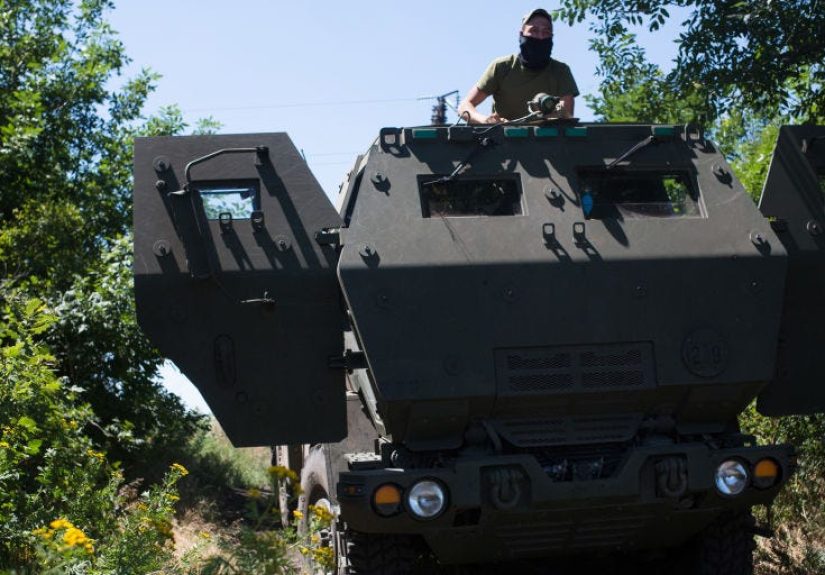
The original reporting described Ukrainian decoys designed to resemble American-supplied rocket launchers closely enough to fool Russian surveillance. Once identified from the air, those fake launchers could trigger a very real Russian response. That was the whole idea. A decoy does not need to survive close inspection at a trade show. It only needs to look convincing enough from the distance, angle, or sensor view that matters most.
That distinction is the secret sauce. Battlefield deception is rarely about creating a movie prop that can pass a beauty contest. It is about producing the right silhouette, the right dimensions, the right placement, and sometimes even the right heat or radar signature. If a Russian drone operator sees what appears to be a HIMARS launcher parked in a tactically believable location, the decision chain moves fast. A target gets flagged. A missile gets assigned. Money burns. The decoy wins.
And that win is not symbolic. It is financial, operational, and psychological. If one cheap dummy launcher soaks up an expensive cruise missile, Ukraine comes out ahead immediately. If that fake also makes Russia believe it has attrited Ukrainian launchers, the effect grows even larger. The enemy not only wastes hardware; it also distorts its own understanding of the battlefield. In military terms, that is a bargain. In plain English, it is getting the other side to pay luxury prices for a wooden prank.
The brilliance of the idea lies in its simplicity. A real HIMARS launcher is highly valuable, relatively scarce, and a priority target. That makes it the perfect thing to imitate. Ukraine did not need to trick Russia into firing at something nobody cared about. It needed to trick Russia into firing at something Moscow desperately wanted to destroy. That is exactly why the decoys worked.
Why HIMARS Became Such a Big Deal
To understand why a fake HIMARS launcher could be so useful, you have to understand why the real one mattered so much. HIMARS gave Ukraine precision strike capability at longer range than many of the systems it had been using earlier in the war. In 2022, that helped Ukraine hit ammunition depots, logistics nodes, command posts, and other high-value targets behind Russian lines. In other words, HIMARS did not just blow things up. It disrupted the machinery that keeps an army functioning.
That is why the launchers quickly became high-priority targets. A weapon like HIMARS combines mobility, precision, and speed. It can fire and relocate, which makes it much harder to hunt down than slower, more static artillery. That mobility is part of its mystique and part of Russia’s frustration. By the time the enemy identifies a launcher and tries to strike it, the real vehicle may already be somewhere else. Add a decoy into that equation, and the chase becomes even messier.
Early U.S. aid packages gave Ukraine a relatively limited number of these systems, which made every launcher feel precious. Later, the number grew. Still, the logic never changed: if a weapon is scarce, effective, and politically symbolic, the enemy wants to kill it badly. That makes decoys more than a side trick. They become part of protecting a strategic asset.
There is also a narrative dimension here. HIMARS developed a near-mythic reputation during key phases of the war. Some of that was earned, some of it was amplified by public fascination, and some of it was likely magnified by Russian anxiety. Either way, the launcher became bigger than a truck with rockets. It became a symbol of Western aid translated into battlefield pain for Russia. Symbols attract attention. Attention attracts targeting. Targeting creates opportunities for deception.
Old-School Trick, New-School Battlefield
At first glance, wooden decoys may sound old-fashioned in an era of satellites, drones, thermal sensors, and precision-guided munitions. But that reaction misunderstands how deception works. High-tech battlefields do not eliminate decoys. They make good decoys more valuable.
The challenge in modern war is not just building a fake object. It is building a fake object that can fool the particular sensor chain likely to encounter it. That may mean getting the outline right for drone footage, using metal elements to create a believable signature, placing the decoy in tactically sensible terrain, or arranging supporting details so the scene looks natural rather than staged. The battlefield is no longer just visual. It is multispectral. But the principle remains the same: fool the observer long enough to trigger the wrong decision.
Ukraine appears to have understood this early and then kept improving. Later reporting described increasingly sophisticated mock-ups of radars, air-defense systems, and other hardware. That suggests the wooden HIMARS decoys were not a one-off gimmick. They were part of a broader culture of adaptation. As sensors became smarter, the fakes got better.
Russia adapted too. It has used decoy drones, balloons, painted aircraft silhouettes, and other forms of battlefield deception. That should not surprise anyone. Once one side proves that cheap false targets can drain expensive real weapons, the other side usually takes notes. In that sense, Ukraine’s wooden HIMARS were not merely clever props. They were early examples in a wider decoy arms race.
What the Wooden HIMARS Story Reveals About Ukraine
The most interesting thing about the decoy story is not the wood. It is the mindset. Ukraine has repeatedly shown an ability to combine Western equipment with local improvisation, decentralized problem-solving, and a willingness to experiment under pressure. That is a major reason the country has often performed beyond what simple balance-sheet comparisons would predict.
In military organizations, innovation is not just about having new gadgets. It is about creating a structure where people can identify a problem, improvise a solution, and get it into the field quickly. A wooden HIMARS decoy is a small object, but it implies a larger system behind it: people who understand enemy targeting behavior, people who can build fast, people who can deploy the decoy credibly, and commanders willing to use deception as part of normal operations.
That culture matters. Wars are not won by hardware catalogs alone. A country can receive excellent equipment and still fail if it cannot integrate that equipment intelligently. Ukraine’s battlefield record has often reflected the opposite pattern. It has taken valuable Western tools and wrapped them in layers of ingenuity, mobility, camouflage, and improvisation. The decoy launcher fits perfectly into that pattern.
There is a broader lesson for militaries everywhere. Expensive systems are vital, but so are cheap enablers that help those systems survive. A decoy, a jammer, a camouflage net, a drone screen, or a false heat source may not look glamorous on a budget chart. But on the battlefield, these low-cost additions can multiply the value of the expensive thing they protect. Wooden decoys are not separate from advanced warfare. They are part of advanced warfare.
Russia’s Problem: Precision Weapons Are Too Valuable to Waste
The economics of the story are almost rude in their elegance. A real cruise missile can cost a fortune. A convincing decoy can be made for a tiny fraction of that. If the fake works even once, it can justify its cost many times over. If it works repeatedly, it becomes one of the best investments on the battlefield.
That matters because modern precision munitions are not infinitely available. They are expensive to produce, difficult to replenish quickly, and strategically important. When a military spends those munitions on false targets, it loses more than money. It loses time, stockpile depth, and opportunities to strike real objectives later. In an attritional war, that drain adds up.
There is also the issue of confidence. If commanders begin to suspect that some portion of the targets they are seeing may be fake, they face a miserable choice. Strike anyway and risk wasting scarce munitions, or hesitate and let a real launcher survive. Either outcome benefits the defender. Good decoys create uncertainty, and uncertainty is a tax on every targeting decision the enemy makes.
That is why the wooden HIMARS story matters beyond its viral appeal. It exposes a weakness in the attacker’s math. The side with more missiles is not automatically efficient. It can be manipulated into becoming inefficient. When that happens, the supposedly weaker side gains room to breathe.
The Real Future of War Might Look a Little Fake
One of the strangest truths of the Ukraine war is that cutting-edge combat keeps producing very low-tech answers. Fiber-optic drones coexist with trench warfare. Satellite-guided strikes coexist with camouflage nets. AI-assisted systems coexist with plywood and paint. The battlefield is not moving in one clean technological direction. It is becoming a layered ecosystem where the old and new are constantly mixed together.
That should reshape how we think about military power. The strongest force is not necessarily the one with the most exquisite platform. It may be the one that can integrate expensive systems, cheap substitutes, rapid repair, deception, electronic warfare, and local improvisation into a coherent whole. Ukraine has repeatedly shown flashes of that model.
So the wooden HIMARS story is not just a quirky wartime anecdote. It is a preview. Future militaries will need real launchers, real rockets, real sensors, and real networks. They will also need fake launchers, fake emitters, misleading signatures, and operations designed to bait enemy fire. In a world saturated with surveillance, making the enemy see the wrong thing may become one of the most important skills of all.
Experiences Behind the Decoys: What This Tactic Feels Like in Real Life
The most powerful part of the wooden HIMARS story is that it brings the human experience of adaptation into focus. It is easy to talk about decoys in abstract strategic language, but every fake launcher represents real people working under pressure. Somewhere, a team had to study the shape of the launcher, think about how Russian drones would view it from above, and decide what details mattered most. Someone had to cut the wood, assemble the frame, paint the surfaces, transport the mock-up, and place it in a spot that looked believable from the air. This was not a prank cooked up in a garage for laughs. It was fieldcraft performed with the understanding that getting it right might protect an actual crew.
There is also a psychological experience behind tactics like this. For Ukrainian soldiers and support teams, decoys offer a rare kind of satisfaction in an otherwise brutal war: the chance to outthink a stronger enemy. That does not erase danger, exhaustion, or loss, but it does restore a sense of agency. When a fake launcher draws fire, it proves that ingenuity can still matter in a conflict dominated by artillery, drones, and missile strikes. It says, in effect, that survival is not only about absorbing punishment. It is also about shaping what the enemy believes.
For drone operators and intelligence teams on the Russian side, decoys create the opposite experience: doubt. Every convincing imitation adds friction to the process of identifying a target. Is that launcher real? Is that radar active? Is that parked vehicle worth a missile, or is somebody on the other side laughing while you spend millions on scrap wood and canvas? Once uncertainty enters the loop, it lingers. And hesitation on a modern battlefield can be expensive.
Civilians experience this war differently, of course, but decoy tactics affect them too. Every missile diverted to a fake target is, at least potentially, one less strike available for a real military system, logistics hub, or nearby infrastructure. No decoy can make war safe, and it would be foolish to romanticize that. But deception can shift risk. It can complicate the enemy’s targeting cycle. It can reduce pressure on real assets that protect cities and troops. That is not theatrical. That is practical.
The broader experience of the Ukraine war has been one of relentless adaptation. Workshops become defense nodes. Civilian industry contributes battlefield ideas. Cheap materials support expensive systems. Soldiers learn that concealment, dispersion, and deception are not optional extras but daily necessities. In that environment, a wooden HIMARS decoy becomes more than an object. It becomes a symbol of how this war has forced creativity into the center of survival. It shows a military and a society learning, fast and painfully, that in the age of drones and precision fire, sometimes the smartest move is to make the enemy attack a ghost.