Table of Contents >> Show >> Hide
- What Does 9,000 MPH Really Mean?
- Where the Navy’s 9,000 MPH Story Comes From
- What Happens If a 9,000 MPH Projectile Hits Air?
- What Happens If It Hits Water?
- What Happens If It Hits a Target Instead of Water?
- Why the Navy Was Excited About Railguns and HVPs
- So Why Didn’t the Railgun Become Standard Fleet Gear?
- What Will Happen, Realistically?
- Experience-Based Scenarios: What This Feels Like in the Real World (Extended Section)
- Final Thoughts
- SEO Tags
Let’s be honest: “US Navy shoots a projectile at 9,000 MPH” sounds like the opening line of a movie trailer where someone whispers, “Sir… it went through the mountain.” But the real story is even better because it’s not pure sci-fi it’s a mix of hard physics, naval weapons research, and some surprisingly weird water behavior.
The short answer? A projectile moving around 9,000 miles per hour carries absurd kinetic energy, creates intense shock effects, and can do very different things depending on what it hits air, water, armor, or a missile-sized target. In some cases, you get raw impact damage. In others, you get shock waves, vapor cavities, bright flashes, and enough engineering headaches to make even the Navy say, “Maybe let’s slow down and rethink this.”
This article breaks down what would happen physically, what the U.S. Navy was trying to do with railguns and hypervelocity projectiles (HVPs), why people got excited, and why the path to deployment became more complicated than the headlines made it seem.
What Does 9,000 MPH Really Mean?
First, let’s translate the headline speed into something easier to picture. 9,000 mph is about 4,023 meters per second (roughly 4.0 km/s). That is far beyond everyday ballistic speeds and firmly in “hypervelocity” territory for many test scenarios. It is also much faster than the speed of sound in air, and even fast enough to become supersonic relative to water in certain impact conditions.
Why does that matter? Because at these speeds, the projectile is not just “going fast.” It changes the physics of impact:
- Shock waves become dominant.
- Materials can behave less like solids and more like fluids under sudden stress.
- Heat generation rises sharply.
- The impact event happens in microseconds, not “human reaction time.”
In plain English: by the time you blink, the interesting part is already over and the scientists are replaying it frame-by-frame at ridiculous camera speeds.
Where the Navy’s 9,000 MPH Story Comes From
A lot of people associate this headline with the Navy’s electromagnetic railgun work and that’s fair. The railgun program was designed to launch projectiles using electromagnetic force instead of traditional chemical propellants. The Navy and ONR spent years pushing this technology, and test milestones helped cement the “future weapon” reputation.
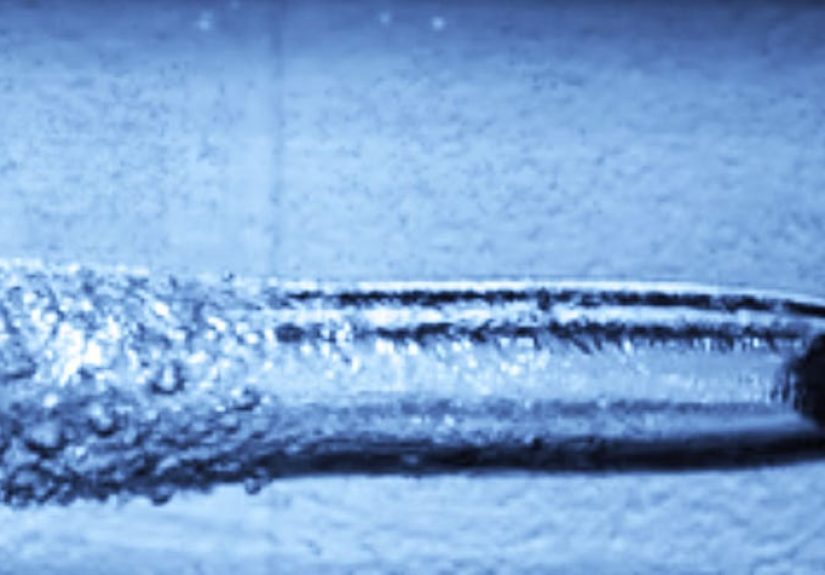
But there’s another angle that matters just as much: what happens when a projectile at these speeds hits water? That’s where the recent Case Western Reserve University work became headline-worthy. Researchers used a two-stage light gas gun and high-speed imaging to study what a hypervelocity projectile does the instant it slams into water. The research is Navy-relevant because naval combat, sea-skimming missiles, and maritime interception all live in a world where water and high-speed impacts interact.
In other words, this isn’t just “big gun goes boom.” It’s also: What does the fluid do? What pressure wave forms? Does a cavity form? Does the impact flash? Can we model it reliably?
What Happens If a 9,000 MPH Projectile Hits Air?
1) The projectile creates extreme aerodynamic stress
At these velocities, air is not just “background.” It becomes a serious engineering opponent. The projectile experiences intense drag, heating, and flow effects, which is why shape, materials, and guidance become critical. If the projectile isn’t designed correctly, it can lose stability, shed material, or fail before it ever reaches the target.
2) Shock waves form around the projectile
At hypersonic or near-hypersonic speeds, the projectile produces powerful shock structures in the surrounding air. These shocks are part of why high-speed projectiles are effective and also part of why they are so difficult to design. The weapon isn’t just launching metal; it’s launching a physics problem.
3) Heat becomes part of the weapon equation
Even if the projectile is not explosive, speed alone can generate massive energy transfer on impact. The faster the round, the more the system relies on kinetic energy, which is exactly why railgun and HVP concepts were so attractive: less explosive payload, more “don’t stand there.”
What Happens If It Hits Water?
This is where the topic gets truly fascinating. Many people assume water is “soft” compared to steel. At normal speeds, sure. At hypervelocity? Water can behave like a brutally resistant medium, and the impact dynamics become weird enough that researchers still need specialized experiments to understand them.
1) A bow shock can form immediately
Recent hypervelocity water-entry research shows that when a projectile enters water fast enough, a bow shock can appear in front of it. That means the projectile is moving so quickly relative to the speed of sound in water that the fluid can’t “get out of the way” smoothly. It compresses violently, producing a shock front.
2) You can get cavitation and a vapor-filled cavity
Instead of a simple splash, high-speed entry can produce a trailing cavity. In low-speed cases, cavities often involve entrained air. In hypervelocity cases, researchers have observed behavior consistent with cavitation and vapor formation, meaning the water itself changes phase locally because the pressure conditions go off the rails (pun intended).
3) Light emission and “flash” effects may appear
One of the headline-grabbing findings from the Case Western coverage is that the impact may produce visible light emission and other unexpected phenomena in the first instant of impact. This is exactly why high-speed imaging matters: the event is too fast and too complex to guess reliably.
4) The splash is not the main event
The dramatic splash looks impressive, but the real physics story is the microsecond-scale pressure wave, shock propagation, and cavity evolution right after impact. That’s where the useful data lives for defense modeling and survivability analysis.
So if someone asks, “What happens when the Navy fires a projectile at 9,000 mph into water?” the accurate answer is: not just a splash. It’s a shock-dominated, compressible-flow event with cavitation, transient light, and pressure behavior that researchers are still actively characterizing.
What Happens If It Hits a Target Instead of Water?
Against a hard target, the outcome depends on projectile design, angle, distance, and whether the target is armored, airborne, or moving. But the Navy’s interest in HVP and railgun concepts points to the same core idea: kinetic energy can do serious work without relying on a large explosive warhead.
Potential effects on target impact
- Severe penetration or structural damage from high-speed kinetic transfer
- Localized heating and fragmentation near the impact zone
- Fast time-to-target, which reduces enemy reaction time
- Useful anti-air / anti-missile potential if guidance and fire control can keep up
This is why the HVP concept remained interesting even as railgun enthusiasm cooled. The projectile itself especially a guided, low-drag design compatible with existing gun systems can still provide value even without a full electromagnetic launch system.
Why the Navy Was Excited About Railguns and HVPs
The Navy and defense community liked the railgun/HVP combination for several reasons:
1) Multi-mission potential
A hypervelocity projectile was pitched as a round that could support multiple missions across different gun systems. That’s a big deal for naval logistics. If one projectile family can cover more than one mission set, ships can carry smarter magazines instead of a giant buffet of niche rounds.
2) Better cost exchange than expensive missiles
One of the strongest selling points was economics. In air defense, using a very expensive missile to destroy a cheaper threat is a painful trade. HVP advocates argued that guided hypervelocity rounds could provide a more favorable cost-per-engagement option for some threats, especially lower-end cruise missiles and larger drones.
3) Existing gun compatibility (the “second life” concept)
The smart pivot was this: even if railguns take longer, can HVPs be fired from existing guns? That idea gained traction. The Navy tested HVPs from a standard 5-inch deck gun on USS Dewey during RIMPAC 2018, showing the concept wasn’t limited to a future ship that may or may not arrive on schedule.
So Why Didn’t the Railgun Become Standard Fleet Gear?
This is the part where engineering reality shows up with a clipboard.
1) Power, heat, and integration are brutal
Railguns are electrically driven, which sounds elegant until you try to fit the power system, thermal management, barrel life requirements, and shipboard integration into a real combat vessel with limited space and many competing priorities. The Navy made real progress, but “works in testing” and “works at sea, reliably, repeatedly, and affordably” are not the same sentence.
2) Strategic priorities changed
As hypersonic missiles, directed-energy systems, and other technologies moved up the priority list, railgun funding lost momentum. Public reporting and congressional documentation later reflected that the Navy proposed suspending further work on the EMRG and related HVP/GLGP lines in the FY2022 budget cycle.
3) Range and operational tradeoffs mattered
The railgun’s test performance was impressive, but defense analysts and reporting also pointed out hard questions: range compared with emerging missile options, ship survivability envelopes, and whether the weapon fit the Navy’s evolving fight. A prototype can be amazing and still lose the budget war.
What Will Happen, Realistically?
If the U.S. Navy (or a Navy-funded research team) launches a projectile at around 9,000 mph, what happens depends on what the projectile is doing:
Scenario A: Lab test into water
You get a high-speed impact event dominated by shock physics, cavity formation, and pressure-wave behavior. It’s less “Hollywood explosion” and more “every frame is a PhD thesis.”
Scenario B: Shipboard or gun-system launch concept
You get a very fast, kinetic-energy-based engagement with potential cost advantages over missiles for some targets if guidance, fire control, and survivability requirements line up.
Scenario C: Full railgun deployment dream
You get a powerful concept with enormous promise, but also steep integration costs: electrical load, thermal management, barrel durability, and doctrine changes. That’s why the technology still matters, even though the original “railguns on every destroyer” vision cooled off.
The most accurate takeaway is this: 9,000 mph doesn’t just make things faster it changes the kind of physics you’re dealing with. And once you cross that threshold, the weapon question becomes as much about systems engineering and logistics as raw speed.
Experience-Based Scenarios: What This Feels Like in the Real World (Extended Section)
To make this topic less abstract, it helps to think in “experience” terms not personal war stories, but the kinds of moments engineers, analysts, and sailors would recognize around high-velocity projectile work.
Imagine a test team in a lab or range environment. Nobody is standing around saying, “Yep, looks fine.” At these speeds, everything is instrumented. You’re not trusting your eyes; you’re trusting sensors, pressure transducers, timing gates, and high-speed cameras. The event itself may last only microseconds, but the preparation takes days or weeks: align the barrel, verify timing, confirm safe standoff, calibrate optics, check data capture, and then do it all again because one mistimed trigger can ruin a shot.
Now imagine the moment of firing. For a conventional observer, it can feel anticlimactic because the “important” part is invisible to the naked eye. The projectile is gone almost instantly. The real excitement happens after the shot, when the team pulls up the footage and sees the hidden physics: a bright flash near impact, a shock front forming, a cavity opening behind the projectile, or a pressure signature that doesn’t match the model. That’s the experience researchers chase the split second where nature tells you whether your assumptions were smart or embarrassing.
On the naval side, the experience is less about a single cool shot and more about repeated, reliable performance. Sailors and program managers care about questions that headlines usually skip: How fast can we reload? How does the system behave after multiple firings? What breaks first? How much maintenance does it need? Can this integrate with existing fire control? Can we actually afford enough rounds to matter in a real engagement? Those questions are not glamorous, but they are exactly why some futuristic technologies survive and others become “remember when?” conference slides.
There is also a practical psychological shift that comes with hypervelocity systems. Traditional naval gunnery has familiar rhythms. Hypervelocity concepts compress those timelines. Faster projectiles can mean shorter response windows, less margin for error, and much tighter coordination between detection, tracking, command decisions, and weapon release. In that sense, the “experience” of a 9,000 mph projectile is not just about the round it’s about the whole combat system needing to move faster mentally and digitally.
For defense analysts, the experience is usually a tug-of-war between excitement and caution. The excitement comes from seeing a capability that could improve cost exchange, expand magazine depth options, or provide a new layer of defense. The caution comes from decades of acquisition history: prototypes impress; operational systems demand compromises. Every breakthrough arrives attached to a maintenance plan, a training pipeline, and a budget hearing.
And for the public, the experience is often headline-first: “9,000 MPH projectile?!” That reaction is understandable. But the deeper story is more interesting than the speed number alone. It’s a story about how modern defense research works physics labs feeding naval strategy, spin-off technologies outliving flagship programs, and a constant effort to turn raw scientific possibility into something a ship can actually use at sea.
So yes, the headline is dramatic. But the real experience of this technology is a long chain of careful tests, strange data, engineering tradeoffs, and occasional moments where everyone in the room leans toward the monitor and says, “Wait… run that clip again.”
Final Thoughts
The idea of a U.S. Navy projectile moving at 9,000 mph sounds like science fiction, but it points to a very real frontier: the intersection of high-speed weapons, naval survivability, and extreme fluid/impact physics. Whether launched by railgun concepts or studied in water-entry experiments, these projectiles reveal the same truth: speed can be a weapon, but only if the surrounding system guidance, power, thermal management, logistics, and doctrine can keep up.
In short, what will happen? A lot more than “it hits hard.” You get shock waves, cavitation, intense energy transfer, and a crash course in why advanced weapons research is equal parts physics, engineering, and budget reality.